

By Rajan Philips –

Rajan Philips
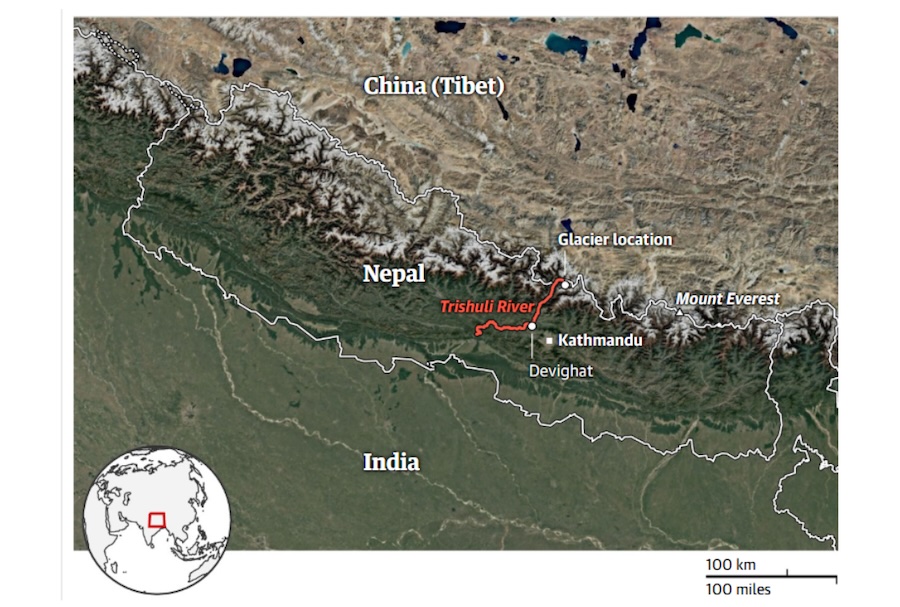
Nepal was bracing for Super El Niño. Then it got hit by a two thousand feet wide glacier collapse way up in the Himalayas that sent torrents of water, mud and rocks down valleys and rivers, devastating communities, tourists and physical assets in the mountainous terrains of Nepal and Tibet in China. The disaster struck along the China-Nepal border wreaking havoc on both sides, but a lot more on the side of Nepal than Tibet. More than a thousand people have died, and thousands more are missing in Nepal; about 20 are dead and over 500 missing in Tibet. Hundreds of tourists are also missing on both sides. Many of the missing tourists are South Asian pilgrims from western countries visiting Hindu sacred sites in the Himalayas.
Terrifying videos of the devastation have been going viral. Especially breathtaking is the one showing a monstrous tide of mud sweeping way the Chinese border station building in the Gyirong gorge, a historic crossing point between Nepal and Tibet. Humankind has no defense against the fury of nature whenever and wherever it happens. The force of water in full turbulence is unstoppable. Werner Heisenberg, the great Quantum Physicist, is said to have remarked that on his deathbed he would like to ask God two questions: why relativity? why turbulence? And he suggested that God may have something to say about relativity, implying that there is little we can know about turbulence.
Screenshot
“El Niño Warnings
With global warming water becomes a problem both in its abundance and in its scarcity. Even as Nepal is struggling to recover from its hydro tragedy, the World Meteorological Organization (WOM) is warning that exceptionally warm Pacific waters are aggravating the “El Niño climate troubles and raising the risk of extreme heat, floods and drought around the globe, over the next several months and until February 2027. The South Asian countries have been earmarked for special treatment by El Niño. Already this year, Europe has experienced unusual heat waves and floods, while forest fires from British Columbia in Canada to Indonesia in the far east.
To climate modellers, “El Niño and La Niña are the yin and yang of a phenomenon known as the El Niño-Southern Oscillation, a years-long cycle of warming and cooling of surface waters in the central to eastern tropical Pacific Ocean.” The former is associated with warming waters, and the latter with cooling waters. Either of them can alter weather patterns and surcharge the extreme effects of climate change.
Also, different continents experience the effects of heat and rain differently. Even within countries, there can be floods in some parts while drought and fires affect others. This year’s El Niño is expected to be unusually stronger and the carryover effects next year are expected to be greater. The baseline comparison is to the year 2024 which was the warmest year in the planet’s history. 2027 may break that record.
The UN and the WOM are doing their parts, but the leaders of states and governments everywhere have other pre-occupations. Donald Trump is being his usual silly busy renaming Lake Ontario, one of five Great Lakes of North America, Lake America! That is his way of spiting his country’s northern neighbour, Canada. Every country is spending more money to defend itself against other countries. Among western countries, defense spending has become the new economic growth pole. More submarines, more jets and yes, more drones, but very little to deal with climate change – to reduce global warming, to increase weather preparedness and to be ready for disaster mitigation.
A few days before the August 26 glacier collapse in Nepal, I was browsing through Sri Lankan news reports about the level of preparation in Sri Lanka to deal with the anticipated effects of El Niño. Per usual the government was under fire for apparent tardiness in preparing for El Niño. The Department of Agriculture (DOA) was advising farmers to conserve rainwaters from the Maha season to cope with the likely drought for the Yala season next year. I have a problem understanding where and how can farmers, on their own, build water reserves for paddy fields between seasons? I suppose any advice is better than no advice.
And droughts are already occurring in many cultivating areas even as the Castlereagh and Maussakelle reservoirs are reportedly reaching overflow conditions. In some places people had taken to freshwater fish farming, but now they are reportedly walking miles in search of drinking water. Sri Lankan Navy personnel have been photographed feeding water to the wild ponies in Delft. A Peradeniya academic has chimed in about the climate physics of El Niño and the disruptions it is going to cause. What was once limited to climate wonks is now daily bread for everyday commentators.
The Nepal Tragedy
Online El Niño browsing took me to papers in Nepal and some informed popular articles by the country’s climate experts and activists. The articles were about getting prepared for the drought and rains of El Niño. But what hit Nepal and Tibet a few days later on August 26, had nothing to do with El Niño, but had everything to do with global warming, rising temperatures and melting ice in massive quantities and at high altitudes. A week after the disaster a clear assessment of what triggered it is emerging, thanks to satellite images and concurrent analyses by climate experts around the world.
The initial attribution to an earthquake in the area and the later causal correction to a glacier side have now been supplemented by the identification of a bedrock failure underneath the glacier and it is the ensuing avalanche that registered a 5.2 seismic event. As two New York Times reporters (Raj Saha and Jeremy White) have graphically illustrated, the avalanche released “more than seven billion cubic feet of rock and ice,” enough to “fill around 100 football stadiums” in the US. Further, “the debris traveled downstream with a flow rate at least 30 times that of Niagara Falls, … reached a peak speed of over 100 miles per hour … and traveled more than 60 miles, destroying towns and bridges and killing more than 1,000 people.”
For more context, the Trishuli River (named after Shiva’s trident -trishula), which flows between Gyriong in Tibet and Rasuwagadhi in Nepal, dropping 2,000 metres over a distance of 30 metres from its glacier origins to the valley below, became the main conduit of carnage. Overall, 32 concrete bridges were washed away and 12 hydropower projects (accounting for 431 MW) were damaged, with many of their tunnels inundated with over 900 workers stuck in them and still unaccounted for.
The disaster is generally attributable to growing glacier instability in the Himalayan are that includes some of the largest glacial systems outside the polar regions. The mountainous area extends over 2400 km and nearly 600,000 sq. km in five countries (India, Nepal, Bhutan, Tibet (China) and Pakistan), and feeds the hugely populated basins of the Indus, Ganges, and Brahmaputra rivers. Climate change and air pollution have led to the glacier system retreating and melting at alarming rates. A dozen mountainous catastrophes have occurred over the last twenty years, and new satellite images are showing old warning signs that would appear to have been missed.
Astha Guragain, a Nepali climate researcher and activist, has raised the very pertinent question of climate justice in assigning cause for the glacial instability in the Himalayan region within Nepal. His argument is that “Nepal contributes less than 0.01% of global carbon emissions yet is exposed to disproportionate vulnerability from its consequences.” The government of Nepal has estimated the cost of disaster to be $5 billion, a huge amount for a country of 31 million people and $44 billion GDP.
The Nepali government has formally requested funding support from the special UN climate fund. The problem is that the fund has little money because of American indifference and non contribution by others. The current fund balance is a disgraceful $820 million in pledges! Already, there are applications from 119 countries for a total amount of $2.8 billion. The US pledged a paltry $17.5 million under President Biden, but it is nothing under Trump after his decision to pull out of the Paris Accord and the Green Climate Fund, even though the US is the world’s largest emitter of greenhouse gases.
The tragedy poses a huge challenge to Nepal’s new Rastriya Swatantra Party government and its 36 year old Prime Minister Balendra Shah. They were elected only in March this year, winning 182 out of 275 seats. The March elections came after massive youth protests and the ouster of the previous government in September 2025. Shah is a Structural Engineer and rapper artist who forayed into national politics when he was elected as Mayor of Kathmandu in 2022. The still fledgling government is also young of age with 17 its 18 ministers, including the Prime Minister, under the age of 40.
Yet the young Engineer Prime Minister is striking the right notes in asking for international help without diminishing Nepal’s sovereignty. Attributing the current disaster to climate change, Mr. Shah has said that “climate change is a global contribution and its response is also a global responsibility.” While asking for legitimate funds, the government has also turned down instant offers of foreign organizations to undertake search-and-rescue operations.
The refusal is based on the country’s experience after the 2015 earthquake, when the arrival of 76 international teams and over 2,200 personnel overwhelmed Kathmandu’s single-runway airport. And the national memory is that while 53 foreign teams pulled 19 people from the rubble, local forces moved much faster and saved many more lives.
Nepal’s tragedy is also a test to the international community, especially to western governments and leaders, to respond to this Himalayan manifestation of the world’s climate crisis in a formal and substantive way through UN agencies and not use it as another charity moment to be handled by the red crosses of the world.