

By Ajith Rajapaksa –

Ajith Rajapaksa
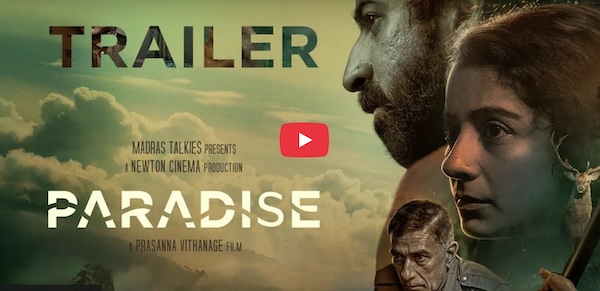
I watched Paradise for the second time, first in the cinema and recently on Netflix. On a second viewing, its political and moral layers felt even sharper. Paradise is a 2023 Sri Lankan-Indian co-produced drama film, co-written and directed by Prasanna Vithanage. The story unfolds during Sri Lanka’s “Aragalaya,” a period when ordinary people were enduring immense hardship amid economic collapse. Yet, despite the turmoil, tourists continued to arrive, drawn largely by the country’s affordability. While the film focuses on a seemingly intimate story of a couple on holiday, its real canvas is far broader. It quietly interrogates privilege, power, and the moral vacuum of those who hold power.
The film centres on a middle-class Indian couple, Kesav and Amritha, visiting Sri Lanka at a moment of deep national crisis. For them, the country is simply a cheap holiday destination, and the protests, shortages, and desperation of its people remain peripheral to their experience. A striking contrast emerges between the unrest in the streets and the insulated world of tourism. While citizens queue for fuel and confront systemic failure, tourists sip cocktails and pursue curated leisure. Meanwhile, locals cling to the comforting myth that someone, like the legendary King Ravana, will awaken to rescue the nation. This myth becomes symbolic, reflecting a collective longing for a saviour in times of despair. Vithanage amplifies the moral and visual divide between public suffering and private leisure, presenting tourism as a lens through which the dynamics of concentrated wealth and economic privilege are revealed: extractive, insulated, and fundamentally indifferent.
Kesav embodies a certain strain of opportunistic capitalism. When he spots a wild deer, he develops a craving to eat it. Though hunting it is illegal, he is willing to pay to break the law. This moment is deeply symbolic. In times of economic turmoil, assets even protected ones, become commodities for those with money. The powerful bend rules when it suits them.
Andrew, the local driver and guide, attempts to share cultural stories, including the Ravana legend. Kesav shows little interest. He is preoccupied with closing a business deal and constantly engaged in phone calls and online discussions about negotiating the sale of a drama production to Netflix. His singular focus is profit and self-advancement. In this sense, he resembles the archetype of the global financier, concerned only with returns, showing little empathy for the human cost of economic systems.
In contrast, Amritha listens more carefully. When Andrew presents the Ravana myth as historical truth, she challenges him, noting that there are hundreds of versions of the story. Andrew falls silent, perhaps embarrassed. Around them, traders commodify myth for survival, selling stories as part of the tourism economy.
Kesav’s attitude toward the law is revealing. He disregards it when it restricts him but demands its full force when it benefits him. When their phones and laptops are stolen, he insists on mobilising state power, using his connections to pressure authorities. In a country where many have lost livelihoods and basic security, his outrage over material loss feels disproportionate. Ultimately, innocent villagers bear the brunt of collective punishment for the crime of a few.
This dynamic mirrors Sri Lanka’s broader reality. For decades, minorities and the poor have paid the price for corruption, mismanagement, and systemic inequality. In the film, the victims are from minority communities, reflecting how ethnic and racial hierarchies have long shaped who suffers the most. When the economy collapsed, the burden fell not on elites but on ordinary citizens, with marginalized groups disproportionately affected. Protests were often met with violence, further highlighting the intersection of economic hardship and entrenched social discrimination. At the same time, the film portrays moments of solidarity across ethnic lines, suggesting that the shared experience of crisis has the potential to bring divided communities together.
Sergeant Bandara becomes a tragic figure in this narrative. He tries to explain the country’s situation to Kesav, but Kesav is unmoved, fixated solely on recovering his belongings. Bandara, caught between duty and conscience, is compelled to unleash brutality on the community. In one of the film’s most striking moments, he refers to himself as a “good dog” serving his master. The metaphor is chilling. The police become instruments of power, enforcing the will of elites and their financiers.
Amritha’s transformation unfolds gradually. She is moved by the suffering she witnesses, particularly in the hospital scenes, while Kesav avoids confronting that reality. When Kesav asks her what happiness is, it exposes his emptiness. He attempts to manufacture happiness through consumption and control, yet he remains disconnected from empathy and humanity.
Amritha begins to see that even myths, though not historically factual, can serve a purpose if they do no harm and help struggling locals survive. She also recognises her own complicity within a global system that exploits vulnerable societies.
The climax is shocking but symbolically loaded. Unable to tolerate Kesav’s escalating aggression and moral blindness, Amritha shoots him in a moment of desperation. Andrew, understanding the deeper context, helps frame it as an accident, allowing her to escape. The act is less about personal revenge and more about breaking a cycle of domination and indifference.
Paradise is not merely a story about a troubled marriage or a stolen laptop. It is an allegory of economic collapse, global inequality, state violence, and moral decay. It critiques a system where power protects wealth while punishing the powerless. On second viewing, the film feels less like fiction and more like a mirror, reflecting the painful realities of Sri Lanka’s recent past and the broader dynamics of global capitalism.
leelagemalli / February 14, 2026
Thank you Ajith.
.
Beyond the well-known narratives surrounding Ravana, a significant portion of daily life in Sri Lanka appears to be influenced by mythological beliefs, despite the country being predominantly Buddhist. While it is understandable that Hindu traditions — as one of the world’s oldest religious systems — contain extensive mythological elements, Buddhism in its philosophical foundation is often regarded as being closer to rational inquiry and personal experiential understanding.
–
Classical Buddhist teachings emphasize meditation, ethical conduct, and the direct realization of truth through individual insight. However, in the Sri Lankan context, Sinhala Buddhism has become highly ritualized and, in some respects, resembles certain devotional and myth-based practices more commonly associated with Hindu traditions. Rather than prioritizing meditation and philosophical inquiry, ritual observances and inherited narratives often occupy a central role in religious life.
–
Tbc
/
old codger / February 15, 2026
It is good that we have directors like Prasanna Vithanage who can make movies about complex political situations with sensitivity, unlike some lady commenters on this page who seem to think that ” going through hardship” entitles one to commit murder.
A good question is whether Prasanna would have been able to make the movie locally.
/
ramona therese fernando / February 15, 2026
That 12 people murdered one man is too much of an outlier. One or two would have probably done it. That they have 12 people who they are going to hang means they do not know who the real murderer is. Keep beating multiples of them, like in the movie, till one is coerced to confess to the crime is what our Lankan courts, lawyers, and police are about. Very sadistic in the absence of much intellect.
/
SJ / February 15, 2026
It was a lynch mob.
It was collective action and the guilt is collective.
I oppose the death sentence, but a life term is acceptable if there is evidence of conspiracy to kill.
/
ramona therese fernando / February 16, 2026
No conspiracy to kill. He was the one with the gun and shot at them. They were protecting themselves.
/
ramona therese fernando / February 16, 2026
There is a wide range of sentences for mob violence, but Sri Lanka seems to only have the ability to choose the most sadistic one (very much like how the film portrays it). Context and reasoning for the mob violence was not taken into account. Absolute proof of perpetrators was impossible to ascertain because it was a mob, where blame went haywire. With these in mind, how were 12 people given the death penalty on such weak evidence and reasoning? Long prisons sentences was the obvious choice when in such doubt.
/
old codger / February 16, 2026
Ramona,
“Long prisons sentences was the obvious choice when in such doubt.”
Death sentences have not been carried out in Sri Lanka for 40 years. You don’t seem to know.
/
old codger / February 16, 2026
Ramona,
Didn’t Amarakeerhi have a right to protect himself.? Nobody was killed by his security officer.
“No conspiracy to kill.”
Was it necessary for the mob to chase both into a building, drag them down and beat them to death in the street? What do you call that but conspiracy to kill ?
/
ramona therese fernando / February 16, 2026
OC,…..
Still it is difficult to ascertain the killers, isn’t it. He had a right to protect himself, but one can’t just blindly shoot into a starving crowd without some retaliation. Was the mob intentending to lynch him? No, but yes, there is a possibility he might have been hurt. But with lack of evidence of starving mob intending to kill him, plus him (or driver) shooting at the mob, one cannot blindly dole out hanging sentences to 12 people. There is also the fact that the mob was protesting political theft that resulted in their critically impoverished states. With all things considered, long prisons sentences would have been the more intellegent option. Whether or not the hangings are carried out isn’t the issue……it is a sadistic and relishing sentence with the lack of brain-power to come to a more intellegent resolution…..and the hangings probably won’t be carried out, but other worse atrocities will gleefully take place in lieu of it, like what that Sargeant Bandara indulged in).
/
ramona therese fernando / February 16, 2026
And strange that the Sargeant Bandara
humbly told the tourist that the tourist was his boss and he was under his commands. Investigation was done only at the end after he has tortured those boys to death. And his sycophancy was just an excuse to start torturing more people. But our Lankas (and Indians) are so used to how police behave in Sri Lanka and India, that they really think what that Sargeant did was correct procedure. By right, he should have told the tourist that he did an investigation, questioned people, but the laptop and phone could not be found. He should have told them to go to the Lankan version of the FBI if this was so important for him. Buy new laptops and phones because all their data was stored on Cloud anyway. It would be expensive on them, but torturing and killing people over this theft didn’t not fit the crime.
/
SJ / February 16, 2026
Did he or the bodyguard fire a shot at any?
/
leelagemalli / February 14, 2026
cont.
Over time, such beliefs have become deeply embedded in cultural identity. For example, there exists a traditional narrative concerning the origin of the Sinhalese people as descending from a union between a lion and a human. From a historical and biological perspective, such accounts are symbolic rather than literal.
–
Similarly, certain natural physical phenomena are sometimes interpreted in supernatural terms. Light reflections and refractions observed on the upper structures of stupas (dagobas) are occasionally described as manifestations of “Buddha’s radiance.” The stupa at Somawathiya, for instance, is particularly associated with such interpretations. However, these visual effects can be explained through well-understood principles of optics, including the reflection and refraction of light on architectural surfaces. Comparable phenomena can be observed on tall structures in various parts of the world.
–
As long as religious authorities continue to transmit these interpretations without distinguishing symbolic meaning from physical explanation, such beliefs are likely to persist across generations. From an academic perspective, these phenomena illustrate the complex interaction between religion, culture, myth, and scientific understanding within contemporary Sri Lankan society.
/
ramona therese fernando / February 15, 2026
Thanks for the review of the movie. I just watched it. It is as you say. What stuck out to me was the brutality of the Sargant Bandara. That’s one typical sadist that is found in Lankan police force (very much like Indian forces). No proper procedures were followed for a simple theft, and he took his chance to torture suspects without much proof, to the death of one young man. How terrible Lankan prisons must be. It’s a bit like the easy hanging sentence meted out to 12 suspects who killed the minister during the Aragalaya, when the Lankan masses were going through much hardship. The minister’s driver had shot a man in the crowd and the crowd fell upon the minister – a minister that had collected much wealth for himself through the hard work of his constituents, with very little invested back into the people. How sure can they be that it was all 12 of them who killed this minister? Somehow, it looks shameful for our country to so easily hand out such sentences, with little caring for human lives, like the way Iran does. I would have thought that a Buddhist country would be more refined and honorable in its justice system.
/
whywhy / February 17, 2026
Paradise is not built on crisis , Only Hell Is !
/