

By Chula Goonasekera –
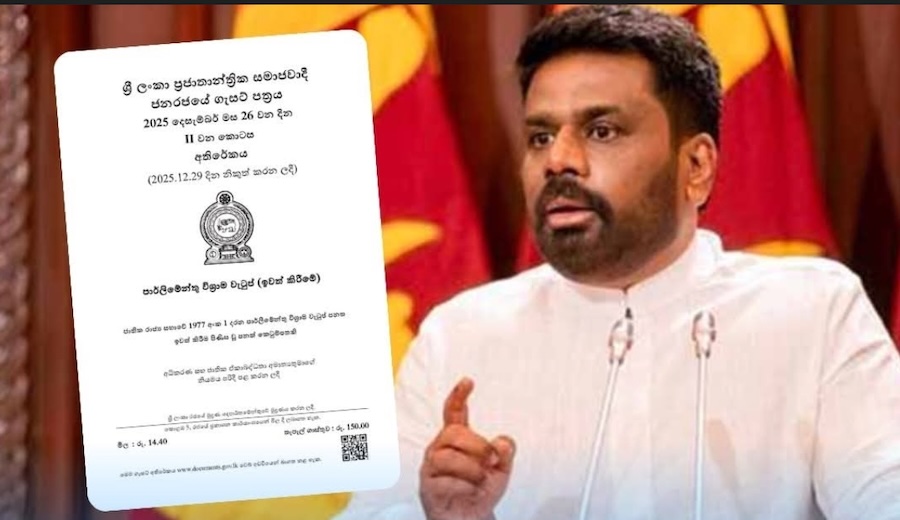
The current debate over pensions for legislators has captured public attention, and Parliament has already taken steps to address the issue. Yet this moment calls for a perspective broader than narrow political argument. Pensions are not merely a privilege granted to a few—they are a fundamental national responsibility.
In any democratic and compassionate nation, pensions represent a social contract. Public funds are generated through the hard work and productivity of citizens during their working years. Society thus has a collective obligation to ensure that those who contribute to national development are not abandoned in retirement. This is not charity; it is justice.
A sustainable and equitable pension system should rest on two clearly defined pillars: a State Pension and an Employment-Based Pension with additional voluntary contributions. This structure reflects the goals of the best pension models—balancing adequacy (providing sufficient income for a dignified standard of living), sustainability (ensuring long-term financial viability), and integrity (maintaining strong governance and public trust).
1. State Pension – A National Foundation
A state pension must be financed through a properly managed, contributory national fund. It should never become an unpredictable burden on the current working population. Instead, it should be built transparently over time through structured National Insurance Contributions, as practised in many developed nations.
Eligibility should depend on years of contribution, with payments commencing only upon reaching a nationally defined retirement age—such as 65 years for both men and women—regardless of continued employment. Early access should not be permitted to ensure sustainability and fairness.
Importantly, the system must recognise unpaid yet invaluable national services, such as parenting. Full-time childcare from birth to age 16 constitutes an essential contribution to society. A mother or father who dedicates years to raising children nurtures the next generation and performs a profound national service. Such caregivers should receive credited contribution years—up to 16 years—towards their state pension entitlement. This is not a concession; it is long-overdue recognition.
2. Employment-Based Pension – Strengthening Security
The second pillar should be a contributory employment-based pension, structured either as a mandatory employer-based scheme or as a voluntary scheme. Contributions should be tax-incentivised to encourage participation, with proportional employer contributions.
In Sri Lanka, the Employees’ Provident Fund (EPF) provides an example of such a system. Established under Act No. 15 of 1958, it requires an 8% employee contribution and a 12% employer contribution, totalling 20%, and is managed by the Central Bank of Sri Lanka. This framework enables workers to build a statutory retirement fund that supplements their state pension.
Certain professions—such as healthcare, police, armed forces, and security services—demand extraordinary commitment, including 24-hour duty and service during public holidays. Sector-specific pension or insurance schemes may therefore be justified, provided they are transparent, actuarially sound, and proportionate to service.
Transitioning to Fairness
Existing pension or allowance schemes—such as the Aswesuma Welfare Benefit Scheme, Samurdhi Allowance, Elderly Allowance, Disability Allowance, Kidney Patient Allowance, and Thriposha Programme—can be gradually integrated into a unified national framework through actuarially calculated conversion mechanisms. Such reform would minimise disparities and eliminate politically negotiated privileges.
No legislator—or any officeholder—should receive disproportionately generous pension benefits for minimal years of service. Equality before the law must extend to retirement security. A transparent and unified structure would restore public trust and ensure fairness across all sectors.
A Broader Vision of Social Responsibility
Pension reform must form part of a wider social responsibility framework. Child benefits, maternity support, and disability assistance should be structured within sustainable and equitable systems. Politically motivated or unsustainable schemes must be replaced with rational, nationally coherent policies.
Unemployed adults should be supported primarily through training, skills development, and job placement initiatives. Limited temporary assistance may be necessary, but it should not discourage participation in available employment opportunities.
Ultimately, social responsibility must apply equally to all citizens. A well-designed pension system enables individuals to retire with dignity, independence, and peace of mind—without becoming a burden on their families or society.
This is not merely an economic reform. It is a moral imperative. If we are to call ourselves a just and caring nation, we must ensure that those who build the country are not left unprotected in their later years.
Nathan / February 19, 2026
My view is opposed to that those who build the country are not left unprotected in their later years.
Who builds the country? Is it the politicians? Rubbish!
I toiled for 25 years to earn a pension.
Show me your 20 years – at least – before you agitate for yours.
/
schandrad / February 19, 2026
You are spot on. Even I spent all my life to earn my pension. Just because somebody for his / her own selfish reason had taken to politics does not mean that he/she has the moral high ground to claim for a pension. The pension is not a mere entitlement, it is to be earned with sheer hard-work and not a thing to be offered on platter.
/
old codger / February 23, 2026
Nathan
I have a solution. MPs should have contributory pension. Like the EPF, 20% from the earnings (including allowances) and 20% from the government. Even 5 years will count, but not for much. If they can be good and stay in Parliament for 20 years, they might achieve a livable amount.
/
whywhy / February 21, 2026
Bimal Ratnayaka in his debate about doing away with MP
pensions for good said , he understands the need of a wider
public pension involving the whole of general public . And
when the economy is ready , they can do it , like in other
parts of such developed world like Europe . Yes , well done ,
but the million dollar question is , in what way abolition of
whatever existing pension going to help it ? Never mind
who gets it , something somewhere already in action and
all you got to do is , take it to another level ! Your talk and
your action don’t seem to go together on some cases . If the
economy doing good , anybody else in your place would
have done the same thing , with or without corruption .
JRJ realised it and initiated it from the the top and in a
different way Dudley’s Rice provision to the whole country
did the same whether you appreciated them or not . We
are still living . Only the Deaf , Dumb and Blind will be misled .
/
SJ / February 23, 2026
Dudley introduced free rice as an election gimmick and the country had to pay for it for many years to come, even after it was replaced by 2 measures per week at 25 cents each. Interestingly Dudley stepped down because he too the exact opposite view when he was PM in 1952.
JRJ increased the perks of office for MPs for purposes other than the said noble reason.
/
whywhy / February 23, 2026
I said this too ” whether you appreciate it or not . ” So no
worries . Why Dudley did it and why JRJ did it , anyone
can explain it from his ‘ world .’ But the fact of the matter
is , the country benefitted from the move . If their actions
are branded gimmick , pension removal too can be called
a gimmick because clearly it was an election promise .
I recommend a Belgian Mirror would help a better image .
/
Govi / February 23, 2026
Chula, I do not understand. Please educate this ignorant old man. When someone gets elected to Parliament as MPs what category do they belong to – State employees or private organisational employees or they are employees of any form?”?
/
Govi / February 23, 2026
Or just because they receive a salary, they become employees of parliament?
/
SJ / February 23, 2026
G
MPs in many countries (e.g. India, UK, Australia, Norway and Germany) receive some kind of state pension.
Pensions were introduced in this country in the mid-1960s for those who served for a sufficiently long period. There was no public resentment. People had a compassionate view of an MP as one who served public interest, as a vast majority did not make money out of their position as MPs. Several MPs had private income. (Some were professional lawyers and a few landed proprietors). Their parliamentary allowance was modest at 600/- per month even in the 1960s. Their perks of office did not amount to much.
There is a case for a modest pension including a widow’s pension on compassionate grounds.
But the current public mood is not in favour of a pension as they see MPs as corrupt swindlers of public funds.
/
whywhy / February 24, 2026
Last two lines reminds me ” cut the nose to spite
the face . “
/