

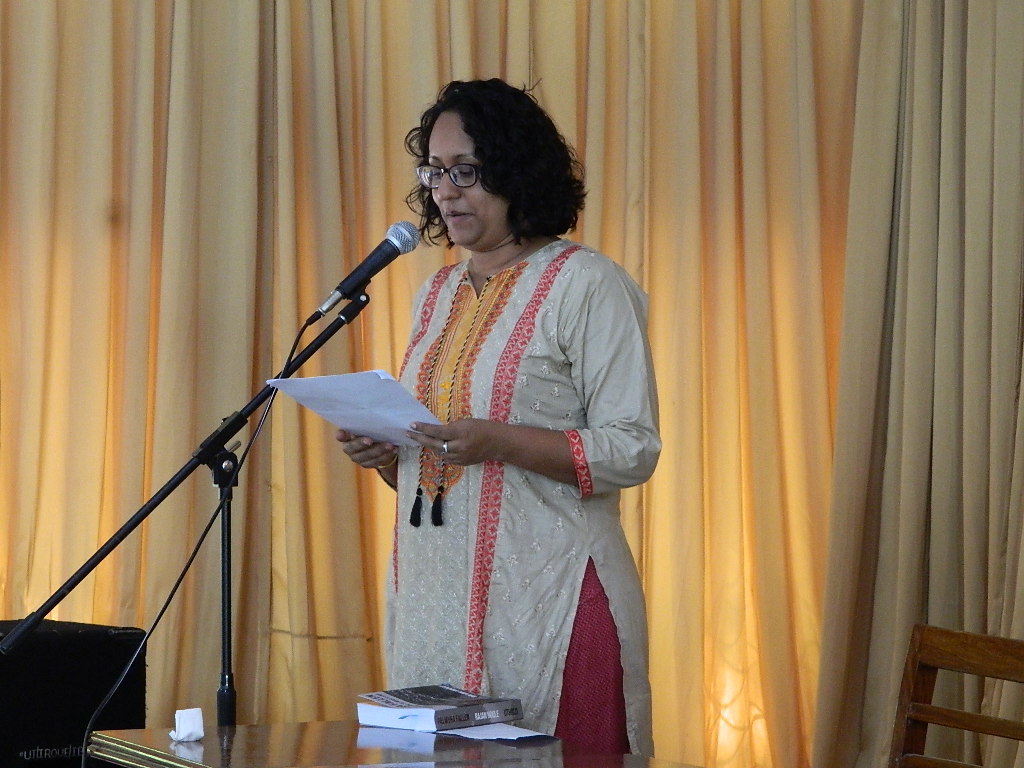
By Amila Muthukutti –

Amila Muthukutti
It is too noisy whether history as a subject should be in the school curriculum or not. Needless to say, one should know one’s own history, so that the same mistake does not repeat. However, Harini Amarasuriya, in the capacity of minister of education has denied the fact that history will be removed from the school curriculum. Moreover, new education reforms have made it mandatory to study subjects such as history, aesthetics and vocational studies. She has further said that focus is to produce a student not limited to a single field.
It is very difficult to take revolutionary steps, especially in a field like education in Sri Lanka, being a country politically and religiously abused. We can recall how some famous Buddhist monks objected, when teenage students were going to be made aware of sex education. Being aware of one’s own body and the opposite sex was a taboo for them. This fact is raised here, to imply the extent to which education reforms have been lagging behind.
Education is the only investment which in fact has the highest spillover effect. More education means higher wages. Higher wages mean higher living standards. Hence, needless to argue, far-sighted education reforms are the best way to develop a nation, only if properly drafted and implemented. Theory says that developing economies like ours should focus more on primary education, while benefitting from research and development in advanced economies. Advanced technology flows into the country through Foreign Direct Investment which we are struggling with at present.
Point 1
Even though the Minister of Education said that the focus is to produce a student not limited to a single field, those who are more trained and educated in a single field can be more productive than those who are trained and educated in scattered fields. In other words, experts can contribute more than generalists. When we accept that countries have comparative advantages and should produce accordingly, why can humans not have comparatively advantaged knowledge and skills? Yes, they have. Consequently, there must be opportunities in which every student can excel, given their set of skills, especially their comparative advantages.
Freedom should be given to students to choose their preferred pathway, without being pushed to follow mandatory subjects. Be it history or any other subject, even mathematics, they should not be made mandatory. Only subjects relevant to their chosen pathway should be mandatory. Otherwise, those with aesthetic skills, writing or other skills are required to struggle with mathematics. Those who want to study in mathematics stream should be able to learn mathematics, leaving literature aside. Country needs experts, not generalists at the early stages of the development.
Point 2
The fact that graduates produced by local universities are unemployed has become a huge issue. The outcome of spending millions on education has not been that productive. Learning something for the sake of learning doesn’t generate expected results but is wasting resources. Politicians abuse this opportunity for their election campaign by promising jobs for graduates. These graduates already put away by the private job market cannot even compete with their counterparts who did their studies at private institutes or obtained professional quaalifications. Hence, they end up as a school teacher, a development officer and some other clerical jobs at government institutes.
A majority of students who sat for advanced level exams do not get university entrance, even though they pass that exam, due to the intense competition. This segment uncapable of continuing their studies at private institutes or professional institutes tend to do lower waged jobs, especially in the informal sector. Therefore, if they can be provided with scholarships or relief loans to continue their education, it will definitely pay off in the future. Who can bear the financial cost? It has to be a public private partnership. Leading private firms that hire them as trainees can financially support these initiatives. agreements can be signed for the fact that when these trainees complete their studies, they should work for the firm for an agreed period of time. Banks already promote students’ loans schemes whereby students can learn and pay later, when they work.
Point 3
Regardless of the student’s preferred area of study, they need to have proficiency in English language. Hence, it can be made mandatory. When we line up all the education reforms, the one for English language proficiency comes first. Recruiting more graduates as English teachers and training them are of the paramount importance, when the shortage of English teachers at lots of schools, particularly in remote areas need to be filled.
Making Sinhala language the official language is identified as a certain kind of crime, when we see the impact of making the rural children deprived of the opportunity to learn in the English medium. Learning a language is different from learning a subject. Hence, the English teacher should be held responsible for creating a conducive environment for speaking in English. This should not be taken collectively with other reforms. Specifically planned program must be executed to improve the proficiency in English among students from kindergarten to advanced level classes.
Point 4
Learning streams should be created for ordinary level examination as well. it should be preparatory examination for their advanced level examination. An argument is likely to be raised that those who sit for ordinary exams have no clue to select what is best for them. They are allowed to change the stream. Changing the stream at the age of 16 is better than changing the stream at the age of 30. It is not rare to see people even with engineering degrees work as accountants and marketers at firms. Their opportunity cost is very high. When we do experiments at an early stage of life, its cost is negligible. Nevertheless, when we have to take that decision at a later stage of life, its cost is significant, most probably unmanageable.
When students choose their stream according to their preference, it is highly likely that they excel in their subjects. Most importantly, they get motivated to do it, as they choose it. Students should allocate their time to learn the easiest and the most comfortable with, instead of struggling with the most difficult. That is how learning efficiency can be improved.
Point 5
The burden of the education that the student has to shoulder is immense. It is like a silent killer, as it puts everything down. From the burden of the text book to the burden of the question paper at the exam hall, this ranges widely. Typical criticism has been that teaching pattern is not student centric and exam oriented. Almost every education minister who genuinely made an attempt to reduce the burden shouldered by students, did it by trying to either cancel or postpone the grade five scholarship examination. All those attempts went futile. However, that action should not be restricted to that examination. The root cause for the grade five scholarship examination to be this competitive has been that schools especially in remote areas are not well developed in terms of physical infrastructure as well as teachers. There are not even toilets at some rural schools. Then, needless to talk about other infrastructure facilities.
Primary schools and central colleges should be developed enough to cater for the student community in the proximity of the school. Some are about to be closed just because of the fact that students in the proximity of the school are going to so-called popular schools. When the president himself is a person from that distant, difficult school, schools of that class deserve more.
Nathan / July 19, 2025
Amila Muthukutti is an able writer. However, he is missing a vital fact, in his Point 1.
I studied Mathematics, Physics, Chemistry, History, Geography, Civics, up until Gr. 10.
/
LankaScot / July 19, 2025
Hello Nathan,
There are good reasons for Specialisation in Universities, Schools and Technical Colleges. The old saying sums it up “Jack of all Trades, Master of None”.
By all means provide a Broad based Education up to the time of choosing A Level Subjects, and still continue (to a lesser extent) to provide some “Arts” subjects to prepare Students for the real World outside, which increasingly requires a good standard of English.
Education is not just for producing competent Engineers, Scientists, Teachers and Business Leaders etc.
It should foster Critical Thinking, Problem Solving, Personal Growth and provide a sound basis to engage in Life long Learning.
If Sri Lanka cannot change the Education System from within, take advice from other Countries that have successfully done so.
Best regards
/
Nathan / July 19, 2025
Story Time:
My classmate, assigned to the Arts stream, walked into Principal’s Office, seeking change.
Our Principal, a B.A. holder, trying to pacify him, said:
Look at me. I hold an Arts degree!
My classmate:
I know. That is the best an Arts degree can get you!!
/
ramona therese fernando / July 20, 2025
School Principal? That is a Huge responsibility! What more respectable job is there?
/
ramona therese fernando / July 20, 2025
As long as, we do not implement the American education model, we’d be alright. American model is racist! It is not explicitly so. It is jot even realized to be so. Indeed there are a lot of laws and educational actions that have zero tolerance for racism……to a level that educators are so scared of it, that no work gets done so as to be democratic to all ; students remain disruptive and unlearning in the classroom.
No, it is an unconsciousness, ingrained, and cultural thing.
–
For example, learning times-tables by heart at an early age (that the British system neatly taught us…..actually they learned it from us),
has become a taboo and no-no by psychologists. See, when all races learn them by heart at an early age, multiplication, division, LCM, GCF, fractions, all become a breeze, and colored races living in US do just as well in Math as the Whites, or even better. So they made it a psychological issue that children shouldn’t be allowed to learn time-tables by heart.
/
ramona therese fernando / July 20, 2025
American educators say that no child should be forced to memorize times-tables. But
Chinese teach the times-tables by heart and at an early age and that country is doing brilliantly!
–
This is the way to do it people:
–
From pre-school level, together with songs and poems, simple times tables can also be repeated, chanted, or listened to.
“One twos are two,
Two twos are four,
Three twos are six”
…and so on
(this wording structure flows easily on the mouth and mind).
–
The easy tables are to be done first – the two times, the five times, and the ten times tables.
From grade one onwards, using just these 3 tables, the methods of multiplication, division, LCM, HCF, and fractions can be easily taught and learned. Other times- tables like 3,4,6,7 and so on can be learned as children go into higher grades.
–
Division, especially long- division is especially complex. Imagine children trying to tackle these whilst trying to figure out their tables? No wonder so many children fail in their Math.They are crushed and disheartned at early levels because they do not know their times tables.
/
ramona therese fernando / July 20, 2025
US psychologists will say that rote memorization takes away creativity as children don’t know the reason why 2×3=6, and that children should be shown first with manipulatives, how multiples group together and jump over each other. But that is an easy concept to learn, even at pre-school level. Do we learn the complex vocal reasons for the sound of “a” before placing it into a word?
/
Nathan / July 20, 2025
What a fallacy!
I learned wrote, that 2×3=6.
Do you think that today I don’t know why 2×3=6?
.
Wrote learning speeds up learning; Reasoning enters at the right stage!
/
ramona therese fernando / July 20, 2025
Nathan,……correct……rote learning is a natural and inherent part of human development! Key is to start it early in life and make a fun-time and play out of it like when children learn their alphabet and numbers. Instead, they waste time and money on all kinds of useless research, and teach the multiplication-tables in all kinds of twisted and silly ways, confusing the children even more. Indeed, it is a whole money-making tutoring industry in USA for children who are severely traumatized by multipication and division sums, together with psychologist industry to give them therapy to cope, and eventually the medical industry to give them medication to ease them through the probable lifetime failure at Math.
/