

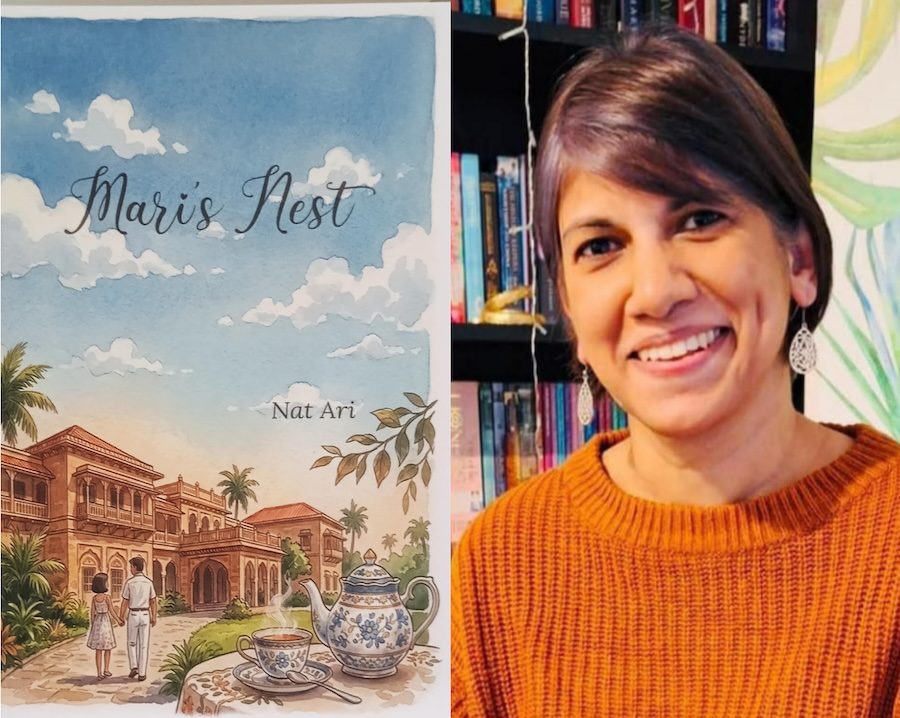
By Gayanga Dissanayaka –
Having grown up in Kandy, Nat Ari considered herself extremely blessed to live with her father, mother and sister in a hotel because her father was a hotelier. Her mother was a Sinhalese and her father was Tamil and therefore the common language at her home was English. As a result, themes like language, belonging and identity were always very important to her and close to her heart. “I was always interested in knowing where people were from, and what their accents were. I was also interested in spelling while growing up,” said Nat. “This continued on and when I finished school, I came to Australia and majored in English, while continuing to enjoy writing.” Nat worked at different education, media and cultural organisations in both Sri Lanka and Australia. She also completed a masters in applied linguistics and went on to do some postgraduate research studies as well, which resulted in publishing three peer reviewed articles in academic journals. However, Mari’s Nest is her first creative piece of writing published through The Jam Fruit Tree Publications.
Screenshot
“Writing this book has been a huge accomplishment for me in my life. I have one daughter who is my greatest admirer and greatest critic as well. She’s also a great writer herself, so I do hope she gets to publish her book too some day,” the author said fondly.
Storytelling feels like a calling to Nat since it’s a way of communicating with people you both know and don’t know. Knowing that someone who is a complete stranger has the potential to read and engage with the story that one has written and perhaps get something out of it means a lot to her. There are two reasons behind the publishing of Mari’s Nest. This book is a dedication to Nat’s father, whom she lost during Covid in 2020. Since she was in Australia and he lived in Sri Lanka, Nat was not able to attend his funeral. The author mentioned how she always wanted to do something as a way of saying goodbye to him. The second reason is when she was doing a course called Dramatic Transformations during her undergraduate years. “We had to compare different versions of texts and movies. Keeping in mind that I wanted to dedicate the book to my father and reimagine a classic story, I was trying to figure out a book that would help me do that. Little Women has always been one of my favourites, so I decided to reimagine Little Women,” explained Nat. “In the original book, the father isn’t around much, but in Mari’s Nest, the father’s character is very prominent.”
Since Mari’s Nest is a reimagining of Little Women, the author explained that the backbone of the story came from the original book in terms of the main scene and the characters. But she has also introduced some minor characters as well and has changed the settings and the scenes to go along with the cultures of India and Sri Lanka. She also drew inspiration from her life growing up in Sri Lanka, her travels to India and Spain and her life in Australia. In terms of the characters, she noted that she used certain characteristics that she’s familiar with in different people, and those were characteristics from her family members and friends, and people she met along the way, and observations she has made. “There’s an aunt of mine whom I admire very much and her name is Mari. So I was quite pleased to use that name for my main character. She has actually finished reading my book and she said to my mum that my tone of voice comes through my book which really made my day,” said the author.
She recalled how she wrote almost the entire book on her phone. She was texting herself bits and pieces and editing them. Nat had just moved houses and had injured her arm so she couldn’t sit at her computer and type. Therefore, she was writing the entire book with just one hand. “Either way, that was an enjoyable experience for me to be able to write the book while having an injured arm. The thoughts actually kept flowing. I did not have an outline or a framework. When I finished one chapter, I knew what the next chapter had to be, so it was a really enjoyable writing process,” explained Nat. The main themes that she hopes will resonate with the readers are family, culture, belonging, friendship, love, loss, identity, caring, sharing and the lasting bonds between family and friends.
“I just wanted to sit and write all day but I couldn’t because I had to attend to work and household tasks. It was also a challenge to decide where to publish my book. When I first started to think of writing a book, I was wondering if I should publish it in Australia or in Sri Lanka. I didn’t even know if that would be a possibility,” said Nat. “And then I came across The Jam Fruit Tree Publications and reached out to the publisher, Jeremy, I straightaway knew that I wanted to publish with them. The publisher’s approach was very straightforward and flexible at the same time.”
Nat wrote this book while dealing with a few challenges in her personal life, therefore it was like therapy for her and writing Mari’s Nest was something she looked forward to everyday. She used to write on weekdays before bed and in the mornings on weekends, and she considered it as her treat for the day. “I just couldn’t wait to keep writing everyday. It got me through a very difficult time in my life so this book would always be very special to me,” she said. “I was also able to keep this book a secret. Only my daughter knew how far I had progressed with the book and it was always fun discussing what I had written and hearing her feedback about the characters. At times, I would adjust things because what she said made more sense. I will never forget the first time I saw a photo of the boxes of books. I felt so overwhelmed and accomplished. I was thinking, Oh my God, I have done it. I have written a book!”
Nat wants her readers to be able to enjoy the simple language in the book. She’s a firm believer that language should be kept simple so that a wider audience can be reached. She also hopes that readers will be able to experience Sri Lankan and Indian cultures even in a small way. And for those who are from Sri Lanka, particularly Kandy or Bangalore in India, the author hopes that they will be able to read the book and identify with different moments she has mentioned in the book and put a smile on their faces. For families, she hopes it makes them laugh and cry when they identify with similar family moments in their own lives. And for those who enjoy classics, in particular, Little Women, she hopes that this book will also be enjoyable to them and be able to see the differences between the characters, the similarities and differences both in language settings, symbols and different aspects of Little Women and Mari’s Nest. She also hopes that students and educators would find her book useful and would use this book as a text for comparative analysis.
“I would also like to leave my readers with a small puzzle. Although the book has been dedicated to my father, the male figure in the cover art is not him. I want the readers to guess who it is. I left it up to the reader’s imagination to identify him,” noted Nat.
“Whether my readers are using this book to get through difficult moments, for pleasure, or as an academic text, I hope there’s something in it that will be helpful and useful to everyone,” the author said, “I would also like my readers to engage with me, either by leaving a review on Goodreads, or by reaching out to me on my Facebook page. I would love to hear your feedback, your opinions, or whatever you may wish to say about my book.”