

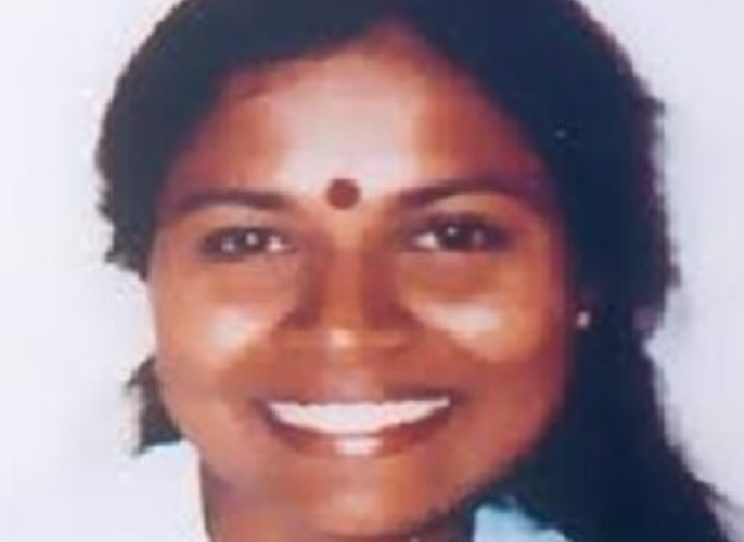
By Fareez Farook –

Fareez Farook
“I live in days that have no meaning.”
Some sentences acquire a different meaning after their author is gone. These words belonged to Thiagarajah Selvanithy, Selvi, a poet, dramatist and women’s-rights activist studying Theatre and Dramatic Arts at the University of Jaffna. She was not a soldier or a politician. She was a young woman who wrote, acted and questioned. On 30 August 1991, members of the Liberation Tigers of Tamil Eelam (LTTE) abducted her from her home in Jaffna.
Selvi
The following day, she was due to appear in a university play about the role of women in the Palestinian intifada.
She never made it to the stage.
Selvi disappeared into LTTE custody.
She would never return.
In 1992, while she was imprisoned, PEN honoured her with the PEN/Barbara Goldsmith Freedom to Write Award, recognizing writers persecuted for their words. In 1993, the LTTE acknowledged that she was in its custody. Four years later, in 1997, an LTTE spokesman acknowledged that she had been executed.
Six years had passed since she was taken.
For much of that time, the organization holding her knew where she was. Her family did not.
Before she became a prisoner
Selvi’s life before her disappearance was defined not by violence but by her engagement with women, theatre and literature.
She was associated with Poorani Illam, a women’s centre in Jaffna that supported women affected by bombing, bereavement and war. She was involved with the university’s women’s organization and founded the feminist journal Tholi. Her plays addressed subjects such as dowry and rape, while her poetry examined women’s lives amid war, repression and social constraint.
Sivamohan Sumathy, who knew Selvi personally, remembered her as a young woman with a questioning mind and a deep commitment to theatre. Selvi acted in Sumathy’s play “Aduppadi Arattai” in 1989 and was closely involved in the work of Poorani.
She was, in other words, part of a generation trying to imagine a different future while war was closing in around them.
The play that went on without her
The circumstances of her abduction remain particularly haunting because of what was supposed to happen the next day.
Human Rights Watch recorded that the university production dealt with a Palestinian prisoner who had been tortured and resisted his captors. Selvi was due to appear in it.
Instead, on the eve of the performance, she was taken away.
The irony was stark: a play about imprisonment and resistance was preparing to open while one of its performers had herself been imprisoned.
The stage was ready.
Selvi was not.
When liberation became intolerance
The LTTE presented itself as a movement fighting for the liberation of the Tamil people. Yet the organization’s record also reveals the darker reality of life under its authority.
Human Rights Watch documented arbitrary detention, torture, disappearances, extrajudicial killings and the suppression of political opponents and critics. It also reported severe restrictions on freedom of expression and cultural life in areas under LTTE control.
Amnesty International documented prisoners of conscience held by the organisation and restrictions on access to detainees. It also reported torture by the LTTE, while noting the difficulty of obtaining independent first-hand information because of the secrecy surrounding its detention system.
This was the political environment into which Selvi disappeared.
There was no transparent public charge against her, no independent court to examine her case and no meaningful judicial process through which she could challenge her detention.
An armed movement that claimed to be fighting for freedom had placed a young poet beyond the protection of any independent law.
The poet’s weapon
Selvi’s poetry did not need political slogans to challenge power. Its questions were more unsettling.
In “Within Me,” she portrays a world in which political absurdity has invaded everyday life and truth itself has become difficult to recognize.
In “Raman, Like Ravanan,” she unsettles the familiar moral divisions of the Ramayana, questioning the certainty with which people divide the world into heroes and villains. The poem asks what happens when those who claim righteousness begin to resemble the oppressor they condemn.
And in “Summertime,” translated by Shash Trevett, the beauty of Sri Lanka’s landscape exists alongside the memory of violence. The poem closes with the words:
“presses mutely on the mind.”
Read today, the line carries an added poignancy, not because Selvi predicted her own fate, but because her poetry understood how violence can remain long after the immediate moment has passed.
Her work has since travelled beyond Sri Lanka, including through Out of Sri Lanka, an anthology of poetry from Sri Lanka and its diasporas.
Six years in captivity
The outside world did not stop asking what had happened to her.
Amnesty International followed her case. In November 1993, LTTE spokesman Anton Balasingham reportedly told Counterpoint magazine that Selvi was still alive and in LTTE custody, as far as he knew. Yet her whereabouts remained undisclosed, and her relatives were not permitted to visit her.
The significance of that statement is difficult to escape.
She was not merely missing.
She was being held.
By then, the international literary community had already taken notice. PEN’s 1992 award had brought her case to the attention of writers and human-rights advocates around the world.
But international recognition could not release her.
The killing
In 1997, the LTTE acknowledged that Selvi had been executed.
Beyond that, the historical record becomes less certain. Later accounts have alleged that she was tortured, while contemporary human-rights reporting establishes that torture was used by the LTTE against detainees. But the available reliable evidence does not establish precisely what was done to Selvi herself or allow the final circumstances of her death to be reconstructed with confidence.
That distinction is important.
Her story requires no embellishment.
She was abducted from her home. She was held for years without a transparent judicial process. Her family was denied meaningful access to her. And the organisation that held her eventually acknowledged that it had executed her.
Those facts speak for themselves.
The tragedy of Selvi’s life lies not only in how it ended, but in the contradiction surrounding it.
The LTTE claimed to be fighting for the freedom of a people. Yet it could not tolerate the freedom of an individual to question, dissent and think independently.
That contradiction is central to Selvi’s story.
She wrote about women caught between war and social control. She questioned conventional ideas of power and righteousness. She remained involved in women’s work at a time when independent voices were increasingly dangerous.
Then she was taken.
Her captors could control her movements and eventually her life. They could not determine what would happen to her words afterward.
Her poems survived. They were translated and published. New readers encountered a woman they could never meet but whose questions remained alive on the page.
Perhaps that is the most fitting memorial to Selvi, not simply that she was killed, but that the attempt to erase her voice failed.
She disappeared in 1991. Her poetry did not.
Decades later, readers still encounter the question Selvi placed before her generation:
What becomes of a liberation movement when it begins to fear the freedom of those it claims to liberate?
Selvi never lived to hear the answer.
Her poetry did.
SebastianSR / September 8, 2026
Thnaks Fareez F for this article. This is also the time when Amirthalingam is being remembered, while the dual assasination of Dharmalingam and Alalasundaram (moderate politicians who tried to make the Thimpu talks work, and got tagged for elimination by the hard Separatism of the LTTE ogre. Unfortunately, so far the TNA, Ponnabalam Jr, Wignewaran (the Colombo-7 late-in-life Eelamist) or any top tamil leaders have not acknowledged these killings; they prefer to claim that the killings were a consequence of the jingoistic terror of hard-line Sinhala Buddhists (SB), and so there is nothing to acknowledge. According to Rohan25, these hardline SBs are actually originally low-caste Tamils who became Tamil-hating SBs! A community that fails to learn from history, and understand or accept its errors, and always finds the Devil only with the other side, and God only with their side, will never learn what co-existence and reconcilliation means. The killers of Thiagarajah Selvanithy and many other young people of that era—killers of our own relatives too— are now said to be living in impunity in Canada and UK; Let people like Adele Balasingham who poisoned the minds of many young women at least regret their actions, admit error.
/
Ajith / September 8, 2026
“Thnaks Fareez F for this article. This is also the time when Amirthalingam is being remembered, while the dual assasination of Dharmalingam and Alalasundaram (moderate politicians who tried to make the Thimpu talks work, and got tagged for elimination by the hard Separatism of the LTTE ogre. “,
This is the time to remind you former Prime Minister SWRD was killed by BS. Over 300 Tamils were dragged out of their houses and massacred in the day light 1958. Over 150 tamils were murdered in Gal Oya in 1956. Over 10000 JVP youths were killed in 1970. SWRD was assassinated by a BS. There was no LTTE until mid 1975. There was not only LTTE but also many other groups in operation in the North. All these groups are against the oppression of Tamils by Sinhalese governments. There is a difference between Tamils fighting with each other and Sinhalese governments killing Tamils.
Do you know how many Sinhalese killed by JVP?
/
The Truth / September 9, 2026
Rohan 25 now reduced to Ocean 11, ! !
If I go on exposing your weaknesses you might end up as ‘Thosai 00’ !
When your son marries Leela’s daughter, it is she who must change her name to Mrs 25 Jnr. Her father in law (you) need not change his name and become this ridiculous Ocean 11.( understand Western culture please, like how Leela has mastered it. Apparently Leela is taking a container full of toilet paper to Africa when he goes there to do charity. !)
With people like migrating there , once proud Australia ( white only)will end up like what Germany has become with comic Leela there, a land crawling with creepy Indians.
You say Mr 11 Ocean that these lower caste of Sri Lankans came from South India. Very possible when I observe their speeches, Just see the lack of integrity in a man like SF and half caste MR family ( Malay ?)
Why are these people lacking in basic integrity ? Is it the South Asian water they drink and the endless rice munching that destroys their human dignity?
/
Rohan25 / September 9, 2026
It’s fascinating that you’ve been commenting on this forum for years and still managed to get everything wrong. I am not Ocean’s 11; This person has been commenting on this forum for years , under this identity. I simply have one son and two daughters. I’d correct the rest of your strange, rambling lecture, but I’m too busy enjoying my “endless rice munching” and wondering why my life occupies so much free space in your mind.
/
SebastianSR / September 9, 2026
One evil does not justify another evil. When Malaysia gained independence, on May 13, 1969 armed mobs, consisting of Malays, clashed violently with Chinese. Chinese-owned businesses, homes, vehicles were targeted, looted, and even people were burned. Later chinese attacked Malay areas. Death toll was close to 800 or 1000, with a vast majority of the victims being Chinese. But after that the Chinese minority (about 30%, compared to the Malays about 60%) followed a very shrewd and pragmatic policy. Let the Malays impose draconian discrimination favouring the Malyas in politics; the Chinese moved to consolidate power in export-import, real estate and the professions, and achieved a dominant position (like the Jews in USA who do not ask for US anthem be sung in Yiddish but know better moves). The Malaysian national anthem (Negaraku) is not sung in Chinese; by law it must be sung in Bahasa Melayu (Malay). Courts are in Malayan. Even with much discrimination Chinese minority did not launch a violent war. In Sri Lanka, Tamil hubris made 7% of the 12% Tamils launch an unwinnable war against Sinhalese, Muslims, etc., paving way for an uneducated psycopath “Sooryathevan”; he assasinated our ligitimate educated leaders and youth.
/
old codger / September 9, 2026
SSR,
Malaya achieved independence on 31 August 1957. The anti-Chinese riots were much later.
But thousands of Chinese were also killed during the 1950s Malayan Emergency.
/
SebastianSR / September 10, 2026
Indeed, I grant you that, technically, Malaya (not Malaysia) achieved independance on 31st August 1957 with the cry of Merdeka etc. But, just as in Sri Lanka, In Malaya from that day onwards there was ethnic, economic and constitutional changes and tensions. However, if we are talking of Malaysia, we have to come forward to 1963 when Malaya joined with Bornea, sarawak and Sigapore to form Malaysia . Then in 1965 Singapore left the fereration of Malaysia. But I find that many writers start from May 1969 because the 1969 constitutional crisis in Malaysia was the most severe political and social disruption in the nation’s history. It fundamentally reshaped the country’s governance, legal framework, and ethnic relations. After the elections, highly charged victory parades by opposition supporters were met with fierce counter-rallies. On May 13, 1969, full-scale racial violence erupted in Kuala Lumpur, primarily between ethnic Malays and Chinese communities—an event now known as the 13 May progrom, similar to the anti-Tamil porgrom of 1983. For 21 months, Malaysia was governed without a parliament. When Parliament was retored in 1971 a system highly discrimnatory to the 30% Chinese minority was put in, highly favouring Malays.
/
Rohan25 / September 9, 2026
It takes a truly remarkable amount of mental gymnastics to compare the geopolitical realities of Malaysia to Sri Lanka. Let’s fix your history: the Chinese arrived in Malaysia as immigrants in the 19th and 20th centuries. Tamils are indigenous to Sri Lanka with an ancient, documented history on the island. Trying to use Malaysia’s systemic discrimination to justify Sri Lanka’s structural racism isn’t the brilliant point you think it is. Indigenous people demanding their fundamental rights in their own homeland isn’t ‘hubris’—but thinking you can erase thousands of years of native history certainly is. Fascinating history lesson, but you seem to have confused Tamils in Sri Lanka with 19th-century Chinese immigrants.to Malaysia. Tamils are indigenous to the island and have been there as long as the Sinhalese. Asking a native population with thousands of years of deep-rooted history to just ‘act like the Chinese in Malaysia’ and quietly accept being second-class citizens in their own homeland is peak delusion. You can’t gaslight an entire indigenous population into acting like guests in their own home
/
SebastianSR / September 10, 2026
Rohan25 says Let’s fix your history: the Chinese arrived in Malaysia as immigrants in the 19th and 20th centuries. Tamils are indigenous to Sri Lanka with an ancient, documented history on the island. This is WRONG HISTORY. Just as India is close to Lanka and so Dravidians, Bengalis, Gujaratis, North Indians like Rama, had come to Lanka long ago, China, being close to Malaya, Chinese had settled there just as Tamils did in Lanka. Maritime trade between the southern coastal China and Malay Peninsula stretches back 2,500 years. The arrival of Princess Hang Li Po from the Ming Dynasty, who was sent to marry Sultan Mansur Shah of Malacca reminds us of princess from Madura coming to marry Vijaya. Princess Li Po brought an entourage of hundreds who permanently settled on a hill still known today as Bukit Cina (Chinese Hill). Large permanent settlements (e.g., Malacca Sultanate) in the 1400s, just as the Chola and Magha rule in Lanka solidified also in similar medieval times. The British imported thousands of laborers from southern China to work tin mines and rubber plantations in the 19th century, just as Malabars were brought to Lanka during the same period.
/
Rohan25 / September 9, 2026
It’s fascinating how you spun a whole essay comparing two completely different historical contexts just to say you support discrimination. Malaysian Chinese are a modern immigrant diaspora. Sri Lankan Tamils are indigenous to the island. You are comparing a migrant workforce to a population with deep, ancient roots and established historic homelands. Trying to copy-paste Malaysia’s complex ethnic politics onto Sri Lanka is desperate. One historical injustice doesn’t validate another, no matter how ‘shrewdly’ you try to word it. The Chinese arrived in Malaysia in the 19th and 20th centuries as immigrants. Tamils in Sri Lanka are indigenous and native to the island, with an ancient history that mirrors the Sinhalese. They didn’t migrate to someone else’s country; they are in their own historic homeland. Using Malaysia’s flaws to justify discrimination in Sri Lanka is a wild take. ‘One country is unfair to its immigrants, so we should be unfair to our own indigenous people’ is certainly a choice. Also, trying to psychoanalyse an entire ethnic group’s ‘hubris’ while rewriting history to excuse systemic inequality is peak mischief. Nice try, but the comparison completely sinks.
/
Rohan25 / September 9, 2026
Key Points of Difference to Remember; Status: Malaysian Chinese entered a pre-existing Malay political landscape as colonial-era immigrants. Sri Lankan Tamils have a continuous, distinct, and ancient civilizational presence on the island alongside the Sinhalese. The Anthem Comparison: The Malaysian anthem is in Malay because the Chinese arrived as immigrants to a Malay land. In Sri Lanka, both Sinhala and Tamil are constitutionally recognized official languages and national languages, reflecting the dual indigenous nature of the island.
/
Ocean11 / September 8, 2026
Yes this article raises a very valid point about the lack freedom of speech under LTTE rule and the low tolerance for dissent.
Yes this should be acknowledged by prominent Tamil politicians. This is not to underscore the human rights abuses and war crimes which were committed by the Sri Lankan military and the Sri Lankan state. Which were often far worse.
Coming back to Rohan25’s point what he is saying is not factually incorrect. As a lot of the coastal Southern Sinhalese namely the Karava, Durava and the Salagama caste are descendants of South Indian migrants who arrived during the 13th-18th . century.
Yes the bulk of the present day Sinhalese are more likely to have originated from South India than North India. With only a small component originating from North India.
He mentions this as we have been fed this bs lie even in our school books that the Sinhalese have their ancestry in Northern India.
Also if the Sinhalese claim to be not caste conscious or worried about supremacy why are they so keen to prove their Aryaness despite it being a very small component.
/
The Truth / September 9, 2026
Rohan 25 now reduced to Ocean 11, ! !
If I go on exposing your weaknesses you might end up as ‘Thosai 00’ !
When your son marries Leela’s daughter, it is she who must change her name to Mrs 25 Jnr. Her father in law (you) need not change his name and become this ridiculous Ocean 11.( understand Western culture please, like how Leela has mastered it. Apparently Leela is taking a container full of toilet paper to Africa when he goes there to do charity. !)
With people like migrating there , once proud Australia ( white only)will end up like what Germany has become with comic Leela there, a land crawling with creepy Indians.
You say Mr 11 Ocean that these lower caste of Sri Lankans came from South India. Very possible when I observe their speeches, Just see the lack of integrity in a man like SF and half caste MR family ( Malay ?)
Why are these people lacking in basic integrity ? Is it the South Asian water they drink and the endless rice munching that destroys their human dignity?
/
leelagemalli / September 11, 2026
Individuals who engage in personal attacks or inappropriate criticism in public forums should be encouraged to communicate within the boundaries of respectful and constructive discourse.
Unfortunately, CT website administrators may be reluctant to intervene, as user engagement and the volume of comments are often important to the sustainability of online platforms.
This can result in inappropriate behaviour being tolerated at the expense of maintaining a healthy and respectful discussion environment.
/
The Truth / September 9, 2026
Ocean now at sea, I like your line-” Rohan 25’s point is not factually incorrect” !
A typical Tamil Nadu, dont you think ? Even in jest, you are praising yourself ! making yourself more employable ?
Your DNA has no integrity.
Only that Mahendran of Central Bank had some…
OC argues that in this Airbus deal there was no loss to the country as the contract was cancelled and the Rajapaksa family brought in 200 million (?) dollars of foreign exchange to the starving country. It was Airbus which lost money !
Pity this OC has no daughter to give in marriage to your second son now growing up as a Aussie boy. Unfortunately this OC follows Ranil even in sexual preference.
/
leelagemalli / September 9, 2026
TT,
Why are you trying to create connections between our children and other people’s families when you could simply look for someone like AKD, who, judging by the public statements, seems to have quite a lot in common with you—particularly the tendency to make sweeping statements without thinking twice? The claims about R25 and his son marrying my daughter, whom I raised as my own, while simultaneously looking to OC or others as possible “daughters,” seem less like genuine relationships and more like narratives manufactured to support your fairy tales.
–
As someone who spent two years voluntarily studying Human Psychology at the University of Heidelberg, I find some of these statements difficult to understand.
Tbc
/
leelagemalli / September 9, 2026
cont.
During my university years in Sri Lanka, I encountered some students who seemed to derive enjoyment from hurting or humiliating others during the ragging period.
Such behaviour may, in some individuals, reflect a social or psychological deficiency, particularly when they seem to find satisfaction in provoking, hurting, or belittling others. At times, these patterns of behaviour can become deeply ingrained and may not necessarily change simply with the passage of time. I cannot know what lies behind this individual’s behaviour, nor would I claim to understand her personal history, but some of her comments come across as incoherent, abusive, and unnecessarily provocative.
–
Perhaps the wisest response is not to become angry or allow ourselves to be drawn into endless arguments, but simply to recognize these comments for what they are and not give them more importance than they deserve. It is unfortunate that so much time is being wasted by people who continue to repeat and engage with what appear to be manufactured narratives.
/
Rohan25 / September 9, 2026
Your comment is correct. Sebastian is a model of objective journalism—so long as you share his fierce dedication to Sinhalese extremism and happen to be reading his dispatches from the safety of the Western nation he so conveniently escaped to.
Here is something for you
https://www.youtube.com/watch?v=WTDJt_wq4ME
The comments are incredibly revealing. It turns out that a fancy Western education is still no match for the deeply rooted Mahavamsa conditioning. Watching the self-proclaimed elite bend over backward to defend a fictional Aryan myth—while their actual DNA links them directly to historical Tamil regions of South India—is the ultimate comedy. The science is right there, but the denial is stronger.
/
SebastianSR / September 9, 2026
Where people came from, and how long they have lived in some place is irrelavant as far as human and political rights go. If a Mongol acquires citizenship in Sri Lanka today, he has the exact same rights as Gajen Ponnambalam or the late SJVChelva or SWRDBanda, even though Chelva’s immediate ancestors were Malabar Indians (Indian British); SWRDBanda’s immediate ancestors were in Ceylonese British. Who lived in Lanka in 500BC or who lived in Jaffna in 1800AD are of historical interest but irrelavant to political rights. Thus, although Captain Percival claims in his book that in 1800AD there were nearly equal numbers of Muslims, Tamils, Sinhalese in Jaffna, today in Jaffna the majority are Tamil speakers. And that is why the local language should be used in local daminstration rather than sinhalese or english. This has nothing to do with contested claims of Jaffna having been the “ancient homeland” of the Tamils. That was true for some small number of Tamils whose progeny have now disappeared because, after about 4 or 5 generations, the maternal mitochondria copies are so widely dispersed that you can find them in Australia or Germany or where ever.
/
Rohan25 / September 9, 2026
Scholars, anthropologists, and modern historians widely agree that colonial-era accounts—such as Captain Robert Percival’s 1803 book, An Account of the Island of Ceylon—must be treated with extreme skepticism. When modern Sinhalese racist and nationalist narratives weaponize Percival’s casual observations—such as his claims about the demographics of Jaffna or the origins of its inhabitants—they ignore the deep biases of the source. Modern academics discount the factual weight of Percival’s specific demographic assertions regarding Jaffna for several reasons: Lack of Scientific Methodology: Percival was a military officer (a Captain in the 18th Irish Infantry Regiment), not a demographer or anthropologist. His counts were based on visual impressions, hearsay, and casual observations rather than systematic census data. Colonial Visual Bias: Percival famously claimed that the majority of Jaffna’s population were “Moors” (Muslims) because of the visual presence of men wearing round white caps. Historians point out that he conflated cultural dress and trade-hub visibility with actual regional demographics, completely misreading the broader population of the peninsula. The “Divide and Rule” Framework: Like many early British colonial writers, Percival viewed the island through a Eurocentric lens that sought to categorise, separate, and rank native populations to justify foreign governance.
/
SebastianSR / September 10, 2026
Scholars, anthropologists, and modern historians widely agree that colonial-era accounts—such as Captain Robert Percival’s 1803 book, An Account of the Island of Ceylon—must be treated with extreme skepticism. So, are we to take seriously the account given in Yalpana Vaibhava Kaumudi ? de Queroz mentions 34 Buddhist temples and 11 Hindu Kovils, and I think a similar number of Mosques. Many muslims dominated Velvettithurai and were sea-faring trader pirates who were driven out by the Poruguese, establishing rule of law. We also have accounts from Baldeus, and many other sources, Portuguese and Dutch land registries giving us an indication of demographics, also showing land ownership and how sinhalese land owners and Muslim land owners sold land to newly rich Tamils (who had got rich by working for the colonials) bought land. So, history has to be pieced together to find that Percival’s account is pretty good, and G.G. Ponnambalam’s picture that Tamils (and Sinhalese) were every where in Lanka- from Point Pedro to Dondra– is actually true, then and now.
/
Rohan25 / September 9, 2026
In modern political debates, partisan groups often cherry-pick historical documents to validate an agenda. When specific passages from Percival are cited to argue that Tamils are “recent immigrants” or that another community historically dominated the north, it represents a classic case of using outdated colonial biases to feed modern ethnic tensions. Reputable historians rely instead on epigraphical evidence, archaeological excavations, and comprehensive multi-source analysis rather than the unverified diaries of a 19th-century colonial soldier.
/
SebastianSR / September 10, 2026
Captian Percival has not said Tamils are recent immigrants. Mahavamsa says Tamils have been there since Before Christ. However, the question of who is recent, and who is not, that obsesses Rohan25 is IRRELAVANT. Once a person becomes an immigrant, even if that be only yseterday, he has the SAME rights as a direct dsecendant of Senaka and Guttika (Tamil horse traders from pre-Christian times).
So, if the Mahavamsa and Sinhala Buddhists have NOT said that Tamils are recent immigrants, who has said so? The statement that Sinhalese were the first rulers of Lanka is implied in the Yalpana Vaipava Malai (often referenced in related historical discourses alongside the Yalpana Vaibhava Kaumudi) in an account of Jaffna being land gifted to the blind lute player by a Sri Lankan monarch. The lute player brought Tamils and created the Jaffna community. So, the Tamil Texts imply that the Sinhalese were there prior to the founding of a colony by the lute player. Colonial historians such as Baldeus, Tenant, and more modern Christian historians like Father S. G. Perera, and G. C. Mendis took a similar narrative of Sinhalese being the earliest settlers. Our Tamil historians started the false narrative.
/
Rohan25 / September 9, 2026
Fascinating history lesson! I must have missed the chapter where the British Empire started mass-exporting ‘Malabar Indians’ just to birth Tamil leaders, while everyone else magically sprouted from the soil of ancient Ceylon. If we are handing out ancestry DNA tests based on internet theories, should we also ask which century your ancestors arrived, or does the ‘who cares where people came from’ rule only apply when it’s convenient for your argument? Love the sudden passion for equal rights for a hypothetical Mongol immigrant—truly a beacon of modern progressive thought! Funny how that same beautiful logic of ‘equal political rights for everyone regardless of origin’ completely evaporates the moment native Sri Lankan Tamils ask for the exact same thing. But hey, top marks for the creative historical fiction regarding Chelva and Ponnambalam! An absolute masterpiece of a fairytale. You managed to rewrite the well-documented genealogies of Chelva and Ponnambalam, invent a random Mongol immigrant crisis, and completely contradict your own point about origin being ‘irrelevant’ all in one go. Did you leave your logic in the West, or did it just not survive the flight?
/
Rohan25 / September 9, 2026
Fascinating history lesson! I assume you’re planning to pack your bags and move back to Sri Lanka tomorrow, right? Because by your own logic, since you live in the West, you have absolutely no right to comment on Western politics, and your presence there must be deeply distressing to the ‘native’ locals. Or does the ‘citizenship equals equal rights’ rule only apply when it conveniently dilutes Tamil political representation, but not when it allows you to enjoy a comfortable life as a diaspora immigrant. Ah, the classic ‘everyone I don’t like is a recent Malabar immigrant’ fairy tale. I’m curious, what year exactly did Chelvanayagam’s ancestors allegedly skip across the strait? Because last time anyone checked a history book, Jaffna Tamils have been rooted there for centuries. But hey, if we are playing the ‘immediate ancestors’ game to disqualify people from having a say in native rights, wait until you find out where the prince who started the Sinhalese kingdom originally sailed from. Spoiler alert: It wasn’t Colombo. Imagine living in the West as an immigrant and spending your free time cooking up fictional family trees for dead Tamil politicians to prove they aren’t ‘native’ enough.
/
Rohan25 / September 9, 2026
The mental gymnastics required to use a hypothetical Mongol citizen to invalidate centuries of Tamil heritage is truly Olympic level. Focus on integrating into your host country instead of rewriting history from a distance. So if a British citizen moves to Australia today, does that suddenly erase the unique land rights and historic injustices faced by the Indigenous Aboriginal people? Of course not. Trying to use the concept of modern citizenship to wipe away the specific, historical, and structural fight for Tamil rights is a nice try, but a terrible argument. But please, tell us more about this Mongol citizen—is he in the room with us right now?
/
SebastianSR / September 9, 2026
Aryan is a lingusitic group and NOT any race or ethnic group.
Indo-European is the parent language family, while Indo-Aryan is a smaller sub-group (a North Indian “grandchild” branch) and the name is used with no racial slur implied. There is no question that Sinhalese belongs to the Indo-Aryan group, while Tamil belongs to the Dravidian family of lnguages. But the flowering of Tamil during the Sangam period was due to vast enrichment gained by Tamil from Sanskrit— the most formally organized Indo-European leanguage of all. Sinhalese too is vastly indebted to North Indian Pali and prakrit (fore-runners of Sanskrit). So, both Sinhalese and Tamil, though belonging to different branches, have been nourished by North Indian Languahes during the 3rd century BC to 5th century AD period. Then, with Chola invasions, Sinhalese picked up much Tamil words. That is why a Tamil can easily learn Sinhala and vice versa –and they would have done so if their minds had not been poisoned by their respective political leaders. So, we have been fed this bs lie even in our school books that the Sinhalese have their ancestry in Northern India is cultually exactly correct and NOT a bs lie.
/
Rohan25 / September 9, 2026
I love your creative rewriting of history, but back in reality, Sangam Tamil was doing just fine without any external help. Old Tamil did not have Sanskrit, and Middle Tamil barely touched it either. If we are talking about borrowing, Sanskrit is the one that heavily leaned on Dravidian vocabulary and syntax to enrich itself. Next time, try opening a linguistics book instead of a mythological fantasy. Sanskrit has borrowed quite as much from Dravidian as Dravidian has from Sanskrit. Tamil has borrowed more words from Sanskrit than Sanskrit has from Dravidian. It is a trivial thing for a language to borrow vocabulary. But when it uses another language’s syntax to form the way it expresses things, and uses another language’s phonology for its sounds, that is really profound influence. The fact is, Sanskrit has been influenced in this way by Dravidian. Of course, some Dravidian languages have also borrowed Sanskrit sounds (bh, etc.) But none of the four Dravidian languages has borrowed anything from Sanskrit syntax that I can identify. Much of the syntax of Sanskrit is Dravidian, and it has a large Dravidian vocabulary. Its system of phonetics is profoundly influenced by Dravidian
/
Rohan25 / September 9, 2026
Sorry. Old Tamil Sangam poetry (c. 300 BCE – 300 CE) was strictly indigenous, featuring less than 1–2% Sanskrit loanwords. However, during the Middle Tamil era—driven by the Pallava and Chola reigns, the Bhakti movement, and the rise of Buddhism and Jainism—Sanskrit terminology integrated rapidly. This predominantly religious poetry adopted the Manipravalam style, which blended both languages. Post-independence, the Dravidian movement systematically purged these superfluous Sanskrit elements, restoring native vocabulary so that Modern Tamil now retains significantly less Sanskrit influence than Middle Tamil. Throughout this evolution, Tamil maintained its original grammatical structure and independence. In contrast, other major Dravidian languages—such as Kannada, Telugu, and Malayalam (which branched off from middle Tamil)—allowed Sanskrit vocabulary to heavily alter their linguistic foundations.
/
Rohan25 / September 9, 2026
Indo-Aryan is the only IE family with Dravidian retroflexes. Tamil is a classical Dravidian language with its own dedicated script, which evolved from an early southern variant called Tamil-Brahmi or Tamili. Script Stability: Unlike Sanskrit, which adapted to local scripts across India, Tamil stayed closely tied to its own unique alphabet system throughout its history Sinhala is genealogically classified as an Indo-Aryan language, not a Dravidian one. However, the perspective regarding a deeply rooted Dravidian/Tamil substrate that predates the 10th-century Chola invasions is highly supported by modern historical linguistics and genetic studies. While the fundamental core of the language remains Indo-Aryan, its centuries of close geographic isolation alongside Tamil have radically restructured Sinhala, making it look typologically like a Dravidian language in many ways. Pre-Chola Merging: Centuries of bilingualism, intermarriage, and assimilation between the local population and South Indian migrants occurred long before the Cholas. Modern genetic studies confirm that the Sinhalese population shares a massive genetic admixture with South Indian populations (specifically Tamils), reflecting this deep historical integration. The most profound evidence of the Dravidian substrate is in the syntax (word order) and structural grammar of spoken Sinhala.
/
Rohan25 / September 9, 2026
While northern Indo-Aryan languages (like Hindi or Punjabi) maintain certain structures, Sinhala shifted completely to align with Dravidian typology: Left-Branching Structure: Like Tamil, Sinhala is strictly a head-final, left-branching language. Modifiers always precede the noun, and relative clauses end in a verb rather than using relative pronouns. Subject-Object-Verb (SOV): Both languages utilize a rigid SOV structure. Loss of Aspirated Consonants: Unlike Sanskrit, Pali, or Hindi, which feature heavy use of aspirated sounds (like bh, dh, gh), spoken Sinhala entirely lost these sounds. Linguists attribute this to a Dravidian substrate, as Dravidian languages natively lack aspirated stops. Dative Subjects: Sinhala allows sentences where the subject is in the dative case (e.g., “To me a cold is” instead of “I have a cold”), a feature mirroring Tamil grammar. Linguists have identified roughly 900 direct Tamil loanwords in Sinhala, alongside an even deeper layer of structural borrowings Everyday Mixing: These are not just technical terms, but everyday vocabulary including body parts, ordinary actions, and tools. Kinship System: While basic words like “father” (thaththa) and “mother” (amma) have contested etymological roots (some linguists link them to Indo-Aryan roots like Bengali/Gujarati, others to Dravidian.
/
Rohan25 / September 9, 2026
the structural organization of the kinship system (how cousins, uncles, and aunts are categorized for marriage eligibility) follows a strictly Dravidian cross-cousin paradigm rather than a North Indian Indo-Aryan one. Linguists often refer to Sri Lanka and Southern India as a “Sprachbund” (a linguistic area). This describes a region where languages from completely different families live together for so long that they morph to share the same structural skeleton. Sinhala is fundamentally an Indo-Aryan language that has been deeply cast into a Dravidian mold by centuries of coexistence long before the Cholas ever arrived. Please stop bullshitting here with your racist propaganda and rubbish
/
LankaScot / September 9, 2026
Hello SSR,
A Google search for “Problems in Learning Sinhala & Tamil as Second” will take you to a PDF by R Kailainathan · 1995 which enumerates some of the main issues.
Best regards
/
SebastianSR / September 10, 2026
The structure of Sinhala and Tamil languages has been analyzed within the Sprachbund concept in a research article that appeared in the Royal Asiatic Society (Colombo Branch) only a few years ago. That article shows how Sinhalese and Tamil interacted, with Tamil being subject to Murya and Gupta influences that made it absorb a lot of sanskrit words. The article also traces the sinhalese and tamil kinship words like Akka, Aiyya, Amma, Mama, etc., to their historic sources and how they independently merged, already in the Indian mainland. The article also has a section on Jaffna Tamil kinship–cousin marraige structure etc. When you read it Rohan25 can see who is bull-shiting — Nandi-shitting. The Palk straits shielded the Island sufficiently to make Sinhala sufficiently distinct from its mainland cousins, as analyzed by James W. Gair and other linguists. Tamils can learn Sinhala more easily than English, and Sinhalese can learn Tamil more easily than English. Now you can use any language and use AI to convert any language to your own. Technology has solved what was an insoluble political problem that killed thousands, down the ages, in many nations . There no “language problem” any more.
/
LankaScot / September 9, 2026
Hello SebastianSR,
“That is why a Tamil can easily learn Sinhala and vice versa –and they would have done so if their minds had not been poisoned by their respective political leaders.”
I am not poisoned and find it much easier to learn Sinhala than Tamil. The problem for us English Speakers is pronunciation. I worked with a number of Keralan and Tamil colleagues for 11 years or so in Qatar. I picked up a little Hindi and Sinhala fairly easily. My Keralan friends tried to teach me Malayalam to no avail. No matter how hard I tried my pronunciation of Banana (വാഴപ്പഴം) was always greeted with laughter. My Hindi for “how are you” kaise hai was usually understood however my “sukham tanyai” was rarely understood.
I know a few Muslims here that speak Tamil, Sinhala and English pretty well. (I am told by Sinhala speakers), My (Sinhalese) 14 year old Granddaughter speaks a limited amount of Tamil and confesses that she finds it difficult to get the pronunciation correct. Her English is excellent; she intends to take it as an A Level. I don’t know any Sinhalese in our area that speak Tamil fluently.
Best regards
/
SJ / September 10, 2026
LS
Tamil and Malayalam have several consonants with retroflex and non-retroflex sounds. Perhaps the highest among all languages. Other I dian languages have a few too, but they are not articulated in current speech. Sinhala has pairs like l–L and n–N. But hardly distinguisable. Also most Indian languages have dropped the aspirated v. non-aspirated distinction in ten pairs of consonants (like k–kh, g–gh etc.) altough writing preserves them.
Most Tamils cannot pronounce ഴ but most Malayalis do.
The problem lies elsewhere: Diglossia is terrible in Tamil, which has a much larger number of regional variants than other Indian languages. Very few speak grammatical Tamil. Malayalis are better that way. (I can only hope that this will not trigger an anti-Malayali barrage from you know who.)
/
SJ / September 10, 2026
LS
Tamil and Malayalam have several consonant pairs with….
/
Rohan25 / September 10, 2026
cont. Structural and Cultural Convergence or the advantage: Centuries of geographical proximity, cultural exchange, and modern education in Sri Lanka have bridged this genetic divide through structural and lexical overlaps: Identical Sentence Structure: Both languages use a Subject-Object-Verb (SOV) syntax. To say, “I am eating rice,” both speakers structure it literally as “I rice eating,” making structural translation seamless. Phonetic Alignment: Nearly every vowel and consonant sound in Tamil has a matching equivalent in the Sinhala script, giving Sri Lankans a significant pronunciation advantage over Western learners. Shared Lexicon: Spoken Sinhala includes numerous Tamil loanwords, and both languages share a vast pool of vocabulary derived from Sanskrit. Modern Tamil still as around 20% Sanskrit derived common words in its day to day spoken vocabulary, as no one hardly uses the pure Tamil equivalent.
/
leelagemalli / September 10, 2026
cont.
The President should also think carefully before making insensitive public statements, such as telling seriously ill people to stay home and drink Koththamalli.
In Sri Lanka, those who depend on government hospitals are often among the poorest people in society. They do not go there for fun or convenience; they go because they cannot afford private healthcare and depend on free treatment and medicine. Sri Lanka voted for genuine change, accountability and compassion ; not for another version of the same old politics under a different name.
/
leelagemalli / September 10, 2026
Hello LS,
–
I can hardly believe that there are no Sinhala-speaking people in your area who speak good Tamil. I know several Sinhalese people who learned Tamil at school, and in that part of Sri Lanka one would expect more people to be bilingual. Even if the number is still below 5%, after all these years one would have expected a government that came to power promising real change to take serious steps to improve language skills and promote reconciliation. Instead, what we are seeing increasingly resembles the same old political culture practised by the Rajapaksas.
–
Just imagine the priorities: President AKD talks about building 1,000 4G towers while more than 35,000 Ditwah flood victims are reportedly still struggling in temporary tents. Videos from areas such as Kotmale show people apparently left struggling after the devastating floods, yet we continue to hear grand political statements about savings and achievements. If the government has really saved so much money over the past two years, why not use some of it to provide meaningful relief to those who desperately need it? People need action, not inflated political promises.
Tbc
/
Ocean11 / September 10, 2026
Yes you are correct Indo-Aryan is more of linguistic identity as opposed to an ethnic identity. In that in Northern India Indo-Aryan languages became more dominant due to elite replacement as opposed to mass migration from the Steppe to the point where the steppe individuals outnumbered pre existing natives or the Dravidians.
Yes there would have been migration from the Steppe regions to the North of India however it was not to the point where they would go on to outnumber the pre existing populations. In most cases what would have happened was that the incoming Indo – Europeans would have overtime made themselves an elite in Northern India which overtime led to the local tribal or Dravidian populations adopting the language and the culture of the Indo-Aryans.
So Yes much of Northern India is more culturally and linguistically Indo Aryan as opposed to being ethnically Indo Aryan. Ethnically most North India are a hybrid of Aryan and Dravidian.
On other hand with the Sinhalese they are not even culturally Indo -Aryan as much of their culture and customs today are more similar to that of Kerala than any other North Eastern state of India.
/
Ocean11 / September 10, 2026
Yes much of Northern India is more culturally and linguistically Indo Aryan as opposed to being ethnically Indo Aryan. Ethnically most North India are a hybrid of Aryans and Dravidian.
On other hand with the Sinhalese they are not even culturally Indo -Aryan as much of their culture and customs today are more similar to that of Kerala than any other North Eastern state of India.
The only thing that is remotely Indo-Aryan is their language and even that has a stronger Dravidian substratum and influence when compared to other Indo -Aryan languages.
Also even many Indo-Aryan languages in Northern India often contain a Dravidian substratum as Dravidian languages were spoken in Northern India prior to the spread of Indo Aryan languages and when the Dravidian speaking populations in the North of India adopted Indo Aryan languages they brought many Dravidian loan words into the Indo – Aryan vocabulary.
/
LankaScot / September 10, 2026
Hello Ocean 11,
My Gt Grandmother (born 1875) told me that our Ancestors were called the Beaker Folk. Her House near Loch Kinord was right next to a site of Iron Age Round Huts, There were a couple of Crannogs on small Islets in the Loch. At that time and well into the 20th Century the Common Archaeological view was that the Cultures and Agricultural practices had arrived from Anatolia with Neolithic Farmers. Only recently has it become apparent that the Bell Beakers accounted for around a 90% Genetic Replacement. The definitive evidence became clear from the work of David Reich and others in around 2018. The book by Alex M Gibson “Bell Beaker Settlement of Europe” provides a good selection of Expert Articles. “All authors also insist upon the multiplicity of evidence”
My DNA is a subset of R1b-M269 (Bell Beaker).
The largest Y DNA haplogroup in India is the R1a-Z93 haplogroup (Steppe Ancestry). The frequency of this follows a declining North West/South East pattern through India –
https://helixline.in/blog/r1a-haplogroup-india
So if you have this haplogroup you may be of Brahmin descent and a distant cousin to me😎.
Best regards
/
Nathan / September 10, 2026
History is not created in a vacuum.
(The rest is left for each individual to decipher.)
/
Nathan / September 10, 2026
Each understands / interprets history according to his own fancy!
/
The Truth / September 8, 2026
How can such crimes be committed by pacifists, idealists and mathematicians ! Maybe Gota or Saley was behind it !
We must appoint a commission of Inquiry.
5 very honest men with unmatched brains.
OC, Vedda, 25, Leela and Ajith.
Since we have 25 here we expect the report to cover at least the past 300,000 years, including Ravanna’s crimes ! OC will be precise in his BS. Vedda will be trying his best to impress. Leela will keep everyone in laughter and this nonentity Ajith will remind the rest of the mediocrity of the world.
Guys, this report will be better than long expected autobiography of our brilliant product ( Nalini + Esmund) Ranil !
/
leelagemalli / September 9, 2026
I think it is high time TT (aka hairy Deepthi); or whoever is operating behind these shifting identities—stopped trying to gaslight people through endless personal attacks and instead demonstrated some actual knowledge of the subjects being discussed. Time and again, the substance of these comments appears remarkably thin, while the disparaging tone is remarkably consistent. If there is a genuine case to be made in defence of a person, a party, or a political position, why hide behind aliases and multiple avatars? Why not come forward openly, make the argument, and allow people to judge it on its merits? I have increasingly come to believe that TT is the same individual previously appearing as “Lester,” who has now conveniently disappeared. Whatever the identity, changing names does not strengthen an argument; it only raises more questions about credibility. None of us—whether former President RW, OC, NV, myself, or any other commenter—needs permission to express a political opinion, and disagreement does not justify repeatedly attacking or attempting to discredit people.
Tbc
/
leelagemalli / September 9, 2026
cont.
If someone chooses to defend a political cause, that is their right; but it should be done honestly, intellectually and without hiding behind manufactured identities. And let us not rewrite history for the sake of political convenience: during those critical 26 months, the foundations laid by the former President and his administration were, in my view, instrumental in preventing Sri Lanka from falling into an even deeper catastrophe.
–
Had those foundations not been established, the country could have faced consequences on a scale far more devastating than what we ultimately experienced. Political debate should be about facts, evidence and ideas; not aliases, character assassination and relentless personal attacks.
–
If TT truly believes her position is defensible, let her defend it openly; the public is perfectly capable of deciding who has knowledge, who has evidence, and who has nothing more than noise.
/
The Truth / September 9, 2026
OC Why are you ignoring me ?
If you do not engage me in debate I will go away to Leela’s castle in Germany ( he paid his hard earned 3 million for it)and sulk.
Who can tell Leela might join cause with me and that will not be good for the South Indians ( dark and ugly and as you say hairy)
/
leelagemalli / September 9, 2026
Hairy Deepthi/TT,
It seems OC has finally figured out that you are Lester himself. The endless incoherent answers and pointless explanations have certainly made that clear. You may have thought you were fooling people in CT, but your efforts have not gone unnoticed.
/
Ajith / September 9, 2026
“The LTTE presented itself as a movement fighting for the liberation of the Tamil people. Yet the organization’s record also reveals the darker reality of life under its authority.”
Now it becomes to who are the darker side of this island. It is now very clear that the past 75 years of the rulers of this island are the darker side of the whole island. The people of Sri Lanka gave a clear verdict who are the darker side by removing them from the power and replacing with a political party or organisation that was called as a terrorist organisation. To this dark side not only SLFP and UNP governments but also contributed by Tamil speaking Politicians as well. The judiciary found many of the government ministers, and officials are responsible for the darker side of the island. There will be more to come.
I would like to tell one of the most factor that helped to show which is the darker side
was the war between rulers and LTTE. The NPP government should not have the opportunity to identify who are responsible for the darker side of this island if not LTTE.
/
SJ / September 10, 2026
Even the darkest of things will not serve to deny that the LTTE had a very dark side to it.
/
Ajith / September 10, 2026
Poor attempt by a Professor of violent Buddhist Sinhala special status.
/
SJ / September 10, 2026
Call anyone anything.
But your escape route will not go far enough to whitewash the dark side of the LTTE.
/
Rohan25 / September 10, 2026
You are correct. It is not very easy to for both people to learn each other’s language. They may share the same genetics and DNA but there is a vast difference in the language. The Linguistic Divide. Sinhala belongs to the Indo-Aryan (Indo-European) family, making it distantly related to Hindi, Spanish, and English. Tamil is a Dravidian language with deep roots in southern India. and northeast Sri Lanka. Distinct Vocabulary: Because they lack a common ancestral language, root words are entirely different. Knowing basic words like “water” or “house” in one language provides zero context for the other. Unique Alphabets: Both languages utilize distinct scripts derived from ancient Brahmi. Neither speaker can read the other’s script without explicit instruction. Pronunciation Nuances: Tamil features specific retroflex consonants (curling the tongue backward) that require untrained ears and tongues to adapt.
/
Rohan25 / September 10, 2026
cont. Structural and Cultural Convergence or the advantage: Centuries of geographical proximity, cultural exchange, and modern education in Sri Lanka have bridged this genetic divide through structural and lexical overlaps: Identical Sentence Structure: Both languages use a Subject-Object-Verb (SOV) syntax. To say, “I am eating rice,” both speakers structure it literally as “I rice eating,” making structural translation seamless. Phonetic Alignment: Nearly every vowel and consonant sound in Tamil has a matching equivalent in the Sinhala script, giving Sri Lankans a significant pronunciation advantage over Western learners. Shared Lexicon: Spoken Sinhala includes numerous Tamil loanwords, and both languages share a vast pool of vocabulary derived from Sanskrit. Modern Tamil still as around 20% Sanskrit derived common words in its day to day spoken vocabulary, as no one hardly uses the pure Tamil equivalent.
/
The Truth / September 10, 2026
25 minus Ocean 10
How does your English wife take your nonsensical talk about these jarring languages ?
She must be thinking you are choking !
Have you written any books on the history of high-pitched begging ( for an Australian Visa )?
/
leelagemalli / September 10, 2026
I have nothing against people who work in the sex industry, and I respect everyone’s right to choose their own path. However, some of my personal experiences around Hamburg’s Reeperbahn have exposed me to language and behaviour that I found disrespectful. #
That is my experience, not a judgment of everyone in the profession, and I believe people should be judged by their individual behaviour rather than by their occupation.
/
old codger / September 11, 2026
LM,
You ought to leave those with personality disorders to talk to themselves.
/
leelagemalli / September 11, 2026
Thank you! What triggered the dumb woman’s behaviour?
/
old codger / September 11, 2026
LM,
Sometimes I miss Lester. He was a nut, but not a kindergarten nut.
🤣🤣🤣🤣🤣🤣🤣🤣
/
Rohan25 / September 11, 2026
I hate to burst your fiction bubble, but your facts are as distorted as your logic. My wife isn’t English; she is Tamil, a close relative and a heritage much closer to home. We’ve been happily married for 16 years, built a life together since I was 24, and have two beautiful daughters aged 10 and 6. As for my 16-year-old son, he is from a previous relationship with my Iranian partner. Rest assured, no one is “choking” on my languages over here. The only jarring, high-pitched screeching comes from your own text. If you’re looking for a cure for all that bitter whining, I highly recommend trying a Korean live-snail facelift—it might finally give you something useful to do. And while we’re correcting history, I haven’t written any books on “high-pitched begging for visas,” but you certainly seem qualified to write the manual on xenophobic projections.
/
The Truth / September 11, 2026
Your Bio info tells me you must be utterly bored at home.
All your wife has to do is to cook vegetables for you, do various rituals and of course sit in front of her computer to place thumbs up for your silly opinions.
Must be an extremely boring personality. such meaningless devotion to an absurd man can be tiresome isn’t it ?
/
old codger / September 11, 2026
Rohan,
“Nearly every vowel and consonant sound in Tamil has a matching equivalent in the Sinhala script, giving Sri Lankans a significant pronunciation advantage over Western learners”
Does the “ball/bowl ” difficulty exist in Tamil speakers too?
/
Rohan25 / September 10, 2026
Sociolinguistic Context in Sri Lanka: Urban and Mixed Centers: In heterogeneous areas like Colombo or multi-ethnic trading towns, daily interaction fosters high bilingualism. Many Tamil individuals living in Sinhala-majority areas achieve fluency out of practical necessity. Monoethnic Regions: In exclusively Sinhala areas (e.g., the Deep South) or Tamil areas (e.g., the North and parts of the East), a lack of daily contact limits natural language acquisition. Institutional Need: True mutual fluency nationwide relies heavily on formalized school education, akin to how English is taught.
/
SebastianSR / September 10, 2026
On the contrary, if you read pygmalion or see My Fair Lady, you see that learning languages is not only easy, but acquiring perfect pronounciation is also possible with the help of a teacher. Sinhala and tamil have similar gammer, a very large common set of words borrowed from the mother languages (prakrit and Sanskrit). Tamil Saaiva and Vishnu devotional literature is heavily sanskritized. The more animistic Murugan and Lingam worship is more Dravidian. The Tamil Tokappiyan grammar was deeply influenced by Panini’s sanskrit grammar following the Sanskrit Sutra and Narpa structure. In analyzing the grammar, the sanskrit phonetics, parts of speech, sandhi and Vibhakthi structures are used.
/
SebastianSR / September 10, 2026
Hello Lanka Scot, Thank you for valuable document: “Problems in Learning Sinhala & Tamil as Second Languages, R. Kailainathan (1995), now at Jaffna University (http://repo.lib.jfn.ac.lk/ujrr/bitstream/123456789/9791/1/Problems%20in%20Learning%20Sinhala%20%26%20Tamil%20as%20Second%20Languages.pdf). During the 1983 pogrom when Colombo Thugs attacked Tamils, they asked Tamils to pronounce words such as Baaldiya (bucket) to test pronouncing the “Baa” sound. The late Earnst MacIntyre wrote an English Play to depict this traumatic situation faced by Tamils. In the 1969 pogrom of Chinese by Malays physiognomic differences between Chinese and Malays were sufficient. After 1983 JRJ relented and restored Tamil language rights etc., but unforunately Tamil leaders got killed and replaced by more violent, stupid uncompromizing forces. In Malaysia heavy discrimination was imposed. In 1971 Malaysia implemented policies to aggressively increase Malay power-Bhumi Puthra- and wealth. The Sedition Act: It became illegal to question the status of the Malay Rulers, Malay special privileges (Article 153), or Bahasa Malaysia as the national language. But unlike Tamils, Chinese leaders wisely avoided arms and suicidal war
/
LankaScot / September 10, 2026
Hello SebastianSR,
Isn’t it very strange that we used the colloqial Arabic term Baladiya to mean the Garbage Collection Vehicles in Qatar. We knew that the term really meant any Local Government Organisation etc.
Best regards
/
leelagemalli / September 10, 2026
Seb,
your use of the word “bucketing” immediately took me back to my days at the University of Peradeniya in the late 1980s, when ragging could be far more than an unpleasant initiation—it could be deeply humiliating and, at times, brutal. “Bucketing” was one of the expressions used for such acts, and I still remember how physically and psychologically sick some of us freshers became. It was one of the experiences that made me seriously consider leaving Sri Lanka, and after moving to Europe I never encountered anything remotely comparable in university life. What strikes me even more today, however, is the continuity between such experiences and the behaviour of some of the political figures who emerged from that generation.
–
Tbc
/
leelagemalli / September 10, 2026
cont.
Many of the present-day JVP/NPP leaders once projected themselves as representatives of the economically deprived and spoke from a position of moral distance from the privileges of the establishment. Yet, after gaining political power, some of them now live in circumstances that appear considerably more comfortable and prosperous than those of their earlier political lives. I am not suggesting that this transformation itself proves corruption, nor that poverty produces brutality or that every JVP supporter shares the same culture. Rather, the more uncomfortable question is what happens when people who have grown up in an environment where power was exercised through intimidation, humiliation and unquestioned hierarchy eventually acquire power, status and material comfort themselves. Perhaps the most revealing test of any political movement is not how fiercely it condemns privilege when it is outside power, but how it behaves once it possesses power; and whether the values it demanded from others continue to apply to itself. That, to me, is the deeper connection between the “bucketing” culture of my university days and what I observe in Sri Lankan politics today.
/
SebastianSR / September 11, 2026
If Tamil turned to native vocabulary so that Modern Tamil now retains significantly less Sanskrit influence than Middle Tamil. it became a much poorer language in some senses, while strengthening it in others. But Tamil started to correct itself by absorbing sanskrit words via construction of technical glossary for Science and engineering. Anyone can provide examples: விகிதம் (Vikitham) – Ratio or proportion. Derived from the Sanskrit root Vihita, meaning distributed, ordered, or arranged. சதுரம் (Sathuram) – Square. Derived from the Sanskrit Chaturasra (चतुरस्र), meaning four-cornered. வட்டம் (Vattam) – Circle. While highly nativized, this shares a long historical relationship with the Sanskrit Vritta (वृत्त), meaning turned, rounded, or a circle. பூஜ்யம் (Poojyam) – Zero. Derived from the Sanskrit Pūjya (पूज्य), meaning venerable or worthy of worship, which historically designated the sacred void or cipher. அகலாங்கு (Akalaangu), நெட்டாங்கு (Nettaangu) – While often substituted by pure Tamil words today, classical geography heavily used அட்சரேகை (Atcha-rekhai) for Latitude and தீர்க்கரேகை (Theerga-rekhai). கிரகணம் (Kirakanam) – Eclipse. Derived from the Sanskrit root Grahana (ग्रहण), meaning seizing, holding, or eclipsing. பூகோளம் (Boogolam) – Geography/Earth sphere.
/
old codger / September 11, 2026
SSR,
“Boogolaya” is the Sinhala word for Geography too, but not for the planet.
/
Rohan25 / September 11, 2026
This is a 1997 posting from Professor Hart University of California Berkley, Professor Emeritus of Tamil language at the University of California, Berkeley. His work focuses on the classical Tamil literature and on identifying the relationships between the Tamil and Sanskrit literature. In 2015 the Government of India awarded him the title of Padma Shri, the fourth highest civilian honour. Hart received his PhD in Sanskrit from Harvard University in 1971. He has also studied Latin and Greek as well as several modern European and Indian languages. He taught Sanskrit at the University of Wisconsin–Madison before joining the faculty at the University of California, Berkeley, where he founded the Tamil Department.
/
Rohan25 / September 11, 2026
சுழியம் (Suzhiyam): The accepted pure Tamil linguistic term for the mathematical zero. பூஜ்யம் (Poojyam) / பூஜ்ஜியம்: Frequently used in formal and academic contexts, though it is a borrowed word from Sanskrit (śūnya), not a pure Tamil root. I can go on but not going to waste time with you, as you are determined and with an agenda.
/
Rohan25 / September 11, 2026
The Tamil word for geography is புவியியல் (puviyiyal), which is not derived from Sanskrit.புவி (puvi): A native Tamil word meaning “earth” or “world.”இயல் (iyal): A native Tamil suffix/word meaning “nature,” “study,” or “discipline” (commonly used in Tamil to form names of academic subjects, similar to “-ology” in English). தகவு (Thagavu): A classical Tamil word that denoting ration, but the standard and more common term used in school and college math textbooks today. Kattam (கட்டம்): A native Tamil word meaning a box, check, or grid-like square space.Naar-konam (நாற்கோணம்): A descriptive pure Tamil compound term meaning a four-cornered shape (naar = four, konam = angle). Whether the Sanskrit word puja is derived from the Tamil word pusai remains an open historical debate, with scholars and linguists proposing both Dravidian and Sanskrit roots. Anointing: Others trace it to the Dravidian root pusu, which means to smear or anoint with sandalwood paste or vermilion. Proponents of this view argue that the Tamil pusai (பூசை) or pūsai reflects an indigenous Dravidian agricultural or floral worship tradition that pre-dates or influenced classical Sanskrit vocabulary.
/
Rohan25 / September 11, 2026
Historical Shifts in Sanskrit Influence. Old Tamil (Classical): Early Sangam Tamil had very minimal Sanskrit loanwords, estimated at around 1-2% or less. Middle/Medieval Tamil: Contact with Sanskrit grew through religious, administrative, and literary exchanges, leading to higher levels of Sanskrit borrowing (Sanskritisation) in formal and literary texts. Modern Tamil: The 20th-century Dravidian movement actively purged many Sanskrit loanwords from daily speech and literature, replacing them with pure Tamil equivalents or newly coined native terms. Why Modern Tamil Diverged. Purist Movements: Writers and political movements systematically removed Sanskrit vocabulary to restore classical native roots. Neologisms: Modern inventions and technical concepts are assigned native Tamil compound words rather than borrowed Sanskrit terms Grammatical Norms: While literary formal standards historically leaned on medieval texts like the Nannūl, spoken and modern standard usage shifted toward native vocabulary
/
Rohan25 / September 11, 2026
cont.: Sanskrit has borrowed quite as much from Dravidian as Dravidian has from Sanskrit. Tamil has borrowed more words from Sanskrit than Sanskrit has from Dravidian. It is a trivial thing for a language to borrow vocabulary. But when it uses another language’s syntax to form the way it expresses things, and uses another language’s phonology for its sounds, that is really profound influence. The fact is, Sanskrit HAS been influenced in this way by Dravidian. Of course, some Dravidian languages have also borrowed Sanskrit sounds (bh, etc.) But none of the four Dravidian languages I have read has borrowed anything from Sanskrit syntax that I can identify. Much of the syntax of Sanskrit is Dravidian, and it has a large Dravidian vocabulary. Its system of phonetics is profoundly influenced by Dravidian — Indo-Aryan is the only IE family with retroflexes. Sanskrit also lacks some sounds that are available in Tamil. Tamil has short e and o, zh, R, n, and many permutations of stops — e.g. k in akam — which are not found in Skt. Actually, both languages have about the same number of phonemes.
/
Rohan25 / September 11, 2026
The word Dravidian clearly comes from the word Tamil. This has been demonstrated time and time again — the earliest occurrences of the word in IA are dramiDa ==> draviDa. I can attest that the grammar of Sanskrit is no more elegant or perfect than any other IE language. It very much resembles Russian, Latin, and Greek (which I have also read) — to which it is closely akin. To my mind, Tamil and the other Dravidian languages have much more elegant and logical structures. Consider this: in Dravidian, you can take any sentence and turn it into an adverb, adjective, or noun by simply changing the ending on the verb. Then you can embed that sentence in any other sentence. The Dravidian relativizing system is extremely straight-forward and logical; the IE one — shared by Sanskrit (and English) — is quite messy and verbose. One could go on and on. I love Sanskrit, but I would never claim its zillions of nit-picking rules make it somehow an epitome of order and perfect structure. Sorry, but it’s just not. The fact is, Sanskrit and Tamil, while originally independent traditions, have from the earliest times formed one cultural stream.
/
Rohan25 / September 11, 2026
Sanskrit, like Tamil, is a very rich language and tradition. It has an enormous variety of writings, some of which are of great quality (which is true of most rich languages). It has been a carrier of cultural tradition, and it is endlessly interesting. But why is it that it is mindlessly glorified for all the WRONG reasons? Both languages are carriers of wonderful and rich intellectual and literary traditions. The only way to appreciate either language is to read these literatures and spend a lot of time pondering them. Now shut up instead of deliberately trying to spread misinformation and create mischief after running to some western country. You mean to say ignorant biased mischief creating racist you, know far more than a learned professor of who knew many languages and received the highest honour from the government of India for his service to Tamil and for Sanskrit too.
/
Rohan25 / September 11, 2026
Contemporary linguists and historians have significantly shifted how they view the relationship between Tamil and Sanskrit, moving away from older, colonial-era assumptions. Instead of treating the relationship as a strict, one-way borrowing where Sanskrit exclusively influenced Tamil, modern scholarship highlights a history of mutual linguistic and cultural exchange between the two language families. Rejection of the “One-Way” Superiority Model. During the colonial era, early European philologists and traditional scholars often operated under the assumption that Sanskrit, as an Indo-Aryan language, was the primary source of high culture, philosophy, and vocabulary in the Indian subcontinent. The Revision: Modern linguistics treats Dravidian (Tamil) and Indo-Aryan (Sanskrit) as distinct language families that encountered each other very early in history. Scholars now look at the relationship through the lens of a linguistic area (Sprachbund), where two unrelated language families living in close proximity naturally influence one another over centuries.
/
Rohan25 / September 11, 2026
Dravidian Substrate in Vedic Sanskrit One of the most significant insights of contemporary historical linguistics is the identification of a Dravidian substrate in the earliest forms of Sanskrit. Phonology (Sounds): The retroflex consonants (like the sounds ṭ, ḍ, and ṇ), which are a defining feature of Sanskrit and later Indo-Aryan languages, are entirely absent from Proto-Indo-European. Modern linguists generally agree that Sanskrit acquired these sounds through early contact with Dravidian speakers. Vocabulary: Even the Rigveda, the oldest Sanskrit text, contains dozens of words that linguists have traced back to Dravidian roots. Words related to agriculture, flora, fauna, and daily life (such as Phala for fruit or kula for family/herd) are widely recognized as early borrowings from Dravidian into Sanskrit.
/
Rohan25 / September 11, 2026
Structural and Grammatical Convergence. The mutual exchange went far beyond just borrowing words; it altered the very structure of the languages. Syntax: Over time, Sanskrit adopted a “Subject-Object-Verb” sentence structure and used gerunds (verbal adverbs) to string clauses together in a way that closely mirrors Dravidian syntax, rather than classical Indo-European structures. Tamil Adapting Sanskrit: Conversely, as Tamil literature progressed into the medieval period, it adopted specific Sanskrit vocabulary, poetic conventions, and philosophical terms. However, Tamil maintained its core Dravidian grammatical structure and phonology, often adapting Sanskrit words to fit its own phonetic rules (a process seen clearly in the Manipravalam literary style). Moving Beyond the Aryan-Dravidian Dichotomy Colonial historiography often framed the relationship as a rigid, sometimes antagonistic dichotomy between “Aryan” and “Dravidian” peoples. Contemporary historians favor a model of cultural synthesis. They view the development of classical Indian civilization not as the imposition of one culture over another, but as a collaborative, bidirectional weaving of northern and southern traditions, where Tamil and Sanskrit served as the two primary literary vehicles. I now hope Sebastian will shut up and this is the end of discussion of this subject.
/
The Truth / September 11, 2026
25–, Sometimes I wonder what you are about. This is like discussing the meaning of life at Greenlands hotel in Colombo 5. People come there to eat thosai not to listen to some pundit.
What is the point in talking about complexities of languages with OC and Leela ?
Granted OC is more intelligent than joker Leela, but yet OC is not an expert on languages.
I am sure if you give Ranil a glass of good whiskey he will also express some impressive sounding words about languages. He will do that with any subject , even Sovereign Bonds and James Bond !But we all know Ranil is no expert. In fact even his English is Singlish -“you alls” and ” cronic man” etc, This is 5th Lane English
So you are trying to impress OC and Leela.
Will a truly learned man waste his time in a forum dominated by such nonentities ?
/