

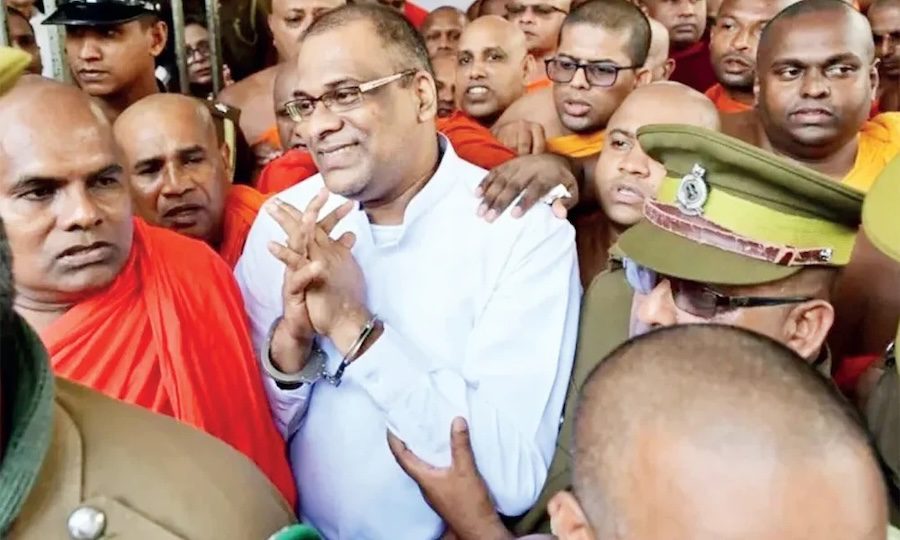
By Nihal Jayawickrama –

Dr Nihal Jayawickrama
In a judgment delivered recently, a three-judge bench of the Supreme Court headed by Justice Janak de Silva, declared that the pardon granted to Ven. Galagoda Atte Gnanasara Thera on 25 March 2019 by former President Maithripala Sirisena was null and void and was of no force or effect in law. The jurisdiction of the Court had been invoked in two fundamental rights applications filed by Dr Paikiasothy Saravanamuttu and Sandhya Ekneligoda. The former President was reported to have apologized to the Maha Sangha for “a technical error in the documentation” relating to the presidential pardon he purported to grant. That technical error, he claimed, was “the failure to obtain the required approval from the Ministry of Justice”. He explained that “as a result, only my signature was obtained without the approval of the Justice Ministry. That was a failure on my part”. He asserted that the Supreme Court had quashed the presidential pardon and committed the priest back into prison owing to that omission. President Sirisena has, either deliberately, inadvertently, or in ignorance, totally misinterpreted the judgment of the Supreme Court.
The constitutional requirement to seek the advice of the Minister of Justice, and examine reports from the trial judge and the Attorney-General, arises only in the case of a prisoner who had been sentenced to death by a competent court. It is on a consideration of those documents that the President is required to determine whether to let the law take its course or to commute the sentence of death to one of life imprisonment. That procedural requirement did not exist in the case of Gnanasara Thero. Therefore, President Sirisena’s excuse of a “technical error” has no basis in law or fact.
Magistrate’s Court of Homagama
On 26 January 2016, the suspects in the case relating to the disappearance of journalist Prageeth Ekneligoda were produced in the Magistrate’s Court of Homagama. During the proceedings, Gnanasara Thero, who was not a party to the proceedings or a witness, had entered the courtroom and (i) obstructed the proceedings by beginning to address the Magistrate; (ii) declared that he would not accept the orders of the Magistrate; (iii) ordered the Magistrate to grant bail to the suspects; and (iv) described the Senior State Counsel who was appearing for the prosecution as “an impotent state officer”. This violent display of verbal threats or open defiance directed at the Magistrate constituted contempt of court.
Court of Appeal
In March 2016, in proceedings instituted in the Court of Appeal under Article 105 of the Constitution, upon a reference by the Magistrate, Gnanasara Thero was convicted on all four counts of contempt. He was sentenced to serve four years of imprisonment in respect of (i) and (ii); six years in respect of (iii), and five years in respect of (iv), the sentences to run concurrently.
The Pardon
On 23 May 2019, President Sirisena granted a pardon to Gnanasara Thera, who was thereupon released from prison. Shortly thereafter, the Centre for Policy Alternatives and Dr. Paikiasothy Saravanamuttu, and Mrs Sandhya Ekneligoda, filed applications in the Supreme Court under Articles 17 and 126, asserting the grant of pardon to be an infringement of their fundamental right to equality and the equal protection of the law. It was six years later, in August 2005, that the two applications were listed for hearing before a Bench of the Supreme Court comprising Justices Janak de Silva, Sobhitha Rajakaruna and Sampath Abayakoon.
Supreme Court
According to the documentary trail placed before the Supreme Court, it appeared that a pardon had been requested by the Mahanayake Theros of the Malwatte, Asgiriya and Kotte Chapters of the Siyam Nikaya, as well as by the Diyawadana Nilame. There was also a letter bearing several names requesting President Sirisena not to grant a pardon. While President Sirisena had been made aware of these requests from time to time, the pardon was eventually granted by him on the basis of a minute submitted to him by the Additional Secretary (Legal) in the Presidential Secretariat, Lakshmi Jayawickrema.
That minute did not disclose any reason why the President should consider granting a pardon. Nevertheless, he approved the granting of a pardon. No reasons for the grant of the pardon were recorded by the President. As the Supreme Court noted, “it is apparent that the President, by simply approving the recommendation of the Additional Secretary (Legal), acted mechanically and abdicated the exercise of the power and responsibilities vested in him”. Accordingly, the Court held that the pardon granted to Gnanasara Thero was “arbitrary, in violation of the public trust and the rules of natural justice, ultra vires the powers of the President, and was an infringement of the fundamental rights guaranteed by Article 12(1) of the Constitution. It had no force or effect in law.
In his judgment, Justice Janak de Silva noted that under the Constitution,
“the President exercises the executive power of the People. As the repository of that executive power, the President holds such power in trust for and on behalf of the People. It follows that the exercise of such power must be directed towards the public interest and cannot be permitted to be exercised for any personal, political or other self-serving interest. . . A pardon is not a private act of grace exercised for the benefit of the President . . . It is an exercise of a constitutional power derived from the sovereignty of the People and must, therefore, be directed to an end which is consistent with the public interest.”
The Court held that the President is under a duty to make a contemporaneous record of the reasons for the grant of a pardon, and to make such reasons available to any aggrieved party when requested, and to the Court when the decision is impugned. In this case, the former President had failed to state in his affidavit the reasons for the grant of the pardon. He had merely stated that the grant of pardon was preceded by requests from several distinguished members of the Buddhist clergy and other religious denominations, and by representatives of civil society.
Justice Janak de Silva cited with approval the following observations made by the late Justice Atukorale to explain the nature of the offence of contempt committed in a Magistrate’s Court:
“A Magistrate’s Court is one of the institutions created and established for the administration of justice in this country. For this purpose, a Magistrate is entrusted with the performance of important judicial functions and duties. In the course of the performance of such functions and duties he is called upon to make various decisions and orders. There is no decision or order he can make which cannot be challenged. But the challenge must be by an appropriate application or proceeding made to this court in accordance with law. It cannot be challenged by a violent display of verbal threats or open defiance directed at the Magistrate himself.
Of all contempts committed against the lawful authority of courts of law the most heinous are those which involve actual or threatened injury to the person of a judge with a view to intimidating him into revoking or altering an order or decision made by him in the discharge of his judicial duties. The outrageous nature of the acts committed by the respondent constitutes not only an affront to the dignity and authority of the court but also a direct challenge to the fundamental supremacy of the law itself. It is a type of contemptuous conduct which appeared to us to be unprecedented in the annals of the courts of this country. . . .Viewed in this light the circumstances of this case call for very deterrent punishment on the respondent.”
SJ / October 24, 2026
Thank you for the legal clarity in a matter that is being muddied for cheap political gain.
/
Sri Lankan Boy / October 24, 2026
Having read Dr Jayawickrama’s article this will be my decision if I were the President:
Decision on the Request for a Presidential Pardon for Ven. Galagoda Atte Gnanasara Thera
Having considered the representations requesting the exercise of presidential clemency under Article 34 of the Constitution, I have decided not to grant a pardon at this stage.
In reaching this decision, I have given particular consideration to the nature and seriousness of the offence for which the prisoner was convicted, the importance of protecting judicial independence, the constitutional guarantee of equality before the law, and the public interest in maintaining confidence in the administration of justice.
The conviction arose from conduct that directly interfered with proceedings before a court of law. Such conduct strikes at the independence and authority of the judiciary, which the executive has a constitutional responsibility to respect.
I acknowledge the representations made by members of the Maha Sangha and recognise the importance of treating all religious persons with dignity. However, religious standing, public prominence or representations from influential individuals cannot, without further compelling justification, constitute sufficient grounds for exceptional executive clemency. (contd)
/
Sri Lankan Boy / October 24, 2026
(Continuation from previous entry) I have also considered the recent judgment of the Supreme Court declaring the previous presidential pardon invalid. While that judgment does not preclude the lawful exercise of presidential clemency in the future, I am not satisfied that sufficient grounds have presently been established to justify such intervention in the public interest.
Accordingly, I have decided that the lawful sentence should take its course, subject to any relief available through ordinary legal procedures.
This decision does not prevent the consideration of a future application based on materially changed circumstances, including credible evidence of rehabilitation, genuine remorse, serious humanitarian considerations or other objectively verifiable grounds.
The question of appropriate clothing and treatment of imprisoned Buddhist monks shall be addressed separately, in consultation with the relevant religious and statutory authorities, without compromising equality before the law.
This decision is made independently, in the exercise of the constitutional responsibility entrusted to the President, and in the public interest.
/
Ajith / October 24, 2026
“it is a type of contemptuous conduct which appeared to us to be unprecedented in the annals of the courts of this country. . . .Viewed in this light the circumstances of this case call for very deterrent punishment on the respondent.”
Where are we in the past 78 years to find the truth?who are the victims of past 78 years? Why the judiciary failed for past 78 years? Why the so called constitutions of 1972 and 1978 and 22 amendments failed? Will it continue or come to an end?
/
Jit / October 25, 2026
If nobody is above the law, as AKD repeatedly claims, why does the Constitution still allow the President to pardon anyone? If he genuinely believes in equality before the law, why not push to abolish the presidential pardon provision altogether?
The so-called pardon process has become something of a farce. On at least two occasions, the Supreme Court has reversed presidential pardons, exposing the weaknesses and contradictions within the system. If the clause were removed entirely, these public charades by rogues and constitutional games by corrupt politicians and lawyers would come to an end, saving taxpayers from footing the bill for yet another round of political theatrics!
No pardon should be permitted to nullify or bypass a Supreme Court ruling. End of story!
/
Ajith / October 25, 2026
“If nobody is above the law, as AKD repeatedly claims, why does the Constitution still allow the President to pardon anyone? If he genuinely believes in equality before the law, why not push to abolish the presidential pardon provision altogether?”
This is a good question. It is true that AKD should remove all that violated equality terms specially special status to Buddhism and the government to protect the Buddhism and so many other amendments made by the previous governments should not be their in the constitutuion. Still the law is not equal to all in the North East Sri Lanka. AKD can do it with his two third majority in parliament.
I don’t know what is his real agenda. It is better to get rid of the past governments. But if it will continue with the protection of special status Buddhism they again fall under the same past group.
/
CChampa / October 25, 2026
Ajit
Are you suggesting that Sinhalese Buddhists should be subjected to religious discrimination and suppression in their own country where Buddhism originated? Huh!!!
/
Ajith / October 26, 2026
“Are you suggesting that Sinhalese Buddhists should be subjected to religious discrimination and suppression in their own country where Buddhism originated? Huh!!!”
Which is the country where Buddhism originated? I never heard that Buddhism is originated in this country. Don’t you think that the Sinhala Buddhism is not the same as Buddhism! What practiced in this country definitely not Buddhism. That is called Ghost Sinhala Bloodism. I am not saying it. It is told by Buddhist Sinhala people of this country. They say you made them bankrupt!
/
Douglas / October 25, 2026
According to the information, this ‘Pardon’ has been requested from the President by (1) Mahanayaka Teros of Malwantta and Asgiriya and the Kotte Chapter of Siyam Nikaya. (2) The Diyawadana Nilame of Dalada Maligawa.
What reasons did they give for requesting a pardon? If, at least, he (President) had minuted those reasons in the file, the court would not have observed that the President had not given his reasons. Having failed in his official duties, he now names and blames an official. That is laughable and cynical.
Were the applicants for pardon so irresponsible and illogical as to make such a request, without considering the repercussions it would have in all future cases of ‘Contempt’ of courts?
Aren’t they giving cover for any religious priests to walk into a court and shout at the magistrates
and lawyers and demand that the accused be given bail? These ‘Mahanayakas’ and all other
‘Dignatories’ (Diyawadane Nilema) must know their limits.
/
nimal fernando / October 25, 2026
There is nothing wrong with the law or the interpretation of the law by the judiciary – with the exception of few lowlifes like Sarath N Silva …….. in the main has been exemplary.
–
What’s wrong is the two-faced nature of people in power/leaders and two-faced sliminess of their supporters ………. then and now ……. 4:10 …….. https://www.youtube.com/watch?v=tXRfRFwMwAs
–
Lanka will come good when ……. people have principles and stand by them: come what may. ………. And when people develop intelligence and the backbones/balls to recognise and acknowledge them. ………. Wishy-washy sissy effeminate pansies who approve all what their favourite leaders/pols do, won’t do.
–
–
Lawyers are the worst unprincipled scum on earth ……… this scum is trying to turn it into an attack against Buddhism ……. 6:15 ……… https://www.youtube.com/watch?v=KSQ84WKeP3U
/
Jack / October 25, 2026
Besides the point of law explained, Punishment given by the Sri Lankan courts of law for contempt of court is very much excessive. If the contempt is only verbal abuse the limit of imprisonment should be restricted to maximum of six months jail or suspended sentence or fine. I think it is duty of the parliament to put limit of punishment of duration otherwise punishment becomes arbitrary of wishes of the judges. If contempt include physical violence higher punishment should apply.
There was gross injustice to Ranjan Ramanyaka for being critical of judicial system due to current contempt law. He was imprisoned for 3 years and he was pardoned by Ranil. All these things are not necessary if due amendments were incorporated into contempt law. All these Gnanasara saga is due to deficiency of law. Buddhist priest should fight for altering contempt law not just asking to release the priest as he was found guilty of contempt of law.
After all judges are human and they can go berserk if limits are not placed.
/
nimal fernando / October 25, 2026
Does anyone still remember the great uproar/furore about the 22nd amendment in the distant last century? Or am I the only one old enough to remember? ….. The others are all newborn?
–
Now, 22nd all hunky dory? No destruction of Lanka?
–
–
What would Lanka be ……… if there were no Lankans?
/
CChampa / October 25, 2026
I am a farmer, not a lawyer. Therefore, could Dr. Nihal Jayawickrama, who is an expert in Constitutional Law, please clarify the following:
1. Which has the supreme authority in Sri Lanka, the codified Constitution or the Supreme Court?
The farmer believes the Supreme Court is secondary to the codified Constitution.
.
2. The farmer believes the Supreme Court’s ruling revoking Venerable Galagodaaththe Gnanasara Thero’s Presidential pardon is a violation of the Article 34(1) of Sri Lanka’s Constitution and an unlawful act of exceeding Court’s powers to “create new conditions” for granting Presidential pardons which are not stated in the Constitution.
1/3
/
CChampa / October 25, 2026
(Continuation)
This is what Article on Presidential pardons says:
“Under Article 34(1) of the Constitution of the Democratic Socialist Republic of Sri Lanka, the President holds the power of pardon and clemency for ANY person convicted of an offense by ANY court within the Republic.”
.
a. Does Article 34(1) say the President should follow an administrative procedure? NO!
.
b. Does it say the President should give reasons in writing in order to exercise powers vested in him under Article 34(1) ? NO!
.
c. Does Article 34(1) say the Sri Lanka President is NOT permitted to exercise any personal, political or other self-serving interest in granting Presidential pardons or the pardons should not be a private act of grace? ABSOLUTELY NO! Why? Because the President is the ultimate power who can correct errors, biases and injustices committed by the Judiciary and also humanize the law as and when he deems it necessary.
2/3
/
CChampa / October 25, 2026
(Continuation)
The administrative requirements for Presidential pardons mentioned in the Supreme Court’s ruling as reasons for revoking the Presidential pardon accorded to Venerable Gnanasara Thero are NOT explicitly, or even implicitly, stated in the Constitution. Where did all this come from? Isn’t the Supreme Court’s ruling a fraudulent alteration of the Article 34(1) of the Constitution with the sole motive to re-imprison the Thero?
As obvious from the excerpts of the ruling mentioned in Dr Nihal Jayawickrama’s article, the Supreme Court has taken pains to describe the nature of contempt of court and why it matters (to them) which is irrelevant. The case is about the legality of the Presidential Pardon granted to Venerable Gnanasara Thero for which the Supreme Court has failed to rationalise their decision. However, the judges have amply proved that the case was personal to them and their self-serving ego.
.
The codified Constitution is all about words. That is why it was written, so there is no confusion. Article 34(1) has granted broad powers to the President where he can pardon anyone convicted by any court including the Supreme Court, or even pardoning himself, as it does not explicitly ban self-pardon either.
3/3
/
Naman / October 26, 2026
” .Viewed in this light the circumstances of this case call for very deterrent punishment on the respondent.”
What could be the very deterrent punishment other than derobing of his monk’s clothing.
He is one of those who aren’t entitled to wear the yellow robes.
/
CChampa / October 27, 2026
This article was buried for 2 days and now surfaced again.
I have more questions as to why the Supreme Court’s ruling targeting Venerable Gnanasara Thero does not apply to the following Presidential pardons:
.
1. President Anura Kumara released 49 prisoners on a “Special Presidential Pardon” on Independence Day on February 4, 2026, 57 prisoners on Christmas Holiday in December 25, 2024 and 11 on Independence Holiday on February 4, 2025 WITHOUT GIVING ANY REASON AND WITHOUT STANDARD AUTHORIZATION.
.
2. Former President Ranil Wickremasinghe pardoned 8 Tamil terrorists in October 2022 WITHOUT GIVING ANY REASON.
.
3. Former President Gotabaya Rajapaksa pardoned 16 Tamil terrorists and death-row convicts on Poson Poyaday in June 2021 WITHOUT GIVING ANY REASON.
.
For the first time in Sri Lanka’s history, the country is dealing with an internationally condemned Judiciary which also lost public trust after it heard its own case disregarding local and international objections and then at a record speed they approved 22nd Amendment to the Constitution that gave a 2-year service extension to the Chief Justice and other selective judges, a ruling specifically benefitted the Chief Justice who was otherwise scheduled to retire at the end of 2026.
/