

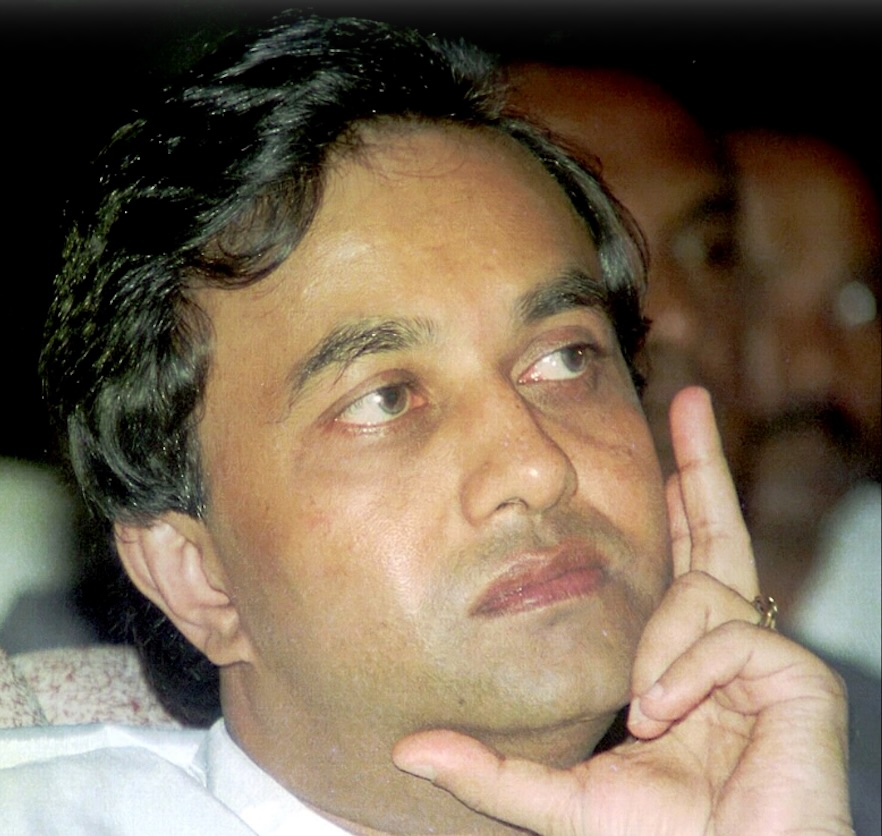
By Palitha Pelpola –

Palitha Pelpola
“We had the experience but missed the meaning.” ~ T. S. Eliot
There are farewells that announce themselves with ceremony, with embraces prolonged by the knowledge that another meeting may never take place. And there are farewells so ordinary, so casual, so utterly innocent of the tragedy awaiting them, that their significance becomes apparent only when it is too late. On the night of October 23, 1994, I said goodbye to Gamini Dissanayake with a few words that have remained imprisoned in my memory for thirty-two years.
“See you at breakfast”
There was nothing unusual about them. They belonged to the familiar vocabulary of our long association, to the countless meetings, journeys, discussions and political engagements that had filled so much of our lives.
But there was to be no breakfast.
Before another morning could properly announce itself, Gamini Dissanayake was dead.
And something within me, something that had been shaped and sustained by nearly two decades of professional companionship, loyalty and shared endeavor, died with him.
Gamini Dissanayake
The Man Behind the Public Figure
It is easy, after thirty-two years, to write about Gamini the politician, Gamini the Cabinet Minister, Gamini the architect of the accelerated Mahaweli Development Program, Gamini the presidential candidate whose life was extinguished at fifty-two.
His achievements are recorded in the history of our country.
But the Gamini I remember most vividly is not the man standing before an applauding multitude.
It is the man seated across a desk, absorbed in a problem; the man impatient with mediocrity, fascinated by new ideas and unwilling to accept that something was impossible merely because an official said it had never been attempted before.
I first entered his service in 1977 as his Private Secretary.
I was young enough to be impressed by political authority, yet sufficiently independent in temperament to appreciate that authority without intellectual substance was an empty possession.
Gamini possessed both.
He was extraordinarily demanding. He expected those around him to think, to anticipate, to question and, above all, to deliver.
He could be impatient. His standards were exacting. His confidence occasionally bordered on audacity.
But he possessed that rare quality among political leaders: the ability to make those who worked with him feel that they were participating in something considerably larger than the advancement of one man’s career.
He demanded much because he believed much was possible.
And, gradually, those of us who worked beside him began believing it too.
Mahaweli: When Ambition Became Achievement
The accelerated Mahaweli Development Program remains among the most enduring monuments to Gamini’s public life.
To describe it merely as an irrigation and hydroelectric undertaking would be to diminish its extraordinary scope.
It involved the construction of massive reservoirs, the transformation of agricultural landscapes, the settlement of thousands of families and the creation of new communities in regions whose possibilities had long remained unrealized.
Victoria, Kotmale, Randenigala, Maduru Oya—these were not simply names on engineering drawings.
They represented the physical expression of an ambitious national vision.
I had the privilege of working within that immense enterprise, first in the ministerial establishment and subsequently in the Mahaweli institutions responsible for its implementation.
I remember the journeys into the developing systems, the endless discussions, the urgency of deadlines and the remarkable commitment of engineers, administrators, agricultural specialists and field officers.
There were disagreements, frustrations and inevitable failures.
But there was also an unmistakable sense of purpose.
Gamini understood that development could not be accomplished through ministerial speeches alone.
It required organization, professional competence, administrative courage and the relentless pursuit of results.
For those of us privileged to participate, Mahaweli was more than employment.
It was an education in the possibilities of public service.
And Gamini was among its most demanding teachers.
Beyond Politics, Beyond Office
Our association survived the changing fortunes of Sri Lankan politics.
There were years of authority and influence, followed by years of political uncertainty, disappointment and struggle.
I saw Gamini in moments of triumph.
I also saw him when political friendships became uncertain, when loyalties shifted and when the ruthless calculations of political survival displaced the ideals publicly proclaimed.
Such experiences can diminish a man.
They can also reveal his character.
Gamini was not without faults. No serious tribute should pretend otherwise.
He possessed ambition, pride and the unmistakable self-confidence of a man who believed himself capable of leading his country.
But his ambition was accompanied by an intellectual curiosity and administrative capacity that distinguished him from many who sought similar authority.
He was capable of imagining a future larger than the political quarrels of the moment.
I have often wondered what Sri Lanka might have become had he been permitted to complete his political journey.
That question has no answer.
History does not accommodate the consolations of those who survive.
It records what happened, not what might have been.
The Last Campaign
October 1994 remains etched in my memory with a clarity that time has neither softened nor diminished.
Gamini was the United National Party’s presidential candidate.
The campaign was demanding, exhausting and intensely competitive.
On that final day, our journey took us through Yapahuwa, Panduwasnuwara, Bingiriya and Mawathagama before returning to Colombo by helicopter.
There was still one engagement awaiting him.
A political meeting at Thotalanga, in Colombo North.
The arrangements had not been without complications. There had been discussions about changing the program. I had insisted that the meeting should proceed, undertaking to ensure that the platform, publicity, sound system and other arrangements were attended to.
Even now, after thirty-two years, I sometimes revisit those decisions.
Not because I believe that history can be reversed by reconsidering an ordinary administrative judgment.
But because grief has a cruel habit of returning us to the smallest details of the day on which our lives were permanently altered.
It had rained.
The evening had become unusually long.
Gamini arrived at the meeting after a demanding day’s campaigning. As the night progressed, I left to attend to other engagements, never imagining that the routine parting would become our last.
“See you at breakfast.”
How carelessly we speak of tomorrow.
How confidently we assume that those who have always been there will continue to be there.
The Morning That Never Came
The assassination at Thotalanga destroyed far more than the presidential ambitions of one political leader.
It took the lives of many others, devastated families and inflicted another terrible wound upon a country already brutalized by political violence.
Among those killed were men and women whose own stories, sacrifices and unfinished lives deserve remembrance.
Their deaths must never become footnotes to the death of a more prominent victim.
Yet for me, the loss of Gamini was profoundly personal.
It was the disappearance of a familiar voice, an accustomed presence, a mind whose restless energy had influenced so much of my professional life.
There would be no further telephone calls. No urgent instructions. No arguments about administrative priorities. No unexpected journeys. No conversations about the political future.
And no breakfast.
Death possesses a terrible finality. It does not negotiate. It does not explain. It offers no opportunity to correct an unfortunate word, complete an unfinished conversation or say what affection and familiarity have persuaded us can safely be left unsaid.
One discovers, too late, that the ordinary moments were never ordinary at all.
Thirty-Two Years Later
Much has happened in Sri Lanka since that October morning.
Governments have risen and fallen. Presidents have come and gone. Political movements once considered marginal have reached the highest offices of the state.
The country has endured war, economic catastrophe, public upheaval and repeated disappointments.
I have watched these transformations from different places and through different circumstances, carrying with me the memories of an earlier political generation.
My own understanding of politics has changed over the years.
Some convictions have deepened. Others have yielded to experience, reflection and the uncomfortable discoveries that accompany age.
But my appreciation of Gamini’s contribution to my life has remained undiminished.
He gave me opportunities that shaped my career. He exposed me to responsibilities I might otherwise never have encountered. He taught me that public administration could be an instrument of extraordinary national achievement when directed by imagination, competence and determination.
More importantly, he became part of the story of my own life.
That is a relationship no political disagreement, historical reassessment or passage of time can erase.
The Unfinished Conversation
Thirty-two years is a long time. Long enough for children to become parents, for political certainties to collapse, for entire generations to inherit a country different from the one their elders imagined. Yet grief does not always obey the calendar.
Sometimes a memory returns with such sudden force that the intervening decades seem to disappear. A familiar road. A remembered conversation. A photograph. The mention of a name. And suddenly one is back in October 1994. Back among the hurried arrangements of an election campaign.
Back beside a man whose life seemed filled with unfinished possibilities.
Back at that final parting.
I do not wish to remember Gamini merely as a political figure cut down before reaching the presidency. That would make the office he never occupied more important than the life he actually lived.
I remember him instead as a man who dared to imagine great things, who translated many of those imaginings into tangible achievements and who left an enduring imprint upon the lives of those who worked with him.
There is a particular sadness in growing older than someone who, in one’s memory, remains forever young.
Gamini will always be fifty-two.
Those of us who survived have continued along the uncertain road of life, accumulating years, experiences, disappointments and occasional moments of happiness that he was never permitted to know.
And sometimes, in the quiet solitude of reflection, the mind returns to a question that can never be answered.
What might we have discussed at that breakfast? Perhaps the campaign. Perhaps the next day’s program. Perhaps some administrative detail of no lasting importance. Perhaps nothing memorable at all.
But how dearly I would now treasure even that most ordinary conversation.
Thirty-two years have passed, Gamini. The breakfast never came.
But the memory of the man I expected to meet that morning has never left me.
*The writer can be contacted at palithapelpola@gmail.com
Douglas / October 24, 2026
That memory of my visit to the section of the Jaffna Library, which has been preserved after the ‘Big Fire (well planned and ignited), and the statue of the Christian Priest who suffered a heart attack and died on hearing of the ‘Fire’ will never leave me.
Mr. Palitha Pelpola: Isn’t the above incident in your memory, or is it a ‘Lost Memory’?
Perhaps, lost memory. That is why you are still waiting for breakfast.
/
old codger / October 24, 2026
I don’t know, but can anyone tell me why Mr. Pelpola writes so eerily like Vishwamitra?
/
The Truth / October 24, 2026
Was this Gamini guy a Hercules ?
Looking at that pathetic country and its pathetic people cannot imaging a Hercules there !
May be a Hercules in earning commissions.
What a puny guy this author Pelpola must be to see things in the way he describes.
Why are Sri Lankans born like this ?
/
Nathan / October 24, 2026
I don’t go past, By Palitha Pelpola.
/
SJ / October 24, 2026
Did not the Mahaweli project bring more net economic benefit to an individual than it did to the country?
/
Jit / October 24, 2026
Palitha, you being a follower of Gamini for the benefits you have mentioned is understandable. I remember people worshiping him and Lalith too – just like you do, for reasons propagated by the UNP dominant media at that time. But after four decades, so many things have been exposed and I dont think the media can fool people to that extent anymore. Better you’d give some thoughts about that aspect before you pen your next glorification story on any politician.
/
Balanced View / October 25, 2026
Dear PP, Did you accompany GD to Jaffna in May 1981 as his private secretary to carry out the plan? Did that memory burnt into millions of people fade away from yours or do you reflect on that, too? Did your conviction deepen or yield to experience, reflection and the uncomfortable discoveries that accompany age? You don’t owe me an answer. You owe one to your conscience.
/
Ocean11 / October 25, 2026
He got what he deserved.
/
SJ / October 26, 2026
“He got what he deserved.”
Like what A Amirthalingam, Rajeev Gandhi and, as some would have it, Mahatma Gandhi did?
Says something about you.
/
Pundit / October 26, 2026
Every once in a while, the writer crawls out of the woodwork to glorify his dearly departed boss. The man clearly had a talent to cut a deal for himself, but it is his vile act in Jaffna that will pull at the heart strings of fair-minded Sri Lankans for years to come.
PP is clearly a man without a conscience or shame, or both.
/