


Dr. Murali Vallipuranathan
The year 2026 marks an unquestionable milestone for public health infrastructure in Sri Lanka: the 100th anniversary of the pioneer Health Unit established in Kalutara in 1926—what is known today as the National Institute of Health Sciences (NIHS). It is entirely fitting and historically precise for the NIHS to celebrate its centenary this year.
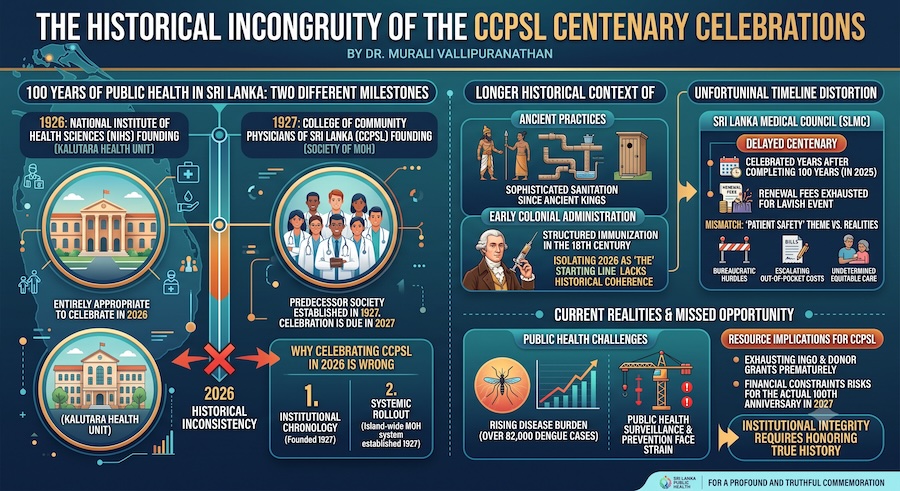
However, the decision by the College of Community Physicians of Sri Lanka (CCPSL) to conflate this milestone with its own centenary celebrations in 2026 presents a fundamental historical inconsistency for two key reasons:
1. Institutional Chronology: The predecessor of the CCPSL—the Society of Medical Officers of Health (MOH)—was formally established in 1927. Therefore, an institutional centenary for the College and its founding body is legitimately due only in 2027.
2. Systemic Rollout: While the Kalutara project was a localized pilot initiative launched in 1926, the island-wide expansion of the Medical Officer of Health (MOH) system was formally instituted in 1927. It was this broader, nationwide deployment of MOH officers that directly prompted the creation of the Society of MOH in 1927.
Furthermore, attempting to frame 2026 as the “centenary of public health in Sri Lanka” misrepresents our longer historical narrative. Archaeo-historical evidence demonstrates that sophisticated public health and sanitation practices—including complex drainage, urinals, and latrines—have existed on the island since the reign of ancient Sri Lankan monarchs. Similarly, structured immunization programs date back to the 18th century under early colonial administration. By any of these foundational markers, isolating 2026 as the starting line for public health lacks historical coherence.
Regrettably, this is not an isolated instance of institutional timeline distortion within Sri Lanka’s medical sector. We previously witnessed a similar anomaly with the Sri Lanka Medical Council (SLMC), which hosted delayed centenary observances years after completing 100 years. Compounding this, those celebrations were funded by depleting the renewal fees collected from its doctor members, all under the high-sounding banner of “Patient Safety and Quality Health Care for All.” That theme stood in stark contrast to grassroots realities, where impoverished patients are often burdened with bureaucratic hurdles when filing grievances, and escalating out-of-pocket medical expenses continuously undermine the promise of equitable, quality care.
A similar disconnect is apparent today. At a moment when public health surveillance and preventive strategies face severe operational strain—as reflected by rising disease burdens, including over 82,000 recorded dengue cases—the CCPSL has chosen to organize lavish centenary festivities in the wrong calendar year.
Beyond the issue of historical accuracy, this premature celebration carries significant resource implications. By exhausting international non-governmental organization (INGO) grants and donor support on premature festivities this year, the College risks leaving itself financially constrained in 2027, when the actual 100th anniversary of the founding of the Society of MOH arrives. Institutional integrity requires that we honor history as it actually unfolded, rather than rewriting timelines for immediate convenience.
*Dr. Murali Vallipuranathan is a visiting lecturer at the Universities of Jaffna, Peradeniya, and Colombo, a Senior Specialist attached to the Ministry of Health, and a Council Member of the Sri Lanka Medical Association. The views expressed in this article are offered in a spirit of professional and social responsibility to advance bioethical standards and institutional accountability, and do not necessarily reflect the official positions of any affiliated institution.
old codger / August 1, 2026
What a let-down! I thought this was about the anniversary of the Chinese Communist Party branch in SL.
Well, one can’t have everything.
/