

By Mohamed Harees –

Lukman Harees
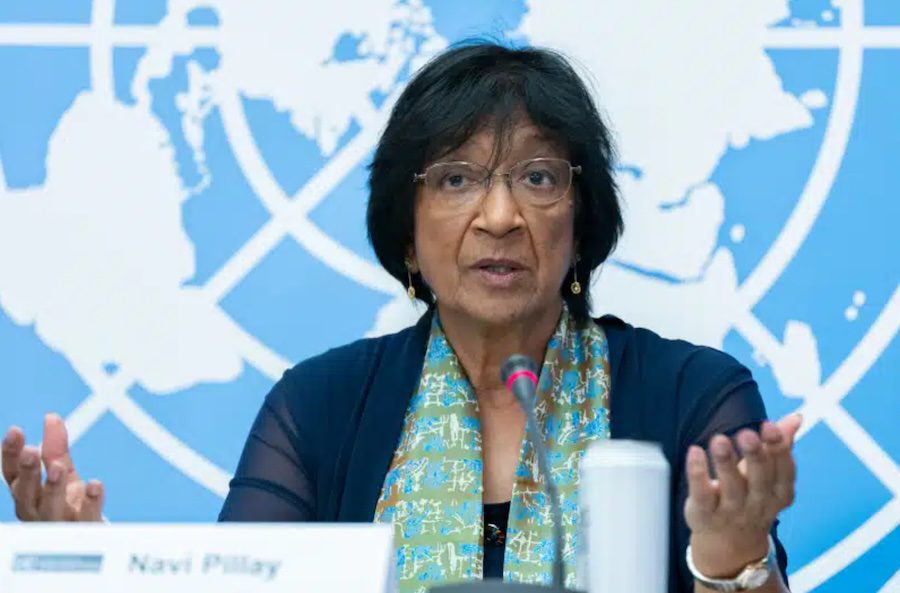
The 2026 Nobel Peace Prize awarded to Navi Pillay has exposed a central contradiction in contemporary international politics. A jurist of Indian Tamil origin from South Africa has been honoured for strengthening international law, while the state and political movement most implicated by the UN inquiry she chaired have sought to recast that recognition as proof of anti-Israel prejudice. The contest is not simply about Pillay. It is about whether the world’s most serious allegations of atrocity can be met with evidence and accountability—or whether they can be made to disappear behind accusations of hatred.
Pillay’s award is a rebuke to the effort to turn Gaza’s devastation into a question too dangerous to name. The UN commission she chaired concluded that Israel had committed genocidal acts in Gaza, with the specific intent to destroy Palestinians in Gaza, and that senior Israeli leaders had incited genocide, findings of which Israel continues to reject. But its response to Pillay’s Nobel has been less an engagement with the commission’s evidence than an attempt to make the very act of investigating Israel politically suspect.
That is why the prize matters. It does not end the war, feed Gaza, or compel compliance with international law. But it refuses the political strategy that seeks to reduce every allegation of Israeli wrongdoing to antisemitism, every UN finding to bias, and every demand for accountability to hostility toward Jewish life. The award puts the focus back where it belongs: on the facts, the law and the human consequences.
A career built against impunity
Pillay was born in Durban in 1941 to an Indian Tamil family. Her life was shaped by apartheid, and her early legal work defending anti-apartheid activists taught her that law can be both an instrument of oppression and a means of resistance. After apartheid, she became the first Black woman appointed to South Africa’s High Court, then served as a judge at the International Criminal Tribunal for Rwanda (ICTR ) and later at the International Criminal Court.
Her work at the ICTR helped change international criminal law. In the Akayesu case, the tribunal recognised that rape and sexual violence could constitute genocide when committed with the intent to destroy a protected group. That judgment did not erase the legal requirement of intent, but it made clear that sexual violence could be part of a deliberate campaign of group destruction rather than a secondary or incidental harm.
That history is important because it explains why Pillay’s work on Gaza cannot be dismissed as the reflex of a political activist. Her career has been built on the difficult, often unpopular task of applying international law to organised violence. The Nobel Committee recognised precisely that: a lifelong commitment to human rights, international justice and accountability for war crimes, crimes against humanity and genocide.
Gaza: the finding Israel wants buried
The UN Independent International Commission of Inquiry, chaired by Pillay from 2021 to 2025, issued a 72-page report in September 2025 concluding that Israel had committed genocide against Palestinians in Gaza. It found that four of the five acts prohibited by the Genocide Convention had occurred: killing members of the group; causing serious bodily or mental harm; deliberately inflicting conditions of life calculated to bring about physical destruction in whole or in part; and imposing measures intended to prevent births.
The Commission did not reach its conclusion by treating every death or act of destruction as genocide. It examined the pattern of Israeli conduct, the scale of harm, the restrictions imposed on humanitarian aid, the destruction of healthcare and civilian infrastructure, and statements by senior Israeli officials. It concluded that the totality of the evidence supported only one reasonable inference: that Israeli authorities acted with the specific intent to destroy Palestinians in Gaza, in whole or in part.
The commission also found that President Isaac Herzog, Prime Minister Netanyahu and former Defence Minister Yoav Gallant had incited genocide. It said Netanyahu bore ultimate responsibility for Israel’s conduct across the occupied Palestinian territory and was directly responsible for ordering acts that constituted war crimes, crimes against humanity and genocide.
These findings are not a final judicial verdict. The Commission is an investigative body, not a criminal court. Israel has rejected its report, calling it false and politically motivated. But rejecting a finding is not the same as refuting it. The proper response to a grave legal allegation is evidence, argument, and independent adjudication—not delegitimising the investigators.
The Zionist movement’s counter-strategy
Israel’s response to Pillay’s Nobel has followed a familiar pattern: shift the issue from conduct to character; from evidence to motive; from accountability to identity. Netanyahu’s office said the committee had “lost its moral compass” and accused Pillay of prejudice against Jews. Israel’s Foreign Ministry called the award a “grotesque weaponization” of the prize, alleged that it legitimised anti-Israel hatred, and compared Pillay’s work to Nazi propaganda.
This language is designed to do more than rebut a report. It seeks to make the accusation of genocide unspeakable. If a UN commission’s conclusion can be labelled a “blood libel,” if a South African jurist with decades of experience in international criminal law can be branded a bigot, and if the Nobel Committee can be accused of legitimising hatred for honouring her, then the practical result is to make scrutiny itself appear illegitimate.
That is the political function of the response. It converts a legal question—whether Israel’s conduct meets the elements of genocide—into a moral and identity-based confrontation. It asks audiences to choose between solidarity with Israel and solidarity with human rights, as though the two were incompatible. It also risks weaponising the real history and reality of antisemitism to shield state conduct from scrutiny. Anti-Jewish hatred must be confronted wherever it appears. But criticism of a government’s war policies, or a demand that allegations of atrocity be investigated, is not inherently antisemitic.
The Zionist movement’s effort to frame the Nobel award as an attack on Jews therefore serves a wider purpose: to delegitimise the international institutions that might otherwise pursue accountability. If the UN commission is dismissed as a Hamas proxy, if the Nobel Committee is accused of moral collapse, and if the ICC is portrayed as politically corrupt, then the architecture of international justice is weakened. That is not a defence of Jewish safety. It is a strategy for avoiding scrutiny.
The Nobel as a battleground
The Nobel Peace Prize has always operated in a political field. It cannot be separated from debates about war, diplomacy, human rights and the legitimacy of international institutions. But this year’s dispute illustrates how a prize can become a battleground precisely because it carries symbolic authority. Israel’s government has called the award a weaponisation of the Nobel; human-rights advocates see it as recognition that international law is under attack and must be defended.
The committee’s decision does not itself determine whether genocide occurred. Its chair said the award did not amount to a position on that legal question. But the committee’s reasoning matters: it honoured Pillay for strengthening the international legal order at a time when that order is under political pressure.
That is why the reaction has been so intense. Pillay’s Nobel does not merely honour an individual. It signals that the world’s most prominent peace prize will not treat accountability as an optional inconvenience. It suggests that demanding evidence, legal reasoning, and the protection of civilians remains legitimate, even when directed at a powerful state with influential allies.
Trump, Machado and the spectacle
Donald Trump’s long campaign for the prize has also shaped the controversy. Last year’s laureate, Venezuelan opposition leader María Corina Machado, presented her Nobel medal to Trump in January. The Nobel Institute clarified that the medal could be given away, but the prize itself could not be revoked, shared or transferred.
Trump’s reaction to Pillay’s award was personal and dismissive. He claimed he should have won, said he deserved multiple prizes for resolving conflicts, and dismissed Pillay as a little-known liberal UN figure. His response turned the award into another instalment in a grievance campaign against institutions that refuse to validate his self-image.
The contrast is revealing. Machado’s medal handover made the Nobel a symbolic gift in a political relationship. Pillay’s award made it a statement about law. One gesture sought to attach the prize’s prestige to a political leader; the other honoured a jurist whose work insists that leaders, too, must answer to law.
What the prize cannot do
A Nobel medal cannot stop bombs, reopen crossings, restore hospitals or bring back the dead. It cannot force Netanyahu to stand trial, compel states to halt arms transfers or ensure that the International Criminal Court can act without obstruction. The prize’s power is symbolic, not coercive.
But symbols matter. They shape what societies are willing to see, name and remember. Pillay’s award challenges the attempt to make Gaza’s suffering a subject too controversial for moral language. It rejects the idea that calling for accountability is hatred. And it insists that the gravest international crimes must be investigated with the same seriousness regardless of who is accused.
The real danger is not that the Nobel Peace Prize has become political. It always has been. The danger is that political pressure will make it impossible to name atrocity without being accused of prejudice. If that happens, the language of human rights becomes hollow: available for some victims, withheld from others, and unusable whenever a powerful state objects.
Pillay’s Nobel is therefore best understood as a refusal. It refuses to let Gaza become a footnote. It refuses to treat allegations of genocide as unspeakable. And it refuses to accept that the demand for justice should be silenced by the charge of antisemitism. The prize does not settle the legal question. It keeps the question alive.