

By PB Jayasumana –
So many skeletons in the cupboard, one is at a loss to know where to start.
Way back in 2005, the World Bank funded several countries including Sri Lanka to automate its government procurement processes knowing that it is a crucial ingredient of being transparent and accountable to the people. In order to do that however, some prerequisites had to be installed: an independent National Procurement Authority (NPA) and legislation which came in the form of the now well-known, NPA Guidelines of 2006 for Sri Lanka.
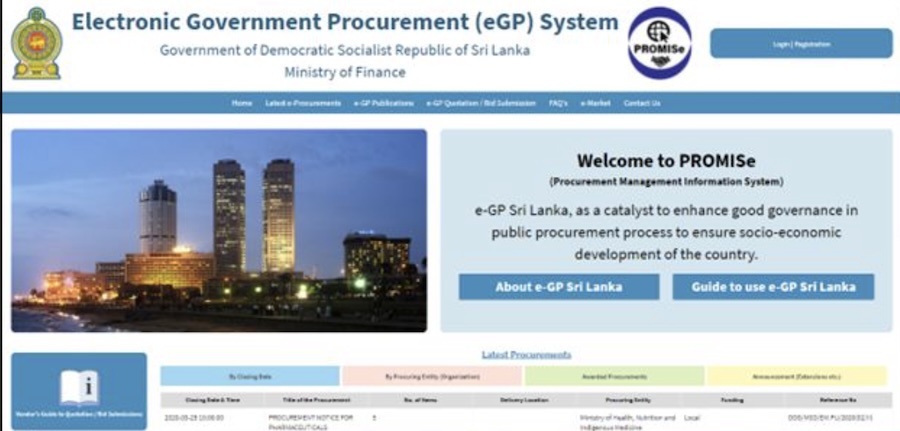
Screenshot
Champions and Villains
A single individual, who then assumed the powerful office of the Secretary to the Treasury (ST) had other ideas, and for reasons best known to him dismantled the whole process and got rid of the NPA, only retaining its guidelines document, which has since been used by all government agencies for procurement.
In 2017, owing to a certain champion within the state system, its Director General of Public Finance, Sri Lanka hosted the Fourth South Asia Regional Public Procurement Conference, where we had to admit with some shame, the truth that we were no closer to achieving transparency in government procurement than we were in 2006! Countries which had begun the process much later, had gone well ahead of Sri Lanka by this time. The aforementioned champion, then reached out to the University of Colombo to help the government to begin the process of automating procurement under a new Cabinet Memorandum in 2018. After initially assisting in drafting the initial documentation for this, a then university affiliated company, now completely independent, was asked by the donor agency, the World Bank, to assist by implementing a prototype of a system based on international best practice as already launched as an open-source software called Prozorro. The World Bank itself, by then had tried two approaches in helping developing countries to implement eGovernment Procurement (eGP) systems: using off-the-shelf solutions based on SAP and Oracle and negotiating to transfer the most successful South Korean eGP system to other countries. Both these having failed, their extensive study of what actually worked in countries made them conclude that only ‘home grown’ systems, with which the country itself ‘grows’ had been successful. A case study of Georgia was then proposed as a possible model for Sri Lanka to follow, where initially just 4 developers put together a software to run the country’s national eGP system!
March towards transparency
Based on this, Sri Lanka began its implementation of an eGP in 2019 and the first version, based on this international best practice, was launched in 2020 to handle procurements in the National Shopping category (at that point with a ceiling or Rs. 20m) – which has the highest traffic in terms of the number of tenders transacted. The only reason for not being able to also launch National and International Competitive Bidding (NCB and ICB), which has much less transactional traffic, was the absence of the necessary legislation!
By this time, the aforementioned process champion was removed from the position by the powerful former ST, who was by now the Secretary to the President! It would be fair to say that this single individual was the reason for the benefits of transparent government procurement was withheld from the people of this country for up to two decades! The eGP process then went into ‘stall mode’ with lots of incompetent officials being put in charge of the new eGP Secretariat set up under the Department of Public Finance of the Ministry of Finance. One such ‘red herring’ was to enlist a ‘procurement specialist’ who evaluated the system, which had by then transacted over 5000 government procurements including some 40 of the National Competitive Bidding category (before they realized that Sri Lanka didn’t have the required legislation for it!). This ‘specialist’ concluded that Sri Lanka’s procurement was ‘different’ and so the eGP Secretariat gave new specifications for what became known as eGP 2.0 spec in 2021. Various processes ensued and after signing various addendums to the original contract, version 2.1 was launched in early 2024 according to these new Sri Lankan specifications. With over 40,000 government procurements transacted, reaching over 800 procurements a week, with government officers involved in procurement working even during weekends (and Poya days) to execute procurements on time in this completely transparent eGP system which can be accessed by the public via promise.lk, the new eGP Secretariat plans to cancel the project this month! This reeks of a textbook case of deception, incompetence and yet, the ability to mislead government. The leadership of the eGP would need to be investigated with at least one of its powerful members being a known deal maker by the IT industry.
Not to distract from the argument, but the ‘service partner’ for implementing and deploying this functional system with an originally contracted value of simply Rs. 70m (later updated to Rs. 130m) has been paid only Rs. 16m for all its efforts. It has persisted up to now, purely because of the clear perceived benefits to the people, especially when the system is provisioned in addition for the large tenders under NCB and ICB.
Sabotaging the march
It seems apparent at this point that the officials of the eGP Secretariat are misleading a government which is committed to transparency and accountability to the people, by making various unfounded and misleading allegations against the software service partner. It is understood that the Secretariat has tried to convince the government that the service partner will only complete the project by 2030, when the system is already running and only awaits the legislation required to run NCB and ICB tenders – something that has been slow in being enacted since 2020 owing to the eGP Secretariat and the Department of Public Finance of the Ministry of Finance.
In addition, contrary to international best practice, the eGP Secretariat has no qualms about hosting Sri Lanka’s procurement information in the public could, even though our Sri Lankan cloud providers are perfectly capable of providing this level of service (which doesn’t require millions of transactions per minute as is the case with eBay or Amazon). Mixing up international best practice in terms of what works on the ground for this specific use case and that of global high throughput platforms, is what even the technical experts at ICTA appear to be doing.
Dealing now, and dealing swiftly
It is ironic that, during Sri Lanka’s fresh start on accountability and transparency, the Finance Ministry, through its Department of Public Finance, and specifically the eGP Secretariat is bent on sending the country back by 2 to 3 years and many millions of dollars by sabotaging the present ‘home grown’ working eGP system, in pursuit of some utopian dream of a perfect system that a more ‘profitable’ service provider may be able to offer!
The present ‘service partner’ is confident that it is only legislation which holds back the Sri Lankan government from launching all procurements – especially the large ones, using the existing system, within 2026, as the technology stack will not change (something that the non-technical staff of the eGP cannot fully fathom).
This is an investigation that the government would be well advised to immediately launch to prevent the country not fully leveraging the results of empowering the people with true government procurement transparency.
Jaffna Man / August 22, 2025
These serious allegations seem to be from a person who seems to know the subject well, and is not hostile to the government — based on the article.
However, the absence of the customary author-photo in the article and the absence of a PB Jayasumana (nor of a P. Jayasumana or B. Jayasumana in a Google search), give me pause. The redeeming feature is that the Editor of Colombo Telegraph, a responsible journalist, would not have waived the usual requirement without good reason.
The author Jayasumana does not even identify the person he calls “a certain champion.” Without knowing him, the key person to be questioned in an inquiry is unknown.
Although I am questioned for naming culprits in my articles, I continue to do so because the names lend credibility to my articles which put me at a risk of a defamation suit — as the CMS Chairman is threatening me with with one, and is cyberstalking me through his threatening emails about drawing huge sums from me as damages (which he says he would give the school) and that old boys of St. John’s are willing to meet his legal costs.
A defamation suit has merit only if what I write is untrue. I do have evidence of that stalking that I allege in the emails I have received from the CMS Chairman Setukavalar and will form my defence on this my cyberstalking allegation).
Without names one can write any nonsense — not that I am calling Jayasumana’s article nonsensical.
The allegations by Jayasumana affect very large sums of money; sums so large that they cry for a serious look into the them. But if there is an investigation — the allegations and huge funds affected warranting one — will Mr/Ms Jayasumana unmask himself/herself and come forward to prove his/her allegations?
Investigting them thoroughly is in the national interest and would enhance the government’s stand against corruption. But unless the author will give up his/her anonymity, an inquiry would be a fool’s errand.
/
LankaScot / August 22, 2025
Hello Jaffna Man,
Having had experience of SAP and Oracle in Government Systems, these are not “off the shelf” solutions to Procurement (Government or otherwise). Both need substantial Customisation and Development Programmes to be successful. I don’t like SAP, but it works. Oracle I like and it also works. I worked with a team of Oracle Developers providing a National CMMS (Computer Management Maintenance System) program. My role was building the Development Hardware Platform and documenting the Installation Procedures and Operator Manuals. In a previous contract (UK Government) I used SAP every day; SAP Developers were paid a fortune back then. Oracle is pretty stable as is SAP, however the Client Front-end Software for Oracle (usually Browser based) was not and required a lot of Maintenance. My experiences may be out of Date now, things change quickly in IT
My question is – “does Sri Lanka have the necessary Professional Personnel to Design, Develop, Commission and Maintain such systems? Governments are notoriously bad at running large IT Systems and controlling their costs.
Here are 2 links that give an insight https://www.computerweekly.com/microscope/feature/Public-sector-IT-projects-stupendous-incompetence-or-bad-luck
I worked on quite a few of these Contracts and also some from the Link below
https://beyondcommandandcontrol.com/library/failures-of-change/examples-of-large-scale-it-failure-in-the-public-sector/
Best regards
/
SJ / August 22, 2025
Do people not exist if Google cannot spot them?
/
davidthegood / August 22, 2025
PBJ, government is first and foremost, accountable to the people.
/
SJ / August 25, 2025
In theory, one can sue against slander, libel and all manner of vindictive personal abuse.
But many do not bother because of the cost in money and time with little to gain. Several go to court out of desperation.
Besides, litigation is not fun except perhaps for some weirdos or those for whom there is good money in it.
The net result is that scoundrels who hurl baseless abuse at others pass unscathed, even claiming that they are doing a service to the community.
/