

By Gayanga Dissanayaka –
Gayanga Dissanayaka
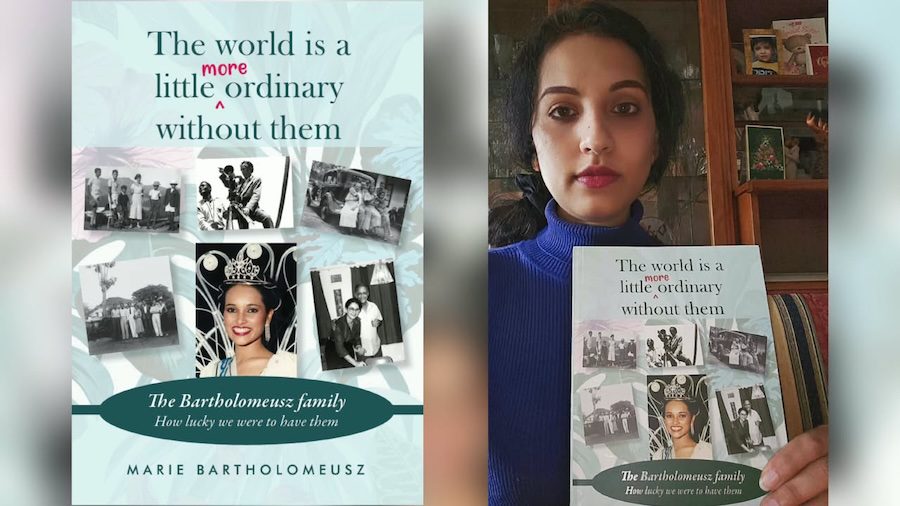
Growing up, Marie Bartholomeusz was the bookworm in the family. You would rarely find her without a book in hand, a habit lovingly nurtured by her father, who encouraged reading and gifted books for birthdays and Christmas. A cherished ritual of their childhood was a weekly routine in Zambia where, every Sunday morning, right after church, they would head straight to the library, where they could lose themselves in the shelves and borrow books for the week. That passion followed Marie everywhere. She was the student that slipped into the school library with a friend during art class or lunchtime, to lose ourselves in a book. She also spent her daily commute back and forth on the school bus with her head buried in a book sometimes, to tune-out the noise around her. Today, she is the author of The World is a Little More Ordinary Without Them: The Bartholomeusz Family, How Lucky Are We to Have Them.
As Marie grew older, her deep love for reading naturally evolved into a passion for writing. It began casually with a personal journal where she logged quick blurbs and early reflections. Over time, that habit matured into a more disciplined craft. Her writing took on a distinct, structured rigor as she stepped into roles that required serious documentation, recording detailed notes, synthesising discussions, and capturing the crucial mechanics of board meetings and other committees.
This trajectory transitioning from avid reading to personal journaling and formal documentation has shaped Marie into a writer who values both compelling storytelling and clear, purposeful communication.
Publishing this book was about honouring her father Markie’s memory by completing what he began when he started documenting his life story on their return from Zambia in 1983. Marie also wanted to preserve the memory of her sister, Ramani Bartholomeusz. No one ever truly gets over losing a sister, so writing became her way of keeping her spirit alive and ensuring her place in our family’s story is forever remembered.
“Additionally, I wanted to document the meaningful contributions made by my uncles, celebrating their lives, achievements, and individual characters. By bringing together my father’s original notes, honouring Ramani, highlighting my uncles’ legacies, and tracing our broader lineage, I realised it needed to be published as a lasting legacy for generations to come so that it becomes a permanent document of where we came from, and the values that shape us today,” said Marie.
Marie started working on the manuscript in 2018, starting on the introduction and his father’s story. Eventually, it became a collaborative, family centred effort as she decided to include stories about her father’s brothers; since they all had a compelling story. “I spent a significant amount of time with my uncle Dennis Bartholomeusz, listening to him recount his vivid memories and personal reflections of the family,” she said. “Crucially, this book could not have reached its final form without the invaluable contributions of my older cousins Denise, Romaine, Jennifer, Brian, Evan and Peter. They generously shared their own stories, personal anecdotes, and key family details helping to fill in any historical gaps and bring to life our shared past. There were many edits, and revisions to ensure the stories captured what was important to preserve.”
Writing this book was a rewarding journey for Marie, but it came with its share of challenges as well. Taking over her father’s initial work required sifting through many notes, drafts and his methodical filing system, so that she could reshape his original work into a unified narrative. It was also important to her that she accurately cross-referenced their family history, tracing back to 1735 in Sri Lanka.
“It was a delicate task editing contributions made by my cousins into a seamless narrative for each chapter with a somewhat similar voice,” said Marie. “Portraying family members authentically, balancing historical records with personal, emotional moments was important. This meant bridging my background in formal documentation with warm, evocative storytelling so that the book remained both historically sound and deeply human.”
A deeply personal and significant part of this journey to Marie was documenting her sister Ramani’s achievements. Capturing her life, contributions, and character gave Marie the opportunity to pay tribute to her legacy, ensuring her place in their family’s story is honoured and remembered alongside the rest of their lineage.
The most emotional moment for Marie was the realisation that her father`s dream of publishing his work was finally coming to fruition. Reshaping his life story into a published book felt like completing a sacred promise to her, ensuring that his vision was carried across the finish line. “I remember the many nights and early mornings he spent at his old typewriter,” Marie said fondly.
“Holding the finished, physical copy of the book The World is a Little More Ordinary Without Them in my hands for the first time was exciting. It was a mix of relief, pride, and fulfillment,” said Marie. “Seeing the physical pages, photographs, feeling the weight of the book, and reading our family name on the cover brought a sense of closure. It was the moment I realised that my father’s dream had finally come to life, along with the contributions of my Uncle Dennis, my cousins, and my own work, was now permanently preserved.”
Holding that book wasn’t just about celebrating a personal accomplishment to Marie, it was about knowing that the lives, sacrifices, and stories of her father, his brothers, her sister Ramani, and generations of their family were anchored in print, safe from being forgotten and ready to be passed down to future generations.
“My hope is that The World is a Little More Ordinary Without Them serves as both a meaningful cultural document and a source of inspiration for readers,” said the author. She hopes it shines a light on the legacy of the Dutch Burgher community in Sri Lanka across medicine, academia, arts, law enforcement and social justice. The book celebrates the profound human qualities that defined Marie’s family members beyond their professional roles, and pays tribute to her sister Ramani, capturing her contributions and the quiet modesty that made her so deeply loved by everyone who knew her.
Marie shared a quote by Marcus Garvey: “A people without the knowledge of their past history, origins and culture is like a tree without roots.”
“I hope this book provides future generations with a sense of identity, pride, and grounding in where they come from, and encourages readers to value and record their own family histories,” said Marie. “Every family has stories of resilience and character that risk being lost over time. I hope it inspires others to speak with their elders, gather oral histories, and preserve their heritage for future generations. I also hope readers find universal themes of love, duty, and human connection that resonate with their own lives.”