

By Kasinathan Nadesan –

Dr. Kasinathan Nadesan
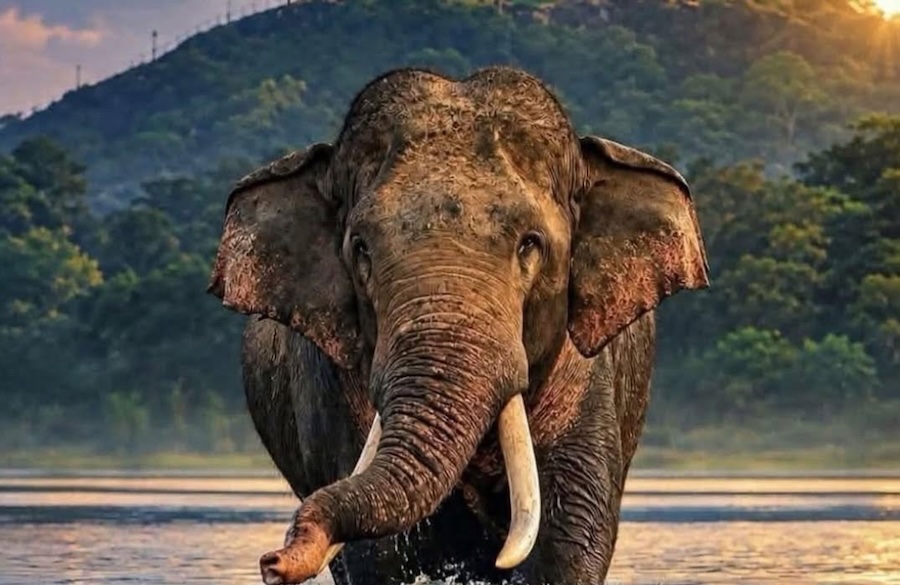
Kawantissa was a famous wild bull tusker who died on October 16, 2026, after suffering gunshot injuries and subsequent medical complications. He was estimated to be around 45 years old. Known to be one of Sri Lanka’s tallest wild elephants, standing roughly 11 feet tall with long, curved ivory tusks. It was roaming around the Galgamuwa area and surrounding northwestern dry zone including agricultural lands. He was spotted limping with a front right leg wound around September 20–21, 2026, with veterinary treatment beginning around September 24. However, he collapsed and died on October 16, 2026, after his condition deteriorated. His death sparked widespread public mourning, scrutiny over wildlife veterinary care, and government measures.
The death of such a majestic animal caused severe pain to people who knew him. Kawantissa’s death brought to light the current ongoing human-elephant conflict in Sri Lanka. Sadly, in a small country like Sri Lanka where shrinking forest cover and agricultural expansion push roughly 70% of the country’s wild elephants outside protected areas. According to information hundreds of wild elephants die each year in Sri Lanka from gunfire, trap guns, electrocution, and train collisions. But as always, this tragic death of a popular animal, became a great opportunity for the opportunistic politicians to attack the government. Our country’s politics survives on creating chaos on some event or incident that occurs even without anyone to be blamed for. But those who blame the authorities have no answer to the problem but are only ready to blame blindly. Another interesting thing is that there are people just waiting to go on a protest march, many even don’t know the exact reason for their protest.
Tuskers Kavanthissa
In Buddhism, elephants symbolize mental strength, wisdom, patience, and tranquillity. Rather than treating elephants as objects of worship, Buddhist texts use their behaviour and nature to illustrate spiritual qualities and the taming of the mind. A wild or agitated elephant often represents an untamed mind driven by anger or desire, while a calm, disciplined elephant represents a focused mind guided by the Dharma. Legend says that Queen Maya dreamed of a pure white elephant entering her side before conceiving Siddhartha Gautama, linking the white elephant to purity, nobility, and spiritual awakening. But being a doctor, I don’t really understand how they found out that it happened during conception or birth. Early texts like the Udāna highlight the elephant’s preference for quiet forest solitude and deliberate movement, paralleling monastic life and meditative calm. In reality, we see hundreds of elephants are incarcerated in captivity and restrained with heavy metal chains and limited food. Their freedom of movement is zero.
Across South and Southeast Asia, elephants play prominent roles in cultural traditions, temple art, and ceremonial processions. At the same time, modern conservationists and animal welfare advocates point to tensions between traditional uses or tourism and the ethical treatment of captive elephants. While there is no shortage of animal lovers in Sri Lanka, they don’t talk much about the cruelty being imposed on these poor animals. The animal owners and mostly in Buddhist temples where these animals are kept in custody with their legs tied with huge steel chains, poor supply of food and lack of natural habitat, they undergo immense mental and physical trauma. This is the reason why at times they go berserk during traditional festivals, mostly Buddhist festivals. Similar things happen in Kerala too, where these poor animals are subjected to similar physical and mental trauma during Hindu festivals.
In Hinduism, the elephant (Gaja) is a sacred symbol of wisdom, strength, royalty, good fortune, and the removal of obstacles. Its reverence centres on elephant-headed deities, cosmic guardians, and temple traditions. Ganesha the elephant-headed god is worshiped during new beginnings, as a symbol of intellect and prosperity and expected to invoke major ventures. Vinayagar Chaturthi, a famous Hindu celebration, is celebrated to honour the birth of Lord Ganesha, common among Tamil-speaking Hindus in regions such as Tamil Nadu, Sri Lanka, Malaysia, and Singapore. Birth or presence of Ganesha is another famous myth with a very questionable start that no known science can explain or even justify. Only thing I am certain of is that this festival is followed by an unimaginable degree of polluting Indian rivers, waterways and other habitats. Ganesha’s large head represents wisdom, large ears symbolize attentive listening, and his single tusk reflects focus and discernment. Elephants appear across ancient Indian sculpture, coins, royal history, and temple architecture. In some temple traditions, elephants act as threshold guardians and bless devotees by touching their heads with a trunk. It appears that Ganesha appeared at the scene after the enlightenment of Buddha. When Buddhists at the time of Buddha started treating the elephants as divine, the rival Hindu Brahmins felt that they too had to do something and thus gave birth to Ganesha. Ganesha, said to be the eldest son of lord Shiva, never born to Shiva or his wife Parvathy, but through artificial means. Thereafter, when his head was decapitated by Lord Shiva by mistake, an elephant’s head was grafted in its place. Prime Minister Modi once said that it was the first “organ transplant” in the universe. Thus, Ganesha became a rival to Elephants that were honoured by the Buddhists. But the present-day irony in Sri Lanka is that Ganesha is a very popular God and deity among Buddhists, despite Buddha stressing against deity worship. But that love and faith were overlooked by some followers during ethnic riots and sadly Ganesha ended up in the nearby ponds. I remember some funny comment made to this incident in Sinhala as “Gane deiyo naanda giya”, that means God Ganesha has gone for a bath. I compare religions with politics; both have never ended rivalry without any logic or commonsense but for mere survival. Through my own research and experience, I have come to a conclusion that Gods and religions are only created by man out of ignorance, fear, exploitation and survival and the world can do very well without any religions or gods.
In Sri Lankan politics, elephants are caught up between land and development policy and human-elephant conflict. It is true that elephants are deeply tied to Sri Lankan culture and religions. Because elephants hold major cultural, religious, and tourism significance, political leaders use them (or abuse them) when appealing to public sentiment. Large-scale agricultural expansion, settlement projects and infrastructure development have reduced forest cover and fragmented elephant habitats and migration corridors. Conservationists and commentators argue that land allocation for political patronage or development worsens clashes between people and elephants. Governments have rolled out mitigation measures ranging from electric fences and firecrackers to national action plans and joint enforcement operations targeting illegal firearms, hakka patas (explosive devices hidden in food), and unauthorized fences. Human-elephant conflict causes hundreds of elephant deaths and over a hundred human deaths each year, making wildlife management a recurring parliamentary and public accountability issue.
Following the October 2026 death of the tusker Kawantissa from gunshot wounds, opposition figures called for specialized tusker protection measures and community consultations, while demonstrators in Colombo marched in November 2026 demanding greater accountability and policy reform from wildlife authorities and the government. Sri Lankan environmentalist and scientist Dr. Ajantha Perera, a very emotional advocate of animal’s welfare, does not promote any workable “solution” to elephant protection, taking into consideration the various limitations including geographical reality, human survival, especially about the poor farmers and religious sentiments. She advocates for strict legal accountability, habitat preservation, and ethical wildlife management. She proposes several core demands and actions in Sri Lanka. She urges to hold government authorities accountable for failing to enforce wildlife laws, prosecute crimes against elephants, and stop habitat destruction. She opposes forest clearing and development projects inside protected wildlife areas and elephant corridors while urging the use of degraded or abandoned land instead. She condemns political interference, negligence, and leadership failures within wildlife and environmental agencies, and demands leadership changes following high-profile elephant deaths. Urging stricter rules for wildlife tourism, such as capping safari vehicle numbers, setting scheduled entry times, enforcing safe viewing distances, and penalizing drivers who harass elephants. She further emphasized non-violence, respect for elephants’ space and freedom, and stronger oversight of wildlife management.
I have seen several of Dr Ajantha Perera’s videos showing her emotional outbursts. Emotional outburst alone won’t solve a problem. These so-called emotional outbursts are practiced very lavishly by Sri Lankan politicians but they are not really intended to highlight any real issues or to find a workable solution. Most of emotional outbursts are only to fool the gullible masses to earn votes. In theory one can go on criticizing but what is important is to first clearly and practically understand the ground situation, its various limitations and how to arrive at a reasonable solution while compromising the ground reality. A thesis or a dissertation alone is not enough to solve, especially very complex issues. In theory we can propose all kinds of fancy solutions but implementing them is the problem. We must understand that we are dealing with the problems in Sri Lanka. We are not living in a developed, educated country where the public understands their responsibilities and knows the true meaning of patriotism. In Sri Lanka the word “patriotism” is the most abused and totally misunderstood word. For many, patriotism and freedom mean doing anything as they please. Littering wherever they want is their basic human right. Pasting posters anywhere is their birthright. The recent massive floods in Colombo are only due to excessive practice of our patriotism and the thoroughly misunderstood human rights. Those who saw the garbage being pulled out of the drains will know how our people have expressed their rights to pollute. In this background only we are trying to solve the huge elephant problem. Unfortunately, the experts who propose the solutions are also of the same mindset, without a clear understanding of our inherent limitations and indifferences.
In a small island with an increasing population and greater need for land for people to live and cultivate, accommodating the elephants among them is a huge problem. To my mind it appears almost an impossible task in the long run. A time will come when our animal lovers have to decide as to whether Sri Lanka is for the people or the elephants. Elephants are huge animals and they are very destructive too and protecting their well-being is going to be a challenge. I know that so many of these poor animals are killed by trains, mainly on the Batticaloa-Trinco route. I hope our experts won’t suggest doing away with these railway lines. The huge dinosaurs perished from the surface of the earth long years ago because of the environmental changes. That is the reality of nature and Darwinism and thus survival of the fittest.
Incidentally and surprisingly, I was surprised to see that Dr Ajantha Perera was emotionally and loudly lamenting that even for the deaths of elephants the Tamil diaspora is behind with their plan to achieve Eelam. Being a Tamil, I am raking my mind to understand her utterances about Diaspora and Eelam. Sri Lankan diaspora comprises of Sinhalese, Tamils, Muslims, Burghers and not only Tamils. But I have to assume that her assertion about diaspora means only the Tamils. What is more frightening is that she boldly claims that the elephant deaths are due to the Tamil diaspora financing the President? Another interesting opinion of hers is that the Tamil diaspora have financed the president to create racial violence in Sri Lanka so that they can continue to remain abroad. It is a very amateurish and mischief making statement that seriously undermines her credibility. The same expert then dragged the diaspora Tamils, Sri Lankan Tamils and the President about a proposal to build a Hindu Kovil at Anuradhapura by Indians. In emotional haste, leaving aside the authenticity of her claim, she has failed to realise that Buddhists do visit Hindu temples out of faith. Almost all the Buddhist deiyos and rituals are from Hinduism. It makes me to infer that Dr Ajantha Perera has clearly moved away from preserving the elephants to create a racial discord. Therefore, it appears to me that all her emotional outbursts for elephants are more a cover while the main objective is politics. One cannot ignore that she is more a politician than an academic, based on her biased but emphatic opinions. May I conclude with the quote, “an expert is a person who uses more words than necessary to say more than what he (she) knows.
*Dr Kasinathan Nadesan – Retired Forensic Pathologist