

By Mahil Dole –

Mahil Dole
Narcotics, firearms, capital flight and a daylight massacre, and the duty of the security state
The past fortnight has not been a collection of isolated crime stories. It has been a pattern: a large maritime narcotics seizure in the North, inland heroin and ICE hauls in the West and South, a cache of military-pattern firearms on the outskirts of Colombo, a multi-billion-rupee foreign-exchange fraud through shell companies, and, worst of all, a daylight shooting in Halpethota, Baddegama. Gunmen in a car intercepted a three-wheeler and fired at point-blank range. A man and a woman are dead. Another woman remains critically injured.
These are not good signs for a peace-loving people. Criminals operating in tandem, brandishing firearms, and treating a public road as an execution ground advertise an insecure environment. When that coincides with Easter Sunday judgments and a presidential claim that politics has been turned from a business into public service, the temptation in Colombo is to treat security as background noise. That would be a serious error.
What the record of two weeks actually shows
On 27 September, personnel of the Northern Naval Command and SLNS Agbo intercepted a consignment at Kusumanthurai Beach, Madagal, Jaffna. One suspect was arrested and a small boat recovered. Examination with the Police Narcotics Bureau established approximately 45.5 kilograms of ICE and 35.7 kilograms of heroin, nearly 81 kilograms, with a street value exceeding Rs. 1.5 billion. It was described as the Navy’s largest ICE-and-heroin haul from northern waters.
That same morning, in Halpathota, Baddegama, a three-wheeler carrying a man and two women was blocked and fired upon with a T-56 type rifle. CCTV captured the car and the gunfire. The driver died; one woman later succumbed; the second remains in intensive care. The victims were said to have been returning after signing at the Galle Crimes Division. Motive can wait. The method cannot: pursuit, interception and execution in daylight, with a military-pattern weapon, in a populated southern town.
In the days immediately preceding these events, officers of the Western Province North Crime Division arrested suspects in Bokundara, Piliyandala, with more than 11 kilograms of heroin and more than 6 kilograms of ICE, valued in the region of Rs. 300 million. In Walgama, Matara, a man and a woman were arrested with nearly 22 kilograms of ICE, together with cash and vehicles suspected of being used in trafficking. In Kolonnawa, raids recovered a 9mm pistol, seven firearms capable of firing T-56 ammunition, and more than 600 rounds of 9mm ammunition. The Financial Crimes Investigation Division produced before court a suspect alleged to have aided remittances equivalent to some Rs. 24.8 billion through shell companies, against imports that never arrived. He has been remanded until 1 October. The file sits inside a wider inquiry into scores of companies and tens of thousands of telegraphic transfers.
Taken separately, each arrest is a success. Taken together they describe a market: drugs arriving by sea, broken and distributed inland, protected by firearms, and accompanied by money moving through corporate vehicles that look lawful until they are examined.
Non-traditional threats in a crowded political climate
National security in Sri Lanka is still too often imagined as the business of preventing another Easter Sunday or another armed insurgency. Those remain real responsibilities. The Colombo High Court Trial-at-Bar has just convicted 15 of 24 accused in the principal Easter Sunday case and imposed sentences running to two centuries of rigorous imprisonment. That judgment matters for victims, for the record, and for deterrence. It does not, by itself, close the file on intelligence failure, institutional negligence, or the wider architecture that allowed a conspiracy to mature. Into that same week has come another publication, and it requires a different kind of honesty.
A book titled Navayay Paha Vikurthiya- 9:5 Distortion, has been launched after Qur’an 9:5. There is a particular hypocrisy in that naming while refusing to read 9:1 to 9:7. The verse is not a licence. It is a wartime clause after a broken treaty, a four-month warning, and an order to honour pacts that were kept. The next line requires safe-conduct for an enemy who only wants to hear the Word of God. To lift “kill the polytheists” and sell it as the meaning of Islam is not scholarship. It is the method Surah Al-Imran 3:7 condemns: those in whose hearts is deviation chase isolated lines to create fitnah, while those firm in knowledge take the Book as a whole.
The vested interest is not hard to see. The same launch that branded a Qur’anic verse as “distortion” was used to seek another presidential pardon and the cover of the Maha Sangha. A cleric already convicted for insulting Islam now packages that faith as a public threat, then asks the State for mercy so that he may continue the same politics. That is not national security. It is the old trade: isolate a line, inflame a crowd, and convert communal fear into personal and political capital. Sri Lanka has paid for that trade before, in broken streets, in a community placed under blanket suspicion after Easter, and in an intelligence culture that watched identity instead of behaviour. Say so plainly, without matching abuse with abuse, and without letting a slogan stand in for the text.
Narcotics, underworld firearms, capital flight dressed as trade, and contract-style public shootings are not “ordinary crime” in a country that still lives with organised violence. They feed corruption and create the cash and firepower on which larger threats later ride. A state that treats them as a blotter problem, while its political class argues in Colombo, has misread its own risk register.
From politics as business to public service, a test, not a slogan
At a mass rally in Gampaha this Sunday, under the theme “People’s Rule – Two Years Strong. Progress for All,” the President said that politics which had become a business has been transformed into public service. The sentence is well aimed. For decades office was inventory: licences, contracts, land, appointments and silence. That marketplace ran into Customs sheds, bank counters, landing points and the underworld’s procurement of weapons. If politics is now public service, the claim must be tested in the court and on the road.
The courts, in recent weeks, have not been idle. Political figures, public servants and entrepreneurs have been produced on corruption charges: a sitting parliamentarian on an alleged aircraft-procurement bribery file; a former Krrish Group director over an alleged Rs. 70 million payment tied to a Fort property; the former chairman of Lanka Mineral Sands; the General Manager of Lanka Salt; a former National Transport Commission chairman over Expressway permits; a former minister’s secretary over an alleged Rs. 8.1 million bribe. Earlier this year CIABOC reported more than thirty public officials arrested in four months. These files are the visible edge of an effort to make “politics as business” expensive.
That effort is a condition of national security, not a side-issue to be parked with the bribery commission. A dinghy does not beach at Kusumanthurai without facilitators. A T-56 does not appear in Kolonnawa or Baddegama without a supply chain that has passed through a compromised official or a bank that asked too few questions. Phantom imports on the FCID’s scale are the financial twin of the narcotics trade. Clean politics starves those networks. Dirty politics feeds them. But a remand is not yet public service, and a rally sentence is not yet a secure street. If directors are in court while a three-wheeler is raked in Halpethota, and if ICE still moves by the kilo through northern waters, the citizen is entitled to ask which marketplace has actually been closed.
There is a further caution. Campaigns against corruption succeed only when they are even-handed and evidence-led. Selective zeal recreates the old business of politics under a new label. An intelligence service used to settle scores will not be trusted when it later asks the public about a landing or a weapons dump. The Gampaha formulation is useful if it becomes an operational standard: the law applies to the powerful and the obscure alike, and the State’s first business is the ordinary person on an ordinary road.
Agency responsibilities: who must do what
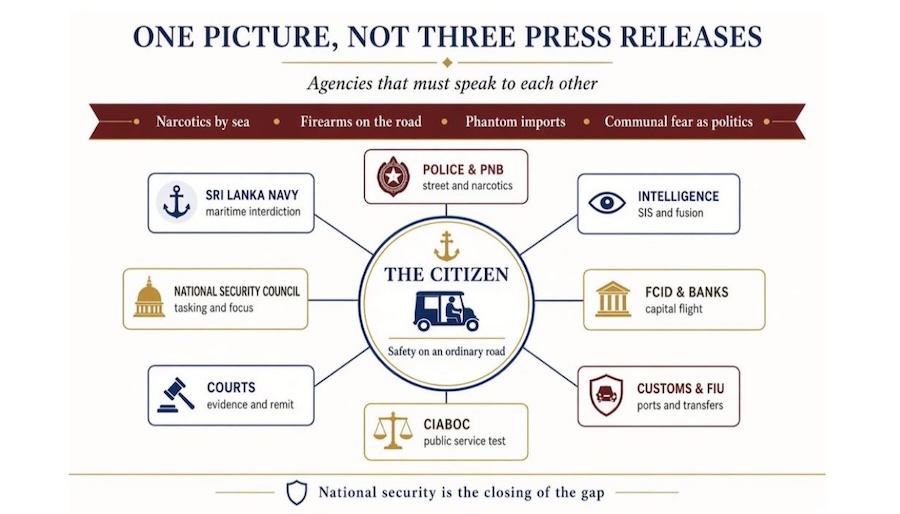
Figure: The citizen on an ordinary road is the test. The Navy, Police and Narcotics Bureau, intelligence desks, FCID and banks, Customs and the FIU, CIABOC, the courts and the National Security Council are not rival press offices. They are one picture — or they are three press releases.
The Navy’s duty on the northern and southern approaches is not ceremonial. The Palk Strait remains a preferred corridor: the crossing is short and fishing provides cover. Interdiction at Kusumanthurai is valuable only if it is followed by source-to-market mapping, packers, landing points, inland receivers, offshore facilitators. That work requires the Police Narcotics Bureau, Customs, the Financial Intelligence Unit, and a fusion cell that treats a dinghy, a bank transfer and a T-56 as one picture.
The Police duty is to prevent the next daylight murder, not merely to investigate the last. When a T-56 is used on a public road against people returning from a crimes division, the question is how the weapon moved, who sanctioned the hit, and why threat assessment failed. Inland ICE and heroin finds must be treated as distribution nodes, not trophies. A 22-kilogram haul in Matara and an 18-kilogram mixed find in Piliyandala, days apart from an 81-kilogram coastal seizure, should be one picture, not three press releases.
The FCID and the banks have a national-security function whether or not the statute uses that phrase. Phantom imports drain reserves, can wash criminal proceeds, and can pay for the consignments the Navy pulls off beaches. The Kotikawatte arrest should open a network case, not close a headline.
Intelligence agencies must resist waiting for a “terrorism” label before they sit up. Organised narcotics, contract killing and covert capital movement are intelligence problems. They require sources, financial intelligence, maritime awareness and the courage to share what is known before the next three-wheeler is stopped on a southern road.
Preventive measures that can be taken now
Prevention is a set of unglamorous tasks. First, a standing joint cell, Navy, Police Narcotics Bureau, Customs, FCID and the Financial Intelligence Unit, with one target list and one weekly assessment to the National Security Council. Measure networks dismantled, not only kilograms.
Second, treat firearms recovery as a campaign. The Kolonnawa cache is a logistics dump. Every recovery should be traced: origin, last custodian, end-user, cash trail. Unaccounted military-pattern weapons remain an unfinished post-conflict item.
Third, close the gap between court appearance and street vulnerability. People required to sign at a crimes division are known to the system. The system then owes a threat assessment. Public roads in Baddegama should not become killing grounds because two factions have a rifle.
Fourth, match telegraphic transfers against Customs and shipping data as routine, not as a special project after a complaint reaches Police Headquarters. The Rs. 24.8 billion file should rewrite that routine.
Fifth, political controversy must be ring-fenced from operational command, and the anti-corruption drive must speak to the anti-narcotics drive. A National Security Council on a fixed cycle, with a fused assessment and written tasking, keeps the permanent State at work while the temporary Government argues its constitutional case. CIABOC, the FCID, the Police Narcotics Bureau and Customs should not discover at a press conference that they have been chasing the same names.
The test that matters
Sri Lanka has spent a generation learning, at terrible cost, that security is not the same thing as the absence of a declared war. The peace-loving public does not ask the State to win arguments in Colombo, or to win applause at a Gampaha rally. It asks that a three-wheeler on a southern road can pass a car without being raked by a T-56; that a northern beach is watched before the dinghy beaches, not after; that a house in Kolonnawa is not a magazine; that billions of rupees cannot leave the country dressed as imports that never were; and that the man who once sold a licence and the man who now fires a rifle are both answerable to the same law.
The detections of the past two weeks prove that parts of the system still work. The Baddegama murders prove that other parts do not work in time. The court list proves that another part has at last been put to work. National security is the closing of that gap, by agencies that know their duty, by a centre that refuses to be distracted, and by a standard that treats public service as the protection of the ordinary citizen from the old business of politics and the new business of crime.
(This analysis is offered in the interest of national security, institutional reform, and public safety)
Sources: contemporaneous reports of the Sri Lanka Navy, Police spokesmen, CIABOC and court proceedings, News First, Newswire, Ada Derana, Daily Mirror and related parliamentary reporting, 21–27 September 2026; Qur’an 9:1–7 and 3:7; book launch of Navayay Paha Vikurthiya, 20 September 2026.
*The writer is a Senior Superintendent of Police (Retired), former Head of the Counter-Terrorism Division of the State Intelligence Service, and a former Member of the Sri Lanka Wakfs Board. He writes on national security, intelligence and institutional reform. Email- mahildole54@gmail.com
Mani / October 2, 2026
Mr. Dole, you have done a good job in tying together recent criminal events to show the serous danger from the current operations of the underworld. However, the title of your article is misleading as it is not a case of crime speaking louder than politics – much rather, it appears that ‘old’ and ‘dirty’ politics, as it is rather constrained in what it can achieve now within the political sphere, is increasingly speaking through crime. If you add the recently orchestrated prison riots in Negombo, Mahara and Magazine prisons to your analysis, then you can see how the underworld is aligned with ‘old’ politicians to protect their respective interests and destabilise the current regime. Apart from the social impacts of drug addiction and occasional collateral from gunfire, the major threat from this spate of crime is not necessarily for the ordinary citizen but for the NPP government. You are right, though, that the centre should not be distracted.
/
Ajith / October 3, 2026
“Sri Lanka has spent a generation learning, at terrible cost, that security is not the same thing as the absence of a declared war. “
The part of the problem of the national security is institutionalised racism and religious extremism. Sri Lanka never learned anything in the past.There was not a single declared war in the country after 1948.
/