


By Sujit Sivasundaram –

Dr Sujit Sivasundaram
European early modern empires in South Asia are sometimes described as water-borne parasites: they command the sea, but only take up small stretches of territory and factories along the coasts. In such a picture, the British win out against their European rivals at sea, and then start forming alliances with South Asian states; they work closely with land-based Indian financiers and merchants and protect the rights of landowners. It is from this ground of mutual interest that British conquest takes shape. By picking up the context of Sri Lanka – placed in the middle of the Indian Ocean and at the subcontinent’s extreme tip – my research aims to challenge this narrative. It takes issue with a series of opposites that are fundamental to the way we think about the British invasion of the subcontinent. Amongst these opposites are: the pre-colonial kingdom versus the colonial state, the indigenous versus the foreign, the maritime versus the landed, and the highland versus the coastal.
The origins of these dichotomies lie in the colonial period. In the interior highlands of the island stood the kingdom of Kandy, which only fell to the British in 1815. In the words of a mid-nineteenth century historian of Ceylon, the Kandyan kingdom was protected by a ‘species of natural circular fortification’, which allowed the Kandyans to defy European modes of warfare for three centuries. Writing in 1841, Lieutenant De Butts noted that the ‘physiognomy of mountaineers is influenced by the bold scenery amid which they reside, and which is supposed to impart somewhat of hardiesse to their manners and aspect.’ This physiognomic difference was said to map on to a divergence in character, evident in the ‘servility’ and ‘effeminate’ nature of the lowlanders, which contrasted with the elevated manliness of the highlanders. In a popular commentary, Robert Percival wrote of how Europeans who were brought into contact with the climate of Kandy fell ill with debilitating ‘hill or jungle fever.’ Added to this was the trope of the oriental despot, which was quickly attached to the last king of Kandy, Sri Vickrama Rajasimha, by the British. One tale that the British publicised was how the king allegedly slaughtered the family of a fleeing minister, Ahalepola, by ordering the heads of Ahalepola’s children to be put into a mortar and pounded with a pestle by their mother.
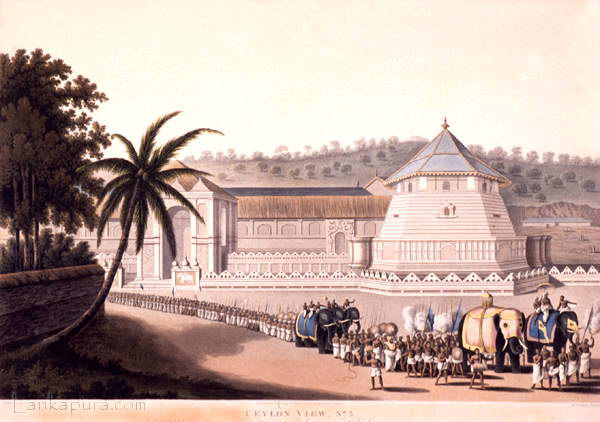
How should these notions of opposition – weighted with a colonial politics – be displaced at long last? In my new book “Islanded: Britain, Sri Lanka and the Bounds of an Indian Ocean Colony”, I argue that there was an evocative similarity between the kingdom of Kandy and the colonial state. Unlike any of the European powers who preceded them, the British could be seen to stand in the lineage of Buddhist kings because they took into captivity the last king of Kandy and into possession the Tooth Relic of the Buddha, as the sacred signifier of their right to rule. Another way in which extant traditions of rule and colonial ones were entangled was around the notion of the island as a unit of governance. The Kandyan kings believed that the island was a territory specially sanctified by the Buddha, who had appeared magically three times on the island after his enlightenment. There was a way of referring to the entire island—as Tri Simhala. When the British took over Kandy their convention announced: ‘The religion of Boodhoo, professed by the chiefs and inhabitants of these provinces is declared inviolable, and its rights, ministers, and places of worship are to be maintained and protected.’
httpv://www.youtube.com/watch?v=RRokQbarKzM
Yet this is not an argument for simple continuities: for the indigenous and the foreign were mutating in definitional terms as the British took over. The British recycled and redefined the laws, religious customs, languages and ethnic affiliations of the island. Unlike India, Ceylon was a Crown colony, and initially, a garrison state under military Governors. This is important, because the rivalry between the Company in India and Crown in Ceylon meant that in governmental terms, the island was cast off from the mainland by the 1830s. It became a separable island colony, and there was a concerted attempt to dredge a channel between the island and the mainland to prevent Company vessels from needing to go around the island in travelling between Bombay and Calcutta.
The apparatus through which Ceylon was unified under a centralised regime of what was expressly declared as ‘colonialism’ amongst Indian observers, set in sway a discursive and intellectual way of thinking and writing of this space as a romanticised and sexualised island, a lost Eden, and a place which was very different to the barren and Hindu mainland. The island’s Buddhism was seen to hold a key to the mainland’s past, but this religious system was seen to have lessened the force of some of the norms of society in India, such as caste or gender oppression.
What emerges to view then is the dynamism of the advent of colonialism – not as a movement from the timeless to the newly rigid, nor as a story of borrowed inheritances or radical ruptures – but as a process with a great deal of energy. Colonialism’s long-term consequences come out of its ability to both accommodate itself to and shape the difference between localities whilst connecting the uneven past to the newly present.
Dr Sujit Sivasundaram is a lecturer in World and Imperial History Since 1500 at the University of Cambridge. He recently won the Philip Leverhulme Prize for History, awarded to academics for contributions to research. He was previously a lecturer at LSE’s Department of International History. This article is first appeared in Blog India at LSE
The Analyst / February 11, 2013
This is a very interesting analysis. Looking forward to read the book . Indeed I’m reminded of Avatar :)
/
Sivaloganathan / February 11, 2013
Indeed need to buy the book, looks interesting . Thank you Dr Sujit Sivasundaram.
/
Jim softy / February 11, 2013
So, where is this book ?
Any e-copies ?
/
w.m.k.Samarasekara / February 12, 2013
“The Kandyan kings believed that the island was a territory specially sanctified by the Buddha, who had appeared magically three times on the island after his enlightenment. There was a way of referring to the entire island—as Tri Simhala. ’”
This exhibits nothing but the little knowledge is more harmful. THREE SINHALAYA comprised with the three provinces called RUHUNU,PIHITI,MAAYA, and all boundaries met in kandy at KATUGASTOTA area.The Buddhist temple call THREE SINHALAARAMAYA still stands as the evidence for this boundaries.
samarasekara
/
L.Shanmugadasan / February 12, 2013
This is a project that has exploited a bright Sri lankan to generate knowledg useful for future colonisation. They want to learn how to óvercome ‘resistence’of native populations against invasion and colonisation.
Native Americans, Canadians and Australian Aborigines did not the geographic advantage or Brahminic cunning to defend themselves. So the LSE now want to prepare to breakdown the Kandyan type of resistence so that the next wave is complete.
Don’t think Sivasundaram understands the purpose of the project, or did the LTTE advised him?
/
nota / February 16, 2013
Hear! Hear!!
Natives such as these are defined as “surrogates” — some willing partners, some unaware of their role in helping the colonization — and NGOs, international human rights bodies, etc. provide an excellent cover….
Also brings to mind the old saying “road to hell is paved with good intentions….”
/
Nalliah Thayabharan / February 17, 2013
Sri Lankans should have retained their friendly, childlike nature and combined it with the inventiveness of their European conquerors. Sri Lankans inherited the power lust of their European colonisers, but none of their vision. Sri Lankans also inherited Portuguese lethargy, Dutch hedonism and British snobbery.The British left no room for the leadership to emerge from the truly indigenous people.
The Portuguese who arrived in 1505 with a gun in one hand and the bible in the other, occupied the coastal areas and soon became a constant source of aggression, annoyance and terror to the large mass of people. In the coastal areas that they occupied, almost all Viharayas and Privenas were destroyed, including the Kelani Raja Maha Viharaya, the famous Totagamuwe Vijayaba Pirvena, Padmavathi Pirivena of Keragala and Sunethra Devi Pirivena of Pepiliyana.
The Dutch who ousted the Portuguese in 1640 and were instrumental in destroying temples, monasteries including the royal palace at Hanguranketa.
The British who ousted the Dutch in 1796 had a well-planned program of activities, for a continuous period of about 150 years, led to the greatest damage to the country’s culture, social cohesion, unity and dignity.
All colonial powers acted on pure and absolute “self interest”. British occupation of Sri Lanka was one of sheer exploitation and devastation. Whatever benefits that were derived by local inhabitants were merely incidental to their exploitation of the country’s natural and human resources in order to reap enormous benefits for the British government. The vast changes that they brought about in almost all areas of life in the country, led to the disruption of the long held culture, values and way of life of local inhabitants, particularly those of the main stream community the Sinhala Buddhists.
To serve their self interests the British practiced the “divide and rule” policy by setting communities against each other. The British gave special privileges to the Tamil minority and those of the Christian faith, by providing with better opportunities for education, employment and other government services to became privileged communities. Jaffna district had the highest density of schools per unit area. In 1870 there were only two Buddhist schools left in Sri Lanka – in Panadura and Dodanduwa, with an attendance of 246 children as against 805 Christian Schools with an attendance of 78,086 children. Several people went after the British and then started to follow their religion and culture in order to gain various positions and other material benefits.
Colombo assumed prominence as the commercial centre and also the center of learning and opportunities for better employment and better amenities for living. This created an outer-oriented, English-speaking urban sub-culture consisting mostly of Christians, with attitudes and behavior patterns seemingly akin to that of the British. Most of the outer-oriented urban elite which included the so called Sri Lankan leaders, held to half-baked foreign values, superficialities and strange ways of living. They were barely conversant with the plight of the majority of the ordinary people. They were not representative of the large mass of people, but they were the ones who became the trusted servants of the British administration. Almost all of the qualified professionals belonged to or subscribed to this sub-culture. The excessively poor living conditions of the large mass of rural youth led to migration to Colombo and other big towns. Some were subjected to the influence of the extremes forms of undesirable urban culture including alcohol abuse, crime and underworld activities that was gaining ground in urban areas.To make matters worse, power -political, administrative, and economic was inherited by those belonging to the westernized Colombo sub-culture.
Dr. Ananda Coomaraswamy urged Sri Lankans to develop a sense of their own traditions and national culture. He challenged the intrusion on eastern values by the expansion of western society. Besides, he was one of the world’s greatest exponents of oriental art, comparative religion and aesthetics.
There were also fearless Buddhist monks who openly spoke out against British rule and the colonial mentality of our so called leaders. Prominent among them was Ven. Migettuwatte Gunananda Thera whose Panadura debate with the missionaries in August 1873 was a remarkable event in the country’s history.
Great Patriot Anagarika Dharmapala (1864-1933) spoke of the superficiality of the lives of those of the Colombo sub culture who have joined up with the colonialists to run the country.
On February 4, 1948 we obtained the so-called Dominion Status with the Queen of England as the Head of State and with the British maintaining military bases in Katunayake and Trincomalee. Aging Englishmen became our first Governor Generals, whereas India became a free republic with an outstanding Indian Dr. Rajendra Prasad as its first President. It was in 1957 through the initiative of Solomon West Ridgeway Dias Bandaranaike that these British bases were taken over by the Sri Lankan government. Even though Solomon West Ridgeway Dias Bandaranaike became a Buddhist to please the masses, Solomon West Ridgeway Dias Bandaranaike was a christian till the day died. Dr. P.R. Anthonis testified that Solomon West Ridgeway Dias Bandaranaike was wearing a cross when he died.
/