


By Chamika Madiwake –
Open Letter to the Government of Sri Lanka
Sri Lanka is once again confronting deeply troubling allegations of sexual abuse involving a 15-year-old girl and a senior Buddhist monk with close proximity to political power. Venerable Pallegama Hemarathana Thero, 71, a chief prelate and custodian of eight of Sri Lanka’s most sacred Buddhist sites, was arrested on 9 May over allegations of sexually abusing a minor over several years. Although he has not been charged and was released on bail, the case has shaken public confidence and renewed urgent concerns about accountability and child protection within powerful religious institutions.
This is not an isolated concern. Venerable Pahalagama Somaratana was convicted in the United Kingdom in 2012 on multiple counts of rape and indecent assault against girls under the age of 16. UK court findings established that the offences were systematic and repeated during the 1970s and 1980s in Chiswick and Croydon, including within a temple shrine room, involving a victim as young as nine. The judgment documented grooming, coercion, and sustained abuse reinforced by threats to ensure silence—judicial findings, not allegations.
Despite that conviction, he is reportedly operating an orphanage in the Gampaha District in full public view. Reports indicate the institution is allegedly unregistered and houses boys between the ages of 8 and 16, many from vulnerable family backgrounds. The central question is unavoidable: how can a person with a documented conviction for child sexual abuse be permitted to run an institution entrusted with the care and protection of children? What regulatory failures have allowed this to persist?
The irony is that both President Anura Kumara Dissanayake and Prime Minister Harini Amarasuriya have reportedly sent congratulatory messages endorsing an individual who was recognized and elevated to the position of Chief Sangha Nayaka of the UK Judicial Chapter. This individual is a convicted child sex offender who served a prison sentence for child abuse, was legally prohibited from being near children, and was placed on the United Kingdom’s National Sex Offenders Register.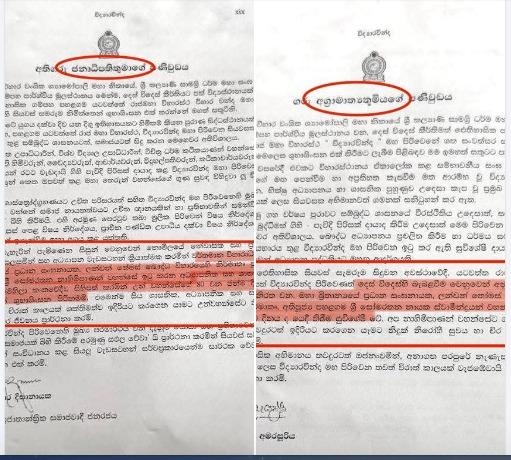
This is not a minor lapse in judgment; it represents a serious moral, institutional, and political failure. It points to a profound failure of due diligence and institutional accountability at the highest level of the state.
The Prime Minister, in particular, cannot readily plead ignorance. Before entering government, she was a contributor to Colombo Telegraph, a platform that has consistently exposed abuse, institutional impunity, and the protection afforded to powerful individuals. The conviction of Pahalagama Somaratana and the concerns surrounding his activities were not hidden facts buried in obscure records; they were matters of public record and public discussion.
If due diligence was undertaken, the public deserves to know how such recognition was granted. If it was not, then even more serious questions arise about the standards applied in conferring legitimacy from the highest offices of the state. Taken together, these cases point to a deeper institutional breakdown—one that extends beyond individual misconduct and reflects systemic weaknesses in oversight, accountability, and child protection within trusted institutions.
At a time when child protection is repeatedly declared a national priority, the public deserves clear answers. The issue is not only individual cases, but the integrity of safeguarding systems and the standards of due diligence expected in public office.
Why has there been no decisive regulatory action? Why is there no transparent inquiry into the operation of the orphanage in question? And what does continued silence reveal about the relationship between religious authority and political power in Sri Lanka?
These concerns are reinforced by other disturbing patterns. In Melbourne, Venerable Naotunne Vijitha, a former temple head, was found guilty in October 2025 on 17 charges, including multiple counts of child sexual penetration and indecent acts committed within temple premises. Despite conviction, he reportedly continues to engage in religious activities within the community, raising further questions about enforcement and accountability beyond Sri Lanka’s borders.
Recent disclosures by the National Child Protection Authority (NCPA), along with data reported by the Organized Crime and Corruption Reporting Project (OCCRP), indicate that nearly 300 Buddhist monks have been accused of child abuse over the past three years. In parallel, 4,289 child abuse cases are currently pending before High Courts across Sri Lanka, many involving rape, sexual exploitation, and other serious forms of abuse.
This growing backlog reflects more than procedural delay; it points to a deeper systemic failure in delivering timely justice and ensuring accountability for perpetrators. Taken together, these figures are not indicative of isolated incidents, but rather a recurring structural crisis embedded within institutions that often command deep public reverence and, at times, political protection. In this context, the scale and persistence of abuse cases expose a broader institutional and political failure to effectively safeguard children and uphold the rule of law.
While the NCPA is formally tasked with operational independence, its structure raises legitimate concerns. Its leadership is appointed by the President, placing it within the executive framework rather than as a fully independent constitutional body. Questions have also been raised about full-time institutional focus and capacity.
In practice, the NCPA depends heavily on coordination with police and prosecutorial authorities, as it lacks independent prosecutorial power. Concerns about political influence over appointments and priorities have also been periodically raised. While there is no clear evidence of direct interference in individual cases, the governance structure leaves room for perceived or indirect influence.
More broadly, when religious authority is treated as beyond scrutiny, accountability collapses. Victims are silenced, institutions close ranks, and abuse is allowed to persist behind a shield of respectability.
In this context, silence is not neutral—it has consequences. It enables impunity.
Child protection cannot be subordinated to religious status, political influence, or institutional loyalty. No individual or institution should be beyond scrutiny when the safety of children is at stake.
The issue is therefore not a series of isolated cases, but a question of power: who is protected, who is held accountable, and who is left vulnerable.
A society that fails to confront this reality honestly is not protecting its children—it is protecting its power structures.
Jit / June 1, 2026
It looks the author is deeply entwined in his own mess of tentacles! Has got heaps of wires crossed with the tasks of the child protection ministry, absence of knowledge on the ongoing judicial process, names of people including the priest concerned……What do you really want from this govermnemnt mate?
/
old codger / June 1, 2026
Jit,
“names of people including the priest concerned”
Pallegama Hemaratana is the Atamasthanadhipathi who got caught recently.
Pahalagama Somaratana was the chief of the London Vihara, and was rehabilitated by Mahinda Rajapaksa on his release from a UK prison.
/
Leonard / June 2, 2026
Answer is simple stop the Phedophiles and child molosters not to give excuses about judicials process. I find the ones who loudly make excuses and defend politicians past and present are themself are phedofiles who are still hiding in the closet and give excuses and thrash the voices who are pointing the failures of politicians and religious leaders who are in cahoots with Pedos .
/
Ajith / June 3, 2026
“Answer is simple stop the Phedophiles and child molosters not to give excuses about judicials process.”
It is easy to answer but very difficult to do it in Sri Lanka where the law cannot do anything because its constitution itself biased in its practice and we have sufficient evidence that it is not ordinary people, but it is protected by the constitution over several decades where some are above the judiciary.
/
Leonard / June 3, 2026
It’s not only constitution and law. just like in US and and the west Child molosters devients & closet Phedos got to powerfull positions over last 30 years and slowly worked on the agenda to make theses abhorrent actions to promote as normal in the eyes of the public under the guise of helping, Proof is Some western politicians even fail to answer the question “what is women”.
/
LankaScot / June 3, 2026
Hell Jit,
Until such time as the Government Funds (and Monitors) an independent Body, with the Right to access any Institution that houses Minors, then the problem will remain hidden (mostly). The Social Services and Family Courts in England could be an example for Sri Lanka to learn from. Other Countries in Europe operate similar systems to provide Child Protection. The Lessons of the Catholic Church’s abuses in Scotland and Ireland are still being addressed – https://home.crin.org/issues/sexual-violence/ireland-case-study-clergy-abuse
For Historical and Religious reasons the Catholic Church had many Institutional Buildings that catered for Children and Young Mothers. These were the places where the worst (and Systematic) abuses took place. –
https://www.scssa.org.uk/Listening
In the UK and Ireland those Adults (and Children) that brought attention to abuses were ignored, silenced or sidelined. It took a long time for the full extent of the problem to be revealed and addressed. Watch the Apologists in Sri Lanka carefully in case they try to cover-up the problem.
Best regards
/
Ajith / June 1, 2026
“A society that fails to confront this reality honestly is not protecting its children—it is protecting its power structures.”
The evidences and facts from this article by a brave author clearly proved that the ruling present and past Governments, political leaders, religious leaders are fundamentality cheated the people and country knowing well all the truth in order to come to power and they all should answerable to the people why they failed to tell the truth or why they hide the truth? This country suffered continuously with riots, wars, corruption and bankruptcy because of the lies spread by these political and religious leaders continuously and he country have to lose millions of people’s life to make happy of few political and religious leaders.
/
CChampa / June 1, 2026
I was also surprised at the fact how monk Pahalagama Somaratana, a convicted serial s-offender, was rewarded with a Chief Monk post in the UK Chapter. Is he a British citizen? Otherwise how did he visit the same temple in the UK, where children are frequent, to take over the post with the blessings of the President and the Prime Minister?
Didn’t monk Pahalagama Somarathana have a permanent restraining order from returning to the same temple in the UK where he committed crimes against women and children?
The next question is, which Buddhist Sect promoted him to the Chief Monk post in the UK Chapter? I hope it is not the Malvathu Chapter again.
S-crimes are rampant in Sri Lankan society which is closely connected with male dominance and misogyny. Serial s-offenders receiving political patronage, least police priority and released on bail have also become a serious societal problem and a threat to public safety and public health in Sri Lanka. Therefore, s-crimes including rape, s-trafficking, s-slavery and s-violence against women and children, which are a violation of human rights and human dignity, should be “designated as a act of terrorism” for the safety of women and children.
/
old codger / June 3, 2026
Champa,
You are totally mixed up. Somaratana went to UK long ago, when the girl in question was probably not even born. He molested her when she was 9. But her parents didn’t believe her.
She complained after they died.
“Pahalagama Somaratana, the former chief incumbent of the Thames Buddhist Vihara in south London, was arrested in 2010 and subsequently convicted of four counts of indecent assault in 2012. He was sentenced to seven years in prison and placed on the sex offenders register for life.”
He returned to Sri Lanka, where Mahinda Rajapaksa rehabilitated him, and currently is said to running an orphanage in Gampaha.
/
CChampa / June 4, 2026
old codger the impersonator
Read the second, third and fourth paragraphs of the article.
/
old codger / June 5, 2026
Ccchampa,
“This is not an isolated concern. Venerable Pahalagama Somaratana was convicted in the United Kingdom in 2012 on multiple counts of rape and indecent assault against girls under the age of 16. UK court findings established that the offences were systematic and repeated during the 1970s and 1980s in Chiswick and Croydon, including within a temple shrine room, involving a victim as young as nine.
Despite that conviction, he is reportedly operating an orphanage in the Gampaha District in full public view. Reports indicate the institution is allegedly unregistered and houses boys between the ages of 8 and 16, many from vulnerable family backgrounds. The central question is unavoidable: how can a person with a documented conviction for child sexual abuse be permitted to run an institution entrusted “
He DID NOT return to UK.
Don’t you know where Gampaha District is?
/
leelagemalli / June 1, 2026
Readers,
The recent allegations involving the abuse of a child by a religious figure have once again highlighted a serious concern that extends beyond any single institution or faith. Crimes against children must be investigated thoroughly and impartially, regardless of the status, influence, or religious position of the accused. When places that are expected to provide spiritual guidance become environments where abuse can be concealed, society has a collective responsibility to demand transparency, justice, and stronger safeguards for vulnerable individuals. Protecting children must always take precedence over protecting the reputation of institutions.
–
Many citizens are concerned that political leaders often speak strongly about crime and social issues during election campaigns but fail to pursue meaningful reforms once in power. Allegations of abuse, exploitation, and criminal activity within religious or community institutions require consistent oversight, independent investigations, and public accountability.
/