

By W.A. Wijewardena –

Dr. W.A Wijewardena
A deep psychological inquiry
The trio, Dr. Bandula Gunawardena, H. D. Premasiri, and Ravindra Guruge, have done it again. Out of sheer generosity, rather than any expectation of profit, they have jointly financed a new Sinhala film, since making money is uncertain in the kind of cinema they choose to support. In the past, each of them has been at the forefront of financing more than a dozen artistic Sinhala films. This time, their support has gone to the celebrated teledrama director Dr. Bertram Nihal, who has adapted for the screen Upananda Welikala’s award-winning novel Karma Charikawa, or A Karmic Travel.
The poetic meaning of the Sinhala title Daree is “daughter”, but Nihal has chosen the English title The Cave. For the uninitiated moviegoer, who expects everything to be stated directly, this may at first appear confusing. If a film requires the viewer to do a little research to discover the meaning intended by its creator, the initial enjoyment may be affected. Yet, once the connection between the Sinhala and English titles is discovered, it deepens the viewer’s appreciation of the film.
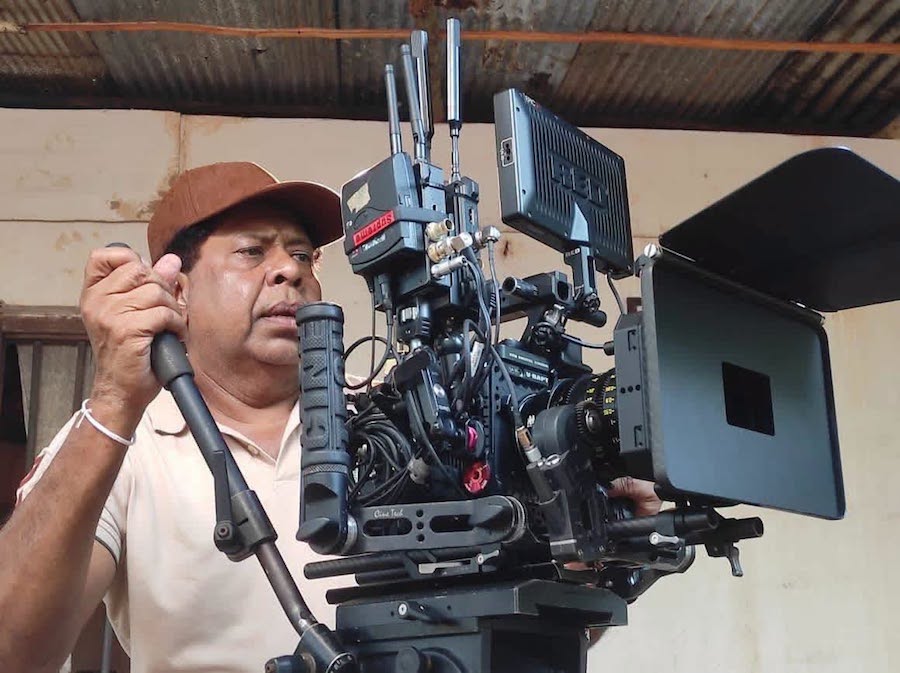
Bertram Nihal
The daughter is the central character around whom the plot is woven; she is also the victim. The cave, by contrast, is a metaphor for the place where truth is hidden: the dark depths of human consciousness and memory. In that sense, the title relates directly to Buddhist philosophy, in which a karmic act committed by a person follows them throughout life, just as the wheel of a cart follows the cart. There is no way to keep it secret.
As Nihal tells us through the words of the chief incumbent of the forest meditation centre, only the dead can keep a secret. However hard we try to conceal it, our own mind, driven by a guilt complex, brings it back to the surface, like a rubber ball pushed under water that rises again once the force holding it down is released.
Movies to promote services sector exports
Since Sri Lanka’s merchandise exports appear to have reached their natural limit, the country is now planning to concentrate on developing the services sector as a potential source of export earnings.
However, the Government’s new Export Development Plan for 2026-2030 does not recognise entertainment, or movies, as a direct contributor to the growth of the country’s services sector.
Instead, it has identified information technology and wellness tourism as priority areas, along with several non-traditional merchandise sectors such as auto components, mineral-based industries, rubber-based industries, marine-based industries, spices and concentrates, electrical and electronic components, and processed food and beverages.
These sectors require the application of advanced technology to produce for global markets and are currently dominated by developed countries that possess such technology and continuously update it. In this context, the development of the entertainment sector, especially movie production for global markets, is an area that should receive the attention of policymakers.
Global movie market
Endorsing award-winning filmmaker Asoka Handagama’s proposal to establish a Sri Lankan-style Oscar award system, I argued as far back as 20131 that Sri Lanka should consider promoting movie exports to the rest of the world as a means of diversifying the country’s services exports.
Handagama had presented an unconventional blueprint for developing Sri Lanka’s movie industry, not merely for domestic consumption but also to meet demand in global markets, a suggestion that critics might describe as “the globalisation of Sri Lanka’s national film industry.”
He proposed that Colombo should host an international film festival modelled on the Busan International Film Festival in South Korea, which began in 1995. His goal at the time was to use the Colombo Port City as the venue for the proposed Sri Lankan film festival. I argued that the global entertainment industry is one of the largest industries in the world because it forms part of an individual’s final consumption bundle.
After consuming every other good or service, people turn to entertainment for the final release of stress. According to estimates by Mordor Intelligence, a global market research and management consulting firm, the global media and entertainment industry, valued at $ 3.1 trillion in 2026, is expected to rise to $ 3.8 trillion by 2031. The current size of the global movie and video industry has been estimated by other analysts at around $ 361 billion, more than three times Sri Lanka’s total GDP in 2025. Hence, this is a major profit opportunity that no country can afford to overlook.
South Korean leadership
South Korea, especially after the 1997 Asian financial crisis, took deliberate steps to develop its entertainment industry and capture global markets. These measures included strategic State support, the abolition of censorship, the adoption of the Hollywood model, the creation of streaming and digital platforms, and the pursuit of international acclaim.
To fund and promote Korean cinema aggressively abroad, the Korean Film Council was established in 1997. Strict authoritarian censorship was gradually lifted after the 1980s as the country moved towards democratic rule. In adopting the Hollywood model, South Korea encouraged the emergence of large, integrated media conglomerates. The establishment of global streaming platforms also helped attract major multimedia firms such as Netflix. At the same time, the industry gained global prestige through major wins at international film festivals.
These developments enabled South Korea’s audiovisual industry to contribute about $ 16.4 billion to its GDP. Sri Lanka could similarly penetrate global markets by aligning itself with stronger performers such as India and South Korea.
Challenge of making artistic movies
In this connection, the contribution made by the Gunawardena-Premasiri-Guruge trio to financing quality Sri Lankan films is commendable. Commercial films that are popular among moviegoers are usually self-financing because they generate enough revenue for producers to recover their costs.
Artistic films, however, stand at the opposite end of the spectrum. They do not earn enough at the box office, and producers are therefore likely to incur losses. The rewards are not monetary but come in the form of subjective satisfaction, especially when such films win awards at local and international film festivals.
As a result, a producer of an artistic film usually undertakes the project not in the hope of making money, but for the recognition it can bring at film festivals. That mental satisfaction is valued at the highest level.
A deep psychological exploration
I find Daree, created by Bertram Nihal, to mark a highly ambitious milestone in contemporary Sinhala cinema, blending a gripping crime investigation with a deep avant-garde psychological exploration. It moves far beyond the conventional boundaries of a standard whodunit thriller.
Instead, it dissects the very architecture of the human mind, reconstructing how a crime originates, fractures, and preserves itself within memory. Inspired by true events and structurally adapted from Upananda Welikala’s acclaimed novel Karma Charikawa, the film functions as a masterclass in philosophical tension. It uses a unique narrative framework reminiscent of quantum superposition, where past, present, and parallel possibilities coexist until the ultimate truth is forced to emerge through direct observation.
Narrative structure and plot evolution
On its surface, the movie tracks a protagonist deeply embedded in a chaotic and unsettling criminal investigation. The discovery of a central crime acts as the catalyst, propelling the characters into a labyrinth where the physical search for clues mirrors an agonising descent into the self. As the narrative progresses, the traditional procedural tracking of evidence is discarded in favour of a psychological battleground.
The film shifts effortlessly between timelines. Rather than treating flashbacks as simple explanatory tools, Bertram Nihal treats time as fluid and subjective. The investigation transforms into a visceral confrontation with heavy guilt, repressed trauma, and severe moral ambiguity.
Every clue discovered by the protagonist is deliberately designed to operate on two distinct levels: an external physical reality and an internal psychological dimension.
The audience is never permitted to remain passive observers; every piece of dialogue and every shift in scenery demands active deconstruction, effectively positioning the viewer as a co-investigator of the human conscience.
The influence of Karma Charikawa
Adapting Karma Charikawa allows Nihal to layer the screenplay with profound Eastern philosophical subtext, specifically centring on the inescapable cycle of action and consequence (karma). However, the film avoids becoming a dogmatic sermon. By pairing these karmic undertones with modern psychological theory and concepts from quantum physics, the script achieves universal resonance.
The narrative treats human choice as a series of branching paths. The characters are caught in a web where an act committed in a moment of madness reverberates across their past perceptions and future possibilities. This philosophical gravity elevates Daree from a regional suspense story to a timeless commentary on the fragility of human morality.
Characterisation of psychological depth
The characters in Daree are far from archetypal heroes or villains; they are deeply flawed, fractured individuals grappling with their own shadows. The protagonist’s journey is particularly harrowing, as the outer chaos of the crime begins to leak into his own psyche, unearthing buried anxieties and ethical conflicts.
The performances are grounded in raw emotional realism. Nihal demands intense restraint from his cast, emphasising micro-expressions, heavy silences, and loaded glances over grand theatrical outbursts. This muted, internal approach amplifies the claustrophobic tension of the film, making the psychological distress of the characters intensely palpable to the audience. The supporting characters add layers of systematic doubt, leaving the viewer perpetually uncertain of who holds the definitive truth, or whether a singular truth even exists.
Direction, cinematic language and aesthetics
Bertram Nihal leverages his decades of expertise as a pioneering visualiser and award-winning television director to deliver a visually stunning cinematic landscape. The film’s alternative title, The Cave, serves as a powerful visual and metaphorical anchor throughout the runtime.
The camerawork treats physical spaces, shadowy rooms, dense landscapes, and tight enclosures as extensions of the characters’ internal mental states. Nihal’s visual style relies on three filmmaking techniques. First, deep shadows and stark lighting contrasts symbolise the ongoing clash between hidden guilt and exposed truth. Second, tight, claustrophobic close-ups trap the characters within the screen, emphasising their psychological entrapment. Third, desaturated tones establish a sombre, haunting atmosphere that mirrors the moral decay at the heart of the story.
The pacing is deliberate, slow-burning, and meticulous. Nihal rejects rapid, low-effort jump scares, choosing instead to construct a thick, unbroken wall of atmospheric dread. The editing serves the film’s quantum-inspired structure beautifully, cutting across timelines in a manner that feels jarring yet entirely logical within the realm of human memory.
Soundscapes and sonic tension
The auditory design of Daree plays an indispensable role in maintaining its gripping suspense. The soundtrack avoids overly dramatic orchestral sweeps, opting instead for a minimalist, avant-garde score rich with ambient textures, sudden dissonances, and prolonged silences. The sound design maximises the impact of everyday noises, footsteps, echoes, heavy breathing, and dripping water, transforming them into symbols of psychological torment. This careful orchestration ensures that the sonic environment acts as an invisible antagonist, constantly tightening the emotional screws on both the characters and the audience.
Thematic brilliance: Truth and superposition
The thematic core of Daree lies in its radical interrogation of objective reality. By invoking the metaphor of quantum superposition, Nihal posits that history and guilt are not fixed points, but malleable constructs shaped by perception.
The film argues that human memory is highly unreliable, frequently rewritten by guilt to shield the ego from unbearable truths. When the truth finally crystallises in the climax, it does not bring standard cinematic catharsis. Instead, it leaves the audience with a profound, lingering sense of discomfort, forcing them to reflect on the nature of justice, human cruelty, and the thin line that separates an ordinary citizen from a criminal.
Final word
Daree, or The Cave, is a monumental achievement in modern Sri Lankan cinema. Bertram Nihal has successfully bypassed the predictable tropes of mainstream commercial cinema to construct an intellectual, deeply atmospheric psychological masterpiece. By grounding an abstract narrative structure in the rich emotional soil of Karma Charikawa, the film delivers an experience that is intellectually demanding and emotionally shattering. It stands as a vital piece of art for viewers seeking cinema that challenges the intellect, redefines narrative boundaries, and lingers in the mind long after the final credits roll.
The movie reminds me of a psychological thriller created by the veteran film director Alfred Hitchcock. In this way, Nihal has attempted to penetrate global movie markets through Sinhala cinema. It is an endeavour that should be supported by all.
Reference:
[1] https://dbsjeyaraj.com/dbsj/?p=17628
*The writer, a former Deputy Governor of the Central Bank of Sri Lanka, can be reached at waw1949@gmail.com