


By Vishwamithra –
“Birds desert trees which are bare; a prostitute abandons a poor, and subjects abandon a powerless king. This always holds true.” ~Kautilya
Conventional economists and sociopolitical pundits typically oppose any departure from IMF-regulated boundaries. The International Monetary Fund (IMF) may have its own prescriptive regulations and farsighted reasons to advise the National People’s Power (NPP) government against pursuing certain economic policies. Such advice, of course, is often well-founded in the context of macro-development and the country’s painstaking journey toward economic stability and eventual recovery. But the IMF does not face the everyday demands of a suspicious electorate, nor is it the entity that has to stand for general elections. It is President Anura Kumara Dissanayake (AKD) and his NPP who must navigate that potentially grueling reality.
This is the central, agonizing paradox of governance in post-bankruptcy Sri Lanka. On one side stands Washington, armed with spreadsheets, debt-sustainability models, and the cold, unyielding arithmetic of fiscal consolidation. On the other side stand millions of citizens whose real incomes have been hollowed out, whose small businesses are teetering on collapse, and whose patience is rapidly evaporating. The technocrats see a primary surplus; the voters see an empty plate. Bridging this chasm is not just an intellectual exercise in economic theory—it is a brutal and unforgiving test of political survival.
The Orthodoxy of the Spreadsheets
To understand why conventional economists remain hyper-vigilant, one must look at the fragile glass house that is Sri Lanka’s current economic recovery. The metrics championed by the Central Bank and international lenders present a picture of hard-won resilience. Following the catastrophic sovereign default that brought the nation to its knees, the strict strictures of the IMF’s Extended Fund Facility (EFF) acted as a financial straightjacket. It was bitter medicine, but the numbers suggest the patient is potentially reaching that rare state of stability.
Gross official reserves have clawed their way back, inflation has been tamed into a single-digit positive territory, and domestic economic growth has shown surprising signs of life. For the global financial architecture, these milestones are proof that the textbook works: if you raise taxes, slash subsidies, enforce cost-recovery utility pricing, and maintain a strict primary surplus, macroeconomic balance will return.
From the vantage point of a pundit’s desk or an IMF boardroom, any deviation from this path is viewed as an act of economic heresy. Economists warn that even a minor lapse into populist spending could spook international markets, derail ongoing debt restructuring, and trigger a devastating return to hyperinflation. To them, the boundaries are not arbitrary restrictions; they are the only retaining walls preventing a second, even more catastrophic economic collapse.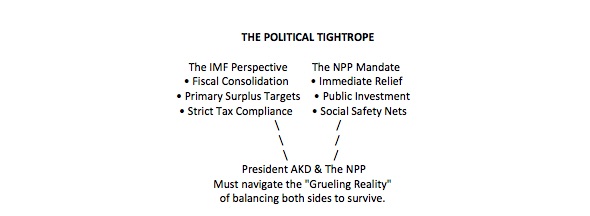
The Human Cost of Austerity
However, spreadsheets do not feel hunger, and mathematical models do not have to pay utility bills. While the macroeconomic indicators point upward, the microeconomic reality for the average Sri Lankan household remains bleak. The revenue overperformance praised by international institutions was largely extracted directly from the pockets of a working population already exhausted by years of crisis.
The widening of the tax base, the lowering of thresholds for Value Added Tax (VAT), and the systematic removal of state subsidies have combined to create an unbearable cost-of-living crisis. Real wages have stagnated while the costs of essentials remain sky-high. Small and medium-sized enterprises (SMEs)—the true backbone of the domestic economy—are quietly closing their doors, crushed under the dual weight of high operating costs and depressed consumer demand.
This is the ‘suspicious electorate’ that President AKD inherited. The historic mandate that swept the NPP into power was fueled by an intense, collective desire for deep systemic change. The public did not vote for a simple managerial transition to oversee the same austerity measures that caused their misery. They voted for an end to corruption, a fairer distribution of the economic burden, and tangible relief from the crushing weight of daily survival.
The Crucial Difference in Accountability
This brings us to the core asymmetry of accountability that our writings so sharply identify. When an IMF program fails or triggers widespread social unrest, its architects face no democratic consequences. Technocrats do not see their names on a ballot paper. They do not hold constituency clinics, they do not answer to parliamentary questions, and they are not held accountable at the polling booth. If a country erupts in protest due to severe austerity, the fund can simply pack its briefcases, cite a ‘lack of political will’ from the local administration, and withdraw to its cushy air-conditioned headquarters in Washington.
For President Dissanayake and the NPP leadership, there is no such luxury of distance, space for comfort and time for reflection. They live and breathe the political consequences of every single policy decision. In a democracy, a government cannot govern purely by executive decree or mathematical equations; it requires the consent of the governed. But that consent has an expiry date; if and when it expires, the political vacuum is inevitably filled by instability, populism, and the resurgence of the very political forces the electorate fought so hard to reject.
Chanakya’s monumental treatise, the ‘Arthashastra’ which laid the foundations for the concept of a welfare state states thus: ‘In the happiness of his subjects lies the King’s happiness, in their welfare his welfare. He shall not consider as good only that which pleases him but treat as beneficial to him whatever pleases his subjects’. AKD may well trade his Socialist/Communist garb for the grand raiments of Chandragupta’s Mauryan Empire.
Therefore, when the NPP government attempts to carve out fiscal space for public investments, targeted welfare, or tax adjustments, it is not acting out of reckless financial mismanagement. It is responding to a profound democratic imperative. A government that fails to provide a safety net for its most vulnerable citizens during a period of intense structural reform will quickly find itself without an electorate to govern.
The Tightrope Walk Forward
Can President Anura Kumara Dissanayake successfully walk this high-stakes tightrope? The early signs indicate that the NPP is attempting an incredibly sophisticated balancing act. The national budgets presented under this administration have deliberately tried to maintain a dual identity. On the one hand, they explicitly commit to preserving the fiscal discipline, revenue targets, and primary surplus goals required to keep the IMF program alive and unlock crucial tranches of international funding. On the other hand, they have introduced strategic interventions designed to cushion the blow for the public, such as pushing for increased spending on public investments to combat the suffocating, contractionary effects of continuous austerity.
Yet, this balancing act will only grow more difficult. The economy remains highly exposed to severe external shocks—ranging from volatile global energy prices driven by geopolitical conflicts to the catastrophic domestic impacts of extreme weather events. Furthermore, the looming shadow of 2028- the year Sri Lanka is scheduled to return to full external debt repayments- means that the window for error is virtually slim or none.
Democracy Cannot Be Budgeted Away
Ultimately, conventional economists must recognize that economic stability cannot exist in a political vacuum. A country cannot achieve sustainable public finances if its social fabric is completely torn apart in the process. Enforcing rigid, uncompromising boundaries without allowing a democratically elected government the flexibility to manage internal social pressures is a recipe for volatility.
The IMF’s advice may well be farsighted, but foresight is a luxury enjoyed by those who do not have to worry about how they will afford their next meal, or how they will win the next election. For President AKD and the NPP, the challenge is far more immediate, personal, and perilous. They must find a way to honor the numbers on the spreadsheet without betraying the flesh-and-blood citizens who put them in office. In this high-stakes gamble, the true measure of their success will not just be a glowing report from Washington, but whether they can keep the trust of a weary, watchful nation.
•The writer can be reached at vishwamithra1984@gmail.com

nimal fernando / June 27, 2026
The poisoned chalice of IMF was handed to AKD along with the bankruptcy.
–
I haven’t seen them all ……… but I’ve never seen AKD say he will kick out the IMF …….. I’ve only seen him saying he will negotiate with the IMF to lessen the burden on the people – the most disadvantaged.
–
True to his word, he increased the salaries of the government servants, tea estate labourers, gave Rs6000 to school kids, reduced some vat on essentials, ……… helped out massively after Ditwah …….
–
Ranil/Rajapakses were just helping themselves.
–
Kicking out the IMF is just a vicious rumour invented by AKD’s detractors to scuttle the great work he is doing ………. to hand the country back to their faves Ranil/Rajapakses to run their drug-running and the rest of the rackets. :)))
–
Ranil’s much vaunted great “economic acumen” was only limited to finding funds for his UNP ……. UNP “financier” Daya Gamage takes massive loans from the state banks and gives a part of it to the UNP …….. and Ranil forces the state banks to write-off the debts as bad debts! ……. Even Native Vedda can be such an “economist” …… even in his sleep!
–
Ah Lankans! Where would Lanka be without them?
/
nimal fernando / June 27, 2026
A part of the money from the Bond-Scam went in to the UNP coffers …….. along with to some of Ranil’s stooges. To try to cover it up, Ranil even had to call poor always-honest Native Booruwa! If you follow the bloodhounds ultimately it was the hard-working people’s EPF that was swindled.
–
Some …. the so called “Colombo Chetties” have a long history of “sorta legally” swindling …… as far back as commissions from Fujikura. Cabrral, Aloysius and their relatives were swindling the EPF with all sorts of scams. Ranil just carried on the scams on a larger scale in cahoots with them: the lot with the skills cum experience.
–
As a favour Ranil never collected the money due from Aloysius’s (and Johnston’s) distilleries. These were not money they had to pay but taxes collected on behalf of the government – most countries impose high taxes on liquor and tobacco. They were just allowed to pocket them. Just imagine the interest-income those vast sums would’ve generated for those who were withholding the funds.
The state coffers are full now …….. because AKD collected those funds.
/
nimal fernando / June 27, 2026
In these matters ……… there’s only Truth and Falsehood. Right and wrong.
–
The rest are narratives ……. and rackets …….. maroon satakayas and ties and coats …….. for the gullible …… weak ….. or intellectually dishonest
–
–
Now, yonder stands a man in this lonely crowd
A man who swears he’s not to blame
All day long I hear him shouting so loud
Just crying out that he’s been framed
–
–
Now, where have you heard that before? :))))
–
No 36 Malalasekera Mawatha, Colombo 07?
/
Naman / June 27, 2026
Sri Lanka is a multi cultural, multilingual multiethnic & multi religious country. In such a setting to maintain the SOCIAL FABRIC is of utmost importance for the country to thrive successfully.
“ Social Fabric” is the relationships and connections we make with one another; making us all a part of the common thread of society as a whole.”
Ceylon later SL had failed miserably to maintain it since the beginning of our independence from the centuries of colonial rule. The Sinhala Buddhist majoritarian domination has wrecked the foundations for a successful thriving harmonious prosperous country. A constitution that protects all sections of our citizens needs to be our sole concern at this crucial/critical time. Ministries of Defence, Archaeology and Buddha sassana need to function in such a manner that they don’t hurt the minorities.
/
Ajith / June 27, 2026
“For President AKD and the NPP, the challenge is far more immediate, personal, and perilous.”
Not only for the President and NPP, but for all the people, country and even for political institutions including the past and present the challenge is far more immediate, personal and perilous.During the period of the so called independence and following years, I born in a mud built home, no electricity, only kerosin oil lights, even no radio, few buses, few cars, no proper toilet, a common well to get water for few families a small temple, walking to school or cycle, but we had, cows, goat, no water pumps but country was not in poverty.
After 78 years, we face economic crisis but we had politics, we start with one party, one country, multi ethnic, then turned into multi party, divided the people , brought power greediness, turned into buddhist Sinhala country, regional power influence, international influence, riots, turned into armed rebellion, war, power greediness, influence of Monks and many changes, which resulted corruption, drug influence, and poverty, economic crisis which took the country in to debt of over 100 billion dollars.
Still we are afraid to talk the Truth to its own people, get the help of the own people who were chased away. You cannot get back immediately, but you can stop the happening of the past. Time is limited, System change is the real challenge. It should happen immediately because you cannot wait till another election.You are now under the control of international power in which democracy need elections.
/
Naman / June 27, 2026
“ Sri Lanka has engaged in 17 lending programs with the International Monetary Fund since 1965.”
For the current and previous regimes to seek to IMF so many times itself shows how much DEFECTIVE Governance was by the rulers of SL.
IMF exists to look after the interests of the LENDERS mainly.
Would not be better for those who committed financial or other crimes to do community service and not be a burden for Tax payers.
/