

By Tisaranee Gunasekara –
“Beloved-of-the-Gods, King Piyadasi desires that all religions should reside everywhere….” ~ Ashokan Rock Edict 7
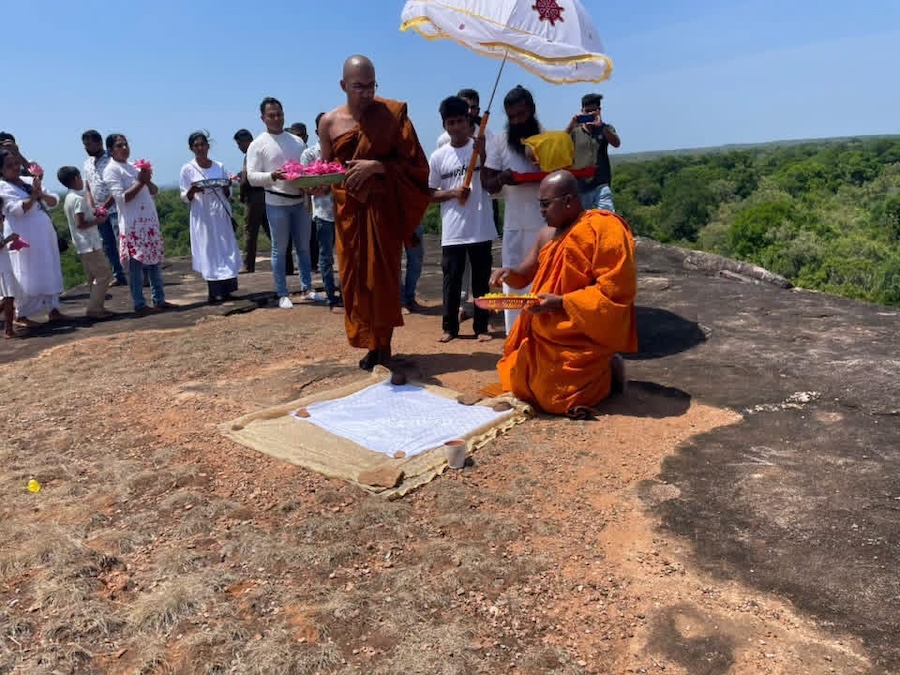
Pallegama Hemaratana thero is no longer the Atamasthanadhipati. Accused of child rape, he was officially removed from that august position in May 2026 by the chief prelates of his nikaya. Yet there he was a few days ago, posing for the cameras while gifting a Sri Maha Bodhi sapling to retired rear-admiral Sarath Weerasekara, SLPP politician, Rajapaksa acolyte, and minister of public security under Gotabaya Rajapaksa.
Mr Weerasekara took the sapling in procession and planted it in Vadunnagala in the Northern province, an archaeological site which is being promoted via social media as the next battlefield between Sinhala-Buddhists and Tamil-Hindus.
Vadunnagala was home to a thriving Buddhist temple complex called Pabbhata Viharaya during the Anuradhapura era. Abandoned about a millennium ago, it was claimed by the jungle like so many ancient sites. In the post-war era, this ancient ruin deep within the Nainmadu forest in the Vavunia district was transformed into a terrain of contestation in ethno-religious politics.
In 2023, Galgamuwe Santhabodhi thero, a monk at the forefront of land-wars in the North and the East, filed a fundamental rights petition seeking a ban on Hindus worshipping at the site. The Supreme Court refused. Instead, it affirmed the right to worship of all parties concerned, subject to archaeological regulations.
Then the limelight shifted first onto Kurundi and subsequently onto Tissa Vihara. Vadunnagala ceased being an ‘issue.’
Now Vadunnagala is back in business. Galgamuwe Santhabodhi thera began a social media campaign, planning a pirith ceremony for 12 September and a mass sil campaign for the full-moon poya. Both were Saturdays, the day when Hindus were to have their Purattasi pujas. The magistrate court allowed the two ceremonies to go ahead, adjuring the parties involved to maintain peace.
It was into these troubled waters Sarath Weerasekara waded armed with the Sri Maha Bodhi sapling gifted to him by Pallegama Hemaratana thero. The sapling was planted at the archaeological site. A plan to build a new Buddhist temple there is being mooted. Battle lines are drawn. The addition of the ‘bo sapling’ has upped the stakes considerably.
The immediate future is easy to imagine – an act of vandalism by Tamil extremists or a false flag operation by Sinhala extremists. And, possibly, an ethno-religious explosion to national (Sinhala, Tamil, and Muslim) detriment.
Their sole refuge
Whenever the Rajapaksas are in need, they seek refuge in the Triple Gems, in their own way. The deploy the images of the Buddha, the Mahanama-version of the Dhamma, and the political Sangha to gain power, retain power, divert public attention or escape justice.
The Rajapaksas are in dire need today. Namal Rajapaksa is in remand prison. A blue notice has been issued on Basil Rajapaksa currently hiding from Lankan justice in his adopted homeland. Shiranthi Rajapaksa is playing hide-and-seek in Singapore.
Salvation is needed, and fast.
Enter Sarath Weerasekara with the supposed Sri Maha Bodhi sapling.
The gifting of a Sri Maha Bodhi sapling is not a simple matter of asking and giving, but a complex process. The propagation of saplings is not done though cuttings but seeds. “The Department of National Botanical Gardens maintains a dedicated facility at the Royal Botanical Gardens, Peradeniya, where seeds are cultivated under controlled conditions.”. To obtain one of those saplings, multiple approvals are necessary from several state and ecclesiastical authorities.
And yet, here is the disgraced former custodian of Sri Maha Bodhi gifting a bo-sapling to a politician with a divisive agenda.
Since Pallegama Hemaratana thero is no longer the Atamasthanadhipati, how did he obtain that sapling? Are the chief prelates and the state authorities aware of this development or not? What was the deal behind the sapling being gifted to Mr Weerasekara? Did the SLPP politician promise the monk freedom from prosecution and restoration of lost status, once the Rajapaksas are back in power?
And if the now-disgraced former custodian obtained the sapling sans official approvals and through the backdoor, what guarantee is there that it is a true sapling? Is this a false sapling being planted in a contested site to set the stage for a false flag operation, possibly in time for November full-moon poya?
Something similar was attempted with Kurundi in 2023. On August 2023, parliamentarian Udaya Gammanpila called a media conference to announce that Tamil politicians were planning to build a kovil in Kurundi on 18 August. On the same day, posters in loud red letters appeared exhorting Sinhalese to Wake Up and Save Kurundi.
Fortunately, Sinhalese-Buddhists in their thousands did not descend on Kurundi. Buddhist and Hindu ceremonies were held side-by-side with no incidents. Galgamuwe Santhabodhi thero was the self-styled chief incumbent of Kurundi. He tried to incite an incident but the police restrained him. One policeman was even heard advising him to make a complaint to the police and to seek judicial assistance instead of trying to create trouble.
Subsequently, the kovil story was revealed as a lie. A group of Tamil residents had been permitted by the Mullativu magistrate court to hold a Hindu religious ceremony in Kurundi, under conditions imposed by the Archaeological Department. That was all.
Three years on, the same Galgamuwe Santhabodhi thero is claiming that a Hindu kovil is going to be built in Vadunnagala. Identical playbook, this time with the addition of a ‘Sri Maha Bodhi sapling.’ Soon, there will be cries about the bo sapling being in danger, demands to protect it. Soon, there will be attempts to ‘awaken’ the Sinhalese to save this priceless heritage. And who better to lead this patriotic struggle than Mr Weerasekara’s boss, former president Mahinda Rajapaksa?
The Rajapaksas are past masters at creating crises and enemies, literally out of thin air.
Remember the Halal issue?
For several months between late-2012 and early-2013, the life and death crisis facing the Sinhala Buddhist nation was the Halal issue. The anti-Halal campaign came from nowhere and raged for several months, to the exclusion of every other concern from rising living costs to the illegal impeachment of a chief justice. It consumed the decades-old amity between Buddhists and Muslims (without which the Eelam War could have taken a different trajectory) and reimaged Muslims as the greatest existential threat to Sinhala-Buddhist civilisation.
Then, as abruptly as it roared into existence, the Halal issue fizzled out. The toxicity it generated would live on though, leading via Aluthgama and Digana riots to the Easter Sunday massacre, which in turn helped Gotabaya Rajapaksa to gain the presidency in 2019.
The BBS and Galagoda-Atte Gnanasara achieved near-instant notoriety with the Halal issue. They promised to banish Halal from Sri Lanka or die in the process. Then, one fine day, they allowed the Halal issue to be consigned to the graveyard of non-issues. They did so because they were not independent agents, but Rajapaksa cat’s paws. A few months after Halal problem vanished, Galagoda-Atte Gnanasara re-emerged as an anti-devolution warrior, at the head of a Rajapaksa creation called the ‘Nationalist Collective.’ Addressing its inaugural rally, Rev. Galagoda-Atte Gnanasara Thero said, “This is not the time for Buddhist monks to meditate in temples…. If politicians are going in the wrong direction, we have a sacred right to step in” (Divaina – 3.7.2013).
In 2025, the Rajapaksas facing another humiliating defeat at the LG polls commenced its election campaign by showcasing Tissa Vihara. Appearing in a press conference with SLPP general secretary Sagara Kariyawasam, Sarath Weerasekara (soundly defeated in Colombo in 2024 parliamentary election) accused the government of endangering national security by allowing Tamil extremists to ‘destroy’ Tissa Viharaya. “Has the North been given to the separatists?” he asked. Now he can repeat the accusation with Sri Maha Bodhi sapling in Vadunnagala replacing Tissa Vihara.
There are certain basic similarities in these non-issues. They appear and disappear suddenly, without warning. Their lives are of short duration, but of burning intensity. They have nothing to do with the real concerns of ordinary people, who are trying to live their lives under difficult conditions, now as then. These people won’t march to save Shiranthi or Namal Rajapaksa. But they might march, if they can be convinced that the government which promised them succour and has failed to honour that promise is also endangering a Sri Maha Bodhi sapling.
Lessons from 2023
The manner in which Ranil Wickremesinghe as president dealt with the Kurundi crisis is a masterclass on how to respond when extremists try to weaponise archaeology.
When Kurundi started becoming a political talking point, President Wickremesinghe called a meeting of the officials of the Archaeological Department and asked the Director General about the department’s unnatural focus on the North and East. He told the director general not to obtain funds from outside sources because as a state entity, the Department can accept funds only from External Resources Department. When the director refused to abide by the law, he took the director to task. The director resigned.
“If anything (of archaeological value) is found nobody can construct a house or Buddhist temple there,” President Wickremesinghe emphasised. “It is owned by the country”. The removal of archaeological sites from the bubbling cauldron of ethno-religious politics is a vital necessity. President Wickremesinghe took an important first step. Thanks to his firm stand, no other religio-archaeological flashpoints occurred during his presidency. Similarly, President Anura Kumara Dissanayake’s refusal to bow down to extremist pressures helped prevent a potential crisis in Tissa Viharaya. Will he act with similar firmness regarding the latest landmine – at least in the interests of his own government – or will he continue to ignore the issue, until it explodes in his face?
Sarath Weerasekara is a veteran in the weaponisation of archaeology. In 2023, he used his parliamentary privileges to launch a vicious attack on the Mullativu magistrate who had intervened to prevent Kurundi from igniting. Reading from a prepared speech, the then parliamentarian Weerasekara said, “We cannot be at all satisfied about the orders and decisions of the magistrate in charge of that area… A few days ago, this Tamil magistrate came to Kurundi Viharaya on an observational tour. I was also there… We must remind this magistrate that this is a Buddhist country… Not just separatist Tamil politicians but also magistrates with such attitudes are responsible for creating conflict between races and religions.”
The Mullativu magistrate, T Saravanaraja, resigned from his judicial posts alleging threats to his life and pressure from state authorities over his Kurundi rulings, and left the country.
The coming battle over Vadunnagala is likely to be dirtier. This time, the Rajapaksas have nothing to lose but their (current and future) chains. They also have an entire lost world to gain. In the Sri Maha Bodhi sapling, they have a potent weapon. Since the sapling couldn’t have been obtained via the proper legal/official channels, an investigation into its theft and the use of the law against the suspects would be the way to go. The question is, will President Dissanayake let the law take its course? Or will he dither until the problem turns lethal?