


By Ruvaiz Haniffa –

Dr. Ruvaiz Haniffa
As Sri Lanka approaches the 80th anniversary of independence in 2028, we must confront an uncomfortable reality: our collective memory is fading too quickly.
The 2022 Aragalaya and economic collapse are already receding from public consciousness. So too are the COVID-19 pandemic and the Easter Sunday attacks of 2019. Further back lie wounds that have not been fully understood, acknowledged or healed: the 30-year civil war—militarily concluded in 2009—the JVP uprisings of 1971 and 1987–89, the anti-Tamil pogrom of 1983, the violence of 1956 and 1958, and the Sinhalese-Muslim riots of 1915.
Between these major national traumas, Sri Lanka has experienced countless smaller political, ethnic and religious confrontations. While each had its own immediate causes, a common thread runs through them: the failure to practice tolerance. Too often, intolerance has been deliberately cultivated, nurtured and unleashed by political, religious, professional and business interests seeking power, influence or economic advantage.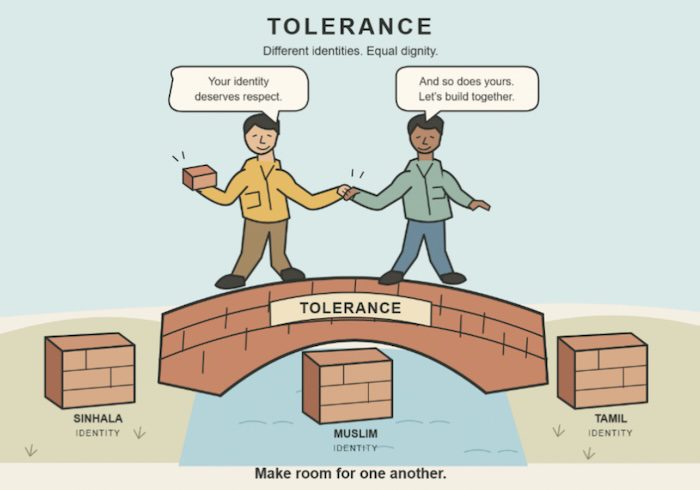
The use of ethnicity and religion for political gain is not new in Sri Lanka. What has become particularly destructive is the weaponization of ethnic and religious identity through democratic politics—and then the use of state power to discriminate, exclude or marginalize citizens through the executive, legislature, judiciary and public institutions.
We have witnessed political movements built upon the fears and insecurities of communities, particularly among the Sinhalese majority in the recent past. These insecurities have been heightened by violence, economic uncertainty, historical grievances and sustained ethnoreligious polarization. At times, Sri Lanka has appeared democratic in form while becoming increasingly authoritarian in practice: power concentrated among political and bureaucratic elites more concerned with preserving the status quo than serving the people.
Citizens must ensure that such an era is never repeated. In a democracy, voters cannot entirely escape responsibility for the leaders they choose. If we allow fear, hatred and division to determine our political choices, we cannot be surprised when those choices produce further instability and injustice.
For too long, sections of the political and bureaucratic establishment (whether in government or opposition) have benefited from exploiting insecurity and intolerance. Power has changed hands, but too often the underlying political culture has remained the same. After nearly eight decades of post-independence governance, meaningful change will remain elusive unless tolerance becomes a lived principle at every level of Sri Lankan society.
There are encouraging signs in the present political environment: rhetoric and some policy directions suggest the possibility of a more inclusive political, professional, social and ethnoreligious culture. Whether this promise becomes reality will depend not only on the government, but also on citizens, institutions and civil society.
Tolerance Is a Beginning; Acceptance Is the Goal
In a pluralistic society, tolerance is necessary—but it should not be the final destination. The higher standard is acceptance.
Tolerance means living alongside people whose beliefs, identities or choices we may dislike, disapprove of or disagree with. It can prevent open conflict, but it may still involve emotional distance or a sense of reluctant coexistence.
Acceptance goes further. It requires open-mindedness, empathy and mutual respect. It recognises that people of different faiths, languages, ethnicities and political beliefs have an equal right to dignity, belonging and participation in the national life of Sri Lanka.
Indian public intellectual Shashi Tharoor has expressed the distinction powerfully. Tolerance can imply: “I have the truth; you are in error, but I will magnanimously allow you the right to be wrong.” Acceptance, by contrast, rests on mutual respect: “I believe I have the truth; you believe you have the truth. I will respect your truth; please respect mine.”
Tolerance, therefore, must not be mistaken for weakness or passive indifference. It is a discipline – in which civic virtue must be consciously cultivated.
Research and experience from plural societies show that tolerance strengthens social stability, enables governments to maintain law and order fairly, and allows citizens to exercise their freedoms without fear. It creates the conditions for democracy to function beyond elections.
The spirit of tolerance can be captured through six essential practices:
Empathy — the ability to understand another person’s experience and perspective.
Compassion — responding to the suffering and vulnerability of others with humanity.
Dialogue — listening and speaking honestly across differences.
Conflict resolution — addressing disagreements peacefully and fairly.
Resilience — resisting provocation, hatred and the temptation for revenge.
Teamwork — recognising that Sri Lanka’s future can only be built together.
These values are not foreign to Sri Lanka. They are deeply rooted in the teachings of Buddhism, Hinduism, Islam and Christianity, as well as in our cultural traditions. Yet our moral compass has repeatedly been distorted by extremists and opportunists seeking personal, political or economic gain.
Justice C. G. Weeramantry observed in the preface to Law in Crisis that Sri Lanka is “embarrassed by the richness of the sources of laws and not the lack of it.” In a similar way, Sri Lanka should be embarrassed by its lack of tolerance despite the richness of its moral, religious and cultural inheritance.
We are a country blessed with numerous religious observances and public holidays representing several faiths. These should be opportunities not merely for ritual, but for reflection: on compassion, coexistence, justice, restraint and our responsibilities to one another.
A Year of Tolerance for 2028
In 2028, Sri Lanka will mark 80 years since independence from British colonial rule. More accurately, it will mark eight decades since liberation from a succession of colonial powers. It should be a landmark moment for national reflection—not another opportunity for division.
Yet the danger is clear. Ethnoreligious political forces are already likely to exploit the anxieties of the Sinhalese majority, particularly fears relating to physical security, culture, religion and identity. Such campaigns may once again target Tamils, Muslims and Christians, deepening mistrust among communities that must instead find a shared future.
Political actors hungry for power may join or enable these campaigns where they see electoral advantage. This is why citizens who follow the middle path -those who reject extremism of every kind- must take responsibility for spreading the message of tolerance.
Civil society has a crucial role to play. We cannot depend entirely on conventional politicians to create a united Sri Lanka. The work must be undertaken by citizens, schools, places of worship, professional bodies, businesses, media organizations, community groups and young people across the country.
We must become the change we want to see. Unity, inclusion and mutual respect cannot be expected as gifts from the state. They must be practiced in our homes, workplaces, schools, communities and political choices.
The present political moment may offer a window of opportunity. The current NPP government has the potential to help foster a genuinely Sri Lankan identity—one that transcends ethnicity, religion and language. That potential must be judged by actions, policies and institutions, not rhetoric alone. But if this opportunity is used well, it could help lay the foundation for a more inclusive national future.
Therefore, I propose that 2028 be formally declared Sri Lanka’s Year of Tolerance.
Such a declaration should not be symbolic alone. It should lead to practical national initiatives: interfaith and interethnic dialogue, school programmes, public campaigns against hate speech, community reconciliation projects, language inclusion, memorialisation of past violence, and stronger protections for equal citizenship.
Sri Lanka cannot change its past. But it can decide what lessons to take from it.
Silence is always an option. But it is never the only option.