

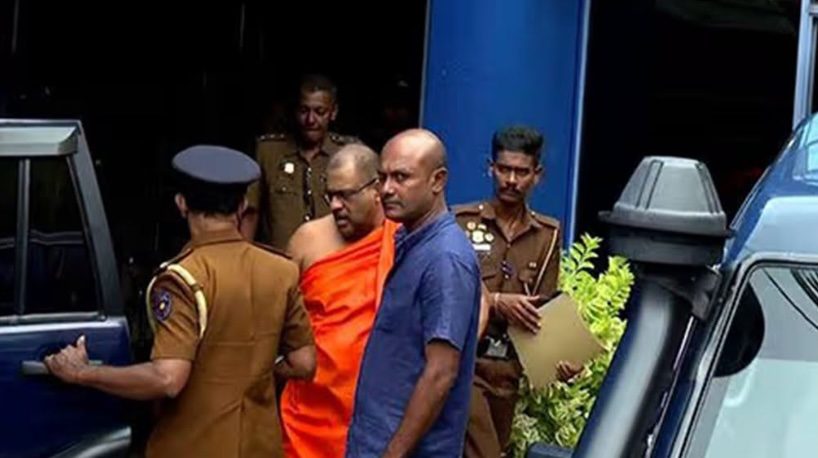
By Vishwamithra –
“Religion is for man and not man for religion.” ~ B. R. Ambedkar
Does Galagoda Atte Gnanasara Thera deserve what the law has finally imposed upon him?
The answer is yes.
Not because imprisonment should ever become an occasion for celebration, nor because the fall of a controversial public figure should provide entertainment for his opponents. Prison is a serious exercise of state power and should always be regarded as such.
Screenshot
The more important question is different.
What happens to a republic when religious identity begins to confer political power, social intimidation and an expectation of exemption from the ordinary consequences of law?
For someone born into a Buddhist cultural environment but whose outlook has become essentially secular, the issue requires no theological judgment. There is no need to determine whether Gnanasara Thero is a “good Buddhist” or a “bad Buddhist.”
That is almost beside the point.
The real question is whether a modern republic can permit religious status—Buddhist, Hindu, Muslim, Christian or otherwise—to alter the relationship between the citizen and the law. Gnanasara matters, therefore, not merely as an individual. He matters as a phenomenon.
The Man Is Less Important Than the Phenomenon
Sri Lanka has spent decades allowing religion, ethnicity and politics to invade one another’s territory. The consequences have hardly been glorious. The country has experienced ethnic conflict, communal suspicion, riots, civil war and recurring political campaigns in which minorities have been portrayed as demographic, cultural, economic or religious threats.
Different communities and political actors have participated in that history at different times. No community possesses a monopoly upon prejudice.
But Sinhala-Buddhist majoritarian politics occupies a particular position for an obvious reason: it operates from within the country’s majority community and consequently possesses access to political leverage unavailable to minorities.
Gnanasara Thera understood that landscape remarkably well.
His public significance did not arise principally from theological scholarship. It arose from his ability to occupy that combustible territory where religion, Sinhala identity, political grievance and fear of minorities intersected.
Reducing the discussion to whether one monk behaved badly therefore misses the larger point. The more important question is why Sri Lankan society allowed such behavior to acquire political significance in the first place.
The Politics of Permanent Insecurity
There is something intellectually curious about a majority behaving permanently as though it were a besieged minority. Sri Lanka is a country in which Buddhism enjoys extraordinary cultural and constitutional standing. Buddhist festivals shape and decorate the national calendar. Temples form part of the physical and cultural landscape. Political leaders routinely seek the blessings of monks. The Constitution itself accords Buddhism the “foremost place.”
Yet periodically the country is warned that Buddhism is endangered.
Endangered by Muslims. Endangered by Christians. Endangered by conversions. Endangered by birth rates. Endangered by foreign conspiracies. Sometimes, it appears, endangered by almost everyone except Buddhists themselves.
This politics of permanent insecurity is enormously useful. Fear is politically productive. Create an enemy and solidarity becomes easier. Create a sufficiently frightening enemy and awkward questions about corruption, inequality, incompetence and governance can temporarily be pushed aside.
This is hardly a uniquely Sri Lankan invention. History is crowded with political movements that discovered how easily economic and social anxiety could be redirected towards another race, religion or tribe. The vocabulary changes. The technique survives.
Then There Is the Law
Gnanasara Thera’s present incarceration arises from his 2018 contempt-of-court conviction following his conduct at the Homagama Magistrate’s Court during proceedings concerning the disappearance of journalist Prageeth Ekneligoda. He received an effective six-year term of rigorous imprisonment.
President Maithripala Sirisena pardoned him in May 2019 after he had served only part of that sentence. In September 2026, the Supreme Court invalidated that pardon, and the Court of Appeal subsequently ordered that the remainder of the sentence be enforced.
There have been other convictions as well, including cases concerning inflammatory remarks about Islam. Those facts matter. But another question matters even more.
Why did a President of the Republic consider this particular prisoner deserving of presidential intervention? That question takes the argument beyond Gnanasara. It leads directly into the psychology of Sri Lankan political power.
The Politician and the Monk
For decades, Sri Lankan politicians have performed an elaborate ritual before the Buddhist clergy. They visit temples, kneel before monks, offer atapirikara, receive blessings before elections and ensure that cameras record the encounter. Some then return to Colombo and practice a form of politics bearing remarkably little resemblance to any recognizable moral philosophy.
The transaction can benefit both parti s. The politician acquires religious legitimacy. The politically active monk acquires proximity to secular power. That is where matters become dangerous.
The problem is not that monks hold political opinions. They are citizens. They may think about taxation, constitutions, foreign policy, education or anything else.
The difficulty begins when religious status itself becomes political currency. At that point, disagreement with a monk can conveniently be portrayed as an insult to Buddhism. Questioning clerical intervention becomes hostility towards religion. And enforcing the ordinary law against a monk can be transformed into alleged persecution.
That is not religious freedom. It is political leverage derived from religious identity.
The Pardon Was More Revealing Than the Offence
The 2019 presidential pardon may therefore tell us more about Sri Lanka than Gnanasara’s original conduct. One individual can behave irresponsibly. Institutions are supposed to contain individual excess. But when political power intervenes after the judiciary has acted, the problem ceases to concern merely one individual. It becomes institutional.
The message transmitted to the public is dangerous: some identities may carry greater political weight than others. Consider the obvious counterfactual. Had the person convicted of contempt been an obscure citizen possessing neither religious standing nor an organized political constituency, would presidential mercy have arrived with equal enthusiasm?
The question almost answers itself.
This is why the invalidation of the pardon matters. Not because Gnanasara must suffer. Because institutions must matter more than personalities.
A functioning republic cannot operate according to a system in which one citizen enters prison through the front gate while another leaves through a political side door.
No Scripture Is Required
There is no need to invoke the Buddha to make the case against communal intimidation. No scripture is required to establish that a Muslim Sri Lankan possesses the same civic dignity as a Buddhist Sri Lankan. No theological doctrine is necessary to conclude that a Christian, Hindu, Buddhist, Muslim and unbeliever must stand equally before the courts.
Reason is sufficient.
That is one of the great achievements of the secular state. Secularism does not require citizens to abandon religion. It does not demand hostility towards Buddhism, Christianity, Hinduism or Islam. It demands something simultaneously simpler and more difficult:
The state must not have favorites among them.
A secular republic protects the Buddhist precisely because it protects the Muslim. It protects the believer because it protects the unbeliever. And it protects religion itself by refusing to allow any religion to become an unofficial department of political power.
A Robe Is Not an Argument
There remains an uncomfortable cultural reality. The saffron robe commands instinctive respect among millions of Sri Lankans. That respect has deep historical roots and enormous emotional force. But respect becomes dangerous when it disables judgment.
A robe is not evidence. A robe is not an argument. A robe cannot transform prejudice into patriotism. And a robe cannot convert unlawful conduct into religious service. None of these propositions should be controversial.
Yet in Sri Lanka they sometimes are. That alone tells us how thoroughly religious authority and political identity have become entangled.
Gnanasara Is Not the Real Question
Eventually Gnanasara Thero will complete his sentence. Sri Lanka will move on. Another controversy will occupy the headlines. But if the country concludes that the problem has therefore disappeared, nothing will have been learned.
Gnanasara did not single-handedly manufacture the social conditions that made him politically significant. Sri Lankan society did. Politicians who courted religious nationalism helped create them. Media institutions that discovered the commercial value of outrage helped amplify them.
Citizens persuaded that another community’s advancement represented their own community’s decline helped sustain them. And governments unwilling to establish a firm boundary between religious authority and secular power allowed the confusion to deepen.
So yes, Gnanasara deserves the consequences imposed upon him by law.
But imprisonment is the least interesting part of this story. The far more important question is whether Sri Lanka has finally become mature enough to distinguish religious freedom from religious privilege.
The first is indispensable to democracy. The second is corrosive of it. No monk should be punished because he is a monk. No monk should be protected because he is a monk. No Muslim should possess fewer rights because he is Muslim. No Buddhist should possess greater civic standing because he is Buddhist.
And no President should confuse religious popularity with entitlement to exceptional justice. That position is neither anti-Buddhist nor pro-Muslim. It is neither anti-religious nor anti-clerical. It is simply the elementary proposition upon which a modern republic must ultimately stand:
Before the law, take off the robe, remove the cross, put away the scripture and forget the surname.
What remains is the citizen.
And that should be enough.
*The Writer can be reached at vishwamithra1984@gmail.com
whywhy / October 7, 2026
Monks of Srilanka , did nothing to take on this Abusive Monk for
his Anti Buddhist behaviour . They all secretly enjoyed his
actions against non- Buddhists . So , he super fits in his robe to
showcase to the world , Srilanka’s Buddhism .
/
Naman / October 7, 2026
‘Gnanasara Thera understood that landscape remarkably well”
From my point of view, creation of BBS/ Gnanasara Thera WAS by Gota Rajapaksa.
GR made use of him to achieve his ambitions. Without the active support of the Rajapaksas there is no people like Gnanasara Thera or like Weerawansa.
/
Naman / October 7, 2026
“Before the law, take off the robe, remove the cross, put away the scripture and forget the surname.”
That’s agreed.
But should it not happen after he or she had been found GUILTY of whatever offences?
/
Naman / October 7, 2026
“Media institutions that discovered the commercial value of outrage helped amplify them.”
That is a fact. Newspapers want to sell as maximum as possible or to get the maximum coverage in order attract the advertisers. When the owners of the media have vested interests in which political party to support, the media will publish biased news.
/
Naman / October 7, 2026
Sinhala-Buddhist majoritarian politics had so far brought our country to our lowest possible position as far as the economy is concerned. What the MINORITIES are expecting is for a BRAND NEW CONSTITUTION that guarantees protection against marginalisation /discrimination/subjugation etc etc.
/
Dayan / October 7, 2026
@Author your defence of equality before the law is valid. However, the article presents a selective analysis while claiming to explain the broader phenomenon.
You Dismiss the Fear Without Examining It: You describe Sinhala-Buddhist insecurity as politically manufactured, yet barely examine its historical, cultural or post-war roots. Understanding these concerns does not mean endorsing prejudice. Dismissing them simply avoids the harder argument.
.
You Ignore Why People Supported Him: Political manipulation alone cannot explain Gnanasara’s influence. He gained an audience because many citizens believed he was voicing concerns that political institutions refused to address. An analysis that condemns the messenger while ignoring the audience is incomplete.
.
You Confuse Protection With Privilege: The article treats nearly every attempt to protect Buddhist identity as a demand for special treatment. Many citizens see it as cultural preservation. You may reject that position, but refusing to engage with it does not disprove it.
/
Ajith / October 7, 2026
“Political manipulation alone cannot explain Gnanasara’s influence. He gained an audience because many citizens believed he was voicing concerns that political institutions refused to address. An analysis that condemns the messenger while ignoring the audience is incomplete.”
It is true that many believed that the concerns raised by the politicians and religious leaders of the past or present are manipulated by the Gnanarasa are the same. In fact, they are against to real Buddhism teach by Lord Buddha. The Monks, Politicians since 1948 are responsible for the violent Buddhism practiced in the country which failed the teachings of Lord Buddha. For example, Buddhist Monks was silent when they used the robe to cover their crimes of smuggling drugs.
/
Dayan / October 9, 2026
@Ajith, I think you have misunderstood my point. I was not defending Gnanasara, nor was I arguing that Buddhism as practiced by some monks is faithful to the Buddha’s teachings. My criticism was directed at the author’s analysis.
.
Even if I accept your argument that many politicians and monks have distorted Buddhism since 1948, the question still remains: why did a significant number of ordinary people listen to them?
.
My point is simple: understanding why people followed a messenger is not the same as approving of the messenger.
/
Ajith / October 9, 2026
“why did a significant number of ordinary people listen to them?”
As an educated person you should know the answer to this question. It is the same people listened to Gotabaya, SWRD, Chandrika, and AKD. All these characters are different. Do you think a Hindu or Christian or Muslim listen to them?
“understanding why people followed a messenger is not the same as approving of the messenger.”
I don’t see any difference between the messenger and approver. It is the same group.
/
old codger / October 8, 2026
Dayan,
“You Confuse Protection With Privilege: The article treats nearly every attempt to protect Buddhist identity as a demand for special treatment. “
What distinctive properties do Buddhists have that must be protected ? Do they not currently wear Western clothes and aspire to speak English, jut like all the others? Do they not carry on businesses? Isn’t the richest man in the country a Buddhist? Haven’t even the non-Buddhist capitalists replaced their non-Buddhist company names? Aren’t the Police and armed forces 95% Buddhist?
So, protection from what? If anything, they need protection from their own self-important monks.
/
Dayan / October 9, 2026
@Old Codger, whether Buddhists actually require protection is a separate debate from the one I raised. My point was that many people sincerely perceive cultural, religious, or demographic challenges and interpret efforts to preserve Buddhist identity as cultural protection rather than a demand for legal privilege.
.
You may disagree with that perception entirely, but simply listing demographic, economic, or political advantages does not answer why those perceptions exist. Understanding a perception is not the same as endorsing it.
/
old codger / October 9, 2026
Dayan,
Perception is not reality. I may perceive that the Eath is flat, but the truth is otherwise. The solution is to prove to the people that their perceptions are false. Protecting monks who promote and take advantage of such perceptions is dangerous.
Forget Gnanasara. Another rapist in yellow has been jailed in Melbourne for molesting teenage girls. He was produced in court wearing a prison tracksuit.
https://www.dailymirror.lk/international/Naotunne-Vijitha-monk-who-preyed-on-girls-at-Melbourne-temple-sentenced-to-13-years-jail/107-352108
I expect the Mahanayakas will now petition the Aussie government to pardon this monster, and the Rajapaksas will provide him with an orphanage on his release (as they did for the London Vihara monk).
The article mentions that some devotees were actually worshipping the monk in court, while his victims were protesting. So much for “perceptions “.
Buddhists must see that that there is a real problem with their monks. Arguing about protocol is pointless.
/
LankaScot / October 8, 2026
Hello Dayan,
70% of Scots Young Adults (18 – 30s) reported in the 2022 Census as having “No Religion”. The days of the Church of Scotland Parish trying couples for Fornication have long gone. My and my Father’s Generation seriously questioned the right of the Kirk to interfere in our Lives. We told the Church in no uncertain terms where to go. The Church has declined to the point of being irrelevant. Did we lose our Cultural Identity? No!
Both of my Grandfathers saw action in the 1st World War and agreed that the Church (English and Scottish) supported the State in it’s War Propaganda (much like the Sri Lankan Buddhist sangha). They had both witnessed things that they could not talk about. And they both agreed with how Wilfred Owen called the following Verse “the Old Lie” – “Dulce et decorum est pro patria mori” translates from Latin as “It is sweet and fitting to die for one’s country”
Best regards
/
leelagemalli / October 9, 2026
Hello LS,
The AKD leadership now faces another failure over the decision to present a convicted monk before court without his traditional robes. Experts argue that while prisoners may be required to wear prison attire, when brought before a court they should be treated according to the protections guaranteed by the Constitution. Many in the country appear to be misinterpreting this issue as simply meaning that the law must be equal for everyone. Religious leaders and monks, however, have never been treated in this manner by previous governments. The government claims to uphold equality before the law, yet questions remain over why figures such as former Petroleum Minister Kumara Jayakody and other ministers allegedly remain untouched, seemingly because of political connections and personal friendships. Meanwhile, the public continues to hear explanations that lack credibility. As a result, confidence in both the President and the Prime Minister appears to be steadily declining.
/
LankaScot / October 9, 2026
Hello Leelagemalli,
The Mafia in Sicily and the United States are a shadow of their former selves. But have a look at how long it took and the resources required to root them out.
https://www.history.com/articles/the-demise-of-the-mafia
Many Judges and Investigators were assassinated before any progress was made. Sri Lanka may not have such a severe problem, however it will take time and great efforts to succeed against corrupt Politicians and Businessmen.
Best regards
/
Dayan / October 9, 2026
@lankaScot,My argument was not that religion must remain influential in public life or that Sri Lanka should preserve clerical authority. Rather, I questioned whether the author had adequately explained why figures like Gnanasara gained support in the first place.
.
Whether one believes greater secularism is desirable or not, understanding why sections of society feel attached to religious identity remains necessary.
.
My criticism of the article is that it discusses the leader extensively but does not sufficiently examine the audience that made him relevant.
/
LankaScot / October 9, 2026
Hello Dayan,
You said “Many citizens see it as cultural preservation” My answer showed a practical result of where a previously Powerful State Religion (Church of Scotland) lost its power and influence whilst the Scottish Culture still remains.
“Rather, I questioned whether the author had adequately explained why figures like Gnanasara gained support in the first place”.
So where is your explanation? Oh and you might like to provide some Data and Concrete Evidence to back up your “Many Citizens” claim.
I have done a quick “Straw Poll” here in our Village, none of them see Gnanasara as a Cutural Hero, in fact they see straight through him to the Rajapaksas (e.g. Namal).
Best regards
/
LankaScot / October 9, 2026
Hello Dayan,
Just in case you might nitpick “The Church of Scotland (known as “the Kirk”) is the national church of Scotland, but it is not a state church and is legally independent in spiritual matters”.
Pretty similar to the Buddhist Relationship with the Sri Lankan State.
Best regards
/
Dayan / October 7, 2026
Part 2…
.
Your Standard Is Uneven: Communalism and religious nationalism are not confined to the majority. Yet the article examines Sinhala-Buddhist nationalism in depth while giving other forms of communal politics little more than a passing sentence. A principle applied selectively is not a convincing principle.
.
You Address the Symptom, Not the Cause: Imprisoning Gnanasara may enforce the law, but it will not remove the grievances that made him influential. Unless those concerns are examined honestly, another figure will simply take his place.
.
The Missing Question: No one should be above the law. But the question you avoid is why so many people believed Gnanasara was defending something that established institutions had failed to protect. Without answering that, the article condemns the consequence while sidestepping the cause.
/
SJ / October 7, 2026
“He gained an audience because many citizens believed he was voicing concerns that political institutions refused to address.”
Even Adolf Hitler gained an audience by identifying a community that he could blame for the plight of the White German Aryan race.
*
“…but it will not remove the grievances that made him influential.”
Fascists too have grievances.
Even the underworld is run by people with grievances against the rest of humanity.
*
D, can you be less pathetic?
/
SebastianSR / October 9, 2026
SJ’s answer (using Hitler) does not answer Dayan’s valid questions. In fact, it re-enforces them. Hitler exploited a deep sense of Germans having been dealt unfairly at Versaille, and Gnasasara is also exploiting similar grivances that seem to be found among Sinhala-Buddhist sections who think that Ganasara is the “only one saying what has to be said”!
I dont know enough about Sinhala-Buddhist thinking to properly summarize it. But a look at Lankaweb.com reveals to some extent how they think.
[see for instance https://www.lankaweb.com/news/items/2022/10/04/bodu-bala-sena-bbs-and-sepal-amarasinghe-part-i/ ]
Dayan says But the question you avoid is why so many people believed Gnanasara was defending something that established institutions had failed to protect. Without answering that, the article condemns the consequence while sidestepping the cause Dyan is RIGHT ON.
Support for people like Gnanasara is perhaps not dissimilar to IRA extemists supporting the violent Catholic priest heavily utilized and valued by the Provisional IRA, viz., Father Patrick Ryan, often dubbed “The Padre” or the “Terror Priest”. We can also think of Christian Tamil priests who were spin doctors for LTTE violence.
/
SJ / October 9, 2026
SSR
I did not answer anything
I pointed to a flawed argument by Dayan.
But then, you seem to have good company in D.
Have fun, but do not expect to be taken seriously.
/
Dayan / October 9, 2026
@SJ, Comparing any attempt to understand public support with defending Hitler is precisely the kind of shortcut that prevents serious analysis. I did not argue that support legitimises a leader. I argued that support requires explanation. Scholars study why extremist movements gain followers. That does not make them extremists.
.
Acknowledging that people have grievances does not mean those grievances are justified, rational, or admirable. It simply means they exist and therefore must be understood if one wishes to understand the phenomenon itself.
.
If understanding causes is now considered apologism, then meaningful analysis becomes impossible.
/
old codger / October 9, 2026
Dayan,
“Acknowledging that people have grievances does not mean those grievances are justified, rational, or admirable.”
Now you’re talking. The problem that Buddhists have is the perception that minorities hold the reins of economic power. To be brutal, envy.
Attempts have been made to rectify this , sometimes by the State taking over wholesale trade and installing (Buddhist) bureaucrats to run it. That, as you know, didn’t work. Why is this so? Is it because the average Buddhist is not brought up in a way that he can compete? Is he/she taught the value of individuality? Can he/ she question established thinking? Who is it that presses young children into a conformist mould in the name of “culture” , and demands to be worshipped and fed? Aren’t the monks themselves part of the problem?
My suggestion is that the State should take over not businesses but monasteries. That’s what the Chinese did, and look where they are now.
/
SebastianSR / October 9, 2026
OC says: Is it because the average Buddhist is not brought up in a way that he can compete? Is he/she taught the value of individuality? Can he/ she question established thinking? Who is it that presses young children into a conformist mould ….? Aren’t the monks themselves part of the problem?
Replace the word Buddhist by Hindu, Christian, Muslim or Marxist and isnt what OC says still at the same level of validity?
Is it because the average Muslim is not brought up in a way that he can compete? Is he/she taught the value of individuality? Can he/ she question established thinking? Who is it that presses young children into a conformist mould ? Aren’t the Mullahs themselves part of the problem?
Is it because the average Hindu is not brought up in a way that he can compete? Is he/she taught the value of individuality? Can he/ she question established thinking? Who presses young children into a conformist mould ? Aren’t the Kururals themselves part of the problem?
The average Hindu is an inaleniable part of his culture emphasizing sacrifical devotion (exploited by Prabhakaran), conformity, and even marriage to a cousin is already determined.
/
SJ / October 9, 2026
“Aren’t the Kururals themselves part of the problem?”
Do Kurukkal’s wield socio-political influence in the community?
Respect ends within temple walls, and perhaps when the Kurural visits a home to perform a ritual.
*
I am amazed how you manage to find daft arguments to justify the unjustifiable?
/
old codger / October 10, 2026
SSR,
Muslims are encouraged to engage in business and trade by their religious leaders. That is why they came here looking for spices. Buddhists didn’t go to Arabia to sell spices, neither did they take pearls to Oman.
Buddhists are taught to look at some trades as unbecoming. You know very well that few Buddhists would go into the leather trade, for example, or the recycling trade. The most successful Sinhalese were those that went into arrack renting, at the time mostly Karawe Christians. The goigamas wouldn’t dream of it.
The above applies to Christians too, and Hindus. Hindus of course have entire caste groups of traders.
Simply changing “Buddhist ” to “Muslim” in a sentence doesn’t make it valid. The conformist mould unfortunately affects Buddhists most.
Finally, is it really necessary to have such large numbers of undisciplined monastics depending on the poor for their sustenance?
/
SJ / October 9, 2026
D
I was comparing two persuasive fascists.
Will you like us to understand the case for Adolf using the kind of logic that you used to understand another demagogue?
/
Naman / October 7, 2026
Political leaders routinely seek the blessings of monks.
AKD too is following this practice/tradition. Is it just to please the Sinhala Buddhist majority?
The presence of CLERGY from any religious backgrounds at political meetings is quite an UNPLEASANT/DISGUSTING SIGHT.
The Clergies should be at their monasteries etc practising their religion and preaching peace harmony and wellbeing.
/
Naman / October 7, 2026
Before one is selected to become a novice monk, he needs to of certain age and with mental maturity.
In SL, because of the poverty, families tries to send a child to become a novice monk at a very young age.
They enter monasteries without much protection against any sort of ill-treatment by their seniors.
Transparency within the monasteries is of utmost importance.
/
chiv / October 7, 2026
Absolutely right.
Robe or not Mr. A. Hole is a criminal, racist, thug, threatened court / communities wearing robe and nothing but a scum.
Only reason to give anything other than prison dress, is
only because morbidly obese Ape cannot fit into a regular human one.
Recently there was discussion about all parties uniting under RW.
Now a corrupt politician contested under SLPP is disowned by Rajapaksas and Vasudeva
both denying he was ever party member ???
haven’t we seen and heard enough of all party BS ……. LOL LOL.
/
SJ / October 7, 2026
c
He may be everything that you say he is, or even worse.
But he was sentence for nothing relating to related offenses.
Our system of justice has some way to go in that matter.
Until then, let the law decide what is appropriate.
/
chiv / October 9, 2026
Lets take this case
Judicial Services Commission removed Colombo Chief Magistrate , former
Moratuwa District Judge Thilina Gamage after finding him guilty of all charges
History,
2016, JSC suspended TG while serving as an additional Magistrate Colombo
2019 indictments filled in Colombo HC
2021 AG withdrew charges citing insufficient evidence
2025 JSC filed a charge sheet , and suspended him
2026 the conclusion, removed from services.
Pretty familiar story isn’t it ??????
Lankan LOW and ODOR.
/
old codger / October 9, 2026
Chiv,
Why do you think that Thilina Gamage and many others are irrationally obsessed with elephants? This guy being a judge, doesn’t it give a poor impression of his judgement?
/
Douglas / October 7, 2026
Everyone who talks ‘BIG’ about the imprisonment of Galabodaatte Gnanasara has forgotten or either trys to hide the court order given to him as a convict.
He was charged in High Court for ‘Contempt’ and ‘Disruption’ of court proceedings at Homagama Magistrate court. He ‘STORMED’ court (while court sittings) along with another band of priests and started abusing the Magistrate, the Lawyers who represented the plaintiff and shouted at the plaintiff (the widow of Prdeep Eknaligoda – the journalist who was abducted and missing up to now) calling her a ‘Prostitute’. The punishment given was ‘ 16yeras’ in prison but to be served within ‘6 years’. This incident took place in 2018. Please correct me if wrong.
It is noteworthy to keep in mind that this ‘Priest’ convict arrived at the Homagama Magistrate court in a ‘ Vehicle’ that belonged to the ‘Security Forces’ of the then Government
My questions are: (1) why the prison term of ’16 years’ reduced to complete in ‘6 years’? (2) what was the reasoning for pardoning him – a man who ‘stormed’ the courts with a ‘Gang of Priests’ unlawfully? (2) who intervened in getting him a ‘Pardon’ by the President MY3..
/
Dayan / October 9, 2026
@Douglas Few things for your better understanding The relevant incident occurred on 25 January 2016, not in 2018. Rather the conviction and sentencing occurred in 2018. The Court of Appeal (CoA) judgment impose a mathematical total of 19 years rather than 16 years as follows. 1. Interrupted and obstructed court proceedings after the magistrate had already delivered a ruling and moved to the next case. – 4yrs rigorous imprisonment (RI) 2. Addressed the Magistrate without permission and persisted after being warned, challenging the authority of the court. – 4 yrs RI 3. Attempted to intimidate or influence the Magistrate into reversing the decision refusing bail to the suspects. The judgment specifically states that the court concluded beyond reasonable doubt that his conduct was intended to intimidate the magistrate and obtain an order he desired. – 6Yrs RI 4. Used abusive and offensive language in court, conduct which the Court of Appeal found amounted to contempt and interference with the administration of justice – 5yrs RI – However, the CoA ordered all 4 sentences to run concurrently, meaning at the same time. Therefore, the longest individual sentence, 6 years determined the effective period of imprisonment. Therefore it cannot
/
Douglas / October 7, 2026
II – This ‘Priest’ was a wanted criminal (absconding the court warrents) and was ordered to be arrested on sight. He was arrested while ‘Hiding’ in a jungle retreat, away from Colombo, his residence in Rajagiriya.
Now the person who drove him to that ‘Hiding’ ( a Bank Officer from Kelaniya) has been arrested. There could be other ‘Accomplices’ to this crime. Hope they too will be hunted and brought to book.
Apart from the implementation of the original jail term, this ‘Man’ must now be charged for ‘Wilfull/Planed” evasion of the court orders (warrants), along with ‘ALL’ who have ‘Conspired’ and ‘Orchestrated’ the ‘Planned Removal’ to be kept in ‘Secrecy’ (hiding) in a retreat nearly ‘100 miles’ away from his normal residence.
These types of ‘criminals’, whether ‘Hiding in Saffron Clothes’ ( a uniform) or otherwise, must be removed from society and incarcerated for ‘Life’, both as a ‘Service’ to society and a ‘Deterrent’ to others. If he doesn’t want to wear the particular clothes given to convicts, he can remain ‘naked’ and enter the ‘JINA’ religion of “Mahavira.
/
Dayan / October 9, 2026
Therefore it cannot be viewed as reduced term of sentence.
–
The presidential pardon by MY3 was arbitrary, contrary to public trust and natural justice, beyond the lawful exercise of presidential power, and inconsistent with the constitutional guarantee of equality.Hence, Supreme Court consequently declared the pardon null and void.
–
Also, bank officer arrest for allegedly helping Thera evade arrest are currently police allegations, not established findings of guilt.It would be premature to describe unnamed people as accomplices or conspirators.
–
The contempt conviction is not the only court matter involving Gnanasara Thera.A separate case concerned statements made at a media briefing that were found to have promoted discord between Muslims and Sinhalese.That proceeding should not be conflated with the six-year contempt sentence.
/
Roxie de Abrew / October 8, 2026
Religions (Buddhism, Catholicism, Hinduism, Islam, and many others) are embedded in SL’s socio-cultural fabric.
We will never be a secular state.
However, it’s disgusting to observe former Politburo members who sent illegally armed youth to exterminate society & social structures, kneeling down with offerings wrapped in gold paper.
/
leelagemalli / October 9, 2026
Hello RdA,
Religions are deeply embedded in the socio-cultural fabric of societies across the world, not only in Sri Lanka. In the United States, Christianity has historically influenced social values, traditions, public holidays, and community life, alongside Judaism, Islam, Hinduism, Buddhism, and other faiths. Similarly, European societies have been significantly shaped by Christianity, particularly through their history, art, architecture, festivals, institutions, and cultural traditions. Although many European countries have become increasingly secular, religious beliefs and traditions continue to influence their identities and social practices. Thus, religion remains an important part of the cultural heritage and social fabric of both Western and non-Western societies.
/
Douglas / October 8, 2026
This may be out of context of the subject discussed in the main article. Yet, this revelation was made yesterday by the Leader of the House and must receive the attention of all readers and the general public regarding how the previous ‘ People’s Representative’ and the ‘Senior Officials’ of the State have performed their entrusted responsibilities. Watch:
https://youtu.be/6bN9jjEVMAs?si=bfg6NVIjUy4OwduM
This is an answer to the Opposition’s accusation that the present Government is engaged in ‘Political Victimization’ and ‘Hunting’ down the Opposition politicians.
Shouldn’t we house them where they deserve to be for the ‘Crimes’ committed against the country and the people?
/
Douglas / October 8, 2026
Please watch:
https://youtu.be/835o1jCIsMc?si=y5NQRVZSL_rF0tAV
This is the discussion that the President had with the ‘Buddhist Maha Nayka’ community regarding the question of the ‘Yellow’ Robe’.
/
leelagemalli / October 9, 2026
Growing criticism of the NPP leadership is becoming increasingly difficult to ignore. President Anura Kumara Dissanayake, also the NPP leader, has defended the removal of convicted monk Galagoda Aththe Gnanasara Thera’s robes as being constitutionally lawful. Yet many question that interpretation and argue that such controversial decisions could eventually face serious legal scrutiny once his presidency ends. Even Prof. Jayadeva Uyangoda has expressed concerns that the government often appears to act without sufficient seriousness, consistency, or experience, suggesting that the JVP/NPP leadership is still immature in governing a complex nation. Prime Minister Dr. Harini Amarasuriya, whom many expected to set a new standard of leadership, is now also being criticised for attacking the opposition rather than demonstrating statesmanship. Some argue that her credibility helped the NPP win public support, despite the JVP’s troubled history during the 1989–92 insurgency. Prof. Dewasiri has even described the government’s approach as seemingly “testing on human beings.”
Tbc
/
leelagemalli / October 9, 2026
cont.
Meanwhile, the claim that the law is equal for everyone increasingly appears unconvincing to many citizens, particularly when opposition figures face harsh treatment while allegations involving government supporters appear to receive different treatment. For voters who placed their hopes in the NPP, the growing perception is that valuable time is once again being wasted.
/
SebastianSR / October 10, 2026
I am amazed how you manage to find daft arguments to justify the unjustifiable? I humbly suggest that SJ has written the above standing in front of a mirror. Hindu gurus and spiritual leaders—referred to in Tamil contexts as Kurural or Gururaala—exercise immense social power. Gurus and local priests (purohits) maintain deep social control, acting as guardians of life-stage milestones and festivals; to enforce caste hierarchies, entrench political orthodoxy, and fuel religious nationalism and anti-Muslim sentiment. Critics, historians, and human rights organizations document that while some spiritual figures promote reform, many others act as powerful vectors for right-wing majoritarianism and exclusionary social structures. To wit: (i)Arumuka Navalar’s Orthodox Legacy, in the 19th century. (ii) Hindu priests and trustees exercise their power to exclude lower-caste Tamils from entering major temples or using public wells. In the late 1960s, this exploded into the violent Maviddapuram Temple entry crisis. (iii) While many Hindu priests and individuals suffered from GOSL bombardments (c.g.,1990 airstrike on the Naguleswaram temple) Hindu priests inside LTTE territory used their religious platforms to bless cadres, validate the Maaveerar cult (iv) recently Siva Senai, Rudra Senai, and Ravana Senai have emerged, led by religious men.
/
SebastianSR / October 10, 2026
To continue my comment of Hindu Kururals:
Siva Senai (Army of Shiva)
• Maravanpulavu Sachchithananthan (Chief Founder) is the central driving force. A former UN official, he returned to Sri Lanka and launched the group in late 2016. He maintains explicit, public ties with Indian right-wing Hindu groups like the RSS, VHP, and BJP, stating that he modeled Siva Senai after consulting their leaders.
• The Then Kailaya Adheenam (Religious Leader): The group was co-founded alongside the head of the Then Kailaya Adheenam (a historic and highly influential Shaivite monastic institution based in Trincomalee). The backing of this high-ranking monastic order provides Siva Senai with institutional religious authority in the Eastern and Northern Provinces.
• Seeniththamby Yoheswaran: A former Tamil National Alliance (TNA) Member of Parliament from Batticaloa, he served as a key co-organizer to weld political objectives onto the group’s religious agenda.
Ravana Senai
Bodu Bala senai imitated this.
• K. Senthuran founded, in the Eastern Province in 2016. Senthuran leads the group on a hardline anti-Muslim platform, openly stating that the organization emerged to combat what he frames as the gradual “takeover” of historically Tamil districts by the local Muslim population.
(continued)
/
SebastianSR / October 10, 2026
Continuing my comments on Hindu Kurural-type influence: Rudra Senai • Grassroots Organizers: Established more recently in 2020 in the Northern Province, [Rudra Sena] is led by a network of localized Tamil Hindu activists and regional organizers. Rather than a single high-profile leader, it functions via committee to distribute hardline propaganda—such as leaflets distributed in Jaffna that explicitly label Christian and Islamic conversions of Shaivite Hindus as a “planned genocide” against the Tamil people. How have the mainstream Tamil political parties (like the TNA) have reacted to these developments? While they point to Bodu bala Sena (which came somewhat after these movements)? To counter their declining parliamentary numbers and combat the surge of national parties, mainstream leaders like Suresh Premachandran of the EPRLF, alongside TELO and PLOTE, organized a new alliance. They have joined forces with smaller regional groups, independent nationalist candidates, and civil society actors under the conch symbol to try to salvage political prestige ahead of local polls. Mainstream remnants of the TNA continue to advocate closer alignment with Colombo via Indian backing. However, rival fringe parties,TNPF, which defected from the TNA—vehemently criticize the mainstream approach, calling the TNA traitors to the Tamil cause.
/