


Dr. Murali Vallipuranathan
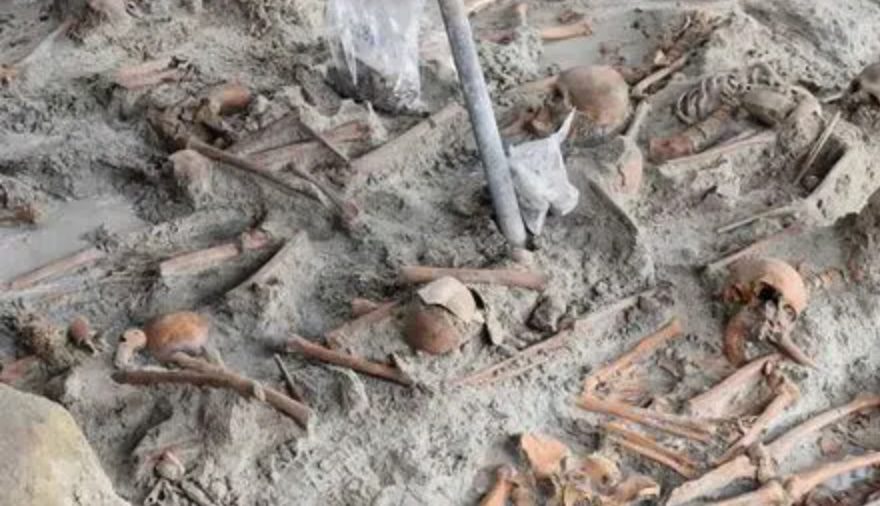
The third interim report on the Chemmani mass grave excavations, submitted on October 19, 2026, to the Jaffna Magistrate’s Court by archaeologist Prof. Raj Somadeva, has triggered widespread shock, dismay, and justified outrage among forensic observers, legal advocates, and human rights defenders. Rather than providing a rigorous, scientifically grounded forensic assessment, the report advances the speculative hypothesis that the mass accumulation of human remains at Chemmani may be the consequence of a forgotten epidemic, a natural disaster, or customary religious burial rites.
A meticulous examination of the report reveals an alarming pattern: it systematically evades perimortem trauma, dismisses contemporary material evidence, ignores the epidemiological and administrative realities of the Jaffna peninsula, and directly conflicts with sworn judicial testimonies. When situated alongside Prof. Somadeva’s broader historiographical record and the documented ethnocentric posture of Sri Lanka’s state archaeology apparatus, the document represents a profound abdication of scientific neutrality.
Screenshot
1. Fatal Forensic and Pathological Flaws
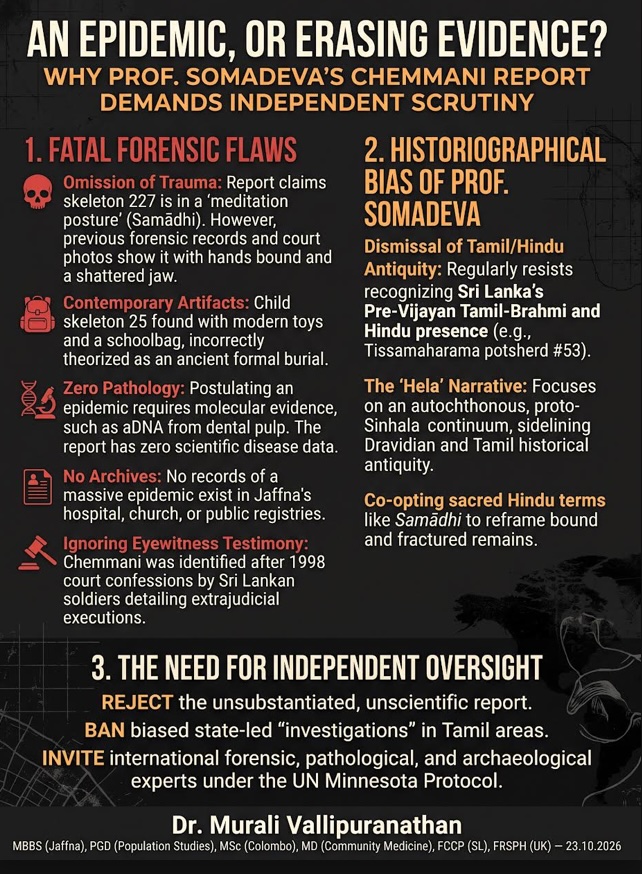
Omission of Perimortem Trauma and Restraints: The “Meditation” Distortion
The report pays particular attention to two skeletons uncovered in a seated posture—numbered 227 and 429—speculating that seated burial is documented in Hindu ascetic traditions, specifically invoking the sacred concepts of Samādhi and Jīva Samādhi. Captioned in the report as “a skeleton buried in meditation posture,” Skeleton 227 is presented as a candidate for a peaceful, customary religious interment.
This depiction directly contradicts empirical forensic findings already documented in the Jaffna Magistrate’s Court. When Skeleton 227 was exhumed in September 2025, contemporaneous on-site records, photographic evidence, and Judicial Medical Officer (JMO) observations revealed that the individual was found with hands bound, a fractured skull, and a shattered jawbone. Classifying an individual who suffered catastrophic blunt-force perimortem craniomaxillofacial trauma while physically restrained as being interred in a tranquil “meditation posture” is not a benign archaeological oversight; it is an egregious misrepresentation of forensic reality that whitewashes lethal violence.
Distortion of Contemporary Material Artifacts
The report points to Skeleton 25 as its prime example of a “relatively formal burial,” citing small nails and degraded cloth fragments to speculate about the remnants of a traditional wooden coffin.
Crucially, the report omits the age and identity profile of this victim. As confirmed by the JMO before the court in July 2025, Skeleton 25 belongs to a young female child aged between four and five years. The artifacts recovered with her remains included a modern blue school bag printed with English alphabet letters, toy sandals featuring cartoon bears, and plastic feeding bottles. Similar child-associated items were linked to Skeletons 48 and 56. Small children interred with modern school satchels, cartoon-decorated sandals, and toys do not represent formal ceremonial coffin burials. They are the undeniable material hallmarks of contemporary civilian abduction, displacement, and extrajudicial execution.
Zero Paleomicrobiological or Pathological Substantiation
From an epidemiological and pathological standpoint, postulating that a mass burial site containing at least 574 individuals—where 41 percent are classified as children and 22 percent as infants (nearly two-thirds of the total dead)—is the result of an “infectious disease epidemic” requires rigorous molecular substantiation.
Validating an epidemic hypothesis demands paleomicrobiological confirmation: ancient DNA (aDNA) sequencing extracted from preserved dental pulp or osteological evidence of skeletal lesions consistent with infectious pathogens (such as Vibrio cholerae, Yersinia pestis, or Salmonella enterica). Prof. Somadeva’s 17-page report offers zero laboratory pathological data, zero molecular sequencing, and zero disease markers. To advance an infectious catastrophe theory in court without a shred of pathological evidence violates the basic standards of forensic medicine.
Complete Absence of Public Health and Archival Records
If a sudden, catastrophic epidemic of such lethal magnitude swept the Jaffna peninsula in the modern era—decimating hundreds of individuals with an extraordinary mortality skew toward infants and young children—it would have generated an unavoidable, extensive institutional footprint.
Jaffna has historically possessed a robust, literate public health network, including the Jaffna Teaching Hospital, peripheral health clinics, municipal registries, and comprehensive Roman Catholic, Church of South India (CSI), and Anglican parish death registers. No such unrecorded, mass-casualty epidemiological disaster exists in the medical archives or demographic histories of Jaffna during this period. Attempting to invent an undocumented epidemic to explain away an accumulation of dead bodies flies in the face of public health reality.
Disregarding Sworn Judicial Confessions
The Chemmani graves were not discovered as an accidental archaeological curiosity. The site was originally exposed through sworn courtroom admissions during the 1998 Krishanthi Kumaraswamy trial, where former Sri Lankan Army soldiers, including Lance Corporal Somaratne Rajapakse, testified under oath that hundreds of Tamil civilians arrested and forcibly disappeared in the mid-1990s were executed and buried at Chemmani by state security forces.
Reclassifying a site identified via military confessions of extrajudicial execution as a “natural epidemic” or “customary burial ground”—without attempting to reconcile the judicial record, JMO autopsy filings, or previous Human Rights Commission inquiries—constitutes a deliberate forensic decoupling designed to evade legal accountability.
2. The Historiographical Record of Prof. Raj Somadeva
The unscientific leaps in the Chemmani report cannot be evaluated in a vacuum. They must be viewed through the lens of Prof. Somadeva’s longstanding public and academic record:
Denial of Pre-Vijayan Tamil & Dravidian Antiquity: Vast archaeological and epigraphic evidence—ranging from the Early Iron Age Megalithic Black and Red Ware (BRW) horizons across Pomparippu, Kathiraveli, and Kandarodai to the bilingual Kō Vēta Anaikoddai seal and early Brahmi inscriptions referencing Dameda (Tamil) householders and chieftains—irrefutably demonstrates an organic, pre-Vijayan Dravidian cultural presence in Sri Lanka prior to the 6th century BCE. Prof. Somadeva has consistently resisted recognizing this early Tamil-Brahmi and Hindu antiquity. A notorious example is the Tissamaharama potsherd (No. 53): while distinguished epigraphist Iravatham Mahadevan and Prof. P. Pushparatnam deciphered the text as Early Tamil-Brahmi (“Tirali Muri”), Somadeva forcefully rejected this consensus, contriving an untenable Sinhala-Prakrit reading (“Purathi Utharasha Mudi”).
The “Hela” Autochthonous Continuum: In public lectures and popular writings, Somadeva has actively promoted an indigenous proto-Sinhala (“Hela”) civilizational model that retroactively nationalizes the island’s deep prehistory, subsuming all ancient regional material cultures into an exclusively proto-Sinhala continuum while marginalizing the island’s Tamil and Dravidian heritage.
Instrumentalizing Hindu Terminology: Invoking sacred Saivite concepts such as Samādhi to characterize restrained human remains suffering from blunt-force head trauma is a dangerous form of historical weaponization. Far from exhibiting cultural sensitivity, it uses religious nomenclature as an ideological smokescreen to obscure extrajudicial violence.
3. Institutional Complicity & The Imperative for International Oversight
The systemic bias and historical distortions characterizing Sri Lanka’s Department of Archaeology and related state-sponsored heritage projects have already been extensively documented—including in these columns [1]—highlighting how archaeological authority is frequently deployed to alter local demographics, challenge multi-cultural heritage, and undermine minority land rights in the North and East.
When the state itself stands accused of serious human rights violations and war-era mass disappearances, allowing state-appointed domestic archaeological consultants to unilaterally redefine forensic execution sites as “epidemics” constitutes an irreconcilable conflict of interest.
The international human rights community, Tamil civil society, and legal representatives must act decisively:
1. Formal Rejection of the Interim Report: The legal team representing the victims’ families at the Jaffna Magistrate’s Court must categorically object to Prof. Somadeva’s interim report, demanding that its unsubstantiated assertions be struck from the record due to the total absence of pathological corroboration and its direct omission of documented trauma.
2. Prohibiting Unqualified Speculation in Mass Grave Sites: Domestic archaeologists with documented historiographical biases must not be granted unchecked control to interpret complex forensic crime scenes in conflict-affected regions. Forensic archaeology must remain strictly subordinate to judicial medicine, physical anthropology, and international criminal investigation standards.
3. Mandating International Independent Oversight Under the Minnesota Protocol: In light of the Sri Lankan state’s historic refusal to permit independent accountability mechanisms, it is imperative that contested mass graves—including Chemmani, Kokkuthoduvai, and Mannar—be investigated strictly under the UN Minnesota Protocol on the Investigation of Potentially Unlawful Death. This requires the immediate deployment of accredited, independent international forensic pathologists, anthropologists, and molecular geneticists to oversee all excavations, carbon dating, aDNA profiling, and chain-of-custody protocols.
Justice cannot be served when the victims of enforced disappearances and state killings are posthumously categorized as victims of phantom diseases. The international community and the judicial system must see this interim report for what it is: an attempt to bury forensic truth beneath a veneer of pseudo-scientific revisionism.
References
Vallipuranathan, M. (2020). A Challenge To Multiculturalism: The Biased History Of The Sri Lankan Department Of Archaeology. Colombo Telegraph. Available at: https://www.colombotelegraph.com/index.php/a-challenge-to-multiculturalism-the-biased-history-of-the-sri-lankan-department-of-archaeology/
*Dr. Murali Vallipuranathan is an MBBS (Jaffna), PGD (Population Studies), MSc (Colombo), MD (Community Medicine), FCCP (SL), and FRSPH (UK). He is a visiting lecturer at the Universities of Peradeniya and Colombo, a Senior Specialist of the Ministry of Health, and a Council Member of the Sri Lanka Medical Association. The views expressed are offered with social responsibility to improve human rights, social justice, and accountability in Sri Lanka and do not reflect official positions.