

By Sarath Dissanayake –

Sarath Dissanayake
Author’s Note: This article is dedicated to Tuskers Kavanthissa and Bhathiya, and to all the pachyderms and wildlife that have perished at the hands of their human guardians. May it serve as an urgent appeal to ensure the absolute protection and care of all remaining elephants, domestic animals, and wildlife within their natural habitats.
The Martyrdom of Kavanthissa and the Collapse of Conscience
The horrendous stories detailing the tragic fate, immense suffering, and cruel deaths inflicted upon our pachyderms have come to light in quick succession all too often over the last several years. The recent wave of tragedies surrounding the circumstances leading to the sudden death of Tusker Kavanthissa serves as a heartbreaking focal point of a much larger, darker reality. Kavanthissa was not merely a magnificent animal; he was a living repository of our natural heritage, a rare and irreplaceable national icon. His tragic demise stands as a damning indictment of our collective guilt, a stark manifestation of a lackluster attitude and a systematic lack of care shown towards our wildlife in general, and elephants in particular.
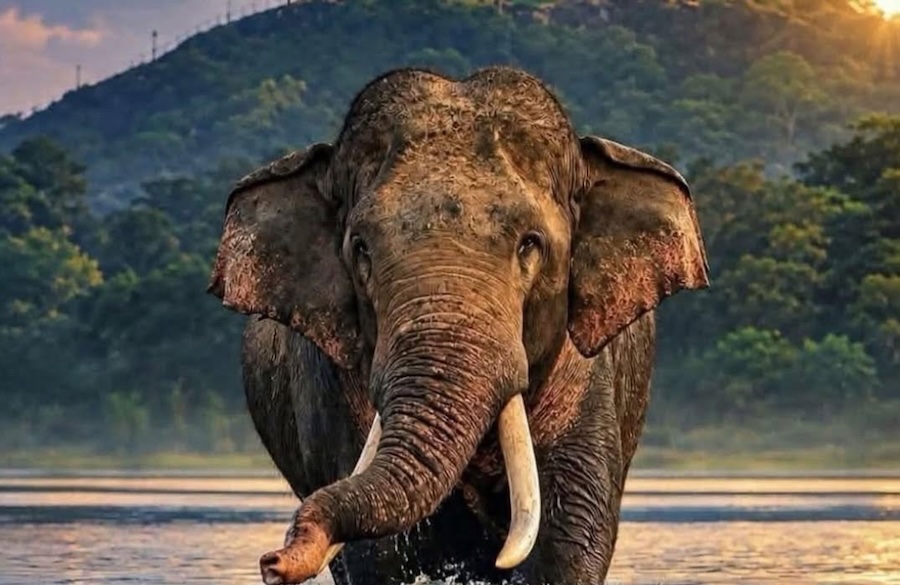
Tuskers Kavanthissa
Across our landscapes, these sensitive and intelligent giants are increasingly placed under unsustainable pressure. Tragically, the very elements of society that should serve as their guardians have instead become their ultimate curse and villains. The state, on its part, has fundamentally failed to live up to its bounden duty to safeguard these majestic creatures. Despite widespread outrage, elephants continue to fall under horrific conditions, with no sign of reprieve from policy makers.
A Continual Voice for the Voiceless
In an extraordinary disclosure that underscores the absolute scale of this ecological warfare, Environment Minister Dr. Dammika Patabendi revealed to Parliament on 20th October that a staggering 784 wild elephants have perished across the island from 2023 to date. In the first nine months of 2026 alone, a horrifying 286 wild elephant deaths were reported; a staggering average of literally one elephant carcass scattered across our lands every single day. The primary weapons of this quiet war are as cruel as they are indiscriminate: Hakka Patas (jaw-bombs concealed in food), illegal high-voltage wire tappings, agricultural poisoning, and targeted shootings. With elephant mortality rates hitting an all-time high, this devastating predicament cannot be understated or ignored as a tragic fait accompli.
In fact, this unfolding catastrophe epitomizes the very warnings documented in my previous analyses, namely, “A Wake-up Call on Human-Elephant Conflict and Animal Cruelty” (Daily Financial Times, August 8, 2025) and “The Cost of Coexistence: Navigating Sri Lanka’s Deadly Human-Elephant Conflict” (Colombo Telegraph, August 22, 2026). My relentless advocacy for these magnificent, silent giants remains unwavering, yet our institutional protective systems continue to fail them at every turn, marking what can only be described as a betrayal of the highest degree.
A Hollowed Legacy: The 2,500-Year Contradiction
For nearly 2,500 years, since the Buddha’s Parinirvana in 543 BC, Sri Lanka has proudly positioned itself as the foremost global bastion and center of Theravada Buddhism. We have historically prided ourselves on keeping these sacred, ancient lineages alive. Yet, our long-held traditions have now come under intense global scrutiny, tested and found profoundly wanting. We have allowed our pristine glory to be compromised, leaving defensive, voiceless, protected creatures, which are designated as Endangered on the global IUCN Red List, at the absolute mercy of an ungrateful present.This systemic cruelty exposes a deep, agonizing ethical contradiction within our societal fabric.
For over two millennia, Buddhist countries have looked up to Sri Lanka as a beacon of spiritual purity. The cornerstone of that reputation is the profound practice of Metta (boundless loving-kindness) and Karuna (compassion) toward all living beings; both human and animal alike. To witness the current spate of killings, the severe lack of empathy, and the blatant neglect of our wildlife is to witness the hallowing out of our spiritual core. We have traded genuine, active compassion for empty, ritualistic pride, turning our backs on the very tenets that defined our civilization’s moral greatness.
A Cabinet Minister’s Outburst Backfires and Boomerangs on the Administration
It is precisely within this climate of compromised values that our governance must be scrutinized. In this context, one must confront the alarming reality of a highly controversial parliamentary address delivered by a cabinet minister in 2025, who openly called on farmers to take unchecked, unilateral action against wild animals encroaching on cultivated farmlands. In a reckless abdication of responsibilities, the minister assured farming communities that the government would neither harbor grudges nor hold them legally accountable for acts of cruelty perpetrated in defense of their crops.
The minister’s outburst has completely backfired, boomeranging on the administration and igniting widespread fury among environmentalists, animal welfare organizations, and citizens at large who view it as a blatant betrayal of the state’s progressive mandate. By actively instigating the lawless slaughter of innocent, defensive creatures at the behest of the cabinet minister, the current administration has laid bare its hollow intentions. Condolences or public tears over fallen tuskers ring entirely empty when the state itself acts as the primary abettor of wildlife destruction, validating a dangerous wave of vigilantism that leaves the fate of Sri Lanka’s vanishing elephants exposed to severe systemic vulnerabilities; a concerning shift that suggests a departure from hitherto advocated best practices.
Geopolitical Friction Over Wildlife Diplomacy: Implications & Constraints
This deep ethical contradiction is no longer just an internal crisis; it has spilled over into the international arena, severely fracturing our ties with a fellow Theravada Buddhist nation. Recent reports in the mainstream media reveal a growing, humiliating backlash from Thailand; a country where roughly over 90% of the population practices Buddhism and holds its heritage in high-stead. Driven by the tragic news surrounding our local wildlife, particularly the demise of Tusker Kavanthissa, Thai animal rights activists and authorities are applying immense pressure to recall their remaining gifted elephants from Sri Lankan soil. This stems from a growing international perception that Sri Lanka’s protective systems are failing to shield our prided national icons, a vulnerability that now threatens the safety of those entrusted to us as sacred diplomatic gifts.
This unfortunate chapter mirrors the diplomatic spat of 2023, when public outcry in Bangkok forced the high-profile repatriation of the ailing Thai tusker, Sak Surin (Muthu Raja), who suffered years of neglect and torture at a local temple. Today, history threatens to repeat itself. Activists are picketing the SL Embassy in Bangkok to rescue the remaining tuskers before they meet a similarly tragic fate. For a nation historically revered as ‘Thrice-Blessed,’ to be viewed by our spiritual peers as a place of systemic peril for sacred animals is an unmitigated disgrace to our global standing.
Protocols, Pitfalls, and Paradoxes: The Mihintale Controversy
It is against this fragile geopolitical backdrop that one must read the recent controversy surrounding the visit of Thai Deputy Prime Minister Suphajee Suthumpun to Sri Lanka. The high-powered Thai dignitary arrived to participate as a chief guest in the sacred unveiling and enshrinement of the pinnacle crest jewel at the newly built Mihindu Maha Seya within the historic Mihintale temple premises. However, the event has triggered condemnation from the opposition, castigating the state for an egregious lack of official protocol, formal courtesies, and state-level security to the visiting leader. While the Ministry of Foreign Affairs swiftly issued a clarification trying to downplay the issue by asserting that the Thai dignitary traveled strictly in a private capacity and received all appropriate courtesies, the political firestorm persists. For a new administration, such lapses toward a top leader from a nation with whom we share millennial-long spiritual and civilizational ties risk straining what should otherwise be a sacred pilgrimage.
This perceived protocol oversight unfolds alongside a major bilateral milestone which is envisaged to facilitate a vital economic lifeline for 10,000 Sri Lankans in Thailand. Orchestrated during the visit of FM Vijitha Herath to Thailand barely a fortnight ago, the agreement was envisioned to support and sustain Sri Lanka’s long-term recovery after years of stagnation. It comes in the backdrop of a rather unwarranted paradox; while the state actively seeks to build strategic bridges and foster rapprochement with like-minded allies, these administrative glitches risk casting a shadow over the multi-faceted, long-cherished relations between Sri Lanka and Thailand; a bond historically characterized by mutual respect and a shared heritage across every conceivable sphere of interest. Unless the current authorities execute a careful course correction in handling international relations with our traditional allies, such lapses will continue to highlight a critical need for greater diplomatic finesse.
Beyond the Bureaucracy: Preserving our Diplomatic Legacy
I, for one, have closely followed the current administration with a constructive disposition and a genuinely favorable impression of the Foreign Ministry’s handling of diplomacy. However, for observers who have maintained an optimistic view of the administration’s early commitments to nuanced Asian diplomacy, these haphazard fallouts are somewhat concerning. Current trends suggest a risk of over-shadowing hard-won diplomatic milestones, primarily due to a momentary departure from established protocols and the meticulous attention to detail required in statecraft. The Foreign Ministry’s long held reputation for cultivating deep global friendships and projecting an image of a hospitable, reliable nation now finds its relationships tested by administrative glitches that often arise under the pressure of domestic exigencies. Such delicate controversies portend a new challenge as the country approaches the historic International Buddhist Conference slated for late November and early December, where prominent global Buddhist delegations are expected to convene. To ensure the continuity of our global standing, the highest echelons of power must engage in careful reflection, treading the path of statecraft with cautious humility and a bounden duty to preserve our shared civilizational spirits.
Reconciling Heritage with Humanity: The Call for Course Correction
The current crisis has escalated far beyond a localized environmental issue; it has rapidly transformed into a full-scale national catastrophe that is taking a dangerous turn for the worse. When a society actively demonizes and destroys its most vulnerable keystone species, it signals a broader moral collapse that threatens our collective social fabric. Passive conservation and hollow political slogans will no longer suffice to stem this tide of blood and suffering.
True course correction demands that we actively bridge the widening chasm between our professed spiritual values and the harsh realities on the ground. While the recent gazetting of the new Animal Welfare Bill introduces long-overdue “duty of care” principles and strict penalties for acts of cruelty, a legislative draft alone cannot halt an iron hook or an explosive trap in the field. Parliament must demonstrate the unyielding political courage to pass this legislation swiftly without allowing special-interest loopholes to dilute its power.
Ultimately, how we navigate this human-elephant crisis will determine the true state of our nation. We must act whole-heartedly, guided by an unwavering conscience, to stand as an unyielding voice for the voiceless. Let us protect these silent giants, allowing them the dignity to thrive peacefully within their own natural habitats, and pray that saner counsel finally prevails before our national icons vanish forever.
“He is not noble who harms living creatures. By having harmlessness towards all living creatures, a man is called noble.” — The Buddha (Dhammapada, Verse 270)
References :-
1.The Cost of Coexistence: Navigating Sri Lanka’s Deadly Human-Elephant Conflict
2. The Cost of Coexistence: Navigating Sri Lanka’s Deadly Human-Elephant Conflict
*The writer is a retired Ambassador and former Foreign Ministry Spokesman. He can be reached at schandrad@hotmail.com