

By Mahinda Pathirana –

Mahinda Pathirana
A sitting MP has now spent more than fifty days in custody without a conviction. Whatever the outcome of his trial, the way we detain the un-convicted deserves scrutiny.
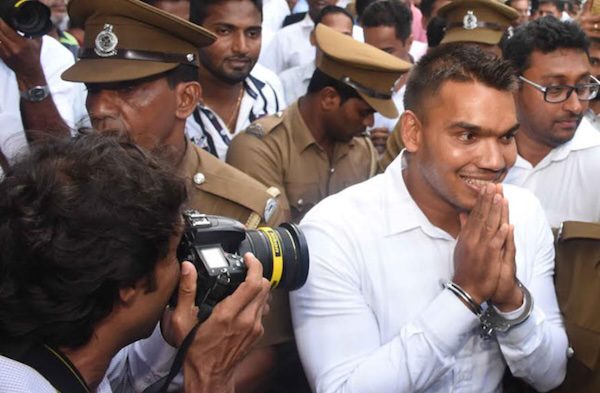
Parliamentarian Namal Rajapaksa was arrested by the Commission to Investigate Allegations of Bribery or Corruption (CIABOC) on 4 September over alleged bribes linked to SriLankan Airlines’ 2013 Airbus purchase. On 27 October the Attorney General indicted him on 24 charges, listing 59 witnesses, before the Permanent High Court Trial-at-Bar, which has fixed the case for 19 November. He also remains remanded in the separate Krrish case, where a bail order is due on 3 November.
This article does not assess the evidence; that is for the court alone. Nor does it question the integrity of any judicial officer bound to apply the law as Parliament wrote it, or suggest that a famous surname should earn anyone favor. Corruption has cost this country dearly, and prosecuting it is a legitimate public demand. My concern is narrower: what becomes of the presumption of innocence when detention before trial turns from the exception into the rule.
A presumption turned upside down
Article 13(5) of our Constitution declares that every person shall be presumed innocent until proven guilty. The Bail Act of 1997 goes further, stating as its guiding principle that granting bail is the rule and refusing it the exception.
Yet in this case bail has been opposed on the strength of a certificate issued by the CIABOC Director General under section 149 of the Anti-Corruption Act. Once such a certificate is filed, release is possible only if the suspect proves “exceptional circumstances”. Arguments that investigations were complete, that his parents are elderly and unwell, and that the principal witness’s credibility is contested were all found insufficient to meet that bar.
The magistrates were applying the statute. That is precisely the problem. The certificate inverts the Bail Act: the accused must now prove why he deserves to be free, and the trigger is pulled not by a judge but by an official of the very body prosecuting him.
To its credit, the Magistrate’s Court observed in October that transfer to a special High Court should not deny a suspect a meaningful chance to seek bail. The defence notes that the Trial-at-Bar is already hearing another lengthy trial daily. If the Airbus trial cannot begin promptly, how long may an un-convicted person be held under a burden he may never be able to discharge?
What other democracies have learned
In Ilijkov v Bulgaria (2001), the European Court of Human Rights held that requiring a detained person to prove he should be released effectively reverses the right to liberty. It is the State, the Court said, that must justify continued detention with relevant and sufficient reasons. In Letellier v France (1991), the same Court found that the seriousness of the charge and public feeling about it cannot by themselves justify keeping someone in prolonged custody.
More troubling is Merabishvili v Georgia (2017), where the Grand Chamber found that a former prime minister’s pre-trial detention had partly served a purpose the law did not allow. I draw no equivalence; the case simply shows that serious courts recognise the risk that detention can serve ends beyond justice, a risk greatest when the detainee is a political figure.
Closer to home, India’s Prevention of Money Laundering Act contains a reverse burden much like ours. Yet in Manish Sisodia v Directorate of Enforcement (2024), India’s Supreme Court released a senior opposition politician after some seventeen months in custody without trial having begun, warning that bail must not be withheld as a form of punishment. It reaffirmed a principle Justice Krishna Iyer articulated decades earlier: bail is the rule, jail the exception.
The UN Human Rights Committee’s General Comment No. 35, interpreting the International Covenant on Civil and Political Rights to which Sri Lanka is a party, says pre-trial detention must rest on an individual assessment of necessity and must not be made mandatory for whole categories of offences. A prosecutorial certificate covering an entire class of charges sits uneasily with that standard.
The cost to public trust
A justice system does not run on law alone. It runs on the belief of ordinary citizens that the law is applied fairly, and that belief is fragile.
The SLPP alleges that the arrest was timed to precede its planned Anuradhapura rally; supporters of the government reply that the law is simply taking its course. A newspaper column cannot settle that. But when an opposition leader is held for weeks under a mechanism that removes the ordinary presumption in favour of bail, suspicion of persecution flourishes, deserved or not, and every further remand date reinforces it.
The damage cuts both ways. A conviction would be shadowed by claims that he was punished before he was judged; a faltering case would suggest liberty was taken for nothing. Sri Lanka has seen this before: many high-profile prosecutions launched after 2015 stalled or were withdrawn after 2019, leaving citizens on every side convinced that justice bends to whoever holds power.
Those in government today should also remember that laws making detention easy are never used by only one government. The powers built now will be inherited by whoever comes next.
And this is not only about one man with senior counsel and television cameras. Thousands of ordinary Sri Lankans wait in overcrowded remand cells with neither. A principle bent for the prominent will not be straightened for the poor.
A way forward
None of this requires going soft on corruption. Courts already have effective tools: surrender of passports, travel bans, heavy sureties, regular reporting, and strict conditions on contact with witnesses. Such conditions were imposed when bail was granted to his mother and to his private secretary in related inquiries.
Parliament should revisit section 149 so that a certificate informs a judge’s discretion rather than displacing it. Statutory limits on pre-trial detention, and guaranteed early trial dates for remanded accused, would protect both liberty and the credibility of prosecutions.
The true test of a justice system is not how it treats those we admire, but how it treats those we suspect. If the presumption of innocence is to mean anything, it must hold most firmly when it is least popular.