

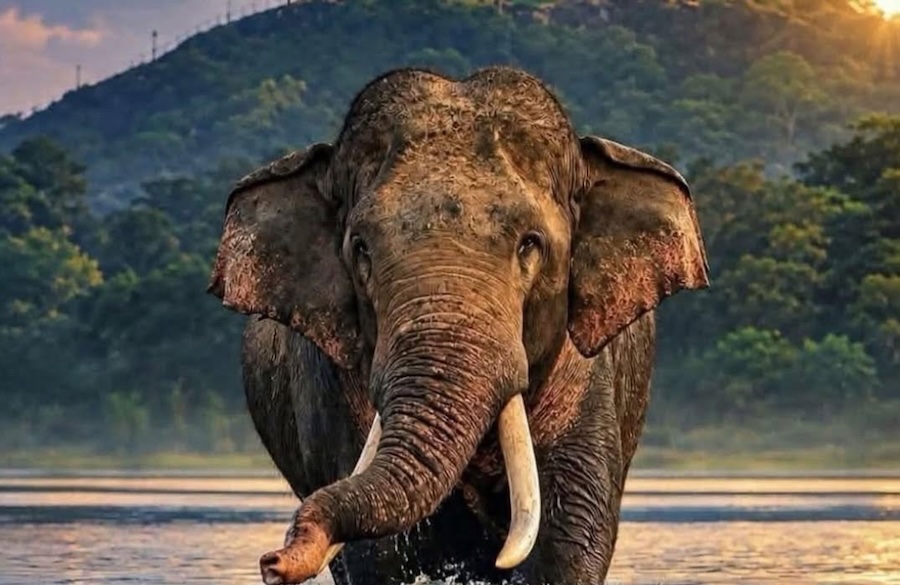
By Sarath Dissanayake –

Sarath Dissanayake
Author’s Note: This article is dedicated to Tuskers Kavanthissa and Bhathiya, and to all the pachyderms and wildlife that have perished at the hands of their human guardians. May it serve as an urgent appeal to ensure the absolute protection and care of all remaining elephants, domestic animals, and wildlife within their natural habitats.
The Martyrdom of Kavanthissa and the Collapse of Conscience
The horrendous stories detailing the tragic fate, immense suffering, and cruel deaths inflicted upon our pachyderms have come to light in quick succession all too often over the last several years. The recent wave of tragedies surrounding the circumstances leading to the sudden death of Tusker Kavanthissa serves as a heartbreaking focal point of a much larger, darker reality. Kavanthissa was not merely a magnificent animal; he was a living repository of our natural heritage, a rare and irreplaceable national icon. His tragic demise stands as a damning indictment of our collective guilt, a stark manifestation of a lackluster attitude and a systematic lack of care shown towards our wildlife in general, and elephants in particular.
Tuskers Kavanthissa
Across our landscapes, these sensitive and intelligent giants are increasingly placed under unsustainable pressure. Tragically, the very elements of society that should serve as their guardians have instead become their ultimate curse and villains. The state, on its part, has fundamentally failed to live up to its bounden duty to safeguard these majestic creatures. Despite widespread outrage, elephants continue to fall under horrific conditions, with no sign of reprieve from policy makers.
A Continual Voice for the Voiceless
In an extraordinary disclosure that underscores the absolute scale of this ecological warfare, Environment Minister Dr. Dammika Patabendi revealed to Parliament on 20th October that a staggering 784 wild elephants have perished across the island from 2023 to date. In the first nine months of 2026 alone, a horrifying 286 wild elephant deaths were reported; a staggering average of literally one elephant carcass scattered across our lands every single day. The primary weapons of this quiet war are as cruel as they are indiscriminate: Hakka Patas (jaw-bombs concealed in food), illegal high-voltage wire tappings, agricultural poisoning, and targeted shootings. With elephant mortality rates hitting an all-time high, this devastating predicament cannot be understated or ignored as a tragic fait accompli.
In fact, this unfolding catastrophe epitomizes the very warnings documented in my previous analyses, namely, “A Wake-up Call on Human-Elephant Conflict and Animal Cruelty” (Daily Financial Times, August 8, 2025) and “The Cost of Coexistence: Navigating Sri Lanka’s Deadly Human-Elephant Conflict” (Colombo Telegraph, August 22, 2026). My relentless advocacy for these magnificent, silent giants remains unwavering, yet our institutional protective systems continue to fail them at every turn, marking what can only be described as a betrayal of the highest degree.
A Hollowed Legacy: The 2,500-Year Contradiction
For nearly 2,500 years, since the Buddha’s Parinirvana in 543 BC, Sri Lanka has proudly positioned itself as the foremost global bastion and center of Theravada Buddhism. We have historically prided ourselves on keeping these sacred, ancient lineages alive. Yet, our long-held traditions have now come under intense global scrutiny, tested and found profoundly wanting. We have allowed our pristine glory to be compromised, leaving defensive, voiceless, protected creatures, which are designated as Endangered on the global IUCN Red List, at the absolute mercy of an ungrateful present.This systemic cruelty exposes a deep, agonizing ethical contradiction within our societal fabric.
For over two millennia, Buddhist countries have looked up to Sri Lanka as a beacon of spiritual purity. The cornerstone of that reputation is the profound practice of Metta (boundless loving-kindness) and Karuna (compassion) toward all living beings; both human and animal alike. To witness the current spate of killings, the severe lack of empathy, and the blatant neglect of our wildlife is to witness the hallowing out of our spiritual core. We have traded genuine, active compassion for empty, ritualistic pride, turning our backs on the very tenets that defined our civilization’s moral greatness.
A Cabinet Minister’s Outburst Backfires and Boomerangs on the Administration
It is precisely within this climate of compromised values that our governance must be scrutinized. In this context, one must confront the alarming reality of a highly controversial parliamentary address delivered by a cabinet minister in 2025, who openly called on farmers to take unchecked, unilateral action against wild animals encroaching on cultivated farmlands. In a reckless abdication of responsibilities, the minister assured farming communities that the government would neither harbor grudges nor hold them legally accountable for acts of cruelty perpetrated in defense of their crops.
The minister’s outburst has completely backfired, boomeranging on the administration and igniting widespread fury among environmentalists, animal welfare organizations, and citizens at large who view it as a blatant betrayal of the state’s progressive mandate. By actively instigating the lawless slaughter of innocent, defensive creatures at the behest of the cabinet minister, the current administration has laid bare its hollow intentions. Condolences or public tears over fallen tuskers ring entirely empty when the state itself acts as the primary abettor of wildlife destruction, validating a dangerous wave of vigilantism that leaves the fate of Sri Lanka’s vanishing elephants exposed to severe systemic vulnerabilities; a concerning shift that suggests a departure from hitherto advocated best practices.
Geopolitical Friction Over Wildlife Diplomacy: Implications & Constraints
This deep ethical contradiction is no longer just an internal crisis; it has spilled over into the international arena, severely fracturing our ties with a fellow Theravada Buddhist nation. Recent reports in the mainstream media reveal a growing, humiliating backlash from Thailand; a country where roughly over 90% of the population practices Buddhism and holds its heritage in high-stead. Driven by the tragic news surrounding our local wildlife, particularly the demise of Tusker Kavanthissa, Thai animal rights activists and authorities are applying immense pressure to recall their remaining gifted elephants from Sri Lankan soil. This stems from a growing international perception that Sri Lanka’s protective systems are failing to shield our prided national icons, a vulnerability that now threatens the safety of those entrusted to us as sacred diplomatic gifts.
This unfortunate chapter mirrors the diplomatic spat of 2023, when public outcry in Bangkok forced the high-profile repatriation of the ailing Thai tusker, Sak Surin (Muthu Raja), who suffered years of neglect and torture at a local temple. Today, history threatens to repeat itself. Activists are picketing the SL Embassy in Bangkok to rescue the remaining tuskers before they meet a similarly tragic fate. For a nation historically revered as ‘Thrice-Blessed,’ to be viewed by our spiritual peers as a place of systemic peril for sacred animals is an unmitigated disgrace to our global standing.
Protocols, Pitfalls, and Paradoxes: The Mihintale Controversy
It is against this fragile geopolitical backdrop that one must read the recent controversy surrounding the visit of Thai Deputy Prime Minister Suphajee Suthumpun to Sri Lanka. The high-powered Thai dignitary arrived to participate as a chief guest in the sacred unveiling and enshrinement of the pinnacle crest jewel at the newly built Mihindu Maha Seya within the historic Mihintale temple premises. However, the event has triggered condemnation from the opposition, castigating the state for an egregious lack of official protocol, formal courtesies, and state-level security to the visiting leader. While the Ministry of Foreign Affairs swiftly issued a clarification trying to downplay the issue by asserting that the Thai dignitary traveled strictly in a private capacity and received all appropriate courtesies, the political firestorm persists. For a new administration, such lapses toward a top leader from a nation with whom we share millennial-long spiritual and civilizational ties risk straining what should otherwise be a sacred pilgrimage.
This perceived protocol oversight unfolds alongside a major bilateral milestone which is envisaged to facilitate a vital economic lifeline for 10,000 Sri Lankans in Thailand. Orchestrated during the visit of FM Vijitha Herath to Thailand barely a fortnight ago, the agreement was envisioned to support and sustain Sri Lanka’s long-term recovery after years of stagnation. It comes in the backdrop of a rather unwarranted paradox; while the state actively seeks to build strategic bridges and foster rapprochement with like-minded allies, these administrative glitches risk casting a shadow over the multi-faceted, long-cherished relations between Sri Lanka and Thailand; a bond historically characterized by mutual respect and a shared heritage across every conceivable sphere of interest. Unless the current authorities execute a careful course correction in handling international relations with our traditional allies, such lapses will continue to highlight a critical need for greater diplomatic finesse.
Beyond the Bureaucracy: Preserving our Diplomatic Legacy
I, for one, have closely followed the current administration with a constructive disposition and a genuinely favorable impression of the Foreign Ministry’s handling of diplomacy. However, for observers who have maintained an optimistic view of the administration’s early commitments to nuanced Asian diplomacy, these haphazard fallouts are somewhat concerning. Current trends suggest a risk of over-shadowing hard-won diplomatic milestones, primarily due to a momentary departure from established protocols and the meticulous attention to detail required in statecraft. The Foreign Ministry’s long held reputation for cultivating deep global friendships and projecting an image of a hospitable, reliable nation now finds its relationships tested by administrative glitches that often arise under the pressure of domestic exigencies. Such delicate controversies portend a new challenge as the country approaches the historic International Buddhist Conference slated for late November and early December, where prominent global Buddhist delegations are expected to convene. To ensure the continuity of our global standing, the highest echelons of power must engage in careful reflection, treading the path of statecraft with cautious humility and a bounden duty to preserve our shared civilizational spirits.
Reconciling Heritage with Humanity: The Call for Course Correction
The current crisis has escalated far beyond a localized environmental issue; it has rapidly transformed into a full-scale national catastrophe that is taking a dangerous turn for the worse. When a society actively demonizes and destroys its most vulnerable keystone species, it signals a broader moral collapse that threatens our collective social fabric. Passive conservation and hollow political slogans will no longer suffice to stem this tide of blood and suffering.
True course correction demands that we actively bridge the widening chasm between our professed spiritual values and the harsh realities on the ground. While the recent gazetting of the new Animal Welfare Bill introduces long-overdue “duty of care” principles and strict penalties for acts of cruelty, a legislative draft alone cannot halt an iron hook or an explosive trap in the field. Parliament must demonstrate the unyielding political courage to pass this legislation swiftly without allowing special-interest loopholes to dilute its power.
Ultimately, how we navigate this human-elephant crisis will determine the true state of our nation. We must act whole-heartedly, guided by an unwavering conscience, to stand as an unyielding voice for the voiceless. Let us protect these silent giants, allowing them the dignity to thrive peacefully within their own natural habitats, and pray that saner counsel finally prevails before our national icons vanish forever.
“He is not noble who harms living creatures. By having harmlessness towards all living creatures, a man is called noble.” — The Buddha (Dhammapada, Verse 270)
References :-
1.The Cost of Coexistence: Navigating Sri Lanka’s Deadly Human-Elephant Conflict
2. The Cost of Coexistence: Navigating Sri Lanka’s Deadly Human-Elephant Conflict
*The writer is a retired Ambassador and former Foreign Ministry Spokesman. He can be reached at schandrad@hotmail.com
leelagemalli / October 24, 2026
Sarath, Thanks for the article. There are rumours that the elephant Kavanthissa was shot because someone was searching for its tusks, highlighting the lucrative business of ivory trafficking. If people in this country are genuinely concerned about wildlife conservation, why have they failed to demand a lasting national solution to the human-elephant conflict? This long-standing crisis has devastated communities across this small island, yet successive elected governments have failed to find sustainable solutions. The people living in affected areas continue to endure untold suffering, with their stories often unheard by the rest of the nation. Given the promises and rhetoric of the JVP/NPP, one might have expected meaningful progress on this issue within the past two years. Instead, the government appears to resort to “whataboutism” rather than providing convincing answers and practical solutions.
Tbc
/
leelagemalli / October 24, 2026
cont.
–
https://www.youtube.com/watch?v=rfbjTK4sRvo&t=69s
–
Some ministers have also attracted criticism for their public conduct and statements, raising questions about their commitment to responsible governance. Lal Kantha’s reported behaviour at public gatherings, for instance, has prompted concerns about the standards expected of a minister. Similarly, questions have been raised about Sunil Handunnetti’s alleged telephone harassment of monks who support the construction of reservoirs to protect wildlife. Beyond these controversies, there is much more to question about the government’s performance in wildlife conservation and its response to human-elephant conflict. Many Buddhists expect a stronger commitment to protecting animals and preserving nature. Yet, the public deserves to see that commitment reflected in concrete policies, accountability, and sustainable action—not merely in speeches and promises.
/
Sarath / October 24, 2026
LM,
1) Thank you for your thoughts. You have clearly highlighted why successive governments have failed miserably due to their lackluster performance in reining in real perpetrators and their chronic inaction at the policy level, creating a systemic inertia that consistently fails to implement decisive, structural measures against the illicit actors holding our nation’s biodiversity to ransom.
2) While the electorate maintained high expectations for the current administration based on its reformative platform, the lack of substantive, system-level change has unfortunately led to widespread public disillusionment. Ultimately, Sri Lanka’s vulnerable wildlife continues to pay a heavy price for the inaction of policymakers and governance frameworks. Addressing the human-elephant conflict and preventing environmental exploitation requires an immediate shift from political rhetoric to metrics-driven policies that guarantee accountability.
3) I fully endorse your forward-looking vision for a sustainable conservation model that ensures institutional integrity and ecological balance. Your dedication to championing this critical cause is highly appreciated.
Thanks and regards
/
old codger / October 24, 2026
“By actively instigating the lawless slaughter of innocent, defensive creatures at the behest of the cabinet minister, the current administration has laid bare its hollow intentions. Condolences or public tears over fallen tuskers ring entirely empty when the state itself acts as the primary abettor of wildlife destruction, “
Well, Sarath, what is YOUR suggestion? Who has votes, elephants or farmers? Let’s go to the beginning.
In Dutch times, elephants were common even around what is now Galle Face. The tea country too was full of elephants, mostly killed off by the British later. The hinterlands had plenty of elephants, which were a valuable export commodity at the time, since tractors hadn’t been invented.
It was DS Senanayake who had the bright idea of settling Southern landless peasants in these areas, once malaria had been controlled.
So, the problem is one of human invasion of elephant territory.
So, what to do? Send all the settlers back to the South? Or popularise birth control among elephants?
/
Sarath / October 24, 2026
OC,
1). Thank you for sharing your perspective and for providing that historical context on how land settlement policies initiated this crisis. Your direct and bold stance provides a compelling critique of the political will surrounding this issue.
2).The current situation is one in which our iconic elephants are subjected to step-motherly care. Instead of implementing a well-planned wildlife protection mechanism to halt human encroachment into sanctuaries, the state has abrogated its primary responsibilities, offering little more than lip service while putting these animals in peril.
3). While the government has recently initiated baseline measures, such as officially gazetting key ecological corridors like Hadapanagala and mobilizing military security detachments to track vulnerable tuskers, these new interventions ultimately represent a semblance of action that has come too little, too late for our dwindling wildlife.
4). While balancing the needs of farmers and wildlife is undeniably complex, the long-term failure to consistently execute baseline conservation strategies and enforce existing laws is what truly jeopardizes our remaining elephant population.
5) Resolving this deep-rooted crisis requires moving decisively past temporary political rhetoric toward sustained, metrics-driven enforcement that permanently legally protects and secures their habitats.
Thanks for pushing this vital conversation forward. Regards
/
raja H / October 25, 2026
Sri Lankans are such a strange lot. So many people are talking about one elephant killed by a human.
But very few are talking about the 500 humans killed and buried in Chemmani, not by elephants but by humans. Is Buddhist Karuna only for elephants?
/
Jit / October 25, 2026
Totally agree Raj! Tamil or Muslim lives are only secondary to elephants in this land full of stupid Sinhala Buddhist extremists. Clearly shows how weirdly the core theories of Buddhism are being understood and prioritized by the ‘sign board’ Buddhists in this country, including the author!!
/
Sarath / October 25, 2026
Jit,
1) Thanks for your brief comment. Your comment lacks substance and relies entirely on another commenter’s hypocrisy, falsehoods, and blindsided harangue. Making sweeping assertions out of false narratives grounded in ethnic and racial hatred only highlights the bankrupt nature of your arguments. Trying to turn a national ecological catastrophe and the critical state of our wildlife and citizens’ well-being into an ethnic dispute lacks sound reasoning, logic, and any constructive value, to say the least.
2) Your attempt to reduce a real national issue to a “Sinhala Buddhist” label is not only an insult to all Sri Lankans but also an attempt to hoodwink the intelligent CT readership, as if they can be fooled by your sheer labeling of the country’s Sinhala Buddhists as racists. This line of argument simply exposes a narrative driven by hatred and fallacy rather than verifiable facts. To dismiss the gravity of the human-elephant conflict by mischaracterizing concern for wildlife as extremism distorts a devastating problem that severely impacts rural Sri Lankans across all ethnic and religious communities
(TBC)
/
Jit / October 26, 2026
Sarath, Your lengthy stream of feeble, meaningless, and hollow words clearly demonstrates your attempt to dodge the core question. If you genuinely think readers are being fooled by your flowery rhetoric, please accept our deepest sympathies!!
Raj simply asked why so many people lament the death of one elephant, or even a couple of them, yet remain silent about the countless human beings who were tortured and buried under the guise of patriotism. The important question is should we talk more of them or of elephants?? What is your answer? A simple, “yes I do agree” or “No I do not agree” is enough to judge the level your compassion towards the non Buddhist and non Sinhalese people. You can enlighten us further by telling us your candid opinion on long list of SL armed forces kidnapping, torturing and killing (mostly) Tamils during those 30 dark years.
–
P.S: Please confine your reply in one comment, under the allowed 200 words…pretty please! Thank you!!
/
Sarath / October 26, 2026
Jit,
1) Thanks. At the outset, let me be absolutely clear that it is my prerogative to choose the direction, length, and style of my responses, all of which remain exclusively at my discretion.
2) Secondly, how dare you treat and justify the killings of these magnificent creatures with a pinch of salt, showing a blatant disregard for the fact that these are the country’s iconic tuskers, let alone Tusker Kawanthissa, who was recognized as Asia’s tallest tusker. To play down the staggering loss of 287 elephants in the first nine months of 2026 alone with mere deflective rhetoric—claiming that I remain silent about human rights abuses—makes absolutely no sense.
3) Because the subject of the article is explicitly centered on the plight of elephants and their deadly predicament, no person with an iota of kindness, remorse, or common sense would treat this unfolding crisis so lightly and audaciously. I have addressed your queries with the serious concern they deserve, and I have nothing more to add to your repeated deflections regarding unrelated allegations. That is the bottom line and the stark reality
Trust the above makes sense. Best regards.
/
Jit / October 27, 2026
Thank you for exposing that you care MORE for 287 elephants over hundreds, if not thousands of humans tortured and buried. Yes, I have read so many comments by you on elephant deaths but NOTHING on human massacres! You can correct me by showing just one comment you have made in CT in any article on human massacres that has happened in this land!! Just ONE comment please???
/
Sarath / October 25, 2026
Jit, (Contd)
3) Official Department of Wildlife Conservation (DWC) data shows that 287 wild elephants died alongside numerous human fatalities in farming communities during the first nine months of this year alone. This country-wide ecological and humanitarian crisis requires serious structural solutions rather than divisive rhetoric or unverified claims.
4) Sri Lankans who respect the country’s 2,500-year heritage and its foundational Buddhist philosophy understand that true Dhamma values all life universally. True compassion is not selective, nor is it mutually exclusive. Framing a critical environmental challenge as a communal hierarchy serves only to fracture the peace, stability, and unity that the vast majority of Sri Lankans strive to build. Please pitch your arguments based on hard facts rather than fiction in a public discourse that warrants a serious discussion on real issues impacting the country.
5) Trust the above makes sense and to your understanding.
Thanks and regards
/
Sarath / October 27, 2026
Jit,
1). Your focus on reducing a complex national issue into a narrow, communal frame demonstrates how completely blindsided you are by a divisive narrative. You and Raja appear to inhabit a cocoon world, constantly chanting the same mantra as if day-dreaming of a reality completely devoid of the country’s real and burning issues.
2). This selective focus is a form of amnesia that is completely unhealthy and deflective to public discourse. I have no panacea for these illusionary ills, which you yourselves must eventually come to terms with.
3). To dismiss a severe country-wide environmental crisis by labeling concern for our vanishing wildlife as “Sinhala Buddhist extremism” is an insult to the intelligence of the CT readership. Given that my article is exclusively on the human-elephant conflict and its devastating ecological and humanitarian consequences for farming communities across the country, trying to force a delusionary ethnic equation into this discourse is completely out of place. It ought to be dealt with under a different thread altogether, as it is an anathema to intelligent readers who are eagerly engaged in a serious discussion on the given subject.
4). Appreciate your understanding and patience. Thanks and regards
/
Sarath / October 25, 2026
Raja,
1). To reduce an ecological crisis to the loss of “one elephant” completely misrepresents both the gravity of the situation and the data itself. According to official records from the Department of Wildlife Conservation (DWC), 287 wild elephants have perished in the first nine months of this year alone. This is a devastating, country-wide humanitarian and environmental catastrophe impacting rural communities and wildlife, rather than an isolated incident.
2). Furthermore, introducing completely unrelated, unverified claims regarding the mass graves at Chemmani is an attempt to deflect from the current crisis. Drawing false equivalences based on unproven assertions does a grave disservice to intelligent readers and serves only to manipulate public sentiment.
3). True adherence to Buddhist Karuna (compassion) is universal and bound by a total commitment to non-violence and truth. It does not look away from real-world suffering, nor does it seek refuge in deflection. Protecting our island’s vanishing wildlife and addressing the human-elephant conflict is a matter of basic ecology and accountability, not a political or communal dispute.
4).Please bring facts to the debate rather than “fiction and myths” in a discourse warranting a serious public discussion on real issues impacting the country.
Regards
/
raja H / October 26, 2026
Mr Sarath,
My comment was not addressed to you, but you seem very upset. As a true Buddhist practising self-awareness, why is that?
I am only saying that many people seem more concerned about animals than about fellow humans.
You say Chemmani is “unverified “? What rubbish, why is Raj Somadeva digging there? Have you never heard of that schoolgirl Krishanthi and her mother raped and murdered in Chemmani. Your comment is completely heartless and insensitive. Would you write such a thing if your own female relatives were involved?
You must be joking when you write “(Buddhism) does not look away from real-world suffering, nor does it seek refuge in deflection”.
/
Sarath / October 26, 2026
Raja,
1). Thanks. Your claim that your comment was not addressed to me defies basic common sense and the standard etiquette of public discourse.
2). When a commenter publishes a response on a public forum regarding a specific article, that comment is inherently open to the entire readership and most certainly to the author. You cannot broadcast inflammatory assertions on a public platform and then hide behind a cloak of deflection when the author holds you accountable to facts.
3). Furthermore, your attempt to exploit the tragic case of Krishanthi Kumaraswamy to validate a completely unproven historical claim about 500 hidden bodies at Chemmani is deeply disingenuous. Pointing out that an explosive, politically charged number lacks verified forensic or judicial evidence is a matter of factual accuracy, not heartlessness.
4). True sensitivity does not mean exploiting historical traumas to distort an entirely separate ecological discussion about endangered wildlife.
5). That said, it is disappointing to note that if you choose to engage in public debate on real national issues, you must have the guts and should possess the capacity to face fact-checked replies rather than inventing excuses to avoid them for your convenience.
6). Trust the above clarifies. Thanks
/
leelagemalli / October 25, 2026
R,
That is certainly true. However, Sri Lankans are predominantly Sinhala Buddhists, and neither Buddhism nor its clergy and laity are immune to wrongdoing. Some politicians cling to religion, animal welfare, and traditional attire like koholla guliya (jackfruit gum) when elections approach, exploiting public sentiment to mislead voters. Despite their self-proclaimed superiority in literacy, political awareness remains alarmingly low across sections of society. Many form opinions based solely on YouTube headlines, arguing emotionally while ignoring facts. Even educated professionals seem unwilling to objectively assess the JVP-NPP government’s performance, with some blindly supporting another three years despite its apparent lack of tangible achievements.
/
leelagemalli / October 24, 2026
The way local sri Lankans express love and care can be unique, yet the growing number of stray dogs raises serious questions about our compassion and responsibility. Whenever I return home, I am confronted by stray dogs desperately seeking food. While many people struggle with poverty, others spend lavishly on expensive pets, often to impress friends and colleagues, portraying themselves as animal lovers. True compassion, however, goes beyond appearances. Despite proudly identifying as Sinhala Buddhists, many seem to have lost sight of mindfulness and empathy. These values should be nurtured across all generations. I also worry about the younger generation’s growing dependence on technology, declining respect for elders, and apparent disregard for social responsibility. Reckless driving, inadequate enforcement of traffic laws, and accidents involving both people and animals remain serious concerns. Have we made any meaningful progress over the past two years? Despite political changes and promises, many problems persist. Economic growth alone cannot uplift a nation without compassion, discipline, accountability, and respect for all living beings. Sri Lanka needs stronger law enforcement and a genuine cultural shift towards mindfulness and responsibility. Only then can we move forward with dignity and hope.
/
nimal fernando / October 25, 2026
As always ……….. it’s all AKD’s fault!
–
Bring back Ranil …… he can stand on Wajira Abeywardana’s shoulders ………. and make all the male elephants effeminate: Royal College tradition/style.
–
Problem nipped in the bud ……… everyone as happy as Larry ……….. and Sarath.
/
Sarath / October 25, 2026
NF,
1). Thanks for joining the conversation.
2). Yet your comment reduces a serious national crisis to a series of sensational fallacies, relying on political satire, myths, and hearsay rather than hard facts. Attempting to draw external political figures into this conversation is simply preposterous and serves only to build a narrative on false pretenses. The intelligent CT readership cannot be hoodwinked by fiction that avoids the reality of the situation.
3) Official Department of Wildlife Conservation (DWC) data shows that 287 wild elephants died alongside numerous human fatalities in farming communities during the first nine months of this year alone. This country-wide ecological and humanitarian catastrophe impacts citizens across all communities and demands serious structural solutions, not divisive political rhetoric or deflective humor.
4). Suffice it to note, the intelligent CT readership would invariably welcome commenters pitching their arguments and discussion points based on verifiable facts rather than fiction in a public discourse that warrants a serious discussion on real issues impacting the country.
5) Trust the above helps and clarifies
/
Jit / October 25, 2026
Your narratives are quite skewed, and biased Sarath!
“…..public tears over fallen tuskers ring entirely empty when the state itself acts as the primary abettor of wildlife destruction…..”
But you don’t mutter a word about pansale lokuhamuduruvo when an elephant dies after prolonged torture – just whisking off by adding “….who suffered years of neglect and torture at a local temple…..”
Dont you find the Buddhist priests the main culprits of elephant deaths, torture and harassment happening under their custody, before you jump to blame the government which do not have funds to employ Sherlock Holmes to protect each and every elephant in the wilderness when low life brutes are after their tuskers or shoot to protect their corn fields?
And your logic on Thai DPM visit to Mihintale (quoted from the opposition!!) is really shocking! Reading this, one has to wonder how you ever did your DPL job!!
Dont you know according to Vienna Convention “….. during a personal holiday, immunity is often reduced or unavailable, and host states need not treat foreign leaders as internationally protected persons…….”? This is more so valid as she had no known security issues whatsoever!
/
Sarath / October 25, 2026
1/2,
Jit,
1). Appreciate your joining the thread for the second time, which goes on to show your heightened interest and enthusiasm in issues impacting the nation, along with your candid comments, though they appear completely out of context and defy logic, reasoning, and common sense.
2). As already replied above to your initial comment on this thread, it is nothing but fair that intelligent CT readership demands from Commenters to pitch their arguments based on verifiable facts rather than personal attacks or selective readings. Confronting real facts and hard realities on the ground is the need of the hour, rather than turning a blind eye and relying on half-baked or completely false narratives.
3). To suggest that animal cruelty is ignored based on where it occurs misrepresents a consistently held stance. My focus has always been an unyielding opposition to animal cruelty in all forms—whether it involves wild elephants facing encroachment or captive animals suffering trauma and neglect, regardless of ownership or institution. Systemic accountability means addressing the root of the problem everywhere, rather than using a national crisis to score divisive points.
(TBC)
/
Sarath / October 25, 2026
2/2, (Contd)
Jit,
4). Regarding your reference to the Vienna Convention and the visiting foreign dignitary, your interpretation misses the broader diplomatic context. While the strict text of the Convention delineates formal immunities for private travel, international relations operate equally on reciprocity, courtesy, and goodwill. When a high-ranking state official visits a country with deep historical and religious ties, providing appropriate hospitality and administrative facilitation is a standard diplomatic practice to prevent unnecessary geopolitical friction and protect bilateral relations. Needless to note, turning a standard matter of international courtesy into a domestic political dispute ignores how foundational diplomacy actually functions.
5). Trust the above clarifies and to your understanding. Thanks and regards
/
Jit / October 26, 2026
My response to your comment at the top end of the comments section applies mostly to these two comments too, so I’d only do a short response to your illusions about DPL coverage on Thai DPM. So you feel very comfortable twisting DPL rules too, just like our good old politicians did, to please every foreign dignitary on their private visits? Why should SL worry “….to prevent unnecessary geopolitical friction…” if we strictly follow the Convention rules and etiquette? Thai DPM must have been fully aware of those protocols, so why you and the Opposition are making such a fuss is beyond any rational thinking!
/
Sarath / October 26, 2026
Jit,
Your insistence on reducing the visit of Thai DPM to a rigid textbook reading of routine protocols completely misses a fundamental pillar of international relations: “the principle of reciprocity and strategic goodwill”. Foreign policy operates dynamically on the mutual respect and traditional hospitality shared between friendly nations.
Thailand’s DPM also holds the Minister of Commerce portfolio, and her faith-driven journey was a gesture of immense personal generosity, gifting a sacred pinnacle valued at LKR 170 million out of her own family wealth to the historic Mihindu Maha Seya.
Treating a dignitary of this stature, bringing an unprecedented gift to our cultural and spiritual heritage with the due decorum and etiquette she deserves is indeed the need of the hour, rather than viewing her merely as a routine private traveler from a holistic perspective.
After all, Sri Lanka has prided itself for centuries on being a courteous and hospitable nation. When a top leader of an ally with whom we share millennial-long civilizational links extends such extraordinary goodwill, the state is obligated to respond with elevated protocol courtesies. Doing so practices sound diplomacy that honors our traditions and secures long-term bilateral goodwill.
Trust the above makes sense. Thanks
/
Jit / October 27, 2026
Not at all Sarath – your version to justify giving state security and DPL protocols on a private visit of a foreign dignitary does NOT make ANY sense! Go back to Vienna Convention and read it, because you have not understood a word of it but trying to politicize the real contents. My concern actually is, how you glorify a ‘sacred pinnacle’ and value the gift, and demand ‘protection’ for Thai DPM going against Vienna Protocol! It is nothing less than the extent of village upasakamma’s behaviour with ‘ane sadu…sadu’ mentality, which is really shocking to have come from a so called Buddhist scholar! Your past writings on Buddhism highlight the correct understanding of real Buddhism and following Buddhas philosophical teachings, aint it? So how come you are so engrossed with useless ආමිස පූජා based පිළිම වැඳීම් (stupa worshipping) over ප්රතිපත්ති පූජා or understanding the core philosophies of Gauthama Buddha?
/
leelagemalli / October 26, 2026
Saying that any questioning is “beyond rational thinking” is itself questionable. As I understand from media reports, leaders of both the visiting and host countries are briefed on relevant protocols. Sri Lankans face serious challenges both nationally and internationally, making the maintenance of diplomatic relations essential to addressing future threats and unforeseen issues. Thailand understands this well, yet unfortunately, the government in power appears to lack even the basic understanding of how to manage international relations responsibly.
/
Sarath / October 26, 2026
LM,
1). Thank you for your insightful response and for sharing your constructive, thought-provoking views on this matter of national interest. You have been forthright on the necessity of a sound, responsible approach to diplomacy and IA.
2). That said, navigating diplomacy with like-minded, friendly nations requires a sophisticated understanding that extends far beyond a rigid adherence to legalistic minimums. Maintaining robust bilateral relations built on mutual respect, strategic interests, and the time-honored principle of reciprocity is absolutely essential for Sri Lanka to effectively manage future threats and unforeseen geopolitical challenges.
3). Your observations make absolute sense, that fostering these shared interests for mutual benefit is fundamental to responsible statecraft.
4) Greatly appreciate you adding such vital clarity to the discourse.
After all Great Minds Think Alike. Regards
/
leelagemalli / October 26, 2026
My anger is that so-called rational thinkers turn a blind eye to thuggery and repeated parliamentary lies. Vijitha Herath should not be a minister when more capable alternatives exist. AKD has proved to be one of the weakest and most inexperienced presidents, delivering little while promises and lies pile up. With public confidence declining and gas queues returning, systemic change seems distant. If this continues, AKD risks following Gotabaya’s path. The nation will eventually face the consequences. Good riddance to bad rubbish.
/
Sarath / October 25, 2026
Jit,
1. Ref. para 4 of your comment above – “Dont you find the Buddhist priests the main culprits of elephant deaths, torture and harassment happening under their custody…”
2. In my two previous articles on this thread (linked below), I have already laid bare my utter revulsion and the inherent cruelty of using elephants in temple processions, explicitly citing it as a violation of basic ethics and the core sanctity of Buddhist teachings of Metta and Karuna toward all living beings.
3. As such, how dare you make such a baseless assertion, which completely defies any logic or reasoned candor, and serves only to prove the complete hollowness of your utterances and insinuations. These points have been eloquently alluded to therein in no uncertain terms.
• The Cost of Coexistence: Navigating Sri Lanka’s Deadly Human-Elephant Conflict
• A Wake-up Call on Human–Elephant Conflict and Animal Cruelty
4. Make no mistake, it is incumbent upon commenters to get their facts checked and verified before publishing remarks on public platforms. Failing to do so only exposes an empty rhetoric and a reliance on blanket, sweeping statements regarding serious matters of public interest and concern.
5. Thanks and regards
/
Jit / October 26, 2026
No, you haven’t addressed what I pointed out! Where are the links Sarath? I am so excited to see you flak any Buddhist priest for any wrongdoing!!
FYI, I only made references on your leniency towards SB priests, slippery slop attitudes to avoid any criticism on popular Buddhism, your lack of empathy towards Tamils or Muslims, turning your eyes away from mass massacres done by (a very few) in the forces etc. Please do not deflect or wave the ‘personal attack’ card when someone points out flaws in your arguments. I didnt talk about your personal life, did I?
Your ignorance and lack of respect to Vienna Convention protocols are actually more shocking than disappointing when considering your ex-DPL status!
/
Sarath / October 26, 2026
1/2,
Jit,
See below my reference to monks and temples in the articles as follows:
A). The Cost of Coexistence: Navigating Sri Lanka’s Deadly Human-Elephant
Conflict – CT of 22. 08. 2026 under the following sub-sections.
1). “High-Level Committee to Safeguard Captive Elephants”
Elephant suffering in Sri Lanka is not confined to the wild; it extends directly into cultural and religious institutions. The exploitation and psychological trauma endured by these animals during pageants (Peraheras) have long been a source of national concern, often met with institutional silence. In a direct response to this crisis, a specialized ministerial committee held its inaugural meeting on July 16, 2026, to construct a new legal framework for domesticated elephants . (read in full) ……….
2) “Moral Imperative: Stop Animal Cruelty (Wake-up Call)”
The plight of Sri Lanka’s wildlife exposes a deep ethical contradiction within our societal fabric. Elephants continue to suffer from systemic human cruelty, demanding that we act as an unyielding voice for the voiceless. This paradox is felt most acutely during major religious festivals where elephants endure immense stress, despite the Buddha’s core teachings of non-violence, compassion, and loving-kindness (Metta) toward all living beings…(read in full) …………
(TBC)
/
Sarath / October 26, 2026
2/2, (Contd)
Jit,
B). Wake-up call on human-elephant conflict and animal cruelty – DFT of 08.08.2025 under the following sub-sections.
1). “Role of religious leaders and civil society”
It is commonplace that elephants have been widely used in Buddhist festivals and religious rituals every nook and corner with scant regard to health, wellbeing and safety of pachyderm – often considered sacred in all by name. On the contrary, one could question the very purpose of parading elephants in processions and taking advantage of their presence at temples in celebration of spirituality and sanctity in the name of Buddhism. Paradoxically, Buddhist monks who advocate compassion, non-violence and loving kindness to all beings, are yet to practice what they preach specially at a time when unimaginable horror, trauma and suffering have been inflicted upon elephants at-will, with no mercy, remorse and respect whatsoever which is sickening.. As a Buddhist, I feel ashamed and guilty of my past inaction in support of elephants, given the increased risks and dangers they face on daily basis both in captivity and in the wild.
Trust the above is self-explanatory and speaks for themselves.
Thanks and regards.
/
Sarath / October 26, 2026
Jit,
1). Besides my reply on the reference links requested in your comment, let me take the liberty of responding to your other queries.
2). I firmly reject your fabricated term “Sinhala Buddhist priests.” In the Buddhist dispensation, there are only Buddhist priests; introducing divisive ethnic labels into a sacred institution is factually incorrect and disrespectful.
3). Furthermore, your sweeping accusation that I lack empathy toward Tamils and Muslims is entirely hollow. My personal and professional circles transcend communal boundaries, and I take serious exception to your branding my commentary with an ethnic label.
4). Your assertion that I turn a blind eye to massacres by individuals within the forces is another groundless claim regarding matters to which I am not privy; I cannot accept allegations devoid of merit.
5). Finally, your characterization of my reasoning as “ignorant” regarding the Vienna Convention is deeply prejudicial. Having served as a career diplomat, I am intimately familiar with its strictures. Pointing out that international relations operate on reciprocal courtesy rather than rigid legalism is not ignorance, it is the reality of statecraft.
6) That said, your repeated deflections only expose the sheer hypocrisy of your arguments. Trust this helps. Regards
/
Sarath / October 26, 2026
Jit,
Though I have provided actual texts and excerpts of the articles requested by you, regret that I have not given links for the two articles referred to in my comments posted above.
Please find the article links below for your ready reference.
1). “Wake-up call on human-elephant conflict and animal cruelty” in the Daily
Financial Times of 08.08.2025
(https://www.ft.lk/opinion/Wake-up-call-on-human-elephant-conflict-and-
animal-cruelty/14-780039 )
2. “The Cost of Coexistence: Navigating Sri Lanka’s Deadly Human-Elephant
Conflict” in the Colombo Telegraph of 22. 08. 2026
(https://www.colombotelegraph.com/index.php/the-cost-of-coexistence-
navigating-sri-lankas-deadly-human-elephant-conflict/ )
Trust the above suffices. Regards .
/
SJ / October 25, 2026
CT editor
Would you have mercy on humanity and make the word limit 200 for the first comment, 100 for the first follow up, 50 for the next, 25 for the the one after, and 12, 6, 3, 2, 1 and 0, 0, 0, 0….. in succession for the rest?
/
Sarath / October 26, 2026
Dear CT Editor,
1. SJ’s suggestion is overly restrictive and diminishes an author’s ability to respond effectively.
2. When addressing a subject as complex and significant as “A Nation’s Treatment Of Animals Foretells Its Own Perilous State,” readers deserve clear, fact-checked, and comprehensive answers. Because individual comments on CT are strictly capped at 200 words, delivering the necessary depth and historical accuracy frequently requires multiple consecutive installments. This is the simple logic behind why my responses comprise a large portion of the thread.
3. Furthermore, I make it a point to thoroughly address critical feedback rather than choosing selective silence. What ultimately matters is not the raw number of posts shared, but whether the quality of the answers is substantive, rational, and directly addresses the reader’s perspective.
4. Trust the above clarifies and justifies my side of the story. Thanks & regards
/
leelagemalli / October 26, 2026
Sarath,
CT commenters are not used to authors responding to every comment.CT author, Vipula W started this practice, and now you have followed suit. Perhaps this is why some regular commenters feel that your responses take up more space than their comments. I personally don’t find it absurd, as I don’t read every comment, especially those from NPP supporters. We all have our biases; that’s human nature. CT will decide how best to respond to the feedback received.
/
Sarath / October 26, 2026
LM,
1) Thank you for your candid and balanced observations regarding the unfolding discussion on commentary space. While I understand that some regular commenters find the practice of an author responding to feedback unfamiliar, attempting to impose artificial word caps or boundaries on expression directly defies logic and palpable reasoning.
2) Freedom of expression, free speech, and unstifled media ethics are fundamental freedoms enshrined in both the UN Charter and the SL Constitution. These rights are guaranteed to all, completely devoid of any bias, color, beliefs, geographical boundaries, or man-made restrictions. Platforms like the CT thrive precisely because they protect these principles. Fortuitously, there are no administrative restrictions whatsoever on this thread, as it remains a beautifully “free-for-all” forum.
3) Furthermore, unlike those who choose a path of selective silence, I maintain the healthy habit of thoroughly answering all critical comments whenever deemed necessary. What ultimately matters is not the raw quantity of posts shared, but whether the quality of the answers is reasonable, sensible, and substantively addresses the reader’s standpoint. True journalism and intellectual discourse require depth, and I will continue to honor that standard by engaging directly with our readers.
4) Appreciate your speaking the truth. Regards
/
Ajith / October 26, 2026
“SJ’s suggestion is overly restrictive and diminishes an author’s ability to respond effectively.”
Are you sure about it? Restictions are necessary when the limits go over limits because you always try to evade or cover the truth. I think it is not about your article length but it is about your comments. You can justify but that is not always accepted by others. Are yu afraid of thr truth?
/
Sarath / October 26, 2026
Dear Ajith,
1) I am appalled by your sinister attempts on imposing word restrictions on an author – which fundamentally contradicts the principles of open discourse and free media. Freedom of expression and the right to articulate one’s opinion are basic fundamental rights that cannot be truncated to suit individual preferences.
2) It is entirely hypocritical to see commenters who position themselves as human rights advocates actively attempting to restrict an author’s right to free expression. Taking cover behind human rights slogans while attempting to stifle an author’s voice exposes your hallow rhetoric and the empty nature of your activism.
3) Platform guidelines are managed exclusively by the CT administration, not individual commenters. The length, style, and depth of my responses remain entirely my prerogative as an author. I have never dictated how others should comment, what style they should use, or what their word counts should be.
4) Unpacking complex realities and exposing manufactured fallacies requires rigorous, detailed text. Those who are truly unafraid of the truth should welcome exhaustive, fact-checked clarity rather than demanding forced silence through artificial constraints.
5) Trust the above clarifies.
/
SJ / October 26, 2026
OK
Let us settle for a compromise:
210 for the first comment, 110 for the first follow up, 60 for the next, 30 for the the one after, and 15, 10, 5, 3, 2 and 1, 1, 1, 1….. in succession for the rest?
Deal?
/
old codger / October 26, 2026
SJ
“Would you have mercy on humanity “
😂😂
Well, would you have mercy on a poor just-retired human, who needs a docile forum to talk as much as he did while he was a Spokesman?
/
Sarath / October 26, 2026
Dear OC,
1) Thanks. Your attempts to restrict my commentary with schoolboy humor show in no uncertain terms that you are simply unable to engage with hard facts. When confronted with fact-checked statistics and structured arguments, you choose to deflect rather than challenge the substance of the discussion. This futile attempt to stifle an author’s voice exposes the sheer hypocrisy and double standards of pseudo-human rights defenders like yourself.
2) For all your grandstanding about rights and freedoms, your immediate impulse to restrict free speech the moment a narrative challenges you exposes your true character and modus operandi. Taking cover behind selective activism while actively trying to censor comprehensive dialogue reveals the utter emptiness of your rhetoric.
3). My career history is a matter of proud public record, and my prerogative to write thoroughly remains entirely my own. The intelligent readers of this platform see right through your sinister attempts to suppress fact-checked clarity. Those who cannot survive an honest, unstructured debate will naturally cry for artificial word limits to save them from the truth.
4) Trust the above clarifies. Regards
/
SJ / October 26, 2026
I am sure that his grandchildren or great grandchildren under 10 years of age will have plenty of time for him.
If he hasn’t any, he can hire kids from his neighbourhood for a small bribe of sweets.
/
SJ / October 26, 2026
oc
I think that we are on territory that is too parched for a crop of humor.
/
leelagemalli / October 27, 2026
OC,let me draw you attention to this. I wonder how SM would have reacted to AKD’s performance had he lived longer. Perhaps he would have regretted ever witnessing such disappointing politics, never imagining that AKD would act like MaRa. Little has been achieved for the benefit of the masses, and the promised wonders remain elusive. Some claimed that Sri Lanka was sitting on a gold mine and that its debts would be peanuts compared with the foreign exchange earnings from mineral wealth, supposedly rivaling Zimbabwe’s gold mines. Sadly, people appear to have bought these blatant lies, only to face disappointment. All things considered, Sri Lanka’s future looks darker than expected. The next elected government will inherit the enormous task of clearing up the mess left by the NPP-led groups. That will not be easy, especially given the JVP’s growing presence in regional bodies, which could allow its influence and divisive politics to persist even after a possible electoral defeat in 2029.
/
Singar A. Velan / October 26, 2026
Monotonically decreasing word count, a jolly good suggestion, what? My preference for the sequence would be: 128, 64, 32, 16, 8, 4, 2, 1 with the last word reserved as “good bye”, or some rude version of it.
/