

By Mahil Dole –

Mahil Dole
Michael Coogan’s World Religions records that for thousands of years the world’s major faiths have supplied societies with ethical frameworks, rituals that offer meaning and healing, and institutions that have helped restrain arbitrary power while attending to the vulnerable. These functions have contributed to social order and individual well-being. When they operate with integrity, communities retain a shared language of restraint and mutual obligation. When they are weakened, the resulting gaps can affect cohesion.
Human Agency in Distortion and Division
Religious traditions have also been subject to selective interpretation and political use. Texts and clerical authority have at times been mobilised to sharpen sectarian identities or to serve narrower interests. Radicalisation and organised violence have, in many documented cases, arisen from such processes rather than from the core teachings themselves. The absence of a universally accepted definition of terrorism further illustrates that the phenomenon is shaped by human decisions and contextual application. Responsibility for distortion therefore rests with those who design or amplify it.
The Sri Lankan Context
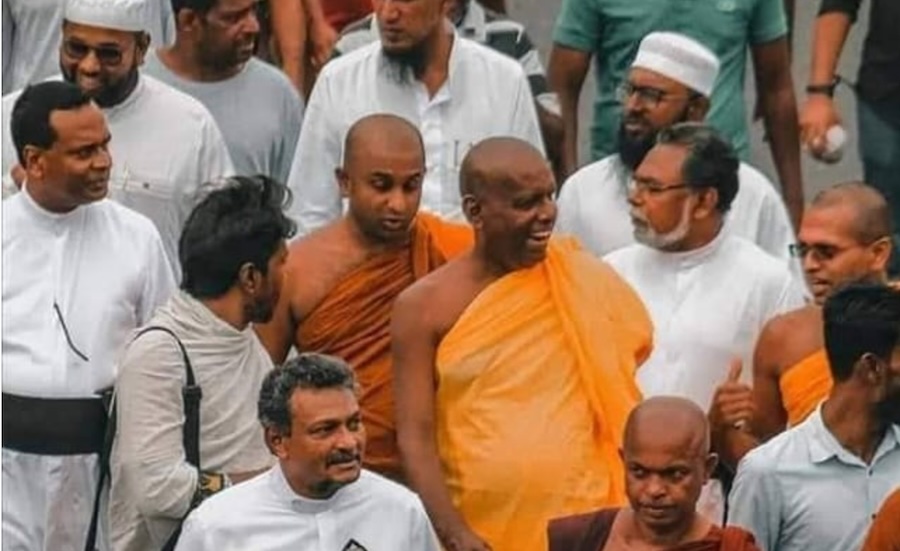
In Sri Lanka the interaction of politics, religion and governance has produced recurring tensions. Periods of everyday coexistence have coexisted with episodes in which religious leadership, including the Buddhist clergy, has been drawn into public controversy. Sustained narratives built on allegations, some proven, others contested or unproven, can affect the standing of religious institutions. When places of worship that have historically served as centres of solace become arenas of contention, public trust may diminish and younger generations may come to view religion primarily through the lens of conflict. These developments carry implications for social stability.
Implications for National Security
An environment of reduced trust among communities can create conditions that are more readily exploited by actors seeking to deepen division. Religious institutions that lose their capacity to function as relatively neutral spaces of refuge may cease to serve as stabilising elements and instead mark potential lines of fracture. For this reason, the integrity of religious leadership and the distinction between individual accountability and broader institutional damage are matters of practical interest to those responsible for public order and security. Unresolved social friction does not remain confined to the cultural sphere; it can affect the wider security environment.
A Standard of Restraint
The Candūpamāsutta (SN 16.3) offers one clear articulation of appropriate conduct. Monks are advised to approach families like the moon, drawing back in body and mind, remaining as newcomers, and avoiding impudence, so that they give light without imposing a burden. The teaching emphasises presence without entanglement and guidance without weight. Applied more widely, it suggests that both religious figures and public authorities serve more effectively when they act with restraint and impartiality. Adherence to such standards can help preserve the constructive role of religious institutions.
Main Stakeholders and Their Responsibilities
Addressing the current tensions requires clear roles among the principal stakeholders:
• Clergy and religious leadership: Uphold the ethical standards of their own traditions in both teaching and personal conduct; maintain restraint in public engagement; and preserve the distinction between spiritual guidance and partisan involvement.
• Lawmakers and political actors: Establish and respect firm boundaries between religious authority and party politics; ensure that legislative and policy responses address institutional integrity without selective application; and prioritise measures that reduce rather than amplify communal friction.
• Media institutions: Report allegations with evidentiary balance; avoid sustained narratives that treat entire clerical bodies as collective targets; and distinguish individual accountability from broader institutional damage.
• Law-enforcement and intelligence agencies: Monitor and address actual security risks arising from social division; protect places of worship from exploitation; and apply investigative standards evenly across communities.
• The public and civil society: Demand evidence-based scrutiny of claims; support the distinction between proven misconduct and unfounded collective blame; and reinforce everyday practices of mutual accommodation across religious lines.
The motto of the Sri Lanka Police, ධම්මෝ හවේ රක්ඛති ධම්මචාරිං (Dhammo bhave rakkhati dhammacāriṃ, “The Dhamma protects those who live by the Dhamma”), places an explicit ethical obligation at the centre of the country’s main law-enforcement agency. It affirms that lasting authority and public confidence rest on conduct that is impartial, restrained and aligned with justice rather than on the exercise of power alone. This standard corresponds closely to the Candūpamāsutta’s image of the moon: both require those who hold responsibility to give light without imposing a burden and to remain free of entanglement. For the police, as one of the principal stakeholders identified here, fidelity to this motto is therefore more than symbolic. It is a practical requirement if law enforcement is to help preserve the institutional trust and social cohesion whose erosion carries direct implications for national security.
Priority for Remedial Attention
The present pattern of contention around religion and the clergy warrants considered attention from both the public and lawmakers. Citizens have an interest in seeing allegations tested by evidence rather than prolonged by narrative, and in maintaining the distinction between individual wrongdoing and the standing of religious communities as a whole. Lawmakers, in turn, can contribute by clarifying the boundary between religious authority and partisan politics, ensuring even application of the law, and supporting measures that protect the institutional role of places of worship without shielding misconduct.
An all-inclusive approach, encouraging clergy to uphold their own ethical standards in conduct, limiting the conversion of religious leadership into permanent political material, and maintaining consistent legal process, offers a practical path. The resources described in World Religions have historically supported social well-being. Whether they continue to do so depends in part on whether current frictions are addressed with priority and even-handedness. Continued inattention risks allowing divisions to deepen, with corresponding effects on cohesion and security. Timely, balanced remedial measures therefore merit consideration as a matter of public and legislative responsibility.
(This article draws on the writer’s direct experience as a member of law enforcement, a masjid trustee, and a member of the Sri Lanka Wakf Board)
*The writer is a retired Senior Superintendent of Police, former head of the counter terrorism desk at the state intelligence service, a former member of the Sri Lanka Wakfs Board, and the author of “Security Beyond Enforcement: Practical Approaches for a Safer Nation” (2026). Email-mahildole54@gmail.com