


By Rehan Fernando –

Rehan Derrick Fernando
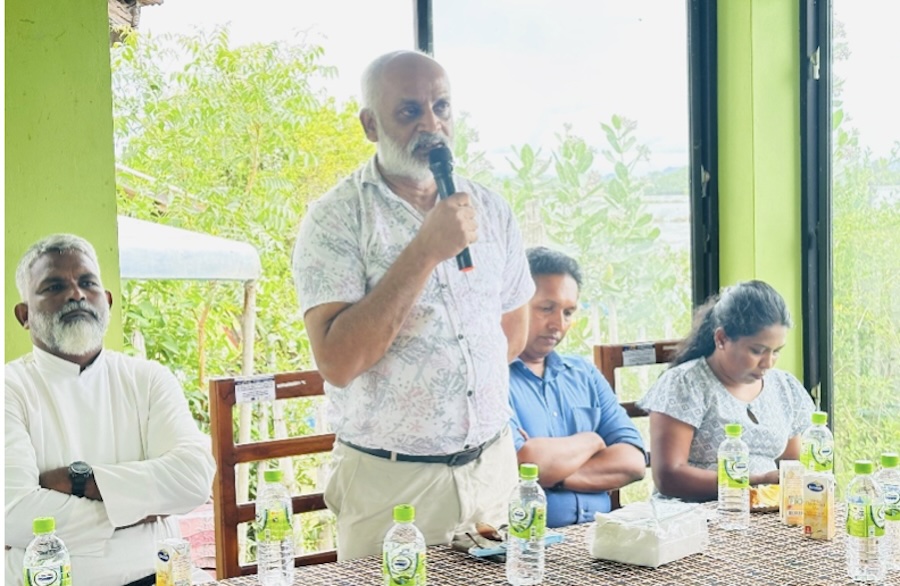
The individual depicted in the accompanying photograph represents a significant figure in the realm of maritime advocacy and community leadership. As a dedicated citizen, organizational director, and National Convener of the World Forum of Fisher Peoples (WFFP), he embodies the responsibilities associated with these roles. His advocacy stems from a robust perspective as a representative of the fishing community residing in coastal regions. Notably, despite lacking direct experience in fishing, he has approached his endeavors with a fresh and analytical mindset, displaying the qualities of a critical thinker and long-term visionary. The phenomenon of underrepresentation among educated fishermen is noteworthy, as many individuals enter the fishing profession during their teenage years without formal educational backgrounds. Contrasting with this trend, the aforementioned individual is a graduate of the University of Peradeniya, thereby positioning himself to engage with fishing communities not merely as a practitioner but as an informed advocate. His efforts are driven by a purposeful commitment to the welfare of fishing communities, reflecting a nuanced understanding of their challenges and aspirations. This article will flow with insightful expression to admire Mr Herman Kumara.
Screenshot
Why fishing people but not fish
In contemporary discourse, the act of “fishing” is conventionally associated with the pursuit of aquatic life, wherein an individual typically utilizes a fishing rod or net to procure a bountiful catch of fish. However, this metaphor raises an intriguing question: what motivates an individual to “fish” for people, specifically men and women involved in the fishing industry? This notion may seem unconventional at first glance.
Herman, a dedicated advocate, has spent over two decades engaging in the practice of “fishing” for individuals within the fishing community. His involvement stems from a profound recognition of the myriad challenges faced by fishermen and women, particularly in Sri Lanka, where they grapple with persistent hardships. These challenges manifest as enduring conflicts, economic and political instability, religious disputes, and pervasive poverty, which have rendered the lives of many fishermen increasingly precarious.
The socio-political landscape has left these individuals fragmented and enduringly marginalized. Against this backdrop of tension and strife, Herman endeavors to support and uplift these vulnerable populations. Therefore, the concept of “fishing people” rather than fish emerges not only as a metaphorical distinction but as a poignant reflection of the social responsibility aimed at addressing the plight of those who have been historically overlooked. Thus, Herman’s commitment represents a critical intervention aimed at rescuing the human element within a community ensnared by adversity.
A Man for Democracy
I have witnessed some of the best qualities of Herman as the director of the National Fisheries Solidarity Movement in Negombo. He engages with staff, ordinary people, and youth, all in the spirit of true democracy. His work is not a one-man show; rather, it reflects a collective effort that respects the freedom of the people. I have observed educated individuals giving public lectures on democracy and discussing it often in political forums. However, in Sri Lanka, we currently encounter many jokes about democracy, as it tends to be perceived as an ideological concept that seems unreachable and unattainable.
Herman has an art of listening to people’s voices and working out with their limitations which eventually he would turn into massive structures. He has profoundly exercised this amazing spirit with fisher communities in 17 districts, especially with several international communities. In maintaining the primary vision [A just and prosperous society, where resources are distributed equally, and peace, justice, and Human Rights prevail for all people, regardless of race, religion, or gender] and mission [To ensure equality sharing of natural resources through empowering small scale food producers, towards, sustainable fisheries, food sovereignty and personal integration and by strengthening People’s Social Movement in Sri Lanka] of NAFSO, he has committed himself not only to enhance dialogue with fisher communities but also to provide what they need in their lives.
Herman’s Involvement with NAFSO
It is apt to see through some essential historical records of NAFSO as Herman has taken some important decision with the jouney of NAFSO as an organization. In 1992, an analysis of Sri Lanka’s economy concluded that the neoliberal economic policies adopted by the government in 1977 had the most adverse effects on farming, fishing, and plantation communities, along with women in those sectors and the Free Trade Zones (FTZ). The challenges faced by women were recognized as significantly different in each sector, warranting individual attention. To address these issues, the People’s Forum for Development Alternatives (PEFDA) was formed to collectively seek viable social and economic alternatives across each sector. A commitment to collaboration among these sectors is the foundation of PEFDA’s activities.
In the fisheries sector, the establishment of a network of organizations led to the formation of the National Fisheries Solidarity, which evolved into the National Fisheries Solidarity Movement (NAFSO). NAFSO represents small-scale fisheries by encompassing marine, inland, and brackish water fisher communities, with a particular focus on women and children. As the network among various communities expanded, irrespective of regions, religions, ethnicities, and groups, differences arose at SEDEC. In June 1997, NAFSO moved from its original venue to become an independent body representing fisherpeople’s organizations. A decisive moment came with NAFSO’s critique of the Fisheries Act No. 02 of 1996, which revealed a clear intention to eliminate small, vulnerable fishers and privatize water bodies for industrial and other aquaculture practices.
In 1996, the Food and Agriculture Organization awarded NAFSO the Margarita Lizzarraga Award in recognition of its efforts in educating and mobilizing fishers on fisheries management, particularly regarding the Code of Conduct for Responsible Fisheries (CCRF). Following the 2004 tsunami, NAFSO played a key role in people-centered rehabilitation, resettlement, and development programs through the People’s Planning Commission (PPC). They were instrumental in mobilizing civil society actors for the People-to-People dialogue on Peace and Sustainable Development (PPD). The work accomplished by NAFSO led to the formation of a land coalition in 2005 that focused on land issues. NAFSO collaborated with partner organizations in Negombo to create the Alliance for the Protection of Negombo Lagoon (APNL), which successfully opposed a government seaplane project. Building on the experiences from the Negombo Lagoon protection, NAFSO further expanded its efforts with the establishment of the People’s Alliance for the Right to Land (PARL) in 2011. Their commitment to strengthening small-scale food producers was recognized when NAFSO was awarded the Food Sovereignty Award by the Why Hunger Campaign in 2012.
Currently, NAFSO is involved in the implementation of the Voluntary Guidelines on Land, Fisheries, and Forests. Since 2010, they have participated in the broader civil society movement, collaborating with entities such as the World Forum of Fisher Peoples (WFFP), the World Forum of Fish Workers and Fish Harvesters (WFF), the International Collective in Support of Fish Workers (ICSF), and the International Planning Committee on Food Sovereignty (IPC). Together, they worked on formulating the International Guidelines on Small-Scale Fisheries (IG-SSF), which aim to secure the rights of small-scale fisherfolk communities worldwide. This historic instrument was adopted in June 2014 by the FAO, the intergovernmental agency of the UN. The National Fisheries Solidarity Organization (NAFSO) represents a significant fisher folk movement in Sri Lanka, dedicated to advocating for the rights of marginalized populations, including internally displaced individuals, women, and youth. Its primary objective is to foster human rights and sustainable development, particularly within the agriculture and fisheries sectors, in a post-conflict context. NAFSO critically engages with and contests detrimental development paradigms, such as land and sea grabbing, which threaten the livelihoods and rights of vulnerable communities. By striving to empower these groups, NAFSO aims to contribute to the establishment of sustainable peace in Sri Lanka. This mission is underpinned by principles of equity, social justice, democracy, and a thorough commitment to upholding the rights of women and minority populations.
Conclusion
What Herman has done throughout his entire career is a remarkable achievement. But I prefer to call it a conscience rather than naming his work as an achievement. Only a true leader who works for people can create a conscience for them, whereas achievements are the results of mere leaders who have egoistic targets. Sri Lanka has lost many valuable individuals throughout its history due to various conflicts. I hope that the country will avoid such tragedies in the future. Herman’s commitment to community engagement demonstrates how he has prepared generations to lead society in every field.