

By Jehan Perera –
Jehan Perera
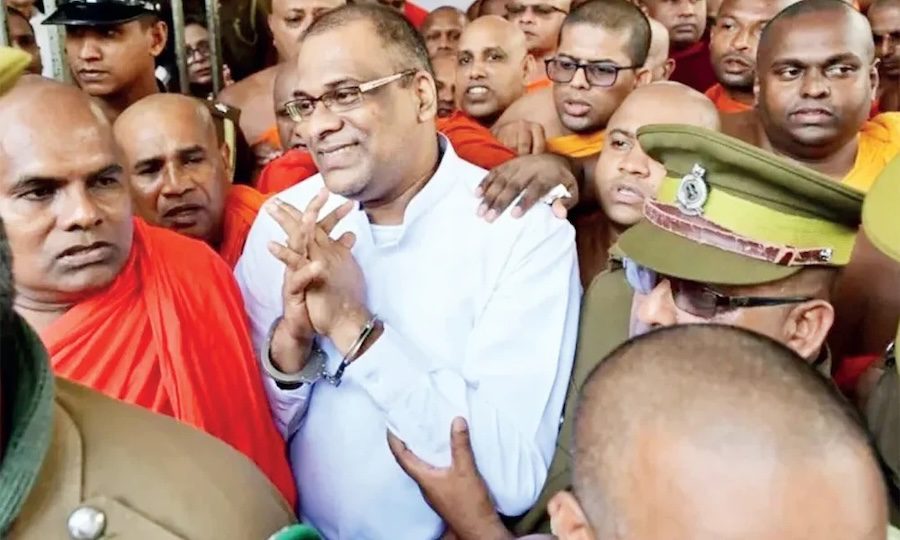
The government appears set to overcome the first major challenge to one of its foundational principles. It has faced down demands from sections of the Buddhist clergy and opposition parties to release Ven. Galagoda Atte Gnanasara from his prison sentence for contempt of court.
Ven Gnanasara is best known as the general secretary of the Bodu Bala Sena, a nationalist Sinhala grouping. The government seemed unfazed by a protest march organised by Buddhist monks and the opposition parties and its supporters organised an even bigger march to support the government’s position. It is notable that the general population did not get involved in either march in any substantial number. The issue has now become a test of whether the government will uphold its commitment to apply the law equally, irrespective of a person’s position or status, even when doing so brings it into conflict with a powerful constituency.
The case has a specific legal history. Ven. Gnanasara was sentenced to six years’ imprisonment by the Court of Appeal in 2018 for contempt of court in a case involving former military personnel where he disrupted the proceedings. The Supreme Court rejected his appeal in 2018. Former President Maithripala Sirisena subsequently granted him a presidential pardon in 2019. Last month, the Supreme Court invalidated that pardon. The initial demand by Buddhist monks and their lay supporters was that Ven. Gnanasara should be permitted to wear his Buddhist robes when appearing in public before the courts. The government has indicated its willingness to examine the procedures governing the treatment of Buddhist monks in prison, in consultation with the relevant religious authorities. However, the initial demand has now been escalated into a demand for a presidential pardon.
One of the central promises of the National People’s Power (NPP) during its election campaign two years ago was to apply the law equally to all. This commitment has shaped the government’s approach to allegations of corruption and criminality involving individuals who previously wielded political power. The NPP government was swept into power on a wave of antipathy towards those in previous governments who were perceived to have abused their positions for private gain. The economic collapse Sri Lanka experienced in 2022, and the hardships endured across society, remain vivid in the public memory. The past two years have seen the government pursuing those accused of corruption and other offences. Several high-ranking members of previous governments have faced arrest and legal proceedings and been sentenced to jail.
Religious Concerns
The ability of opposition parties to mobilise widespread resistance against proceedings involving their leaders has been limited, as much of the general population continues to favour accountability for past financial crimes. However, the case of Ven. Gnanasara is different. It does not concern allegations of financial corruption, but the relationship between religious authority, the courts and the law of the land. This is where the distinction between respecting religious traditions and upholding the law becomes crucial. There is a sense among sections of the general population that Buddhist monks should not be treated on a par with others and that requiring Ven. Gnanasara to appear in court without his robes was unjust and contrary to the national ethos. Such sentiments reflect the special place Buddhism occupies in Sri Lanka’s history and society. Sinhala Buddhist nationalism has been a potent political force throughout the country’s history, drawing on a heritage that extends back more than two millennia. The question is whether respect for Buddhism needs to also entail the exemption of individual monks from the ordinary requirements of the law and thereby treat them differently.
The challenge would be to accommodate legitimate religious concerns through rational and lawful procedures without allowing religious status to become a source of legal privilege. The government has been amenable to addressing the issue of monastic robes, but has so far resisted the demand to release Ven. Gnanasara through a new pardon. President Anura Kumara Dissanayake and government members have made it clear that the government would not bend the law to accommodate any individual. They have taken the position that any shortcomings in existing rules should be addressed by changing the rules through proper procedures, rather than by making an exception for a particular individual. If the government holds its position, it will demonstrate that its commitment to the rule of law extends even to constituencies that have historically enjoyed considerable political influence.
This is important not only for the country’s democratic institutions but also for its economic future. Sri Lanka is seeking to recover from its economic collapse and establish the foundations for sustained growth. The International Monetary Fund’s analysis of Sri Lanka’s governance weaknesses has repeatedly emphasised the economic costs of corruption and institutional deficiencies. Its 2024 analysis of governance and growth concluded that comprehensive and coherent reforms could bring significant macroeconomic benefits. The IMF’s 2025 assessment also highlighted the importance of sustained governance reforms in unlocking the country’s growth potential. Investors, both domestic and foreign, need confidence that public institutions function according to predictable rules, that contracts and property rights are protected, and that political connections or social status will not determine how the law is applied.
Sensitive Issue
Sri Lanka has long sought the leap towards prosperity that has proved elusive under successive governments. Economic reform alone will not achieve it. The connection between the rule of law and economic prosperity is direct. Businesses are more likely to invest when they can expect disputes to be resolved fairly, public resources to be managed transparently and regulatory decisions to be made on rational grounds. No country can achieve a durable economic take-off if its institutions are perceived to operate according to political favour, inherited privilege or communal pressure. Sri Lanka cannot afford to return to a political culture in which powerful interests are shielded from accountability while ordinary citizens bear the costs.
Changing a political culture that has evolved over the decades if not centuries is a difficult undertaking, particularly in a country where political leaders have long relied on religious and communal identities to consolidate their support. It requires not only firmness but also sensitivity, dialogue and a willingness to reform laws and institutions where genuine deficiencies exist. The present controversy offers an opportunity to demonstrate that these objectives need not be in conflict. The government can respect the Buddhist clergy’s concerns about the treatment of monks in prison while refusing to grant an individual an exemption from a judicial sentence. It can recognise the importance of Buddhism to the country while maintaining that no religious or political authority stands above the law.
The question is whether national traditions and ethos are interpreted in ways that strengthen justice, responsibility and social harmony, or invoked to defend privileges that undermine them. The country needs a transformation in public expectations from privilege to accountability, from communal claims to equal citizenship, and from personal discretion to institutions governed by law. The government’s handling of the case involving Ven. Gnanasara is therefore about more than one monk or one sentence. This particular case will determine whether the government can build a system in which no government, religious authority or politically influential individuals can place themselves beyond the law. A just society must be able to honour both its traditions and its commitment to equality before the law.
nimal fernando / October 20, 2026
Unfortunately Lanka is a Democracy.
–
Now, closest to an ideal it has ever been …….. in its 78-year, post-independent, history.
–
Wish it was a totalitarian dictatorship ……. could’ve taken Mao’s liberties to put them to till the fields ……. get the freeloading parasites to earn their keep.
–
–
Ol’ Capitalist Roaders ……..Mahinda and Ranil tethered to the same plough ……. wearing dunce caps.
–
Sweet Dream are Made of This!
/
Native Vedda / October 20, 2026
nimal fernando
–
“Ol’ Capitalist Roaders ……..Mahinda and Ranil tethered to the same plough ……. wearing dunce caps.”
–
Sri Lanka 2026: Economic Reality, Indian Ocean Politics & Systemic Reform
https://www.youtube.com/watch?v=fFXBdm4VPkw
(In this edition of “The Neighbourhood Scope” by ORF’s Strategic Studies Programme, our panel examines the domestic political landscape, economic recovery efforts amid external headwinds, and Sri Lanka’s foreign policy maneuvering across the Indian Ocean Region.)
–
How would you rate this ORF discussion, and what can we learn from the discussion as a whole?
/
Native Vedda / October 21, 2026
nimal
–
Is it true that the occupying Saffronistas have organised a huniyam session at Viharamahadevi Park to curse AKD and bless Gnana for his release?
–
Watch these clips:
–
A group of Buddhist monks and civil society representatives gathered at Viharamahadevi Park yesterday evening to appeal to “divine forces” for the release of arrested Ven. Galagoda Aththe Gnanasara Thera. The programme included rituals and offerings, with participants seeking divine intervention for his release.
https://www.facebook.com/reel/2213508226178944
—
Well, if true Nimal, if you don’t put an end to this huniyam comedy, no one will be able to save Buddhism.
/
nimal fernando / October 21, 2026
Native,
–
Watch this ………. https://yts.torrentbay.st/movies/angel-heart-1987
–
New Orleans, you have all sorts of things hanging from trees …… and signs everywhere warning not to pick the fallen. Voodoo gives me the willies!
Once unleashed, no one has control …… keep your distance from the monks …….. the Voodoo might turnaround and come and bite them in the ass.
/
Naman / October 20, 2026
“Ven Gnanasara is best known as the general secretary of the Bodu Bala Sena, a nationalist Sinhala grouping.”
Everyone KNOWS who were behind the creation of these extreme religious organisations [i.e. BBS/ Shiv Sena /NTJ]. Rajapaksas in order to keep the tight control of the POWER sustained the DIVISIONS among the different racial and religious groups as well as let the Drug peddlers and thuggish gangs freedom to operate.
Fear permeated not only in the traditional Tamil areas but also through out the country. In addition Tamils had to be watchful of security apparatuses of GoSL. The HUGH FUNDINGS for the Defence Ministry deprived
such needed money from the EDUCATION /HEALTH / TRANSPORT departments.
/
Native Vedda / October 20, 2026
Naman
–
Forget what is happening now, with Gnana-friendly saffronists trying to rock the boat. This is not something new, but a continuation of past events.
_
Gota appointed Gnana to head a Presidential Task Force on legal reforms aimed at implementing the principle of “One Country, One Law.”
_
The hypocrisy is now being exposed. Why, then, does the Sangha demand Gnana’s release?
/
Ajith / October 20, 2026
” This particular case will determine whether the government can build a system in which no government, religious authority or politically influential individuals can place themselves beyond the law. A just society must be able to honour both its traditions and its commitment to equality before the law.”
I understand that this government is in transition and it has to come out of the unitary system change to reflect that the system that one community or one religion is above the law and share the powers with other communities are who are suffered under the past political culture and political system.
If the government wants to keep the system, then Tamil speaking people should decide whether they can live together with the same system which is only decided by a government and religion of a community?
/
SebastianSR / October 21, 2026
To Ajith who says If the government wants to keep the system, then Tamil speaking people should decide whether they can live together with the same system which is only decided by a government and religion of a community?
The more vociferous leaders of the Tamil speaking people have decided several times that they CANNOT live together and have even gone to war—AND LOST, decimating the Tamil speaking people. The leaders of these Tamil speaking people now rush to India asking them to force decisions on what Ajith calls a government and religion of a community. The Indians are happy that they have now got the these “Tamil speaking people” at their feet; the Indians would love to get the Tamil nadu leaders also at their feet — but that hasnt happened yet. Unfortunately, the leaders of our “Tamil sepaking people” have not looked at how the Jews of USA, the Tamils and Chinese in Malaysia, or how even in Sinapore have handled it. In Singapore, reflecting the region’s indigenous history, Malay is used exclusively for the national anthem (“Majulah Singapura”), military commands, and state decorations although there are 4 official languages.
/
Ajith / October 21, 2026
“The more vociferous leaders of the Tamil speaking people have decided several times that they CANNOT live together and have even gone to war—AND LOST, decimating the Tamil speaking people.”
Yes, Tamils went war but they did not loose it. You may think that way but Sri Lanka become a poor bankrupted country because of the war, not because of the JVP or any other Buddhist Sinhalese political parties. Tamil speaking people are not slaves of Sinhalese or any other community or any other religions.Similarly Sinhalese as well. Those who claimmed that they won the war are now in jail.
/
Naman / October 20, 2026
For a JUST SOCIETY to be born in our country, a government can’t do it alone without the divided communities getting together and without applying the laws equally. Since those individuals who were associated with the previous corrupt governments are still in ACTIVE service, to achieve a just society is very hard. The politicians who are seated in the opposition benches are not keen to see that the current GoSL succeed in controlling the alcohol & narcotic issues; gun culture; black or ill gotten money.
A break through is needed in bringing TRUTH JUSTICE & RECONCILIATION for ethnic minorities.
Not having a disciplined buddhist clergies + a very SLOW judicial system too is working against a just society.
I haven’t seen the society that is actively promoting the CLEAN SRI LANKA project. The beaches are dirty.
Mosquitos would not be spreading terrible diseases in a clean SL.
/
SebastianSR / October 21, 2026
Naman says A break through is needed in bringing TRUTH JUSTICE & RECONCILIATION for ethnic minorities. But do the activist leaders of the minorities (and here I speak only of Tamils as that is the community that I know best) really WANT reconcilliation? Did you listen to the speeches recently at the Thileepan statue? Very soon there will be Prabhakaran’s birthday and also the so-called Maveer day. Go and listen to what our leaders say about reconcilliation—a dirty word.
Some people here think that the Siva Senai, Rundra Senai and Ravana Senai were creations of the Rajapaksas. NO, the facts are very different. Collapse of LTTE also implied collapse of secularization. Just as Sinhalese rush to militant Monks, Tamils now rush to militant Hinduism strongly alive in India. Siva Senai (2016 in Vavuniya) founder is Maravanpulavu Sachchithananthan, a former UN official, publisher, and Tamil nationalist. Ravana Senai (2016 in the Eastern Province) founder K. Senthuran. The Rudra senai was formed directly against Islam. By 2016, with LTTE out, Hindu nationalists argued that Sri Lankan Tamils (Shaivite Hindu) were losing ground. They claim to defend against state-sponsored Sinhala-Buddhism, aggressive evangelical Christianity, and expanding Muslim economic and cultural influence.
/
Douglas / October 20, 2026
Dear Readers: Please watch the story of ‘ONE’ woman among (thousands and thousands) of women who are seeking ‘JUSTICE’ and looking for answers for the loss of their loved ones.
https://youtu.be/mlJN8F2l3AU?si=ksW5-W0IOU_4_Rw4
In today’s context, imagine how a group of ‘THALAIBAN’ type of ‘Cheevaradhariya’, self-proclaimed ‘Buddhist Priests’ and their ‘Political Thugs’ have got together and are trying to take this country back to the ‘Gloomy’ and ‘Tyrannical’ days. This woman in the story is fighting to find out what happened to her husband and is also facing the onslaught directed at her by the ‘Saffron’-clothed hooligans, now assembled in Viharamahadevi Park. As she correctly says, these ‘Thalaiban’ types are not concerned with what happens to Gnanasara, but with making him a ‘BAIT’ to topple the administration and capture power.
In fact, one leader of this campaign (Kassapa) said in public: ” If this President doesn’t sign the papers to release Gnanasara, we will ‘Remove’ him and ‘Install’ another President of our choice and get the papers to sign releasing Gnanasara from prison.
Don’t you see the ‘TYRANICAL’ (Thalaiban-type) nature of this campaign and the direction it leads
to?
/
Rajash / October 21, 2026
Ven Gnanasara is best known as the general secretary of the Bodu Bala Sena, a nationalist Sinhala grouping
===
was he not Chairman of the Presidential Task Force on “One Country, One Law”
appointed in October 2021 by none other than his master Gotabay Rajapaksa during his short Presidential stint?
===
The one law in the country is that Monks are untouchable?
=======
by the way why are these guys stilled addressed as Ven?
who has the power to disrobe them?
=====
/
SebastianSR / October 21, 2026
Why did the Siva Senai, Ravana Senai etc., form a few years after the demise of the LTTE? The timing directly correlates with the rise of Hindutva in India. Sachchithananthan openly admitted forming Siva Senai after consultations with Indian right-wingers, RSS, VHP, and Indian Shiv Sena, adopting their vocabularies, anti-conversion platforms, and the saffron flag. Sachchithananthan expressed frustration that mainstream Tamil political parties were failing to protect Hindu interests and opposed over-representation of Christian candidates. The Bodu Bala Sena in the south was formed around the same time, due to the Islamophobia uptick all over the world. While Siva Senai in Jaffna collaborated with Indian Hinduthva groups, Bodu Bala Sena seemed to have had Islamophobic groups in Norway and USA who gave them initial funding. While post-1948 Tamil nationalism was for Tamil Eelam, groups like Siva Senai, Ravana Sena, Rudra Senai focus heavily on religion and cultur rather than secession. Unlike LTTE the new organizations are NOT linked with the Diaspora but linked with the Indian Hinduthva Orthodoxy. Siva Senai and like Bodu Bala Sena share a “marriage of convenience” rooted in Islamophobic and anti-Christian activism and may even join hands!
/
SJ / October 21, 2026
Hindutva emerged well before the LTTE as born.
Its rise had nothing to do with the LTTE.
the VHP had made a footprint in this country in the 1970s.
*
The LTTE restricted all rival political forces and that affected all.
Why don’t you ask the relevant question as to why “Siva Senai, Ravana Senai etc.” fsiled to take off?
*
BS is born of failure to think through.
/
SebastianSR / October 21, 2026
I dont think anyone had said that the rise of Hinduthva had anything to do with the LTTE. But as long as the LTTE was there, no other political program could arise in the North as any dissenter was executed. The first viable dissent arose in the East with Karuna and his armed power group. They paid a big price for that. After 2009, the vacuum of power was quickly filled by these Religio-nationalist organizatons. The Eelamist movement was headed by people like SJV Chelva, EMVNaga, Anton Balasingham and other Christians. Former Vicar General of the Jaffna Roman Catholic Diocese, Father Emmanuel became the most prominent international clerical face of Eelamism. Many of the LTTE suicide cadre were Christians, Catholics. The Church fathers who were Tamil worked closely with the LTTE. The rise of Siva Senai, Rudra senai and Ravana Senai led to a displacement of Tamil Chirstian leaddership, and I think Abraham Sumanthiran was a casuality of that wave of resurgent Hindu Orthodoxy with the rise of these Hinduthva Senai groups in Sri Lanka. Those who claim that the Rajapaksas created these groups to get Gota elected are inventing history to vent their anti-Rajapaksa anger.
/
SJ / October 21, 2026
“Why did the Siva Senai, Ravana Senai etc., form a few years after the demise of the LTTE? The timing directly correlates with the rise of Hindutva in India. “
*
That is what you said.
My comment concerned that.
How dishonest can you be?
/
SJ / October 21, 2026
Hindutva emerged well before the LTTE was born.
….
…why “Siva Senai, Ravana Senai etc.” failed to take off?
/
CChampa / October 21, 2026
I saw a weird pattern of “timeline” in Venerable Gnanasara Thero’s knee-jerk re-imprisonment and Anojan Sivarasa’s sentence in Saudi Arabia in which Anura Kumara, Ministers, diplomats, Solicitor-General’s Department and lawyer Upul Kumarapperuma, who represented Sandya Ekneligoda in her case against Venerable Gnanasara Thero, were heavily involved.
.
This is the “timeline” which is too coincidental to be a coincidence.
.
July 1, 2026 – Anojan Sivarasa was arrested for violating the Blasphemy Law in Saudi Arabia.
.
July 27, 2026 – Sivarasa was sentenced to 5-year jail term and a fine of US$ 800,000.
.
August 24, 2026 – Sri Lanka submitted an appeal for Sivara’s release which was rejected by the Saudi Courts.
.
September 10, 2026 – A knee-jerk move by Sri Lanka’s Supreme Court was seen in its sudden ruling on a 7-year old fundamental rights petition filed by Sandhya Ekneligoda against Venerable Gnanasara Thero by revoking the Presidential pardon accorded to him in 2019 and reinstating his previous rigorous imprisonment.
.
September 17, 2026 – Saudi Courts converted Sivarasa’s prison sentence to a “mandatory death sentence”.
1/2
/
CChampa / October 21, 2026
Continued…
.
Late September, 2026 – Sri Lanka filed a formal appeal for pardon for Sivarasa but the Embassy officials were of the view that the prospects of a pardon was “extremely low”.
.
October 3, 2026 – Venerable Gnanasata Thero was arrested and remanded.
.
October 5, 2026 – Venerable Gnanasara Thero’s official monastic robe was forcibly removed on video camera in prison, donned layman clothing and brought before the Courts.
.
October 5, 2026 – The Court of Appeal of Sri Lanka ordered immediate enforcement of Venerable Gnanasara Thero’s rigorous imprisonment.
.
October 8, 2026 – A Sri Lankan government legal delegation has arrived in Saudi Arabia to file an appeal on Sivarasa’s case before the deadline of October 15.
.
October 11, 2026 – Sri Lanka formally filed a death penalty clemency appeal on behalf of Anojan Sivarasa.
.
October 13, 2026 – In a swift judgement, the Supreme Court of Saudi Arabia overturned Sivarasa’s death sentence.
.
Am I wrong in seeing an unusual pattern and connection in the two cases?
I am not sure whether Sivarasa was fully pardoned and released, if so, did Anura Kumara make Ganasara Thero serve Sivarasa’s prison sentence?
2/2
/