

By Ananda P. Dasanayake –
Prof. Ananda P. Dasanayake
The Professor sat at the dining table with a cup of Ceylon tea. He had allowed it to steep properly, as a man of Sri Lankan birth and British academic habits considered appropriate. Orwell’s famous 1946 essay, A Nice Cup of Tea, laid down eleven rules for making tea. He was quite particular about the business. So was the Professor.
Lady Usha was at home. This was fortunate for the Professor, who had lately discovered that running a household and running a country were two entirely different undertakings, although both appeared to require an unreasonable amount of patience.
In the cartoon on his phone, five politicians stood on a wooden platform above six Buddhist monks. Strings connected the men above to the monks below. The politicians held the controls, while the monks appeared to be performing their assigned roles.
The Professor studied the picture, took another sip of tea, and pushed his telephone towards his mental butler.
“Jeeves, this is a rather crude illustration. But I am afraid the artist may have a point.”
His invisible butler appeared in the usual way, which is to say that he did not appear at all.
“Would you care to explain, sir?”
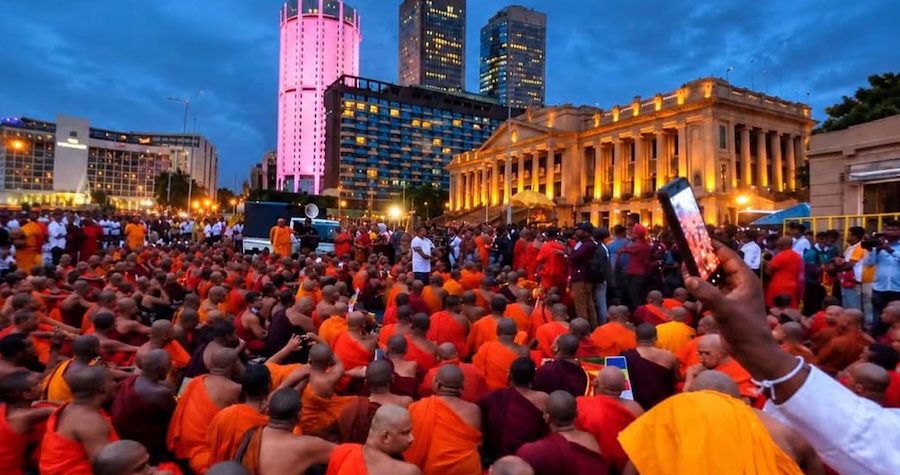
“Look at what is happening in Sri Lanka. A group of saffron-robed monks has camped outside the President’s office, demanding the release of a racist monk who is in prison. There have been reports of verbal abuse, threats against people, and a court order directing the protesters to move. And now look at this picture.”
Lady Usha, who had been listening from the other side of the table, leaned forward.
“Are you saying the monks are puppets?”
“I am saying that we should ask who benefits from this performance. Some of the politicians associated with the old order are under investigation. If religious pressure can be used to force the government to intervene in a legal matter, those politicians have something to gain.”
“Something to gain is not the same as proof that they are pulling the strings,” Usha said.
The Professor looked at her over his glasses.
“I knew you would say that.”
“Because you know me. You become so angry about injustice that sometimes you reach the conclusion before you have finished examining the evidence.”
Jeeves cleared his throat.
“The artist has supplied the strings, sir. We must supply the evidence.”
“Very well,” said the Professor. “Let us begin with the monks.”
He put down his cup.
“I have no objection to monks expressing their views. I have no objection to them protesting against a government, criticizing a court decision, or demanding that a prisoner be treated fairly. But why should the color of a robe give anyone the right to intimidate the police, abuse public officials, or disregard a lawful court order?”
“It should not,” Usha said.
“Then why does it seem that some people expect special treatment because they wear saffron?”
“Perhaps because people have given them special treatment for so long. Respect can become dangerous when the person receiving it begins to mistake it for immunity.”
The Professor smiled.
“Now you are talking.”
“I was talking before. You preferred this part.”
Jeeves inclined his head.
“The robe neither establishes guilt nor confers innocence.”
“Precisely,” said the Professor. “I am not asking for the monks to be punished because they are monks. I am asking that they be held to the same standards as everyone else.”
“And that,” said Usha, “is a demand worth making.”
For a moment, the Professor seemed satisfied. Then he looked again at the cartoon.
“But the puppeteers concern me even more.”
“Why?” Usha asked. “The monks are the ones in the street.”
“Because the people in the street may be doing the visible work while others enjoy the political benefits. Suppose politicians facing investigations encourage a religious campaign, allow it to create pressure on the government, and then present themselves as defenders of Buddhism. If the government refuses the demand, it can be accused of disrespecting the religion. If it gives in, it risks undermining the legal process.”
“A most convenient arrangement, sir. The benefits upstairs, the disturbances downstairs.”
“Exactly.”
“But there is another possibility,” Usha said. “What if the monks do not need to be controlled by politicians? What if they have their own political ambitions, their own grievances, and their own reasons for wanting this man released?”
The Professor paused.
“Then they are not puppets.”
“Not necessarily. They may be allies. They may share interests. They may be using one another.”
“That would make a rather untidy cartoon,” said Jeeves.
“It would make a rather untidy country,” said the Professor.
He looked down at the picture again.
“Then we need to know who organized the protest, who supports it, and what connections exist.”
Usha nodded.
“Now you are asking questions.”
He did not like having his anger slowed down by questions. He knew, however, that the questions were necessary.
“Still,” he said, “a government elected by the people must not be forced to interfere in a legal case merely because a group can make enough noise outside its office.”
“Agreed,” said Usha. “But it cannot use the rule of law as an excuse to silence people it dislikes. The protesters have rights. The prisoner has rights. So do the people being threatened or obstructed. And the court’s order must be respected.”
“So, the government must stand firm without becoming vindictive.”
“Exactly.”
“And the courts must be allowed to do their work.”
“Yes.”
“And politicians must not be allowed to hide behind religion.”
“Nor should you put them behind the curtain merely because the cartoonist has drawn one.”
The Professor sighed.
“You make everything conditional.”
“That is because you teach cause and effect, my darling. You would not accept a conclusion about a disease merely because a cartoon looked convincing.”
He laughed.
“That is a low blow, Usha.”
“It is an accurate one.”
The Professor reached for the teapot. In his mind, Jeeves had already anticipated the requirement.
“I keep thinking about that peaceful march with Aloka,” he said. “What troubles me is the contrast. Religious identity can be used to encourage peace, or it can be invoked to demand a invoked to demand a favor.”
“Then write about the conduct,” Usha said. “Let people examine the contrast for themselves.”
“And what troubles me here is that religious respect can be turned into political currency.”
“Then that is what you should say.”
He looked at Jeeves.
“What do you think?”
“I think, sir, that respecting a monk need not include obeying him.”
The Professor smiled.
“That will do very nicely.”
Outside the window, Greenwich Village was beginning another ordinary day. A delivery truck rumbled past. Someone was walking a dog. The world seemed content to leave the affairs of Sri Lanka to people who were thousands of miles away.
But the Professor had spent too much of his life studying the consequences of institutions that failed to protect the public. He worried about what happened when an exception ceased to be an exception and became something the influential could expect.
“Tell me something, Jeeves. What happens when people begin to believe that the law is for ordinary citizens, while the powerful can escape its consequences through political connections or religious influence?”
“They may begin to regard compliance as a disadvantage, sir.”
“And then?”
“The people still obeying the rules are left to wonder whether they have misunderstood the arrangement.”
Lady Usha reached across the table and touched the Professor’s hand.
“Then do not let your anger make you careless. You want the law to be stronger than political influence. Make that your argument. Do not turn it into a fight against every monk or every politician.”
The Professor looked at her. For all his talk about governments and republics, she had brought him back to the principle he sometimes found hardest to apply.
Fairness had to extend even to people he disliked.
He raised his cup.
“To Sri Lanka,” he said.
“To the rule of law,” Jeeves replied.
“And to the hope that people will learn to look beyond the robes,” said Usha.
“And beyond the strings,” the Professor added.
“Yes,” she said. “But first establish whether anyone is holding them.”
The cartoon remained on the telephone. The Professor studied it once more, then turned the screen face down.
“Another cup, Jeeves.”
“Certainly, sir.”
“Ceylon tea, naturally.”
“Of course, Professor.”
Usha pushed the teapot towards her husband.
There were limits to what a man could accomplish from a dining table in Greenwich Village.
But he could still insist on the right questions.
*Professor. Ananda P. Dasanayake, BDS, MPH, PhD, FACE, Department of Epidemiology, New York University College of Dentistry