

By Gayanga Dissanayaka –

Gayanga Dissanayaka
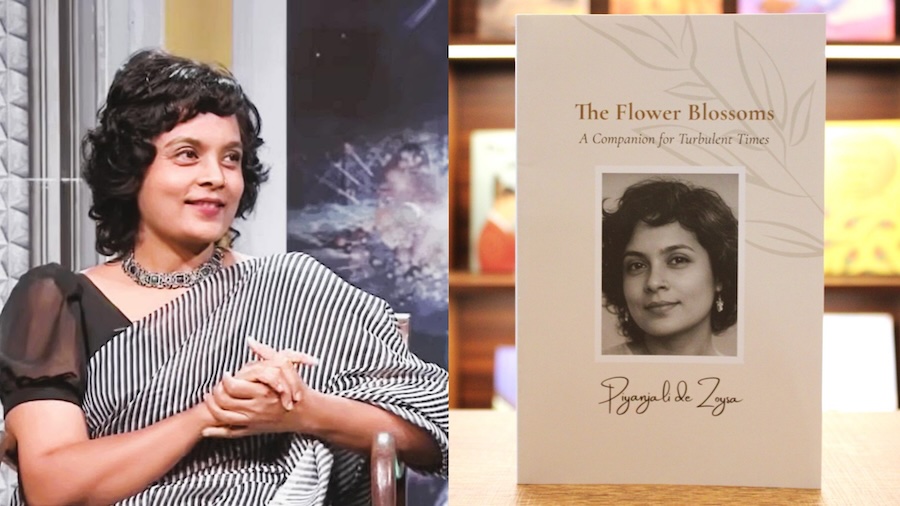
Piyanjali de Zoysa has been practicing as a clinical psychologist for about thirty-one years, and also serves as a senior professor in clinical psychology at the University of Colombo. Today, Piyanjali is also the author of the book, The Flower Blossoms: A Companion for Turbulent Times published through The Jam Fruit Tree Publications.
“I’m quite a contemplative person, and have been meditating in the Buddhist tradition for about twenty-two years as part of my own inner cultivation,” she said. “Through these years of intense inner work, I do a lot of contemplation on my life experiences, and when this is coupled with my formal meditation practice, it gives me a lot of insight which broadens my perspective on life.” Her book was a result of all that work and experiences in her life since her childhood.
Piyanjali has learned to look at difficult life circumstances as opportunities for self-growth. “Even as a child, when I got, say, bullied, I would not attack them back, and as an adult I would still be practice patience with those same bullies knowing that I have grown differently to them. I also met really good human beings whose good qualities I started incorporating into my life,” she said. Going through tough situations in life didn’t make her feel like she should give into toxicity, and she never let it break her true nature. She has always focused on how to get out of a difficult situation or how she could work with it and use it to improve herself.
When she was very young, there were two aunts of hers who came into her life and they had a major positive impact on her. She remembers wanting to be someone just like them, particularly the way they supported and nourished her in her youth. Therefore, she tries to makes sure that she makes a positive and pleasant impact on the people she meets, even strangers, knowing that it could change someone’s life.
“As a school child, I wouldn’t call myself brilliant at all, I was rather average compared to others in my grade,” the author said. “The closest I got was being the twelfth in the class. The last few years of my school years I was in Rome and attended a school there. The school system I experienced there was more relaxed which really opened my eyes. After that I went to India to do my higher studies which was another beautiful experience. This is where I met some lovely people who introduced me to spirituality and Hinduism, with whom I’m still good friends.”
Piyanjali explained how during their school years, all they had were a few options of fixed professions, and her father wanted her to pursue one such profession even though she herself wasnt contemplating on it. “Later I met a Buddhist monk who came to Rome and stayed with our family. With him came a young novice Buddhist American monks who was a graduates as well,” she said. “At the breakfast table, I used to look at them and think that they had very few items but were far more satisfied than me. I got into a conversation with one of those monks and got to know that he studied psychology and that iaround 4 am to meditate, and how they seemed much happier than her, whilst she seemingly had many more possessions, lived in a large house, with many domestic helpers. Piyanjali thought about this contrast a lot, and it left a life-long impression on her. When she went to India, she remembered this monk and decided to study psychology for her own higher studies as well. Piyanjali added how this was the best decision she took in her entire life.
The author explained how the best part of being in the psychology field is that we have all the knowledge to really understand the mind. She realised that the English-speaking community has much of the material to get that information, simply by tapping into the entire web. This is also why she started her YouTube channel in Sinhalese for those who don’t have that privilege. In her YouTube channel she started doing a weekly topic spanning areas such as narcissism, co-dependancy, or difficult parents. “When people see me in public and say that their lives were changed after watching my videos, that satisfaction is immeasurable. It’s a very rewarding career,” she said.
Piyanjali was not at all into writing or the languages. But of course when she got into an academic career, she had to naturally get into writing as well. It was here she realised that she can express things easily through the written word. This got better as she meditated and her mind became clearer. The stories and contemplations included in The Flower Blossoms were inspired by two years of her own life journey. Slowly Piyanjali shared them on Linkedin and Facebook, which is when Priyangwada Perera, a journalist, told her that she should publish these stories. In a few months, she sat down and put together the entire book and was able to get it published as an ebook on Amazon shortly. After a while, due to requests for a physical book, she decided to get it published through The Jam Fruit Tree Publications. She explained how the whole process of this book felt like a spontaneous burst of energy.
“Some of my personal favourite titles from the book is, The Peacock Queen and some spiritual journeys such as The Pilgrimage Without Luggage where the main character instead of travelling through airports, travels into her mind and finds places that are truly peaceful that the cities of Japan or the markets in Istanbul could never give,” said the author. In her book, Piyanjali brings all sorts of indirect ways of going into ones’ mind and healing and growing it. The book also explores relationships, body images and self-awareness. It’s a book meant for those who desire more from life and are eager to better themselves.
Piyanjali explained how looking at obstacles, anger and problems from a detached point of view would make one realise that the burden comes from the emotions and life-perspectives one is carrying more than the situation itself. Looking inward is a vital aspect which Piyanjali believes would help many of us in our daily lives. This way, something massive can happen and you still won’t be unnecessarily disturbed. Not because you have controlled your disturbance but because you have become the person that won’t get affected and starts seeing everything broadly and realistically. “Even in therapy, we may first train a person to be mindful and make them realise the weight of what they are carrying within them and guide them to gradually let go of their inner shackles of the mind. This also can motivate them to look at others with compassion instead of holding resentment, which is how the transition happens. Most of the time, this change happens by looking inward and eventually you won’t get disturbed even by your worst enemy,” explained Piyanjali.
According to the author, there are several levels for mindfulness which is a key technique leading to mental healing and growth. The most rudimentary one would be to attentively being in the here and now. Most of us are not in the here and now since we are thinking either of our past or future, lost in daydreaming or fantasizing. We have grown to believe that this is natural and desired. However, when a person who is training in mindfulness realises that their mind has gone to the future or the past, he/she can gently bring it back to the present moment. When one starts doing that, they realise that these external situations to which our mind goes to are ever-changing and we actually have no control over it. With this realisation, ultimately, your mind starts coming to the present moment on its own. Then, the burden of constant thinking, planning, worrying, etc, starts gradually reducing which leads to peace. Piyanjali also explained how this encourages us to appreciate the little moments in the present situation a lot more as well. “When you are mindful, you start seeing things that you have never noticed before and you start seeing beauty in the ordinary and the tiniest things, which eventually makes you not want more and more and more from life. Because, where would that constant desire lead to, and when will it ever get appeased? This can give you lots of bursts of happiness. Usually if we don’t have high stimuli, we don’t feel happy. Mindfulness trains your mind to be happy with the smallest things in life,” she said.
“I have received feedback that people are actually keeping The Flower Blossoms in their bag and carrying it around. Which is also the reason I wanted the book to be smaller in size – a book that would fit inside a small bag, and act as a daily guide,” Piyanjali said. Even with her patients, she always uses analogies and similes to help them understand their recovery journey, because she has noted how that this method of using stories and analogies is used in Buddhist teachings as well, which helps one understand the concept better. This is one of the reasons that Piyanjali has used stories in The Flower Blossoms, in order to help readers overcome the shackles of their mind and broaden their perspectives on life, ultimately leading one towards healing and growth.
“Life is short and you have a choice in how you live your life,” said Piyanjali. “A lot of people get riddled with guilt as they grow older. So. I feel that we should always remind ourselves to be a better version of who we are, rather than a bitter version. That way, you won’t find it difficult to sit with yourself, and you will have the courage and confidence to be with yourself above anything else. This would lead to a much kinder and empathetic world too.”