

By Jude L. Fernando –

Jude L. Fernando
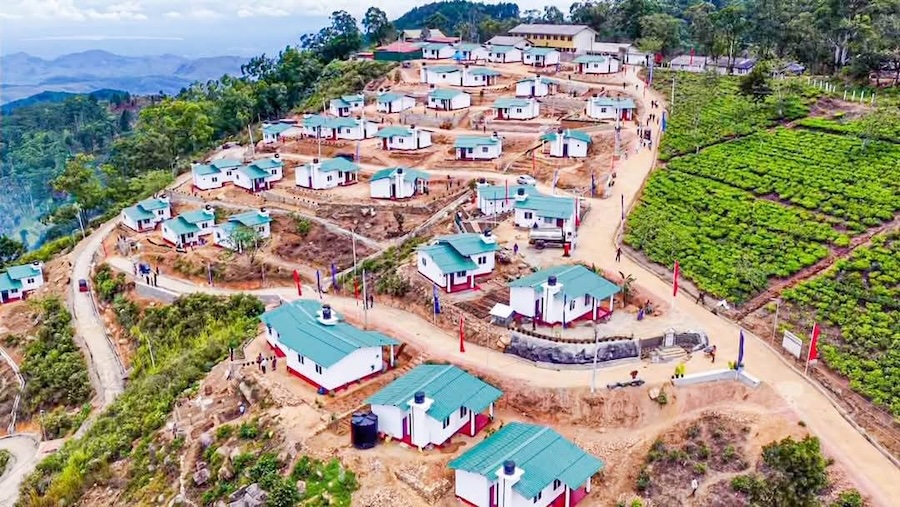
On 28 August, President Anura Kumara Dissanayake opened the Kabaragala housing project for disaster victims in Poonagala, Badulla District — mountains that carry a history heavier than their soil. For two hundred years, these tea-blanketed highlands drew extraordinary wealth from the hands, backs, and lives of the Malaiyaha community, Tamil-speaking plantation workers brought here under colonial coercion. Ever since, they’ve been denied the most basic right of all: to belong, permanently and securely, to the place where they live and work.
This is an account of one project, in one place, at one moment, and it should be read that way. Fifty-one families now have homes and land titles they didn’t have before. Whether that becomes a national pattern or stays an exception depends on decisions not yet made. That tension runs through everything below, not just the ending.
Call this what it is. What the Malaiyaha community built with two centuries of labor, the wealth Sri Lanka still trades on, still exports, still boasts about as national achievement, was extracted at the cost of their own right to live as equal citizens. Kabaragala is not simply a housing project or an act of state generosity. It is reparation, however partial, for a debt this country has carried since the first estate was planted: the debt owed to a people whose deprivation subsidized a nation’s development. Any account of this project that skips that word risks mistaking payment for gift.
What’s risen here is not just a housing scheme — it reimagines what a home for the Malaiyaha community can be. Each unit sits on land designed as an agroecological homestead, where shelter stays inseparable from livelihood and the ground beneath a family’s feet feeds them, sustains them, and belongs to them in law as well as in life. This is housing built not as four walls containing a family, but as an integrated ecology of dignity: land title, cultivation space, environmental sustainability, and community life bound into one replicable model. The project answers centuries of struggle by plantation communities for a dignified life, and it fulfils a promise the NPP made before the election — the Hatton Declaration, a pledge to listen to these communities’ voices. The model speaks not only to Kabaragala’s fifty-one families, but to what’s possible across every plantation community still waiting for the same recognition, if the government chooses to extend it.
That gives reason for cautious optimism about a longer promise. It suggests a government making good, in this one place at least, on the Hatton Declaration, which helped deliver the NPP historically unprecedented support at the ballot box. A government chose to build rather than delay. A military traded its conventional mandate for the patient work of building homes. MONLAR refused to let the project stop at four walls and a roof, insisting instead that land, livelihood, and dignity be built in from the foundation. Together, they’ve shown the Hatton Declaration’s promises aren’t beyond the government’s capacity. Whether they extend beyond Kabaragala is the question this government now has to answer.
On 29 October 2023, the mountains turned against the community that had long depended on them. The Kabaragala Estate landslide displaced fifty-one families in a single catastrophic moment, stripping them not just of their homes but of the last physical anchor to a place they’d worked their entire lives. The disaster didn’t create vulnerability — it exposed one manufactured over two centuries of systemic injustice. The Malaiyaha community didn’t simply happen to live in a landslide zone. A plantation system put them there, deciding where they slept, how they moved, what they owned, and what futures they were allowed to imagine. A house built on that history without confronting it would be nothing more than a comfortable version of the same confinement.
Kabaragala confronts it. But confronting one landslide, in one estate, is not the same as settling two hundred years of dispossession. What Kabaragala proves is capacity: government, military, and civil society can deliver land and dignity together when they choose to. Whether this marks the start of the government fulfilling its whole Hatton Declaration promise, or a singular act of goodwill that ends here, remains open. Until every Malaiyaha family holds the same secure title to the land that sustains them, MONLAR and the community it stands with will keep fighting for land rights.
Leadership That Showed Up Before the Answers Did
Commitment of this magnitude reaches the top of the Sri Lankan state. In early 2026, President Anura Kumara Dissanayake and Prime Minister Harini Amarasuriya took direct steps to confront the long-standing inequities plantation workers face, backed by institutional will, financial commitment, and follow-through visible on the ground at Kabaragala. Conceived under the Ministry of Planning and Community Infrastructure and championed by Minister Samantha Vidyarathna, the project found its driving force in Deputy Minister Sundaralingam Pradeep, whose investment reaches beyond the administrative into the personal. Pradeep pushed the vision past conventional shelter, insisting that ecological intelligence, community empowerment, and social integration weren’t additions to the brief but its foundation. He also brought civil society in, not as diplomatic courtesy, but as a structural commitment to accountability and co-creation. In a political culture used to leaders who arrive after decisions are made, Pradeep is rarer: he arrived before the answers did.
The Soldiers Who Traded Rifles for Tools
The choice of who built Kabaragala makes its own statement. Under Colonel Susantha Perera, two hundred Sri Lankan Army soldiers deployed here not in a security role but as builders — the disciplined hands through which a long-overdue promise took physical form. Using the military for civilian housing raises its own questions, about precedent and about why civilian contracting systems couldn’t be reformed instead of bypassed, and this project doesn’t fully answer them. What the soldiers built does, however, answer back in concrete and timber against the failed housing schemes that came before it. Where previous governments produced projects defined by delays, inflated costs, and corruption that consumed resources before reaching the people they were meant to serve, Kabaragala produced, by the project’s own account, the opposite: efficiency, transparent accountability, and construction quality visible in each of the fifty-one completed homes.
The soldiers did more than build. Cricket matches and musical events gave families moments of relief and normalcy during a period that could easily have felt isolating, and helped hold the community’s spirit in place as construction progressed.
The technical precision was no accident. Soldiers ran quality control down to the materials level, scrutinising and rejecting low-standard inputs rather than letting shortcuts pass. Colonel Perera, a Civil Engineering graduate from Moratuwa, brought that engineering discipline to the project himself, making sure the work met specification and was built to last, not just to finish. Even where pressure to speed up would have been easy to justify, the standard never moved.
That broader lesson matters too, with a caveat. Given operational freedom and without the constraints that typically let private contractors inflate costs or dilute quality, the Army delivered housing that combined lower expense with higher standards — at least by this project’s own reckoning. One project is thin evidence for a general claim about military-led construction. Treat it as a hypothesis worth testing again, not a settled conclusion.
Houses Designed to Grow, Not Confine
These houses are platforms for socially and ecologically responsible flourishing, not finished objects families must adapt to. Earlier plantation housing allocated a reported seven percent of space to the family living in it; Kabaragala sets that figure at ten. Each home is generously proportioned, with an upper floor, dedicated storage, and garden space, on a plot large enough for a family to shape rather than be shaped by. Every structure allows vertical and horizontal extension as families grow, with internal arrangements free to evolve alongside them. The house grows with the family, not against it.
Post-disaster housing too often produces rows of identical, inflexible structures that impose uniformity on people who deserve individuality. Kabaragala’s design breaks that pattern, treating residents as capable people with their own needs and visions rather than passive recipients of a standard unit.
That freedom extends to something that might look small but carries legal and symbolic weight: every home at Kabaragala now has its own address, won through a court battle fought by advocates who understood an address as more than locational convenience — as civic recognition, the state’s formal acknowledgment that a family exists and belongs. For communities whose homes were kept off official maps for generations, an address is not bureaucracy. It’s a form of justice, and one that took litigation, not policy, to secure. Worth remembering when weighing how far the state’s willingness to act stretches on its own.
Ownership Without Strings Attached
Sri Lanka has seen plenty of housing projects for plantation communities come and go, and too many quietly reproduced the dependencies they claimed to dismantle. Houses were built, sometimes well, but ownership stayed conditional. Step outside the plantation economy, change employers, assert independence, and the ground beneath your feet could vanish. It was shelter as control, welfare as leverage.
It seems Kabaragala is trying to break from that pattern by handing over houses with land outright, which is no small feat for a government to do given how entrenched the old model is. That is the home of fifty-one families who own their homes unconditionally and legally, with no clause tying them to any estate or employer. Free to work where they choose, they can build their futures on grounds that belong to them alone. For a community whose relationship with housing has, for two centuries, stayed bound to servitude, this is not a minor administrative distinction. Whether the deeds hold up over time, through inheritance, disputes, and pressure from estate management, only years will tell.
Beyond Shelter: Agroecology Homesteads
Kabaragala’s ambition here goes beyond typical practice in Sri Lanka, arguably beyond typical practice anywhere. Envisioned as an agroecology homestead rather than mere shelter, the housing turns the land around each home into a site for livelihoods, agriculture, livestock, water harvesting, and climate resilience — a whole package, at least on paper. At its core sits a simple conviction: a house is not the destination but the starting point of a transformation toward socially and ecologically dignified, sustainable living. The five perches deeded to each household, together with a separate parcel set aside as community farmland, add up to more than a garden plot. It’s the ground on which a new relationship between people and nature, and between individuals and community, is meant to be built—though residents are still working out exactly how the community farmland will be governed and shared.
This vision finds its fullest expression in the Kabaragala homestead model, drawn from MONLAR’s broader agroecological philosophy, where housing, agroecology, food sovereignty, cooperative governance, direct democracy, solidarity economy, waste management, rainwater harvesting, renewable energy, and biodiversity function as dimensions of one way of living rather than separate programs. Even the fences reflect this: designed as living eco-fences, they mark boundaries while preventing soil erosion and producing food for people and animals. The design is intentional. But intention and long-term maintenance are two different things, and the second has yet to be tested at Kabaragala.
MONLAR: A Movement, Not a Contractor
The organization entrusted with this broader vision defies easy categorization as a conventional development partner. MONLAR, the Movement for Land Rights and a pioneer in agroecology-driven social and ecological transformation, is not a service-delivery outfit that arrives with a predetermined plan, distributes inputs, and leaves when the grant cycle ends.
Rooted in the conviction that land is the foundation of dignified life, MONLAR treats agriculture as a political relationship between people and the earth, one where genuine transformation can’t come from above. Change has to build from below, through the patient work of organizing communities to understand their own power and construct their own futures. MONLAR brings no toolkit to this project, only a worldview: resettling these families is a historic opportunity to build, on land now allocated to each household and the community as a whole, a way of living that is ecologically responsible, socially just, and politically self-determined.
That significance came through on 17 March 2025, when Deputy Minister Pradeep invited civil society organizations, MONLAR among them, to a structured dialogue on how best to support Kabaragala’s residents sustainably and holistically. Embedded in that gesture was a governing philosophy worth naming: the state alone cannot finish the transformation these communities deserve. Whether this habit of consultation outlives Kabaragala, or was specific to one deputy minister’s style, will say a great deal about how seriously the state takes its own philosophy.
Three Foundations of Agroecology Homesteads for a Lasting Future
A house is only the beginning. Three foundations must rise alongside it if we are to realize the goals of MONLAR’s collaboration with the Government and the community.
Landownership comes first: secure, legally recognized title to the five perches beneath each family’s feet, because the deed matters as much as the door. Fifty-one families have received these deeds, becoming landowners whose rights can’t be casually revoked.
Livelihood diversification follows: dignified, self-directed economic paths that free families from total dependence on the plantation wage. A separate parcel has been set aside as community farmland to build livelihoods collectively, with civil society invited to help shape its use.
Ecological restoration completes the triad: living infrastructure meant to protect the mountain these homes stand on and restore balance that two centuries of extractive monoculture undid.
Together, these foundations aim to make homesteads working models of responsible settlement. Success here depends less on the design, which is thoughtful, than on maintenance, funding, and follow-through over years the project hasn’t lived through yet.
Confronting the Forces That Resist Change
No honest account can skip what strains against this project. This government isn’t reforming a blank canvas — it’s trying to transform a deeply entrenched order saturated with corruption, bureaucratic inertia, and nepotistic networks whose survival depends on nothing changing. These obstacles adapt and persist: slow-walked approvals, quietly diverted resources, sustained efforts by those who profited from the old order to discredit the new one.
Kabaragala navigated those forces by design. The Army’s deployment bypassed contractor networks historically ripe for capture. Deputy Minister Pradeep’s direct involvement denied intermediaries their usual room to extract and obstruct. Bringing in civil society created an accountability layer that’s hard to manipulate. None of this guarantees permanence, and the strategy won’t always replicate elsewhere — structural resistance won’t dissolve because one project succeeded. What Kabaragala proves is that transformation is possible under the right conditions. Whether those conditions can be manufactured again, at scale, without the same minister, the same colonel, and the same level of attention, is the real test still ahead.
From Bondage to Equal Citizenship
The homes stand complete, waiting only for their keys, soon to rest in the hands of fifty-one families who’ve waited two centuries for this moment. But the work doesn’t end with a ribbon-cutting. MONLAR will keep implementing the agroecology project, turning each plot, together with the community farmland, into a homestead that produces food, harvests water, restores soil, and builds economic sovereignty. This resettlement is a starting point, not a conclusion. The harder work, maintenance, governance, proving the model holds under ordinary pressures rather than the concentrated attention of an opening ceremony, still lies ahead.
In a country where the plantation Tamil community has, for generations, received promises that dissolved before they could be touched, these fifty-one homes stand as something that can’t easily be taken back. They set a standard, of construction quality, institutional commitment, and seriousness of intent, that future housing interventions in plantation communities should now be measured against. Walking house to house alongside Deputy Minister Pradeep and Colonel Perera, with civil society asking the hard questions accountability demands, you feel something not often felt at a government project in this country: not the manufactured hope of political slogans, but a quieter kind that comes from watching something real take shape, tempered by the knowledge that real and permanent are not the same thing.
Kabaragala should be read for what it is: a signal, not a settlement. In 1992, the Hatton Declaration set out a vision the Malaiyaha community has waited more than three decades to see honoured: permanent housing, land rights, and an end to a system that treats human beings as fixtures of the estate rather than citizens of the nation. Kabaragala suggests, cautiously, that this government may be moving toward that horizon. Fifty-one families now hold deeds instead of estate-issued permission slips. That is not nothing.
Fifty-one homes are not fifty-one estates, and one mountain is not the plantation belt. Kabaragala’s families, for all they’ve gained, remain residents of an estate landscape still governed, beyond the boundary of their five perches, by the old rules of the plantation industry. The true measure of this government’s promise will be written on the hundreds of thousands of acres still governed by line rooms and labor registers, where families remain estate dwellers rather than citizens with title deeds. What’s been built at Kabaragala must now extend, deliberately and at national scale, until plantation communities across the hill country shed the status of resident labor and become what they’ve long deserved to be: villagers on their own land, equipped to become smallholders of tea much as Sinhalese tea smallholders have, earning from bushes they own on soil that is legally and permanently theirs. This isn’t a distant aspiration. It’s a mandate the government already holds, if it chooses to use it.
Only then will the promise made at Hatton be more than a declaration on paper. Only then can Sri Lanka’s tea rest on a foundation of justice for the hands that pick it.
Because the deeper reckoning was never just about housing. The post-independence Sri Lankan state was built, and its relationship with society legitimized, on a simple arrangement: land seized, labor bought below subsistence, and the surplus exported as national wealth, while the people who produced it were denied the citizenship, the land titles, and the political voice that would have let them ask for their share. That arrangement had a name in law and policy, but never a price. Every estate that turned a profit, every government that pointed to tea exports as proof of development, drew on capital accumulated through a dispossession it never had to account for. That is what made the old order stable, not the absence of injustice, but the fact that no one holding power was ever required to answer for it.
Whether Kabaragala remains an exception or becomes evidence of transitional justice for the Malaiyaha community depends on one thing: whether the government treats it as an act of generosity, or as the first repayment on a debt two hundred years overdue, a debt this state and its economy were built on, profited from, and have never once accounted for.
Ratnam Nadarajah / August 29, 2026
Dear Jude thanks for a well detailed writing upholding the dignity of Malayaha people of SriLanka.
We hope this is a blue print for future similar projects. The plantation companies should take a lesson from the MONLAR pilot project. Its their duty to look after these forgotten and unfortunate masses
Thank you also the army the the ministers behind this scheme. Well done
IF THERE IS A WILL THERE IS A WAY
Ratnam Nadarajah
/
Douglas / August 29, 2026
Please read: https://www.facebook.com/share/v/1EoXnuSuzs/
This is the ‘Beginning’ of the ‘End’ of an era of ‘SURFDOME’ held by the ‘Thondamans’ and ‘Thalaiyvar’ associates.
Dear People of Malaiyaha community: Wake up and embrace your freedom to live on equal terms, enjoyed by all of us.
/