


By EA Gamini Fonseka –
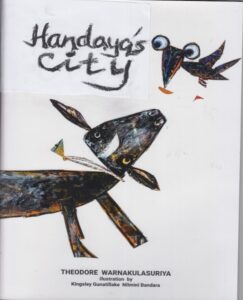 “Handaya’s City” by Dr Theodore Warnakulasuriya, formerly a Professor of Mass Communication at the Open University of Sri Lanka, portrays the fascination of a calf about what he experiences in terms of the beauty of ethnic coherence. The publication of this pictorial storybook was sponsored by the Social Cohesion and Peace in Sri Lanka (SCOPE) programme funded by the European Union, the German Federal Foreign Office, and the Deutsche Gesellschaft für Internationale Zusammenarbeit (GIZ). It appears in all three official languages of Sri Lanka – English, Sinhala, and Tamil.
The protagonist Handaya introduces himself as “a calf with a moon-like white spot on [his] forehead”. This beautiful piece of child literature is full of attractive illustrations produced by Kingsley Gunatillake and Nilmini Bandara to specify its theme and function. The images drawn in the fashion of collage designs, following the principles of abstract art, are pleasantly excitable to the child readers. The plain drawings in flashy colours have the potential to inspire in children a search for strategies to illustrate their own imaginations in graphics.
The setting is a so-called “border village” that seems to have emerged in a remote area in Sri Lanka as a result of the LTTE terrorism-led island-wide July 1983 incident of ethnic conflict. The story develops from Handaya’s group of friends, resident in Joe Auntie’s house, that includes the Labrador Rover, the goat Raju, a couple of hens, a couple of ducks, and the feathery rooster Peter. Joe Auntie has been widowed under the circumstance that her husband Uncle Joe lost his life during an ethnic riot. The most fundamental element of the group’s behaviour is their commitment to friendship that ensures their healthy co-existence. “We all go out together in search of food.”
Also, their tolerance towards the cat Tooby, who visits their home during the mealtimes, conveys a moral for the children to follow. The Labrador Rover owned by Joe Auntie’s son Ravie and her daughter Janakie symbolises their middleclass lifestyle in a city before their shift to this remote settlement in the face of violence. The ritual garlanding that Handaya undergoes during the Hindu celebration “Thai Pongol” suggests the Tamil identity of the family who shelters them all.
Handaya’s perception of Joe Auntie’s story is noteworthy. According to what he has heard, the incident of violence in July 1983 that caused their expulsion from their home was the consequence of some false rumours and useless gossip that led to a misunderstanding among the ethnic communities which used to live together in harmony. Ravie and Janakie’s new friends Meena, Jaya, Sama, Hameed, Rasid, Somapala, and Peterson, are representative of all ethnic communities in Sri Lanka. They are all victims of ethnic violence ignited by LTTE terrorism. Their classroom recitations in their respective languages fascinate Handaya. It even revives Joe Auntie’s memories of her school days with peers from all communities in Sri Lanka – Moor, Tamil, Burgher, Sinhala, Malay, and Chinese – whose races and religions never mattered in her interactions with them.
The incident of landmine explosion that causes Ravie to lose one leg, adds a tragic element to the narrative. As a young animal, Handaya wonders about the brutality of the terrorists that urges them to revengefully kill the innocents through wicked ways and means. Seeing the artificial leg Ravie wears thereafter and listening to his acknowledgement of the moral and material support he and his family received from their Moorish and Sinhalese neighbours during July 1983, Handaya ponders upon the resilience of Joe Auntie and her family and the virtues of humanity. His positive impression of the humans reaches some heights while listening to Janakie’s stories about the Tsunami which made all communities work together. All that Handaya sees and hears with regard to Ravie’s debacle and Joe Auntie’s trauma raises his consciousness that the separatist war that lasted for over three decades left Sri Lanka and her people behind the time in many ways.
While pondering upon the worries of the humans, Handaya relates the joyful life he and his friends lead, listening to bird songs, watching colourful butterflies, enjoying the cool under shady trees, and thanking all birds and bats for the fruit they pick from the ground. His happiness is implied in the mothers who quieten their crying babies, saying, “Look at Handaya and the friends!”
His pleasure reaches a climax when he notices an old crow that has returned after a long absence from the settlement area, wondering how the path he and his friends had been used to, has made the village get connected with a highway and grow into a city with temples, mosques, churches, kovils, schools, supermarkets, shops, restaurants, and so on, bustling with numerous parents and children. Handya shares the crow’s perception that unity, friendship, and cooperation between him and his friends as an important factor of that development.
Janakie’s migration to a foreign country for higher studies, Ravie’s employment in a local industry, and Joe Auntie’s ability to come to terms with life prove their resilience and courage. Handaya recalls the simple poem Joe Auntie recited and explained to Janakie and Ravie in the good old days, which personifies the interrogatives, “What and Why? When and How? and Where and Who?” as six honest men. He happily recites it to his friends; the Labrador Rover, the goat Raju, the couple of hens, the couple of ducks, the feathery rooster Peter, and the meal time visitor cat Tooby, who all approve of its contents. They share its wisdom in light of how crows react to something thrown at them. Crows ask six important questions before approaching it. “What and Why? When and How? and Where and Who?” Although the narration is made in a fairy-tale mode, the emphasis it makes on love, compassion, friendship, and unity carries a didactic flavour. Therefore, the book proves very relevant to children.
The book mirrors Dr Warnakulasuriya’s concern about humanity and his conviction that good values should be taught to children through the medium of literature in the expectation that they will be decent adults one day. An erudite scholar, amidst his regular professorial duties at the Open University of Sri Lanka, Dr Warnakulasuriya has served the Universities of Colombo, Visual and performing Arts, Jaffna, and the Trincomalee Campus of the Eastern University of Sri Lanka, as a visiting senior lecturer and dissertation examiner. He has also presented many academic papers on Media in Sri Lanka at various local and international conferences and has served as the Chairperson for Research at the OUSL Faculty of Humanities and Sciences. Currently, he is the Secretary for the Manila-based Asian Congress for Media and Communication.
*EA Gamini Fonseka, BA (Kelaniya), MA (Edinburgh), PhD (Vaasa), FRSA, Professor Emeritus of English, Department of English & Linguistics – University of Ruhuna