

By Rajasinghe Bandara –

Dr Rajasinghe Bandara
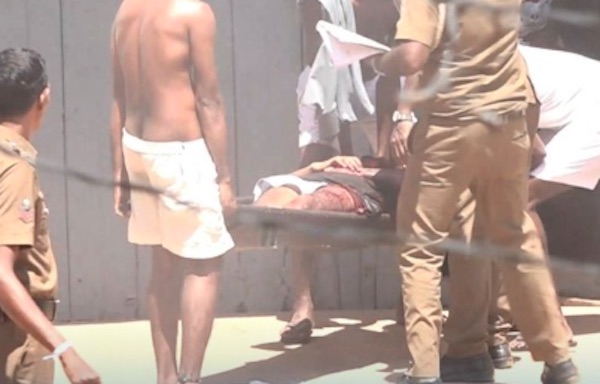
It is always better to wait to comment until the dust settles in the aftermath of a bloodshed. On the news channels, I watched Negombo prison riots from London, and the tragic deaths of the prisoners and the prison officers who were killed during the riots. 10 prison officials and 21 prisoners died in the two days of fighting between two groups of inmates at the prison. I condemn the killing of the prison officers and the prisoners in the strongest possible terms. I saw the cry, anger and emotions of the devastated relatives of the prisoners and prison officers. Some mainstream media in Sri Lanka always exaggerate the cruelty of the prisoners while ignoring the circumstances of the ill-fated prisoners and their poor relatives. The government came to power promising to eradicate poverty but their priority became eradicating the drugs. By launching the aggressive war on drugs, the government sent a skyrocketing number of prisoners to the prisons without a plan to accommodate them. They did not see the consequence of sending thousands of suspects to the overcrowded prisons. There were complaints and reports about how some police officers had abused their power to arrest and detain some individuals on false drug charges
Did the government give the true figure of the current prisoner population? It is reported to be 41000, but in their NPP election manifesto (2024) it said the total number of prisoners in 2022 was 138,581. How did the number drop to nearly 100,000? Did the NPP exaggerate the true figure for political gains?
https://www.scribd.com/document/766722056/NPP-Presidential-Election-Manifesto-2024
(see page 115-116)
Negombo Prison had capacity for about 650 inmates, but held around 2,400.
In the National People’s Power (NPP) election manifesto, ‘A Thriving Nation, A beautiful life’, it recognises the increase in the remand prisoner population is a major cause of prison overcrowding due to the long time it takes to complete the legal proceedings. This is a crystal clear example that President Anura Kumara Dissanayake was well aware of the critical issues in the prisons and the judicial system, and giving effective solutions for them must have been a priority of his government. But neither the judicial system nor prison services have been improved as they promised. Legal proceedings suffer from delays due to severe court backlogs. The vast majority of people waiting for justice suffer due to the delays in the courts. Even under the current government Sri Lankan courts have some of the worst backlogs and delays from magistrate courts to the supreme court.
The following attractive pledges were made in the (NPP) manifesto to improve the conditions of the prisons and the life of the prisoners;
* Preventing all forms of torture inside prisons
* Analysing the nature, mental status and other qualities of the prisoners and categorizing and placing of prisoners accordingly.
* Expanding the facilities within the prisons, including special facilities according to international standards.
* Ensuring the quality of food given to the prisoners. (pages 115-116)
But according to the reports and the prisoners’ experience, appalling conditions in the prisons had gone from bad to worse since the NPP government came to power.
It is reported that the prison officers had been killed brutally by the prisoners. This shows the exploded anger of the prisoners and the mental status of them. Why did the government let the prison authorities neglect the suffering of the prisoners for such a long time?
President Anura Dissanayake has been in power since 2024 and the government had sufficient time to address the issues, at least the major issues. Had he taken genuine interest to resolve the critical issues, in consultations with the prisoners and the relevant parties, this tragedy would have been prevented. Although the minister of Justice Harsana Nanayakkara has taken responsibility for the tragedy, President Anura Kumara himself is also responsible for the bloodshed, as the minister of defence. The government always boasts about the ministers and advisors in the hierarchy with so many professors. Did they advise the president and the minister/s about the remedies for the prisons’ situations?
Does Anura Kumara Disanayake really listen to the voice of the people? Do the ministers listen to the voice of the people? They have very good reasons to doubt it. I have my own experience. The sycophants around the president have made him inaccessible to the ordinary public, like a king. They always filter the actual voice of the people according to their assumptions of what he should hear. Although the sycophants misled him, Anura Kumara should have been sensitive to the media. Some of our great kings, in the history, had disguised themself and gone from village to village to listen to the actual voice of the people. As an educator and freelance journalist I published many articles to educate the government to address the critical national issues proposing viable solutions to them such as human-elephant conflict, deforestation, human-monkey conflict and invasive foreign fish which destroyed the biodiversity in our fresh water lakes, with my international experience. But many issues still remain unsolved because of lack of political will. For example, deforestation continues largely aggravating the human elephant conflict; invasive fish released to the freshwater lakes, by The National Aquaculture Development Authority (NAQDA), continue to destroy the biodiversity in our freshwater lakes including traditional fish such as ‘Lula’, lotus, and the waterweed. Did the government take serious interest in the disasters?
Anura Kumara is very clever at delivering ‘fairy tale speeches’ in public stages about ‘the prosperity his government brings to the citizens’. Do people really believe him as they did in the past? A chief incumbent of a famous temple told me ‘Many people now call him ‘King Chethiya-Chethiya Rajjuruvo’, the king had a reputation as a liar. The unrest among the farmers was created by importing massive quantities of rice from India and China when Sri Lanka had more than enough stocks of paddy to meet the needs of the rice consumers. ‘Recent farmer unrest in Sri Lanka was heavily exacerbated when over 160,000 tonnes of imported Indian and Chinese rice flooded the domestic market immediately before the local harvesting season, crashing paddy prices.’
Last week, by launching a Japan-backed safe drinking water project in Anuradhapura President Anura Kumara said ‘We imported rice for foreign tourists, they don’t like to eat Sri Lankan rice.’ This is a totally misleading picture. When tourists go to any country they like to enjoy the traditional foods of the country including rice and curries, so do they in Sri Lanka.
The government has clearly failed to deliver its promises yet, as they pledged. The paddy farmers’ protests against the government demanding a reasonable price for paddy, demonstrate widespread anger and the frustration of the farming community. The harsh blows on the faces of the effigies of the minister Lal Kantha and Deputy Minister Namal Karunarathna demonstrate the frustration of the farmers. The islandwide outbreak of Dengue is another example of failure of the government’s ‘Clean Sri Lanka.’ programme, even the Beira Lake next to the presidential secretariat is not clean. People travelling on the trains can feel the bad smell of the filthy water. The controlled price for rice is also not working. Although the maximum retail price (mrp) of rice per kilo is Rs260, people always have to pay more than Rs.360 per kilo for good quality rice such as Araliya, Amul and Ponni samba. Araliya samba is widely sold in the black market at around Rs.400 per kilo. One of the aims of the government’s digitalisation programme was to improve efficiency in the government departments and minimise delays in serving the public. However, when you send emails to government officials including to the permanent secretaries, they never bother to even acknowledge the receipt of the email thus forcing the public to come to their offices physically if they need to. If you sent an email to the president’s office or prime minister’s office, the waiting time to get a response could be 6 months. In most cases there are no solutions.
One of the deadliest prison riots in our history is a wakeup call for the authorities, to take immediate action about the appalling conditions in the sardine packed prisons. After the riots, the minister of Justice Harsana Nanayakkara announced that Bogambara Prison would be used to accommodate the prisoners. It is a wise decision although some politicians and NGOs are critical about the location next to The temple of tooth relic. As it was a purpose built colonial prison and the 2nd largest prison, it can be improved and developed within a short period of time to accommodate more than 2000 inmates. In my view it should be preserved and continued as a prison for the benefit of the prisoners. The critics should understand the priorities. Since the closure of the prison in 2014, the conditions of the buildings have deteriorated. The prison will help to remind the colonial legacy to our citizens and the tourists.
Jit / July 18, 2026
What a thrilling show Raja!! Most people need ‘reality facts’ than textbook versions before they start throwing punches, but you’ve clearly decided to go with punches one finds in bad action movies.
Let’s be real: the government definitely dropped the ball on the recent prison situation by not fixing conditions over the last 20 months. But your expectations of whiz kid solutions for every single garbage NPP inherited, is so pathetic! They were NOT created by the NPP! You conveniently deleted the massive global and natural crises they’ve actually managed to navigate successfully using billions from the coffers to keep things afloat. And the massive amount of unpaid taxes collected plus savings made by cutting absolute waste practiced by previous regimes!
You stoop down to Sajith Premadasa level by calling AKD Chethiya and that is your best shot? And 75.5% people approving his leadership so much love a Chethiya? While you’re busy firing off attacks from a comfortable London home, AKD is actually out in the field doing the heavy lifting, tackling problem after problem that you expect to vanish in five minutes.
When the truth doesn’t back up your narrative, you just twist things as you go. Anyway, thanks for the entertainment. The gallery loved the show! Moving up to the balcony seats seems like a stretch for you, so stay cool over wherever you are!
/
SJ / July 18, 2026
Hello Jit
You were missing for a few days after your masterpiece:
“Declaring official one-month period of national mourning including two days of public, bank, and mercantile holidays for Band’s funeral not a big show?”
*
This is from AI search:
S. W. R. D. Bandaranaike (1959): Following his assassination, his remains lay in state at the Parliament building
When former Prime Minister S.W.R.D. Bandaranaike was assassinated in September 1959, the government of Ceylon (now Sri Lanka) did not declare a specific, government-mandated nationwide mourning period in the immediate aftermath of his death, though it was an event of deep national shock. [1, 2, 3, 4]for two days. The funeral was held on the third day at Horagolla.
*
Any more tales to defend your false claim?
/
Jit / July 19, 2026
SJ, I based my earlier comment on the narratives commonly circulated in Sri Lanka when I was growing up. I didn’t do a forensic dissect on how Banda’s funeral was conducted because, frankly, it’s not a topic that interests me at all.
I’m not interested in the usual theatrics around this either. The point I raised was about your unfair and biased criticism of Dudley’s funeral. He was a good man, who lived a humble life and the public response he received reflected genuine respect and gratitude. Whatever JRJ did or didn’t do is irrelevant — it wasn’t Dudley’s problem, and it certainly wasn’t the problem of the thousands of people either, who queued day and night to pay tribute to their leader.
/
SJ / July 19, 2026
So all your tales are based on idle old gossip?
Please tell us in advance so that we will not waste time rebutting them.
*
You are the first person that I came across who claimed “…official one-month period of national mourning ….”, let alone the rest.
Did your sources include the fine details as well?
You had not have the decency to admit the mistake (I will like to believe that it was a mistake and not a concoction) or retract a false allegation.
But you go at a tangent instead.
Shame!
/
Jit / July 20, 2026
You need not waste your energy to be so pathetic to keep harping on just one thing that I have already said was circulating in the society a long while ago, while you conveniently ignore the wider points I mentioned. Yes, I admit I did not do a proper research on that – as I do on many other matters – so that was my mistake. Now take your medicine and rest well my friend!
/
SJ / July 20, 2026
Thank you for saying “that was my mistake”.
/
RB / July 19, 2026
Hello Jit,
Thank you for addressing directly to me, to the author. I didn’t mention anything from Sajith’s perspective. What you see in the article is the ground reality. Everything I mentioned here is from my own experience, not from books. It is my feedback to AKD and his minsters to reflect on them. AKD doesn’t have to carry every burden on his shoulders as the executive president. It is his responsibility to listen to genuine voice and the grievances of the people and the media to monitor the progress of what the ministers have been assigned to. When we give our thoughts through media, we need to feel they have been listened by the actions of the government. For example, when J.R. Jayawardena was the president, there was a proposal to close University of Peradeniya permanently. When I exposed the government’s conspiracy by writing to The Attha (Truth) newspaper to protect our nation’s one of the greatest assets, the government had to withdraw the plan. It is the way to welcome thoughts from educators and journalists who love the motherland. AKD has to be careful about the sycophants around him who always filter the actual voice of the people. I hope you can share my thoughts.
/
Jit / July 20, 2026
Raja, I will just reproduce one of your quotes “….What you see in the article is the ground reality …. Everything I mentioned here is from my own experience, not from books….”
–
Instead of me giving you a long speech, please research on what the international reports say:
• Last six IMF reviews – Very high level of comments
• World Bank country updates-post (2022 crisis) – Upgraded SL to upper middle class status
• Transparency International’s Corruption Perceptions Index – elevated SL by 14 places
• Credit rating agencies (Fitch, S&P, Moody’s) – stable and some upgrades to CAA+
Plus, Verité Research and CPA findings that over 65% people support the government and many positive trends mentioned.
Needless to mention that they all use much higher and stringent research methods and tools to get their results than your own methods.
Do all those reports sound like ‘fairy tales’? Chethiya narratives??
–
I will finish by quoting another very interesting one you wrote: You say that JRJ was going to “close down” the Peradeniya university and you exposed the “government’s conspiracy” in The Attha (Truth) newspaper and then the government had to withdraw the plan!!
So you are the one who stopped that mighty JRJ just by posting a piece in a tabloid newspaper with a circulation of 16,000 copies??
I rest my case!!
/
RB / July 22, 2026
Jit,
Let the target audience i.e. the government to judge the truth in the article. Truth doesn’t depend on the circulation of the newspaper or opinion of the IMF etc.
Did you know President JR Jayawardane’s most trusted newspaper was Attha (The Truth). JR didn’t like sycophants in the national newspapers. He publicly admitted that Attha was the very first paper he used to read in his daily routine in the morning, so mighty JR listened to the truth what I published.
/