


By Savitri Kumar –
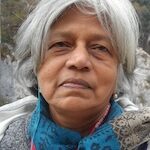
Prof. Savitri Kumar
Dr. Raja de Silva (Raja Aiya) is no more. He was a favourite cousin of mine and one of the most charming persons I knew. His charm made all his cousins feel they had a special place in his heart. We were the children of Pabo, the youngest (the 13th) sibling of his mother, Maggie (the 4th) and so there was a big age gap between Raja Aiya and us, but the man was such that we “small brats” never felt out of place with him.
In later life there was a more immediate connection between us as both of us were chemists. Like me and my husband, Raja, two of his brothers and a few of his other cousins were followed the special degree in Chemistry. Raja Aiya used to loan or gift me books relevant to the subject and several owned by his late brother, Lucian (CL) who was in the academic staff of the University Chemistry Department, long before I joined it.
The early chemists were called alchemists and they spent their lives, seeking the means to convert base metals to gold and discovering the elixir is life which would guarantee immortality. Raja although in his 102nd year seemed no different when we visited him last month than the younger Raja Aiya I used to know. Sill young at heart if not body, we had come to believe that he had indeed found the elixir of life which long eluded the alchemists in the form of quality scotch, which he truly enjoyed in sips from the hip flask he often carried. So his sudden passing away came as a big shock to us. More so as I too had written an article for “Raja 100”, released on his hundredth birthday edited by a nephew of his, Uvindu and we fully expected to bring out a follow up for his 105th.
Raja Aiya was a raconteur par-excellence. We will truly miss his never-ending range of stories, some true, many exaggerated, and a few concocted but all with a touch of humour. He had the talent to make his listeners hang on to his every word until the very end, even when they may have heard it from him before.
Raja, while working in the Archaeology Department lived in Kollupitiya with his batchmate, “Pips” Siriwardene. My father (Botany) and Pips (Chemistry) were in the Faculty of Science at the University in Colombo. Our family (father, mother and five children) could not comfortably travel on long trips (Kataragama, visits to relatives of our extended family) in our Peugeot 203 and Pips’ often helped out by taking some of us children in his Mercedes. Raja Aiya would usually accompany Pips and we always tried to get into Pips’ car as Raja’s stories would keep us entertained throughout the trip
Raja Aiya like most of his male siblings and cousins studied at Royal, a place close to his heart, which he believed moulded his character through teaching him to learn of books, learn of men and learn to play the game.
Raja graduated in 1946 from the University of Ceylon followed next year by yet another degree in Chemistry from the University of London. He then joined the Archaeology Department as Assistant Commissioner, the first chemist and indeed the first with a scientific background. He was awarded the doctorate by the University of Oxford a few years later based on his research on technical aspects of art history.
The Archaeology Department was headed by civil servants during the British period although a few of whom had some practical training in excavations. The educational background of the first two Archaeological Commissioners of Sri Lankan origin, Paranavitana and Godakumbura were in Oriental languages. They specialized in Epigraphy and their research was concentrated on the study of ancient inscriptions, the area of specialization of most of the others in the Department at that time.
As the first chemist appointed to the Department, Raja established a chemical laboratory in the Department devoted to conservation problems where he worked on ancient temple paintings and their restoration. He became the third local Archaeological Commissioner and served eleven years from 1967 until he retired. He then became an advisor in the Department for seven more years and continued to write on archaeological topics. His principled thinking and logical mind permitted Raja to present an alternate, often controversial, viewpoint.
His background in science allowed him to steer clear of the racial undertones that were slowly permeating into archaeology. Some subsequent Commissioners actively exploited archaeology for political purposes by excavating for Buddhist relics in the North and East, identifying areas as archaeological sites, restricting their use by locals and establishing Buddhist temples there. Raja brought into the Department people with backgrounds in architecture and anthropology including Siran Deraniyagala who initiated scientific stratified excavations in Sri Lanka.
Raja even though retired by then was very critical of the relationship between the newly established Central Cultural Fund (CCF) and the Department of Archaeology. With the influx of dollars from tourists visiting archaeological sites, the CCF was flush with funds while the Department was starved of money. Raja felt that the funds collected by CCF legally belonged to the Department and should help pay for departmental research. Instead, the CCF was using its funds on projects run by University academics, architectural and foreign consultants, many of them with little or no training in practical archaeology. The unkindest cut was that UNESCO funds negotiated by Raja for improving the Departmental laboratory, but received after he retired, were handed over to the CCF and wasted on constructing a largely non-functional laboratory in Anuradhapura. It is clear that Raja’s warnings on the CCF should have been heeded as the CCF appeared to be rather lax in its treatment of accounts as is shown by the many allegations that have surfaced of Ministerial misuse of CCF funds.
In October 1967, the archaeological site of Sigiriya was in crisis as some unknown persons had daubed green paint on the frescoes and scratched some with daggers. Raja was given the task of removing the paint. It was apparent to Raja that the work required expertise of a high order not available in the country and an Italian paint conservator, Luciano Maranzi was brought in, sponsored by UNESCO and the Smithsonian Institution. The work involved removal of the paint, consolidation of the plaster and application of a preservation coating. Since Maranzi’s assignment was only for a few weeks, the work had to be continued after he left and was eventually completed in April 1968 by Raja and his team. All but two of the paintings were saved.
Raja was fascinated by the story of Sigiriya and questioned the conventional wisdom accepted by all Archaeological Commissioners and many archaeological scholars that it was Kasappa’s palace. Raja provided evidence to suggest that it was in fact a Mahayana monastery and pointed out that the Mahavamsa, written seven centuries after the event, was an unreliable source because of the bias felt against Mahayana by its author from the Mahavihara Hinayana tradition which had successfully suppressed the growth of Mahayana. According to Raja, the paintings were not of ladies of the Court as claimed, but of the goddess Tara, revered by the Mahayana tradition. He provided evidence by comparing them with similar paintings in the Ajanta caves in India. Although there were many challenges to Raja’s proposition, he dealt with them effectively and provided more evidence to support his assertions.
Raja’s attachment to Sigiriya was such that he built a modest holiday home close to the rock. Kamala and he would regularly spend time there. After Kamala’s passing too, he paid regular visits to Sigiriya but in the past few years, travelling had been a problem. Raja however remains close to Sigiriya with the rock impacting his everyday thinking, writing and actions. Just as Dhatusena told Kasappa that his treasure was the water in the Kalawewa, Raja could justly claim that the treasured moments of his life were those spent with the painted ladies of Sigiriya.
*Savitri Kumar is Professor Emeritus at the University of Peradeniya and a former Senior Professor at the University and the National Institute of Fundamental Studies (NIFS)
Lasantha Pethiyagoda / February 24, 2026
It is sad if not tragic that very few people care to either read or comment on works that have cultural, scientific or even literal significance. However, if the topic was on some trashy political shenanigan by an illiterate moron, there would be many comments here. This reflects very badly on the intellectual rigor of average Sri Lankans. Anyway, back to the article. Controversy is a common feature of academics who have generally become redundant with age or with technology that has superseded their original works. Gananath Obeysekera too became increasingly controversial in his later years, desperately attempting to remain relevant. The problem of ethnic or religious supremacist ideology or suppression of evidence that support alternate views is not new. I believe UNESCO was prevented from excavating pre-Buddhist archaeology in the Anuradhapura sites, also due to fear of upsetting the established status quo.
/
SebastianSR / February 24, 2026
Good to read about Sigirya as seen by Bell, Paravitana, and then Rahaj de Silva. Mahayana Tara normally carries a Lotus, unlike Sigri “apsaras”. For HCP Bell and Paranavitana, it was a Royal Palace, and the Court ladies were personifications of lightning/clouds (Meghalata and Vidyulata). Bell and Paranvitana had good reason given the the massive lion entrance, a symbol of royalty (Sakyan or Sinhala pride); the sheer scale and “gatekeeper” nature suggest a royal citadel. The pleasure gardens at the base—complete with fountains, pressurized pipes, and swimming pools—are hallmarks of secular luxury, not monastic austerity (as seen in Ritigala). The Bell-Paranavitana theory syncs with the Chulawamsa account and what is revealed from Sigiri Griffiti. Raja de Silva is also correct in regard to some matters of icongraphy, plainess of the “Asana” (meditation seats) on top, chemistry of the paintings etc., pointing to a “Vihara”(Temple) of the Mahayanists. The modern view is that Sigriya was originally a Mahayana site, usurped by Kasyapa for his “Alakamanda” palace. This modern “middle view” has been proposed by Senaka Bandaranayake, Roland de Silva and others.
/
Jaffna Man / February 24, 2026
Senake Bandaranayake also proposed at a conference, as I heard him boast at a UGC meeting, that Pali originatdmin Sri Lanka and went to India. He added rather boastully that no one challenged him.
A lot of this is common sense that one can pick up through reading. But when we ordinary folk read and comment we are asked “Ehere is your degree? This is particularly so with the English language. So it is that a few people dominated these fields.
Senke’s boast makes clear why at a sociology conference at the OU no one challenged his attocious suggestion.
It is easy to understand the previous comment “It is sad if not tragic that very few people care to either read or comment on works that have cultural, scientific or even literal significance. However, if the topic was on some trashy political shenanigan by an illiterate moron, there would be many comments here. This reflects very badly on the intellectual rigor of average Sri Lankans. “
I think name calling like “trashy political shenanigan by an illiterate moron” silences those who can intelligently comment.”
Comment by a”trashy political shenanigan by an illiterate moron” on this subject.
/
SebastianSR / February 24, 2026
if the topic was on some trashy political shenanigan by an illiterate moron”
Political topics, and “political science” are NOT “scietific”, but mostly opinion.
Socail science, anthropology and religion are nor different, and indeed an educated person can educate himself on such topics by reading and doing a bit of background work.
Jaffna man has correctly noted the “bogus arrogance” of some individuals and gurus.
The Buddha’s Kalama sutta and his attack on Brahamins in the BrahmaJala sutta, and
Socrates’ going about asking questions in Ancient Greece
show that this problem existed even in the 5th century BC.
Today google search and AI helps to cut thorugh the journal paywall and the need
for libraray subscriptions that kept people bound within narrow subject specifications.
Anyone can, and should, comment on them.
Illiterate or not, moron or not, every adult who has not been judged mentally incompeternt and locked up in a psychiatric facility has ONE VOTE, and the right to express their opinion.
/
Manel Fonseka / February 26, 2026
Jeevan
What has my husband done that makes you rush to condemn him at the slightest (relevant or irrelevant) opportunity that crops up? Why didnt you take him on when he was living? And why, why, why are you still hiding the correct (?) source of yr November CT garbled attack on him?
—
And now you accused him of boasting! The last thing he wd have done. I am beginning to think that your English comprehension is somewhat inadequate (for want of a better word). He certainly wdnt havent sd Pali originated in SL & went to India. Please educate yrself about the Pali language and the written Pali texts. Look up Wikipedia if you cant handle more scholarly explanations.
—
I wonder how many more egs you have tucked under yr belt to bring up to attack him with.. Incidents you claim to have witnessed, garbled versions of published texts or misunderstandings. And now you also appear to accuse him of racism, Sinhala nationalism! The last thing he was.
—
Are you enjoying putting out all this rubbish in order to distress, punish, his widow — for what?
—
And is CT happy to provide the space for you todo it?
/
SebastianSR / February 27, 2026
Dr. Senaka Bandaranayake was the energy and driving force that pushed through the Cultural Triangle archeological research, and his contribution, together with is associates, Shiran Deraniyagala, and otherd will always be remembered with respect. Under the UNESCO-Sri Lanka Cultural Triangle Project launched in 1982, Bandaranayake served as the founding Director of Archaeology for the Sigiriya Project. His work shifted the focus from just historical monuments to the wider settlement archaeology of the region. Sometimes, when silly questions were asked, a speaker (be it Senaka or Shiran or Ratnajeevan Hoole) can rightly brush off the question, and this may seem arrogant. what you see and hear is in the eye and ear of the beholder.
/
Manel Fonseka / February 28, 2026
Great! What a reader you are, LankaScot!!
Many thanks for coming to my rescue.
—
Re my response to JaffnaMan, above, in a sense S has kinda “arisen from the dead”.
A book he conceived years ago (“Ancient & Historic Gardens of Sri Lanka,” based on years of work in the field), for which he finalised his main chapters the day before he died (on 2 March 2015), appeared, expanded & somewhat altered by his non-SL partner, a landscape architect (invited mainly to attend to illustrations etc.), as “Gardens of SL…: 2,000 Years of Garden & Landscape Design Tradition”. A huge & heavy book, incorporating later material that ws not part of S’s plan.
—
For nearly a year I have tried to read it but it’s too heavy for me to hold. And I’m not madly happy about — lots of problems. The least of them being that the “invitee” is now the “visitor”.
—
Wot to do? Not to worry.
/
LankaScot / February 28, 2026
Hello Manel,
I have read your Husband’s 2012 Book “Continuities and Transformations” and nowhere does he suggest that Pali was homegrown in Sri Lanka and passed on to India. There are Brahmi Inscriptions in Sri Lanka earlier than any in North India as Dr Coningham found at Anuradhapura in his Excavations.
To quote from Emeritus Professor Bandaranayake’s book “They use the ‘Early Sinhala’ or ‘Proto-Sinhala’ language and the Indian Brahmi alphabet to record the granting of the caves to the Buddhist monastic order (Paranavitana 1970). This was in Chapter 5 “Settlement patterns of the Protohistoric–Early Historic interface in Sri Lanka”.
A thoroughly Interesting and Informative Book which gave me a good insight into not just the Archaeology but also the Cultural relevance of the different periods in Sri Lanka’s past. I really enjoyed his explanations of Sigiriya, which completely destroys the theories of one particular contributor to CT.
Best regards
/
Manel Fonseka / February 28, 2026
Great! What a reader you are, LankaScot!!
Many thanks for coming to my rescue.
—
Re my response to JaffnaMan, above, in a sense S has kinda “arisen from the dead”.
A book he conceived years ago (“Ancient & Historic Gardens of Sri Lanka,” based on years of work in the field), for which he finalised his main chapters the day before he died (on 2 March 2015), appeared, expanded & somewhat altered by his non-SL partner, a landscape architect (invited mainly to attend to illustrations etc.), as “Gardens of SL…: 2,000 Years of Garden & Landscape Design Tradition”. A huge & heavy book, incorporating later material that ws not part of S’s plan.
—
For nearly a year I have tried to read it but it’s too heavy for me to hold. And I’m not madly happy about — lots of problems. The least of them being that the “invitee” is now the “visitor”.
—
Wot to do? Not to worry.
/
SJ / February 26, 2026
“However, if the topic was on some trashy political shenanigan by an illiterate moron, there would be many comments here”
Sad but true.
Why should one take exception to the phrase ”trashy political shenanigan by an illiterate moron” ?
It is harsh, but are there none such on CT pages?
Do not personalised trivia attract more comment than serious matters?
/
Manel Fonseka / February 28, 2026
Jaffna Man
I ask you once again:
PLEASE give me the CORRECT source of the Sunday Times article you describe as “cheap”.
—
You say Senake ws interviewed in it a number of years AFTER he died.
He ws capable of many things but, unlike the guy I believe you worship, rising from the dead ws not one of them.
—
Alas.
—
Your accusation/s was/were carried by CT in November. Dont you want back up your claim? Or have you actually made everything up to suit yr purpose?
/
SebastianSR / February 24, 2026
So, what I want to note is that when someone says :>i>t is sad if not tragic that very few people care to either read or comment on works that have cultural, scientific or even literal significance” that smacks of the same arrogance and pushing down others. Let us comment on the material than on the individual. Let us ignore all ad homenem comments and thrashy comments.
/
SJ / February 26, 2026
SSR
Can you honestly disagree with the observation that “it is sad if not tragic that very few people care to either read or comment on works that have cultural, scientific or even literal significance”?
It is only a call for serious comment on serious articles.
Personalising issues and then proceeding to attack individuals is not uncommon on CT pages.
Before accusing others of arrogance, it will be useful for one to check one’s own modesty and humility.
/
SebastianSR / February 27, 2026
SJ says “Can you honestly disagree with the observation that “it is sad if not tragic that very few people care to either read or comment on works that have cultural, scientific or even literal significance”?
The author of the above, Mr. Pethiyagoda did not add anything to the discussion on Sigiriya (e.g., the various hypotheses about it being a Mahayana temple, a Fortress, a pleasure palace, and/or all of the above etc.) but attacked others. The best approach to raising the level of comment is by example, and not by making ad hominem remarks.
/
SJ / February 27, 2026
Does his not adding to the Sigiriya controversy mean that he makes trivial remarks?
Grow up.
He has made a valid point to which some people take exception.
Where it hurts is anybody’s guess.
/
SebastianSR / February 24, 2026
Instead of waiting for the “Government to do everything” people should make theor own cooking gas by setting up biogas generators. Many newspaper articles have appeared on this by alternative energy advocates like Gnana ஞானா ඥානා, Para Jayasinghe, Chandre Dharmawardana, Ralapanawa and others. To ensure safety and reliability, organizations like the Sri Lanka Standards Institution (SLSI) and the National Engineering Research and Development (NERD) Center have worked on establishing national codes of practice for domestic biogas systems. The Kuliyapitiya Pradeshiya Sabha (a “Green Energy Champion” winner) successfully implemented community biodigester units to process organic waste for the benefit of the entire area. That is the way to go.
/
SJ / February 27, 2026
“people should make theor own cooking gas by setting up biogas generators. “
Where may I wonder in Colombo or other urban centres?
*
I remember the enthusiasm of the late 1970s for biogas here, in India ans China. It made barely a dent on the national scene. I have seen some serous projects here.
There is a case for it in a rural context. But it is not as easy as it is said to be.
/