

By Sarath de Alwis –

Sarath de Alwis
The optics were as breathtaking as they were damning. On a Saturday, an opulent parade of luxury, chauffeured chariots rolled directly into the Kotte headquarters of the Kotte Sri Kalyani Samagri Dharma Maha Sangha Sabha of the Siam Nikaya.
Out stepped saffron-clad potentates, oozing obesity and some limping with diabetic neuropathy, the telltale evidence of indolence masquerading as piety.
These Japanese, Korean, and German SUVs—capsules of wealth representing the absolute antithesis of Siddhartha’s doctrine of impermanence and renunciation—stood as symbols of the ultimate upward mobility of the Kotte Chapter’s prelates.
These monks had not gathered to meditate on the deep crises of our economic recovery process or moral decay paralyzing the nation. Instead, they convened an emergency conclave to defend a convicted, imprisoned colleague: Galagoda Atte Gnanasara.
By forcefully demanding his immediate release and fiercely protesting the prison administration’s removal of his saffron robes under then existing regulations, these prelates sent an unmistakable, fearsomely toxic message to the citizenry: the robe is an absolute shield against the ordinary laws of this land.
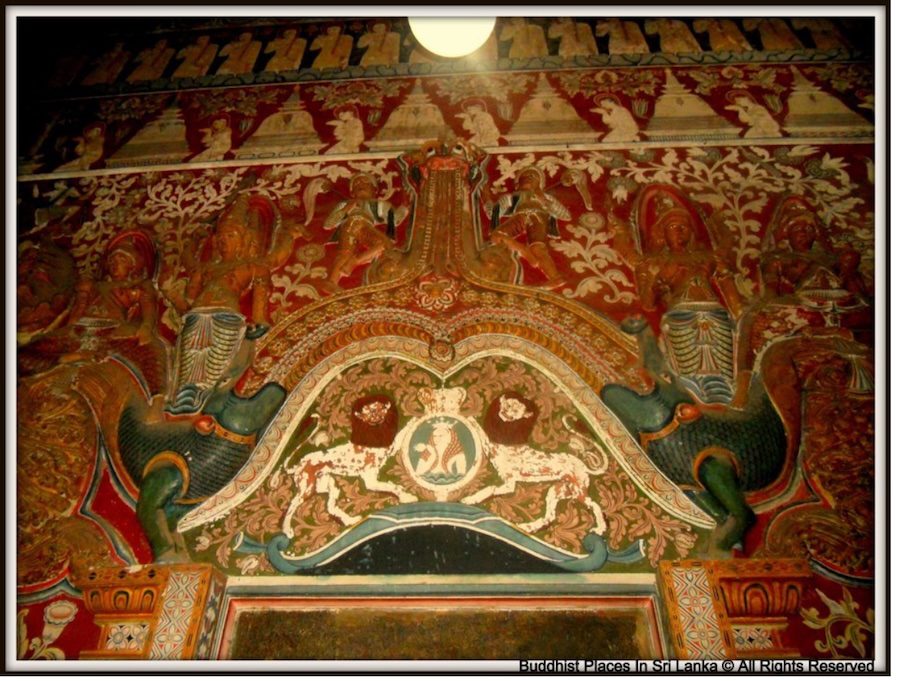
Queen Victoria in Kotte Raja Maha Viharaya
(The image house of the Kotte Raja Maha Vihara is notable for its architectural and artistic features. It consists of two chambers, with the walls of the inner chamber adorned with Kandyan Era frescoes. The outer chamber appears to have been constructed more recently and features modern frescoes. The inner chamber has two entrances framed by sculpted Makara Thorana (Dragon arches). A unique feature is a framed portrait of Queen Victoria painted over the right-side entrance door, accompanied by two lions.)
A Watershed Event in 1959
That shouldn’t surprise the Buddhists of this fortunate ‘Dharma-Deepa’. To borrow the razor-sharp pun coined by legendary journalist Tarzie Vittachi, these prelates have systematically operated as “Buddy-Racketeers.”
The historical blueprint for this corporate monasticism was perfectly captured during the assassination of a Prime Minister, a watershed crisis we faced in 1959.
Vittachi directed his biting double-entendre at Mapitigama Buddharakkhita, the then-powerful Chief Incumbent of the hallowed Kelaniya Raja Maha Vihara.
The pun was a devastating indictment. Buddharakkhita, whose name literally translated to “Protected by the Buddha,” had subverted his sacred vows to become a ruthless political kingmaker. He weaponized an influential network of political “buddies” to run highly lucrative commercial “rackets.” The irony was magnified by the sanctuary he controlled.
The Kelaniya Temple is deeply revered by millions because chronicled tradition states it was consecrated by a personal visit by the Buddha himself.
Operating a shadow corporate empire out of a temple of such mythic spiritual purity laid bare the utter rot eating into the post-independence state even to this day!
Buddharakkhita’s fatal fallout with Prime Minister S. W. R. D. Bandaranaike was driven not by doctrinal disputes, but by a failed corporate undertaking.
Having heavily financed and mobilized the monk-led campaign that swept Bandaranaike into power under the “Sinhala Only” wave of 1956, the “Buddy-Racketeer” expected immediate, untaxed financial dividends.
He was deeply aggrieved when the Prime Minister flatly refused to award a lucrative government monopoly to his venture, Colombo Shipping Lines, which aimed to corner state-subsidized rice imports from Burma and Thailand.
When Bandaranaike further blocked his plans for a state-licensed sugar enterprise, Buddharakkhita’s transition from a frustrated investor into a murderous conspirator was finalized.
The monk masterminded the Prime Minister’s assassination out of sheer spite.
It set a terrifying precedent: when the democratic state refuses to bend to the financial greed of the robe, the robe will attempt to break the state.
Remarkably, despite being convicted by the Supreme Court and sentenced to life imprisonment, Buddharakkhita was never officially defrocked by his Nikaya, illustrating an early, absolute refusal by the monastic hierarchy to subject its own to secular criminal accountability.
An Ordained Nobility – A colonial legacy
This resistance to state authority is rooted in a colonial legacy of institutionalized privilege. One needs only to visit the Kotte Raja Maha Vihara shrine room to see a stunning material manifestation of this alliance: a prominent portrait of Empress Victoria painted directly onto the temple walls.
Far from a bizarre historical accident, it is the Siam Nikaya’s grateful, enduring acknowledgment of British imperial patronage.
Through the Buddhist Temporalities Ordinance, the British colonial administration effectively legalized and protected “monastic landlordism.”
By granting vast tracts of untaxed, state-secured land to specific temples and reinforcing elite caste-based hegemonies—such as the Radala-Goyigama dominance within the Malwatta and Asgiriya chapters—the colonial state transformed the Sangha into an untouchable class of landed aristocrats.
Secularism and progressive governance have always been viewed by this monastic elite as existential threats to their inherited property, wealth, and systemic immunity.
As a result, whenever the state attempted to implement progressive legislation or equitable social reforms, the corporate Sangha has swiftly weaponized religious sentiment to torpedo them.
In the mid-20th century, when progressive forces within various coalition governments attempted to introduce redistributive land reforms that would cap private holdings, the monastic landlord cartel fiercely opposed the legislation.
They disingenuously framed property rights for wealthy temples as the defense of the ‘Buddha Sasana.’
More destructively, the Sangha has consistently served as the final burial ground for any rational, peaceful settlement of our historical ethnic discords.
The historic Bandaranaike-Chelvanayakam Pact of 1957 and the Dudley-Chelvanayakam Pact of 1965—both offered modest, sensible frameworks for regional devolution and minority language rights.
These tentative accords were violently derailed by street protests orchestrated by monks who marched to the Colombo residences of prime ministers to demand their unconditional abrogation.
Decades later, their unyielding hostility toward the 13th Amendment and any form of power-sharing continues to keep the country shackled to a suffocating, hyper-centralized state model that deliberately alienates its minority citizens.
The Rise of the Saffron Cartel
These “Buddy-Racketeers” have clearly failed to absorb or implement the profound thesis of Walpola Rahula Thero’s seminal 1946 work, Bhikshuvage Urumaya (The Heritage of the Bhikku).
Rahula Thero argued that while the monk historically possessed a socio-political role, that role was strictly tied to selfless social service, intellectual enlightenment, and fighting for the freedom of the downtrodden.
Instead, modern political monks have perverted this heritage. They have transformed it into a license for demagoguery, corporate enrichment, and chauvinistic extremism.
The upper echelons of the Sangha no longer serve as spiritual leaders. They are no longer trailblazers of the caliber of Hikkaduwe Sri Sumangala Thero, Welivitiye Soratha Thero, or the later sage Walpola Rahula Thero.
Instead, they function as highly organized members of an economic and political cartel. This flagrant display of monastic arrogance is not a modern anomaly. It is not a sudden deviation from tradition.
Instead, it is the continuation of a long, dark history of political monasticism. For decades, these powerful forces—manipulated by crony elite classes and, in turn, manipulated by capricious monks who routinely outsmart their own patrons—have acted as a formidable barrier obstructing our slow, bitter crawl toward structural progress, secular governance, and true modernity.
This systemic cancer reached its malignant zenith during the presidency of Mahinda Rajapaksa. The Rajapaksa regime fundamentally understood that its rampant institutional corruption, familial nepotism, and economic mismanagement could be shielded from public scrutiny if it systematically fed the beast of majoritarian paranoia.
The MR presidency was aided by GR the soldier who never was a true warrior, deliberately cultivated and weaponized extremist monastic front groups, most notably the Bodu Bala Sena (BBS)—co-founded by none other than Galagoda Atte Gnanasara.
Backed by state intelligence apparatuses and protected by political patronage, these extremist monks were given free rein to instigate anti-minority riots, vandalize property, and terrorize communities with complete impunity.
By tethering its legitimacy to the absolute worst elements of the saffron cartel, the Rajapaksa presidency rapidly disintegrated into a viciously parochial, kleptocratic regime that bartered the country’s economic future for majoritarian cheers.
The Cowardice of the Secular Elite
The final, tragic defense of this toxic paradigm is encapsulated by the political survival tactics of Ranil Wickremesinghe.
Long marketed to the international community as a sophisticated, Western-educated liberal and a champion of the rule of law, Wickremesinghe’s political calculus eventually exposed the sheer cowardice of the secular elite.
His political alliance’s defense of Gnanasara—protesting the court-ordered return to prison, the removal of the monk’s robes and appeasing the Kotte prelates’ outrage—completes the vicious circle of state capitulation.
It proves that regardless of whether the regime in power is overtly nationalist or determinedly committed to make the republic inclusive, the secular state must either bow in terror before the saffron cartel or meet it head on.
As long as our political classes continue to coddle these “Buddy-Racketeers,” allowing them to arrive in luxury chariots to dictate judicial outcomes and veto progressive state actions, the country will remain trapped in its post-independence malaise.
True modernity and progress will remain a distant, impossible dream until the rule of law applies equally to all—whether one wears a civilian suit, a politician’s shawl, or the sacred robes of the Buddha.