

By Ranmalee Nanayakkara –
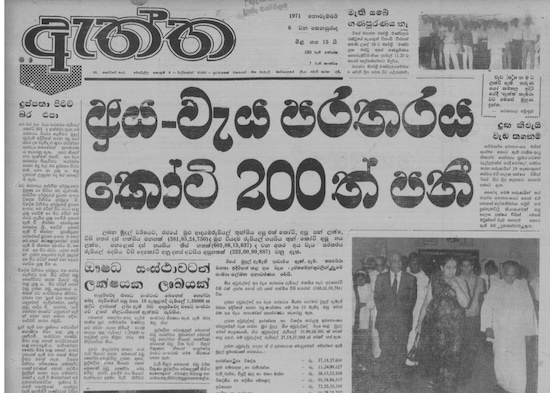
Sri Lanka has had a complex economic history, marked by periods of growth and challenges. By the early 1970s, the country found itself at a crucial juncture, grappling with a combination of internal and external factors that would ultimately culminate in a significant economic crisis during the Sirimavo Bandaranaike’s regime. On most occasions, the only source of information the public had was the daily newspapers that were circulated islandwide. Among those, was a Sinhala-Language daily newspaper published from Colombo by the Communist Party of Sri Lanka(Hereinafter CPSL). The Aththa Newspaper emerged as an important element in Sri Lankan journalism. At the 1970 General election, Sirimavo Bandaranaike’s United Front won an overwhelming majority, defeating the ‘United National Party’ led by Dudley Senanayaka. Sirimavo’s coalition government consisted of ministers from several parties from the Left including the CPSL. Pieter Keuneman and BY Tudawe both held ministerial positions in the coalition government. This article will further discuss the economic crisis during the 1970s and the actions taken by the United Front. Additionally, it will explore the portrayal of this pivotal and contentious period in Sri Lanka’s history by the ‘Aththa’ newspaper.
The Aththa Newspaper spoke highly of the coalition government at the beginning. The newspaper used their resources to promote the then government in various ways. The following is taken from an article which was published in the Aththa Newspaper right before the 1970 General Election (1970/05/26). This particular newspaper also portrays a newspaper advertisement, issued by a collective of Samagi Peramuna supporters that request all readers to be aware of news that is spread by the capitalist newspapers.
“Mrs. Sirimavo Bandaranaike requires no introduction, as her dedicated service to the nation speaks volumes. She is revered as a maternal figure for her profound impact on our country” – Malwatu Maha Nayaka
“Our struggle extends beyond merely ousting the government led by Dudley Senanayaka; it also aims to establish a government comprising the Lanka Sama Samaja-Communist coalition within the United Front. All three parties have wholeheartedly embraced this vision, and our policies are unequivocally aligned with it”.
However, uncontrolled inflation between 1973 and 1974 led to economic uncertainty within the country and public dissatisfaction against the Government. within the nation. The Aththa Newspaper began to criticize the United Front coalition and its policies. The following is taken from the editorial column of the Aththa Newspaper which was published on 25th of May 1972.
“The true measure of government ministers lies not in their rhetoric but in their ability to actualize their proposed visions through implementation”
‘As public discontentment grew, Aththa began to criticize the same coalition government that it campaigned for” This shows that whenever there is a political turmoil in the nation the Aththa Newspaper would side with the people. It was critical of capitalist policies, often highlighting socio-economic disparities and injustices within Sri Lankan society.
After the United Front government came to power in Sri Lanka, it embarked on an ambitious economic agenda aimed at shifting the country from a liberal market structure toward a state-led model. Key initiatives included the nationalization of major industries, an emphasis on import substitution, and extensive land reforms aimed at redistributing wealth and increasing agricultural productivity. Initially, these measures were a response to the nation’s worsening economic woes rather than a deliberate embrace of import substitution industrialization. However, over time, trade restrictions evolved into potent tools, reshaping the landscape of private sector production to align with perceived national interests.
Between 1968 and 1970, Sri Lanka began modest economic liberalization, easing trade restrictions, promoting private investment in select industries, and boosting agricultural exports. However, from 1970 to 1977, this trend reversed as the government pursued a socialist agenda, bringing trade, industry, agriculture, and banking under state control. State-owned enterprises expanded significantly, emphasizing centralized economic planning.
This shift was as much political as it was economic. Sri Lanka aimed to enhance government control over the economy, deliberately reducing the influence of private businesses—going even further than India in this regard
In a system where getting permission to import was hard and what you imported determined how well your business did, government officials held a lot of power. They could decide if local businesses that replaced imports could make money or not.
By the mid-1970s, Sri Lanka’s economic trajectory veered sharply inward, with strict rules on trade, money, and lots of government involvement in everything. It was like sailing into unknown waters on the world’s economic map.
As indicated in the Ceylon Today, 2018
“This started off when The Sri Lankan government implemented significant land reforms driven by socialist principles, resulting in the nationalization of approximately 502 privately-owned tea, rubber, and coconut estates. This move aimed to curtail the extent of privately-held land holdings”
One of the memoirs written by Leelananda De Silva in the book ‘Sirimavo; Honoring the world’s first woman Primeminister’, states the following.
“There were many unintended consequences that arose from the policy of land reform of the 1970-1977 government, one of which was the elimination of most of the traditional land-owning classes from the political arena of Sri Lanka. Mrs. B herself was one of the “Victims” of this policy of land reform…..A significant aspect of the takeover of tea and rubber estates under the Land Reform Act was the nationalization of the sterling companies. There were over a hundred such British-owned companies holding around 125,000 acres of land.”
Bandaranaike’s administration initiated land reforms to tackle landlessness and enhance agricultural output in rural regions. The 1972 Land Reform Law sought to redistribute land to those without it, empowering rural dwellers and promoting agricultural self-reliance.
In a newspaper article by Milton Perera for the Aththa Newspaper, on 26th of February 1972 states the following,
“The government’s imperative now lies in reclaiming lands rightfully belonging to foreigners without compensation. This approach stands as both just and effective. Centuries of exploitation by foreign companies, predominantly of white descent, have exploited our people and resources. It’s time to rectify this historical injustice”.
Throughout this period, the government invested extensively and prioritized substitutes, a trend that was highlighted by the Aththa Newspaper in 1972.
“Only 25% of the country’s population constitutes the active labor force, with the remaining 75% relying on this minority for sustenance. This imbalance contributes to a stagnant economic system within the country”.
Between 1972 to 1977, there were even recommendations to the government to halt not only the importation of goods but also of equipment. In an interview to the Aththa on 18 January 1973, SSS Karunathilaka, a former Additional Research Director at the Central Bank, mentioned that the sole path to economic recovery lies in fostering and enhancing the agricultural sector of the country. He suggests that as a nation, we should even consider prohibiting the importation of tractors and other necessary cultivation equipment. Instead, the focus should be on domestic production of these items to stimulate our economy’s growth.
In 1948, a six-year economic integration plan, including the private sector, was introduced but abandoned due to a government change. In 1959, a new administration created a National Planning Council (NPC) and launched a comprehensive ten-year plan targeting both public and private sectors. The plan, projecting 6% growth, aimed to prevent Sri Lanka from lagging behind East Asian nations. However, successive governments failed to fully implement it.
As stated by Kelegama in 1998 in ‘Development in Independent
Sri Lanka: What Went Wrong?,’ in 1962, a short-term implementation program was initiated, sidelining the NPC and the ten-year plan. Foreign-exchange crisis further disrupted planning efforts, leading to a new recovery program in 1965 under a different government. This program focused on mobilizing foreign aid to support economic growth but was discontinued after a change in government in 1970.
Reading the Aththa Newspaper sheds light on the profound shifts in policy that had a dramatic impact on Sri Lanka’s economy. This pattern, sadly, resonates even in today’s context. Governments of the past, in their bid to please various stakeholders, often altered policies without considering the long-term consequences. The recent economic crisis of 2022 serves as a stark reminder of this phenomenon, mirroring the patterns seen in the economic turmoil of the 1970s.
In 2021, the Sri Lankan government persisted with ill-conceived policies, including flawed monetary strategies, mounting foreign debt, stringent import regulations, and dwindling export revenues. These decisions stemmed from a short-sighted focus on appeasing voters rather than prioritizing the nation’s growth. Short-term fixes and fleeting satisfaction only sowed seeds of chaos, ultimately prompting the nation’s leader to step down. This narrative underscores the crucial importance of stable, enduring policies that foster long-term growth rather than serving the narrow interests of a few.
In tracing the economic journey of Sri Lanka through the 1970s, the Aththa newspaper provides a revealing lens into the shifting policies, ideological battles, and public responses that shaped the era. Initially a fervent supporter of the coalition government’s state-centered approach, Aththa later became a critical voice, capturing the people’s growing disillusionment with economic strategies that ultimately deepened hardship. This archive reminds us of the cyclical nature of economic policies shaped by political motivations, parallels that resonate with the recent economic challenges of 2022. As the country grapples with modern issues of foreign debt, inflation, and policy instability, the lessons from the Aththa newspaper serve as both a historical record and a cautionary tale, underscoring the need for sustainable, well-considered economic strategies that prioritize the long-term welfare of the nation.
The Aththa newspaper from 1964-1992 is now digitised and open access on JSTOR.
https://www.jstor.org/site/south-asia-open-archives/saoa/aththa-38065172/?so=item_title_str_asc
Sarath / December 16, 2024
Thank you Ranmalee Nanayakkara,
Very interisting indeed. You’ve done lots of hard work for many of us. Keep it up.
/
ramona therese fernando / December 16, 2024
Thanks for the very informative essay. The Aththa newspaper was indeed a great source of insight and inspiration for needs of the country.
–
Sirimavo especially installed excellent plans, that as you say, successive governments refused to follow through. Our current government on the other hand, is working well with the previous government’s IMF plans – the difference being that AKD government is following the Sirimavo path with the given loans, whilst the previous government (Ranil and co.) followed the JR path…..the very path that initiated the long-standing, ever-growing, never-ending, debt burden.
–
Even the IMF has realized that a country like ours does best and will actually pay them back, and not become a borrowing nuisance, with the Nationalizing Socialist plan.
/
ramona therese fernando / December 16, 2024
Correction : No comments
ramona therese fernando / December 16, 2024
0 0
Thanks for the very informative essay. The Aththa newspaper was indeed a great source of insight and inspiration for needs of the country.
–
Sirimavo especially installed excellent plans, that as you say, successive governments refused to follow through. Our current government on the other hand, is working well with the previous government’s IMF plans – the difference being that AKD government is following the Sirimavo path with the given loans, whilst the previous government (Ranil and co.) followed the JR path…..the very path that initiated the long-standing, ever-growing, never-ending, debt burden.
–
Even the IMF has realized that a country like ours *will do best with the Nationalizing Socialist plan*, and will actually pay them back, and not become a borrowing nuisance.
/
ramona therese fernando / December 16, 2024
👆🏼 Sorry, the above is the result of using my phone to comment.
–
Correction : Even the IMF has realized that a country like ours *will do best with the Nationalizing Socialist Plan*, that will actually pay them back and not become a borrowing nuisance.
/
Jit / December 16, 2024
I am not here to comment on the contents of the article (actually, it is really boring and tiring to discuss one of the worst regimes in SL from 1970-77). I am really interested in why the media always uses the spelling ‘Bandaranaike’ instead of ‘Bandaranayaka.’ When we Sinhalese people pronounce this name, it sounds like this – බණ්ඩාරනායක, not බන්ඩාරනායිකේ! So why? What I have heard during my time in SL is that the Bandaranayaka family wanted a distinguished spelling of their names (in English) from other ‘peasants’ in the country because they called themselves රදළ (radala) or having aristocratic pedigree, so they wanted a different identity to call themselves. A distinguished spelling for their surname! If one has a functioning brain, they wouldn’t stop laughing at this explanation! Because the phonetics of this name originated in the Sinhala language, NOT in the English language! The Sinhala spelling is the same as its pronunciation. So why does it matter whether it is written in whichever way in English, because the Sinhala pronunciation is බණ්ඩාරනායක!!”
/
Nathan / December 17, 2024
… the phonetics of this name originated in the Sinhala language,
Are you sure of the origin of that name?
/
old codger / December 17, 2024
Jit,
The English spelling of Sinhala names is connected to caste and religion. Rajapaksas are different from Rajapakshes. The latter aren’t quite as high.
Bandaranaikes are or were Anglicans, like Wijesinhas, Edirisinhas and Wickremesinghes
Bandarananayakas, Wijesinghas, Edirisinghas and Wickramasinghas are commoners.
But, curiously, they are all the same in Sinhala.
/
SJ / December 17, 2024
oc
The ‘e’ in place of an ‘a’ in names like ****dana, ****nayaka, ****tilaka has to do with the way the vowel sound gets modified in Sinhala speech. The “a” sound coming at the end of a name is not a full blooded “a” as in Tamil.
But variations based on Sinhala speech are not strictly followed. Certain English spellings have got established among caste groups and are jealously guarded.
It is however easy to caste protect an awkward spelling like “naike”.
/
Jit / December 18, 2024
“…..The ‘e’ in place of an ‘a’ in names like ****dana, ****nayaka, ****tilaka has to do with the way the vowel sound gets modified in Sinhala speech….”
Really? Sinhala being my first language, I had never known about that rule SJ!
Of course the last character pronunciation between Perera and Jayathilaka are different despite having the same last letter when written in English.
“……The “a” sound coming at the end of a name is not a full blooded “a” as in Tamil…..”
Where do you get Tamil names with letter ‘a’ as the last letter? All Tamil names I know only have unstressed, neutral vowel sounds at the end (schwa sound – represented by the symbol /ə/)
Names such as:
Balasingham
Prabhakaran
Selvam
Maheshwaran
Sivalingam
Kadirgamar
Ponnambalam
Devanayagam
/
Jit / December 18, 2024
OC, the crux of my comment is summed up in your last sentence! That is exactly what I meant! If England did not invade Ceylon, then how would these genius fellas write their name to ‘reflect’ the ‘supremacy’ of their blinking castes!! Funnily, this is not confined to Sri Lankans only. Once my neighbor was a South African Indian family. They always wanted to see their family name written as ‘Naidoo’ NOT ‘Naidu’. I asked why, then they said because ‘we are Brahamins!’. Momentarily I felt I was in Chennai or Kandy despite the freezing cold outside 🤣
/
Manel Fonseka / December 18, 2024
Jit,
I have also wondered why some people use the ‘naike’ ending in English renderings of the B…..e name.
I have always thought that the correct transliteration of the name in English is actually “Bandaranayake” …not ‘nayaka’. And that’s what I inherited. The final vowel sound is a short sound.
–
/
Jit / December 19, 2024
Because Manel, stupidity has no limits for some people! What all those people who parrot the ludicrous suffix ‘naike’ do not know is the difference between Sinhala and English phonetics. Sinhala language has a unique phonetic system i.e: every spelling is pronounced as exactly as it is written (there few extremely rare exceptions) unlike English. There are contentious concepts about the origin of Bandaranayaka name such as it came from Tamil word ‘Pandaram’ but that is a topic for another day. My point is, Bandaranayaka is a Sinhala name and the way it is written in Sinhala is බණ්ඩාරනායක so why do Sri Lankan media write it as ‘naike’?? Remember in the 80s, Sri Lankan English TV and radio presenters called JRJ as ‘Jayawordena’?? Both are same erratic mispronunciations of Sinhala names.
/
old codger / December 20, 2024
Manel,
There are wheels within wheels.
Bandaranaikes are (or were) Anglicans, like the Wijesinhas (Sam and his offspring Rajiva and Sanjiva), Abeynaikes etc.
Bandaranayakas, Wijesinghes, Abeynayakas, etc can be Catholics or Buddhists.
This I know from observation. Please don’t ask me why it happens.
Perhaps Jit’s comment about South African Brahmins and SJ’s about caste groups is relevant.
/
ramona therese fernando / December 18, 2024
All these different spellings of names are incongruent with the nature of democracy, egalitarianism, Buddhism, and modern economic policy to uplift living standards of the masses. Sirima’s socialist economy would have done better if she worked like the NPP and removed the feudal Wallawa economy.
/
Manel Fonseka / December 18, 2024
Jit,
I have also wondered why some people use the ‘naike’ ending in English renderings of the B…..e name.
The correct transliteration of the name is actually “Bandaranayake” …not ‘nayaka’. At least, that’s what I inherited. The final vowel sound is a short sound.
–
/
Raj-UK / December 17, 2024
I have never read the ‘Aththa’ because it was the ‘voice’ of a political party & not necessarily the ‘truth’. I have no recollection of the Dudley era but I remember very well standing at the bread queue at 6am to get an inedible underweight loaf of bread brought to the ‘gramasevaka’s house in the back of a taxi unhygienically on a few sheets of newspaper & then dumped on a table on which the cat slept in the veranda of the house. There were weevils in the bread & we used to refer them as raisins. It was a period when the country went backwards & I thought I will never see such a time in my lifetime but if the NPP with its socialist JVP agenda wants to bring back the failed economic policies of Mrs B, I pity the poor citizens. In brief, the Bandaranayakas, from SWRD, the biggest hypocrite, his weeping widow & much hyped CBK have contributed a lot to answer for what SL is today.
/
SJ / December 17, 2024
“I have never read the ‘Aththa’ because it was the ‘voice’ of a political party & not necessarily the ‘truth’”
It was no less the truth than what was dished out by the Lake House, which had undeclared party affiliations.
At one time the Aththa, despite its limited printing facilities, had a very impressive readership outside the CP circles.
The ‘failed’ economic policy was at least well intended unlike the sell out of the national economy by JRJ with his obsessive privatisation and uncontrolled imports.
*
Have you ever asked yourself why there was a grain shortage at the period of the bread queues? Then we had someone who pledged 8 kg of grain, without telling the price.
The UNP has been a most distrusted party since 1989.
/
ramona therese fernando / December 18, 2024
Oh come on…..those were the anomalies to the socialist programs. The starving Lankan masses eased their hunger however. Motherland would have done excellently if these programs were given a decade or two to develop.
/
Jit / December 18, 2024
“….There were weevils in the bread & we used to refer them as raisins….” 🤣🤣🤣
Don’t you also remember the ‘gantara’ (bell) sarongs and ‘lamputhel’ (kerosene) oil ‘cheeththa’ (womens dress) as well? 😂
I bet Sirima or Felix or Ilangarathna or their families ever had to consume those items!
Your last sentence makes you well-deserved for a return ticket to Tahiti, mate! 😂
/
deepthi silva / December 17, 2024
I understand that leaders like NM Perera who were deeply influenced by Western intellectual tradition did not use the prefix “Dr” although he was qualified to do so. He preferred NM, Comrade NM or simply NM Perera.
But this was not good enough for the more Sinhala type leftists who were coming to the scene then and began this fulsome DR NM business.
Maybe Sinhala and Tamil cultures are ornate and like shinning things to make them look valuable !
/
SJ / December 17, 2024
Colvin too had a doctorate which he did not use as title. But the medical doctors among politicians used it.
Try to figure out why before you go on to further theorise on the subject.
*
One of my former colleagues (one Dr K) fainted on the road and was hospitalised. They identified him as Dr K. The hospital staff treated him with great respect. One day an attendant asked him what kind of doctor he was. To which he responded “I am not the kind of doctor you have in mind, but a PhD”. The attendant exclaimed “So you are a public health doctor!” Luckily, he was discharged before his reputation could get further tarnished.
Most people do not know what a PhD is and are quite justified in not caring two hoots to find out what it means.
/
LankaScot / December 20, 2024
Hello Deepthi,
Ask Lester, in a previous life he loved Shiny things (Gollum).
Best regards
/