


By Raj Sivanathan –

Raj Sivanathan
Reform Without Reality An Illusion
The recent remarks by Tilvin Silva, General Secretary of the Janatha Vimukthi Peramuna, at the April Heroes Day commemoration in Vavuniya have reignited debate on Sri Lanka’s reform trajectory under the National People’s Power government. His central argument that meaningful transformation of a deeply rooted political and institutional system cannot be achieved within a short period is reasonable. However, this argument also reveals a deeper issue that continues to shape Sri Lanka’s national crisis. Reform discussions are still detached from the political realities that define the country.
Time is not the main constraint. Political avoidance is the central problem. Sri Lanka is not a uniform state that can be reshaped through administrative reform alone. It is a multi ethnic and multi linguistic society shaped by decades of conflict, mistrust, and competing political narratives. Any reform process that ignores this reality will not only fail but also deepen existing divisions.
Reform must therefore be grounded in reality. It must recognise the lived experiences of all communities, particularly those that have faced historical marginalisation. Without this foundation, reform becomes an academic exercise rather than a meaningful transformation of governance and society.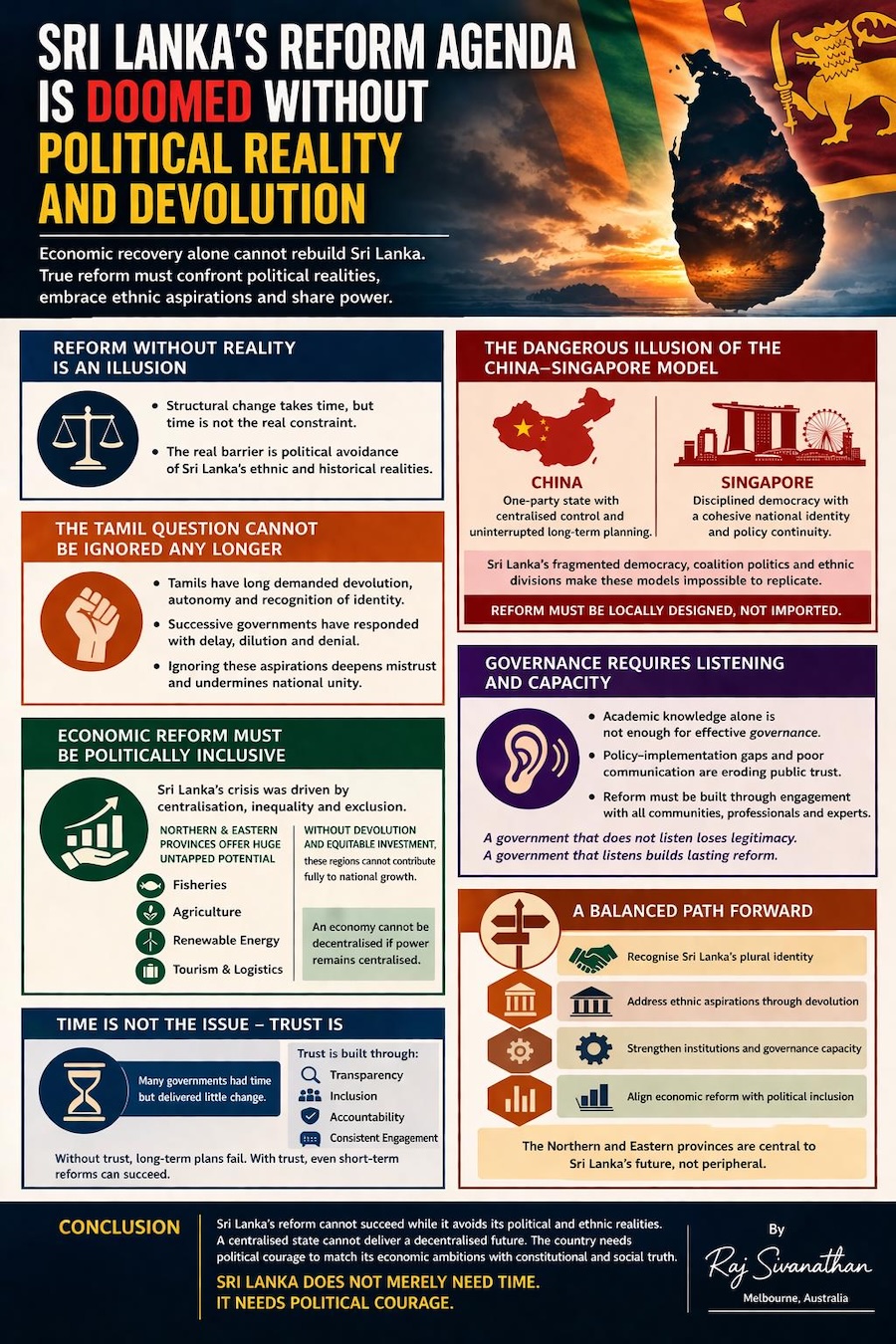
The Misleading Comparison With China And Singapore
The comparison with China and Singapore continues to dominate public discourse, yet it reflects a misunderstanding of governance structures. China operates under a single party system that allows for uninterrupted planning and centralised decision making. Singapore, while democratic, has maintained strong institutional discipline and a cohesive national identity that supports continuity in policy.
Sri Lanka does not possess these characteristics. It operates within a competitive democratic environment influenced by elections, shifting alliances, and diverse expectations from different communities. Attempting to replicate models from fundamentally different systems is unrealistic and counterproductive.
Reform cannot be imported. It must be designed based on local realities. Sri Lanka must develop its own path that reflects its diversity, democratic obligations, and historical context. Blind comparison only delays the development of practical and sustainable solutions.
The Tamil Question As A Central Reality
At the core of Sri Lanka’s long standing political crisis lies the unresolved Tamil question. The Tamil population, particularly in the Northern and Eastern provinces, has consistently demanded meaningful devolution of power, regional autonomy, and recognition of identity. These demands are not recent developments. They are rooted in history and have been reinforced by decades of political experience.
Successive governments have avoided addressing this issue directly. Instead, they have relied on temporary measures, partial solutions, and delays. This approach has not produced stability or unity. It has deepened mistrust and reinforced the perception of exclusion.
A credible reform agenda must acknowledge that Sri Lanka is a plural society. It must recognise that different communities have distinct aspirations that require accommodation within a unified framework. Ignoring the Tamil question is not a neutral act. It is a continuation of a policy approach that has already failed.
There can be no lasting reform without addressing this reality in a meaningful and structured manner.
Economic Reform Must Be Inclusive And Decentralised
Sri Lanka’s current reform agenda focuses heavily on economic stabilisation. Debt restructuring, fiscal discipline, and macroeconomic recovery are necessary steps. However, they do not address the deeper structural issues that contributed to the crisis.
The economic collapse was not only financial. It was driven by governance failures, unequal development, and the erosion of public trust. These issues are particularly visible in the Northern and Eastern provinces, which continue to remain underdeveloped despite their significant potential.
These regions have opportunities in fisheries, agriculture, renewable energy, tourism, and logistics. However, without political empowerment and fair allocation of resources, they cannot fully participate in national growth. Centralised decision making has limited their ability to develop independently and contribute effectively.
An economy cannot be decentralised while power remains centralised. Inclusive growth requires decentralised governance. Without this alignment, economic reform will remain incomplete and fragile.
Governance Capacity And The Need For Practical Leadership
Another critical challenge lies in governance capacity. Effective governance requires more than academic knowledge. It requires practical experience, coordination, and the ability to implement policies efficiently. There is a visible gap between policy design and execution.
Communication also remains a concern. Inconsistent messaging creates uncertainty among citizens and investors. Limited engagement with stakeholders reduces confidence in the reform process. Governance must be transparent, consistent, and responsive.
Strengthening governance capacity requires collaboration with professionals, industry experts, and the diaspora. It also requires a willingness to adapt policies based on feedback and changing conditions. Without these elements, even well designed policies will fail in implementation.
The Importance Of Listening And Inclusion
Listening is a fundamental aspect of effective governance. In a diverse society, policy making cannot be imposed from the top. It must involve engagement with communities, civil society, and opposition voices. Listening allows governments to understand ground realities and design policies that are relevant and effective.
In Sri Lanka, trust in governance has been fragile. Inclusive engagement can help rebuild this trust. It reduces resistance and enhances the legitimacy of decisions. A government that listens is better positioned to respond to challenges and deliver meaningful outcomes.
Ignoring voices from different communities does not create stability. It creates distance between the state and the people. Inclusion is therefore not optional. It is essential for sustainable reform.
Time Versus Trust
The argument that reform requires time is often used to justify extended political mandates. However, Sri Lanka’s history shows that time alone does not produce results. Many governments have had sufficient time but failed to deliver meaningful change.
Trust is the key factor. Trust is built through transparency, accountability, and consistent engagement. It requires governments to demonstrate commitment to fairness and inclusion. Without trust, even long term plans will fail to gain public support.
With trust, however, progress can be achieved even within limited time frames. Sri Lanka’s reform journey must therefore focus on building trust across all communities rather than relying solely on the passage of time.
Conclusion
Sri Lanka stands at a critical crossroads. The country has an opportunity to redefine its governance and economic model. However, this requires a realistic and balanced approach that recognises both political and economic realities.
Reform must be inclusive, decentralised, and grounded in the country’s diversity. It must address ethnic aspirations, strengthen institutions, and ensure equitable development. The Northern and Eastern provinces must be integrated as active contributors to national growth.
A centralised political structure cannot sustain a decentralised economic vision. Without addressing governance structures and political inclusion, economic reforms will remain fragile and reversible.
Sri Lanka does not merely need time. It needs clarity, commitment, and political courage. Only by aligning economic ambitions with social and political realities can the country achieve lasting stability and sustainable development.
leelagemalli / April 9, 2026
Devolution of power in Sri Lanka is persistently distorted by myth, fear, and political opportunism. Instead of being understood as a practical governance tool to improve efficiency, accountability, and regional development, it is often miscast as a threat to national unity—or worse, as a covert attempt at land division and ethnic separation. This misconception has been repeated so often that many accept it as truth. Yet real-world examples contradict this narrative: federal and devolved systems in countries like Switzerland and Germany function with strong national cohesion while empowering regions to manage their own affairs effectively. Devolution, in these contexts, strengthens the state—it does not weaken it. The problem in Sri Lanka is not the concept itself, but the deliberate distortion of it to mobilize fear and win elections.
–
This culture of misinformation has deeper societal consequences. When public understanding is shaped by gossip rather than evidence, even life-and-death decisions can be compromised. It reflects the same dangerous mindset seen when individuals reject proven medical treatment due to superstition or fatalistic beliefs, only to seek scientific help when it is too late. A nation cannot move forward if it consistently elevates myth over reality. The devolution debate is just one manifestation of a broader issue: the erosion of rational, fact-based thinking in public discourse, which allows falsehoods to dominate and meaningful reform to stall.
/
leelagemalli / April 9, 2026
Cont.
If Sri Lanka is serious about economic transformation and institutional stability, it must confront both governance failures and this underlying crisis of public reasoning. Devolution is not division; it is a mechanism to bring decision-making closer to the people, reduce bureaucratic inefficiency, and enable regions to respond to their own economic priorities. But no structural reform will succeed without an informed electorate capable of distinguishing propaganda from policy. Leadership, in turn, must move beyond excuses and communicate with clarity, honesty, and technical competence. Without that dual shift—better governance and a more critically engaged public—the country risks remaining trapped in a cycle where fear overrides facts and progress is repeatedly deferred.
/
Nathan / April 9, 2026
Worth repeating!
/
Lester / April 10, 2026
Devolution is not necessary for economic advancement. Singapore is a good example. Similarly, China does not have any system of devolution but did very well anyway. The author draws a false equivalence to hide his real agenda, which is a separate state in the North and East.
/
Ajith / April 13, 2026
“Devolution is not necessary for economic advancement.”
Sri Lanka is not same as China or Singapore since 1948. First of all, you you should analyse why Sri Lanka became a poor, bankrupt country and why not China or Singapore did not become developed Country. Singapore follows western economics, China did not allow the religion come into politics. Sri Lanka became poor, under developed, bankrupt country because of Buddhism,Racism, and political opportunism. The fact is you don’t like the North East becoming a developed region.
/
leelagemalli / April 14, 2026
Ajith,
.
While Singapore is often cited as proof that devolution is not necessary for economic advancement, this comparison is somewhat misleading.
–
Singapore is a highly urbanized city-state with a relatively small population and minimal regional diversity, making centralized governance far more practical and efficient. Its structure is closer to microstates like Monaco than to large, complex nations. Because there are fewer regional disparities to manage, policies can be implemented uniformly without the administrative challenges that larger countries face.
In contrast, countries with populations exceeding tens of millions—such as India or Brazil—must deal with significant economic, cultural, and geographic diversity. In such contexts, devolution or decentralized governance is often not just beneficial but necessary to ensure policies are responsive to local needs and conditions. Therefore, while Singapore demonstrates that centralization can work under specific circumstances, it should be viewed as an exception rather than a universal model for economic development.
/