

By Ananda P. Dasanayake –
Prof. Ananda P. Dasanayake
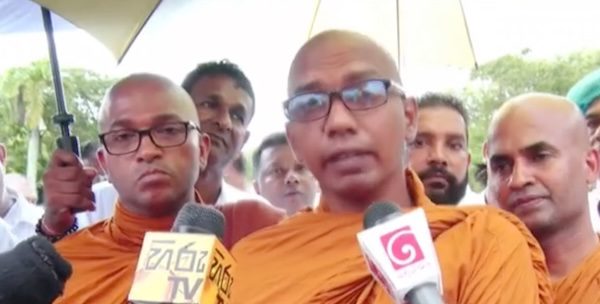
On November 9, the Anuradhapura Chief Magistrate’s Court ordered five Buddhist monks to appear on November 20 after police said they had failed to comply with an order to leave their protest site near the Ruwanwelisaya. Among them was Ven. Balangoda Kassapa Thero.
The monks are holding a Satyagraha or a peaceful sit-in against the proposed Anuradhapura Sacred City development plan. Their lawyers told the court that the protest was on grounds used for dansal, the free meals offered to pilgrims, rather than within the Ruwanwelisaya courtyard. They denied that it obstructed the public and alleged that police had misled the court when obtaining the restraining order. Police maintained that the protest caused public inconvenience and that the monks had ignored the order to leave.
Those competing claims belong before the court. Opposing a government plan is legitimate democratic activity, and a robe takes away none of a monk’s civic rights. Challenging a court order through lawful proceedings is not a claim to immunity; neither is disagreeing with the government.
But the robe grants no immunity either. A monk who draws on religious authority in political disputes should expect to answer questions about his conduct, his campaign’s support and the consistency of his principles. This applies equally to monks who support governments and to those who oppose them.
Religious purpose and public law
The distinction matters in the Trincomalee Buddha-statue dispute involving Kassapa Thero. On February 3, the Court of Appeal dismissed petitions seeking to quash the remand orders made against him and another monk in connection with that incident.
That dismissal was not a conviction. It should not be turned into a verdict on the underlying allegations. Nor should the religious purpose of a disputed structure settle whether the law was followed. The proper questions concern the applicable rules, the evidence and whether those rules are enforced consistently.
A defence of religious freedom and a demand for equal treatment before the law should reinforce each other, not compete.
Two questions from October
In October, Kassapa Thero participated in a Satyagraha demanding the release of Ven. Galagoda Aththe Gnanasara Thero, who was serving a prison sentence for contempt of court. Following controversy over his stay at Colombo’s Kingsbury Hotel, Kassapa Thero said he had developed a severe fever during the protest and that devotees had arranged accommodation and medical treatment. He said different devotees covered the accommodation and treatment expenses. He also confirmed that former minister Sarath Weerasekara had visited him while he was ill.
That explanation deserves a fair hearing. Devotees caring for a sick monk is nothing unusual. A politician’s visit does not establish political sponsorship, and a hotel stay is not evidence of wrongdoing.
The separate controversy over his statements during the protest requires the same restraint. On October 26, police informed the Colombo Chief Magistrate’s Court that they were investigating his statement about two people allegedly arriving at Viharamahadevi Park carrying knives. The investigation followed a complaint from an NPP organiser. Police described the statement as false and misleading, and the magistrate ordered media institutions to provide unedited footage.
An investigation is not a finding. The police allegation should not be repeated as an established fact. But a speaker who wears the robe draws on its credibility. That makes accuracy and a willingness to correct the record especially important.
Who pays?
The Kingsbury episode does not establish who financed the protest, and it should not be used to insinuate an answer. The broader question of campaign funding remains legitimate.
Sustained political campaigns require resources: transport, accommodation, publicity, legal assistance and organisation. Those who lead them should be willing to explain how those resources are provided and whether parties, politicians or business interests offer material support.
A devotional gift is not necessarily a political contribution. Nor does public accountability require exposing every private act of generosity. The relevant question is whether support for a political campaign creates relationships or obligations that the public should understand.
That standard should apply regardless of the campaign’s position. Transparency cannot be demanded only of opponents and waived for allies.
The deeper test
The question is not whether monks may enter politics, but whether they accept the scrutiny that political influence invites.
That scrutiny must itself be fair. An arrest is not proof of guilt. A police statement is not a judicial finding. A meeting is not evidence of a conspiracy. Respect for those distinctions strengthens the case for accountability; it does not weaken it.
A monk may protest, campaign and dissent. Even repeatedly. What he may not reasonably demand is both the moral authority of the robe and exemption from questions about how he uses it.
The robe commands respect, but respect must never be mistaken for immunity.
*Professor Ananda P. Dasanayake is a Public Voices Fellow of The Op-Ed Project in partnership with New York University.
Rajash / November 15, 2026
The robe commands respect, but respect must never be mistaken for immunity.
=========
the robe commands respect ….that’s why these thugs, financed by the Rajapaksa clan , adorn it.They know they can get away.
======
but respect must never be mistaken for immunity…..
===
except when they want to grab land around Hindu temples.
the police and army look away
====
/