

By Vishwamithra –
“Religion is for man and not man for religion.” ~ B. R. Ambedkar
Does Galagoda Atte Gnanasara Thera deserve what the law has finally imposed upon him?
The answer is yes.
Not because imprisonment should ever become an occasion for celebration, nor because the fall of a controversial public figure should provide entertainment for his opponents. Prison is a serious exercise of state power and should always be regarded as such.
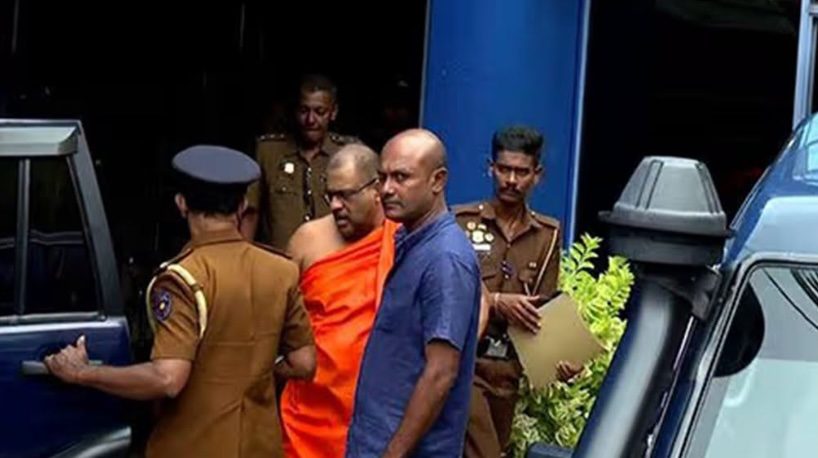
Screenshot
The more important question is different.
What happens to a republic when religious identity begins to confer political power, social intimidation and an expectation of exemption from the ordinary consequences of law?
For someone born into a Buddhist cultural environment but whose outlook has become essentially secular, the issue requires no theological judgment. There is no need to determine whether Gnanasara Thero is a “good Buddhist” or a “bad Buddhist.”
That is almost beside the point.
The real question is whether a modern republic can permit religious status—Buddhist, Hindu, Muslim, Christian or otherwise—to alter the relationship between the citizen and the law. Gnanasara matters, therefore, not merely as an individual. He matters as a phenomenon.
The Man Is Less Important Than the Phenomenon
Sri Lanka has spent decades allowing religion, ethnicity and politics to invade one another’s territory. The consequences have hardly been glorious. The country has experienced ethnic conflict, communal suspicion, riots, civil war and recurring political campaigns in which minorities have been portrayed as demographic, cultural, economic or religious threats.
Different communities and political actors have participated in that history at different times. No community possesses a monopoly upon prejudice.
But Sinhala-Buddhist majoritarian politics occupies a particular position for an obvious reason: it operates from within the country’s majority community and consequently possesses access to political leverage unavailable to minorities.
Gnanasara Thera understood that landscape remarkably well.
His public significance did not arise principally from theological scholarship. It arose from his ability to occupy that combustible territory where religion, Sinhala identity, political grievance and fear of minorities intersected.
Reducing the discussion to whether one monk behaved badly therefore misses the larger point. The more important question is why Sri Lankan society allowed such behavior to acquire political significance in the first place.
The Politics of Permanent Insecurity
There is something intellectually curious about a majority behaving permanently as though it were a besieged minority. Sri Lanka is a country in which Buddhism enjoys extraordinary cultural and constitutional standing. Buddhist festivals shape and decorate the national calendar. Temples form part of the physical and cultural landscape. Political leaders routinely seek the blessings of monks. The Constitution itself accords Buddhism the “foremost place.”
Yet periodically the country is warned that Buddhism is endangered.
Endangered by Muslims. Endangered by Christians. Endangered by conversions. Endangered by birth rates. Endangered by foreign conspiracies. Sometimes, it appears, endangered by almost everyone except Buddhists themselves.
This politics of permanent insecurity is enormously useful. Fear is politically productive. Create an enemy and solidarity becomes easier. Create a sufficiently frightening enemy and awkward questions about corruption, inequality, incompetence and governance can temporarily be pushed aside.
This is hardly a uniquely Sri Lankan invention. History is crowded with political movements that discovered how easily economic and social anxiety could be redirected towards another race, religion or tribe. The vocabulary changes. The technique survives.
Then There Is the Law
Gnanasara Thera’s present incarceration arises from his 2018 contempt-of-court conviction following his conduct at the Homagama Magistrate’s Court during proceedings concerning the disappearance of journalist Prageeth Ekneligoda. He received an effective six-year term of rigorous imprisonment.
President Maithripala Sirisena pardoned him in May 2019 after he had served only part of that sentence. In September 2026, the Supreme Court invalidated that pardon, and the Court of Appeal subsequently ordered that the remainder of the sentence be enforced.
There have been other convictions as well, including cases concerning inflammatory remarks about Islam. Those facts matter. But another question matters even more.
Why did a President of the Republic consider this particular prisoner deserving of presidential intervention? That question takes the argument beyond Gnanasara. It leads directly into the psychology of Sri Lankan political power.
The Politician and the Monk
For decades, Sri Lankan politicians have performed an elaborate ritual before the Buddhist clergy. They visit temples, kneel before monks, offer atapirikara, receive blessings before elections and ensure that cameras record the encounter. Some then return to Colombo and practice a form of politics bearing remarkably little resemblance to any recognizable moral philosophy.
The transaction can benefit both parti s. The politician acquires religious legitimacy. The politically active monk acquires proximity to secular power. That is where matters become dangerous.
The problem is not that monks hold political opinions. They are citizens. They may think about taxation, constitutions, foreign policy, education or anything else.
The difficulty begins when religious status itself becomes political currency. At that point, disagreement with a monk can conveniently be portrayed as an insult to Buddhism. Questioning clerical intervention becomes hostility towards religion. And enforcing the ordinary law against a monk can be transformed into alleged persecution.
That is not religious freedom. It is political leverage derived from religious identity.
The Pardon Was More Revealing Than the Offence
The 2019 presidential pardon may therefore tell us more about Sri Lanka than Gnanasara’s original conduct. One individual can behave irresponsibly. Institutions are supposed to contain individual excess. But when political power intervenes after the judiciary has acted, the problem ceases to concern merely one individual. It becomes institutional.
The message transmitted to the public is dangerous: some identities may carry greater political weight than others. Consider the obvious counterfactual. Had the person convicted of contempt been an obscure citizen possessing neither religious standing nor an organized political constituency, would presidential mercy have arrived with equal enthusiasm?
The question almost answers itself.
This is why the invalidation of the pardon matters. Not because Gnanasara must suffer. Because institutions must matter more than personalities.
A functioning republic cannot operate according to a system in which one citizen enters prison through the front gate while another leaves through a political side door.
No Scripture Is Required
There is no need to invoke the Buddha to make the case against communal intimidation. No scripture is required to establish that a Muslim Sri Lankan possesses the same civic dignity as a Buddhist Sri Lankan. No theological doctrine is necessary to conclude that a Christian, Hindu, Buddhist, Muslim and unbeliever must stand equally before the courts.
Reason is sufficient.
That is one of the great achievements of the secular state. Secularism does not require citizens to abandon religion. It does not demand hostility towards Buddhism, Christianity, Hinduism or Islam. It demands something simultaneously simpler and more difficult:
The state must not have favorites among them.
A secular republic protects the Buddhist precisely because it protects the Muslim. It protects the believer because it protects the unbeliever. And it protects religion itself by refusing to allow any religion to become an unofficial department of political power.
A Robe Is Not an Argument
There remains an uncomfortable cultural reality. The saffron robe commands instinctive respect among millions of Sri Lankans. That respect has deep historical roots and enormous emotional force. But respect becomes dangerous when it disables judgment.
A robe is not evidence. A robe is not an argument. A robe cannot transform prejudice into patriotism. And a robe cannot convert unlawful conduct into religious service. None of these propositions should be controversial.
Yet in Sri Lanka they sometimes are. That alone tells us how thoroughly religious authority and political identity have become entangled.
Gnanasara Is Not the Real Question
Eventually Gnanasara Thero will complete his sentence. Sri Lanka will move on. Another controversy will occupy the headlines. But if the country concludes that the problem has therefore disappeared, nothing will have been learned.
Gnanasara did not single-handedly manufacture the social conditions that made him politically significant. Sri Lankan society did. Politicians who courted religious nationalism helped create them. Media institutions that discovered the commercial value of outrage helped amplify them.
Citizens persuaded that another community’s advancement represented their own community’s decline helped sustain them. And governments unwilling to establish a firm boundary between religious authority and secular power allowed the confusion to deepen.
So yes, Gnanasara deserves the consequences imposed upon him by law.
But imprisonment is the least interesting part of this story. The far more important question is whether Sri Lanka has finally become mature enough to distinguish religious freedom from religious privilege.
The first is indispensable to democracy. The second is corrosive of it. No monk should be punished because he is a monk. No monk should be protected because he is a monk. No Muslim should possess fewer rights because he is Muslim. No Buddhist should possess greater civic standing because he is Buddhist.
And no President should confuse religious popularity with entitlement to exceptional justice. That position is neither anti-Buddhist nor pro-Muslim. It is neither anti-religious nor anti-clerical. It is simply the elementary proposition upon which a modern republic must ultimately stand:
Before the law, take off the robe, remove the cross, put away the scripture and forget the surname.
What remains is the citizen.
And that should be enough.
*The Writer can be reached at vishwamithra1984@gmail.com
whywhy / October 7, 2026
Monks of Srilanka , did nothing to take on this Abusive Monk for
his Anti Buddhist behaviour . They all secretly enjoyed his
actions against non- Buddhists . So , he super fits in his robe to
showcase to the world , Srilanka’s Buddhism .
/
Naman / October 7, 2026
‘Gnanasara Thera understood that landscape remarkably well”
From my point of view, creation of BBS/ Gnanasara Thera WAS by Gota Rajapaksa.
GR made use of him to achieve his ambitions. Without the active support of the Rajapaksas there is no people like Gnanasara Thera or like Weerawansa.
/
Naman / October 7, 2026
“Before the law, take off the robe, remove the cross, put away the scripture and forget the surname.”
That’s agreed.
But should it not happen after he or she had been found GUILTY of whatever offences?
/
Naman / October 7, 2026
“Media institutions that discovered the commercial value of outrage helped amplify them.”
That is a fact. Newspapers want to sell as maximum as possible or to get the maximum coverage in order attract the advertisers. When the owners of the media have vested interests in which political party to support, the media will publish biased news.
/
Naman / October 7, 2026
Sinhala-Buddhist majoritarian politics had so far brought our country to our lowest possible position as far as the economy is concerned. What the MINORITIES are expecting is for a BRAND NEW CONSTITUTION that guarantees protection against marginalisation /discrimination/subjugation etc etc.
/
Dayan / October 7, 2026
@Author your defence of equality before the law is valid. However, the article presents a selective analysis while claiming to explain the broader phenomenon.
You Dismiss the Fear Without Examining It: You describe Sinhala-Buddhist insecurity as politically manufactured, yet barely examine its historical, cultural or post-war roots. Understanding these concerns does not mean endorsing prejudice. Dismissing them simply avoids the harder argument.
.
You Ignore Why People Supported Him: Political manipulation alone cannot explain Gnanasara’s influence. He gained an audience because many citizens believed he was voicing concerns that political institutions refused to address. An analysis that condemns the messenger while ignoring the audience is incomplete.
.
You Confuse Protection With Privilege: The article treats nearly every attempt to protect Buddhist identity as a demand for special treatment. Many citizens see it as cultural preservation. You may reject that position, but refusing to engage with it does not disprove it.
/
Ajith / October 7, 2026
“Political manipulation alone cannot explain Gnanasara’s influence. He gained an audience because many citizens believed he was voicing concerns that political institutions refused to address. An analysis that condemns the messenger while ignoring the audience is incomplete.”
It is true that many believed that the concerns raised by the politicians and religious leaders of the past or present are manipulated by the Gnanarasa are the same. In fact, they are against to real Buddhism teach by Lord Buddha. The Monks, Politicians since 1948 are responsible for the violent Buddhism practiced in the country which failed the teachings of Lord Buddha. For example, Buddhist Monks was silent when they used the robe to cover their crimes of smuggling drugs.
/
Dayan / October 7, 2026
Part 2…
.
Your Standard Is Uneven: Communalism and religious nationalism are not confined to the majority. Yet the article examines Sinhala-Buddhist nationalism in depth while giving other forms of communal politics little more than a passing sentence. A principle applied selectively is not a convincing principle.
.
You Address the Symptom, Not the Cause: Imprisoning Gnanasara may enforce the law, but it will not remove the grievances that made him influential. Unless those concerns are examined honestly, another figure will simply take his place.
.
The Missing Question: No one should be above the law. But the question you avoid is why so many people believed Gnanasara was defending something that established institutions had failed to protect. Without answering that, the article condemns the consequence while sidestepping the cause.
/
Naman / October 7, 2026
Political leaders routinely seek the blessings of monks.
AKD too is following this practice/tradition. Is it just to please the Sinhala Buddhist majority?
The presence of CLERGY from any religious backgrounds at political meetings is quite an UNPLEASANT/DISGUSTING SIGHT.
The Clergies should be at their monasteries etc practising their religion and preaching peace harmony and wellbeing.
/
Naman / October 7, 2026
Before one is selected to become a novice monk, he needs to of certain age and with mental maturity.
In SL, because of the poverty, families tries to send a child to become a novice monk at a very young age.
They enter monasteries without much protection against any sort of ill-treatment by their seniors.
Transparency within the monasteries is of utmost importance.
/
chiv / October 7, 2026
Absolutely right.
Robe or not Mr. A. Hole is a criminal, racist, thug, threatened court / communities wearing robe and nothing but a scum.
Only reason to give anything other than prison dress, is
only because morbidly obese Ape cannot fit into a regular human one.
Recently there was discussion about all parties uniting under RW.
Now a corrupt politician contested under SLPP is disowned by Rajapaksas and Vasudeva
both denying he was ever party member ???
haven’t we seen and heard enough of all party BS ……. LOL LOL.
/