


By Asoka S. Seneviratne –

Prof. Asoka.S. Seneviratne
“The future belongs to those who see possibilities before they become obvious.” — John Scully
The submission of the Draft National Electricity Policy (NEP) 2026 in January marks a decisive point of no return for Sri Lanka’s energy sector. Few policy areas better capture the country’s deeper structural failures than electricity. For decades, the sector has functioned as a black hole of debt, inefficiency, and political interference—absorbing public resources while delivering high costs, unreliable supply, and mounting fiscal risk. At the centre of this dysfunction lies a rigid state monopoly in the form of the Ceylon Electricity Board (CEB), locked into an outdated operating model and heavily dependent on imported fossil fuels priced in foreign currency.
This legacy has imposed a heavy economic burden. Electricity tariffs in Sri Lanka have become among the most volatile in the region, exposing households and firms to repeated shocks whenever global fuel prices rise or the exchange rate weakens. Businesses—particularly small and medium enterprises—face eroded competitiveness, while low-income households are forced to absorb a disproportionate share of adjustment through higher living costs. At the macroeconomic level, energy imports have been a persistent drain on foreign exchange, worsening balance-of-payments pressures and contributing directly to Sri Lanka’s recurring external crises.
NPP Election Pledge
It is against this backdrop that the National People’s Power (NPP) Government’s election pledge to reduce electricity costs by 30 percent must be understood. The promise resonated strongly with a population exhausted by (i) inflation, (ii) declining real incomes, and (iii) years of crisis management that placed adjustment costs squarely on consumers. Yet from the outset, critics dismissed the pledge as unrealistic—arguing that tariff reductions were incompatible with the hard constraints imposed by Sri Lanka’s IMF-supported Extended Fund Facility (EFF), which prioritizes (i) cost-reflective pricing, (ii) financial discipline, and (iii) the elimination of quasi-fiscal losses in state-owned enterprises.
Sri Lanka now stands at a critical crossroads. On one side lies a political mandate for relief, growth, and economic fairness; on the other, an IMF programme designed to restore macroeconomic stability by enforcing fiscal realism and institutional reform. The Draft NEP 2026 sits precisely at this intersection. It is not merely a technical policy document but a statement of strategic intent—signalling whether Sri Lanka intends to continue managing decline within a fuel-import-dependent framework, or to undertake a genuine transformation of its energy economy.
The central thesis of this analysis is clear: a 30 percent reduction in electricity tariffs is not a populist pipe dream. Nor is it inherently incompatible with IMF conditionality. However, its realization does not lie in administrative price controls, fiscal subsidies, or short-term political fixes—approaches that have repeatedly failed and worsened Sri Lanka’s structural weaknesses. Instead, it depends entirely on the country’s courage to dream big: to abandon a crisis-prone, import-dependent energy model and transition decisively toward a renewable-energy-led growth strategy.
Sri Lanka is uniquely positioned to make this shift. Its solar and wind potential far exceeds current utilization, and technological advances have dramatically lowered the cost of renewable generation worldwide. Unlike fossil fuels, renewable energy reduces exposure to external shocks, strengthens energy security, and improves the balance of payments by displacing imports. If properly scaled and integrated, renewables can lower the true cost of electricity generation while remaining fully consistent with cost-reflective pricing principles demanded by the IMF.
More ambitiously, Sri Lanka has the potential to evolve from a fuel-importing island into a renewable-energy-exporting hub within the Indian Ocean region. Regional grid connectivity, green hydrogen, and cross-border power trade—once viewed as aspirational—are increasingly becoming practical policy options. Such a transformation would fundamentally alter the economics of electricity in Sri Lanka, allowing tariff reductions to emerge organically from lower generation costs rather than fiscal transfers.
The Draft NEP 2026, therefore, represents more than an energy policy—it is a test of political will, institutional reform, and long-term vision. It challenges policymakers to move beyond incrementalism and confront entrenched inefficiencies within the CEB, reform governance structures, attract private investment, and align energy planning with broader development and climate objectives. Success would not only make a 30 percent tariff reduction achievable but would also anchor Sri Lanka’s recovery on a more resilient and sovereign economic foundation.
In short, Sri Lanka has reached a watershed moment. The choice is not between tariff relief and fiscal discipline, nor between populism and reform. The real choice is between remaining trapped in an energy system that perpetuates crisis—or embracing a bold, forward-looking transition that makes affordable electricity a sustainable reality rather than a political slogan.
The Pillars of Revolution: Breaking Technical Barriers
To silence the opposition, we must understand the “unbundling” of power. The 2026 Policy rests on three technical pillars that turn technical complexity into public benefit.
The HVDC Undersea Cable: Our “Energy Highway”
HVDC (High-Voltage Direct Current) is a super-expressway for electricity. Unlike standard wires that lose significant power over distance, HVDC allows us to transport massive amounts of electricity under the sea to India with almost zero waste.
* The Benefit: It turns our surplus wind into export revenue. Instead of “wasting” power when our wind turbines spin at night (when domestic demand is low), we sell it to India for Dollars. This profit subsidizes our home bill without a cent of government tax money).
BESS: The “National Battery”
BESS (Battery Energy Storage Systems) are industrial-scale batteries.
* Why it is Vital: Solar and wind are cheap but “intermittent” (they stop when the sun sets). Currently, we pay an “Intermittency Tax” by keeping expensive oil plants on standby for the evening peak. BESS captures cheap midday sun and releases it at night, making those expensive oil plants obsolete.
Competitive Procurement and Global Capital
In the past, we relied on Feed-in Tariffs (FIT)—fixed prices promised to developers. The 2026 Policy moves to Competitive Bidding.
* The Logic: When global companies compete, the cost of wind power drops to 12-14 LKR/unit. To achieve this, we must attract cheap global capital. Capturing cheap global capital means securing long-term international financing at very low interest rates to invest in areas such as renewable energy. Global pension funds, development banks, and green investment funds actively look for countries that offer policy clarity, regulatory credibility, and macroeconomic stability. Because renewable energy projects require high upfront investment but have very low operating costs, the interest rate on borrowed capital becomes a decisive factor in the final cost of electricity. When policies are unstable or contracts are subject to political interference, investors perceive higher risk and demand higher returns, which immediately raises project costs. In contrast, a stable, rules-based policy environment—supported by credible institutions and IMF-anchored fiscal discipline—reduces risk premiums and allows access to the world’s lowest financing rates. These lower financing costs flow directly into cheaper electricity generation, meaning that national policy credibility ultimately translates into lower monthly electricity bills for consumers. If we make international lenders nervous, the cost of building goes up. Policy stability ensures we get the world’s lowest interest rates, which directly lowers our monthly bill.
The “IMF Pincer Movement” vs. The Debt Special Purpose Vehicle (SPV)
The Opposition claims the IMF will block tariff cuts. This is a misunderstanding of the IMF Framework, which insists on Cost-Reflective Pricing. The government cannot use the Treasury to hide losses, but it can lower the actual cost of production.
The Solution: Separation of Legacy Debt
The CEB carries billions in “Legacy Debt” from the coal-and-oil era. Currently, today’s consumers are paying for yesterday’s mismanagement. We must move this debt into a “Debt Management Special Purpose Vehicle” (SPV)—a separate legal bucket.
* Is this implementable? Yes. By removing debt-servicing interest from the tariff base, the “cost-reflective” price of a unit drops by 10-15% immediately, satisfying the IMF while providing relief to the public.
Dreaming Big: The Green Hydrogen Frontier
If we have the courage to build Offshore Wind (massive turbines out at sea where the wind never stops), Sri Lanka’s 40 GW potential is 10 times our current demand.
* The Energy Banker: We can convert this excess wind into Green Hydrogen (a clean liquid fuel) at the Ports of Trincomalee and Hambantota. We stop being a “begging nation” and start selling fuel to global shipping fleets. This is no longer just an energy policy; it is a Foreign Exchange Policy.
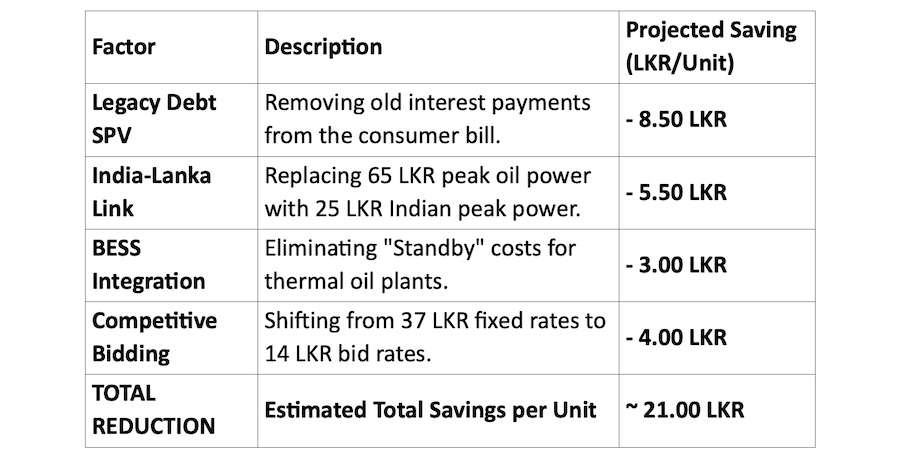
The Math of the 30% Reduction
This data proves the reduction is mathematically sound and fiscally responsible.
Conclusion: A Call to Legislative Courage
The National Electricity Policy 2026 is the most significant economic document of this decade. To the policy makers: Do not be intimidated by the IMF. The IMF does not demand high prices; it demands financial discipline.
By aggressively lowering the cost of production through renewables and creating new revenue via exports, we satisfy the IMF while delivering the 30% relief promised to the people.
The National Electricity Policy 2026 stands as the most consequential economic policy document of this decade. It will shape not only electricity tariffs, but also Sri Lanka’s credibility with investors, lenders, and its own citizens. At this pivotal moment, policymakers must resist a persistent misunderstanding: the IMF is not an obstacle to affordable electricity. The IMF does not demand high prices; it demands financial discipline, transparency, and a credible pathway to sustainability. High tariffs are a symptom of structural failure, not an IMF requirement.
The real opportunity lies in aggressively lowering the cost of production through large-scale renewable energy while simultaneously creating new revenue streams through regional electricity exports. This approach satisfies IMF conditionality by strengthening the financial position of the power sector and reducing fiscal risk, while delivering the 30 percent tariff relief promised to the people—without subsidies, price controls, or off-budget liabilities. Affordable electricity, under this model, is not a political concession but the natural outcome of sound economic reform.
However, achieving this outcome requires more than technical plans or policy statements. It requires legislative courage—the willingness of Parliament and the Cabinet to enact and defend reforms that may be politically uncomfortable in the short term but transformative in the long term. Legislative courage means passing clear, stable, and investor-credible laws that lock in competitive procurement, protect power-purchase agreements from arbitrary renegotiation, and insulate energy regulation from political interference. It means reforming the governance of the Ceylon Electricity Board to enforce accountability, cost discipline, and commercial logic, rather than allowing losses to be socialized through tariffs or public debt.
Legislative courage also involves resisting the temptation to micromanage prices while ignoring structural costs. Instead, it requires lawmakers to focus on reducing generation costs at their source—through open competition, grid reform, land access, and streamlined approvals for renewable projects. Just as critically, it means committing to regional energy integration and export frameworks, even when the benefits extend beyond a single electoral cycle.
The path to energy self-sufficiency is already visible, and it is paved with wind and sun. Sri Lanka has the natural endowment, access to technology, and the ability to attract cheap global capital. What remains is the resolve to translate vision into law and law into execution. History will judge this moment not by the ambition of the policy, but by whether the legislative courage existed to make affordable, sustainable electricity a lasting reality rather than a missed opportunity.
The path to self-sufficiency is paved with wind and sun. We have the resources; we now need the legislative courage to execute the vision.
Policy Summary: A Credible Path to Affordable and Sustainable Electricity
Sri Lanka’s electricity crisis is not the result of high wages, excessive consumption, or IMF conditionality. It is the outcome of a structurally flawed system that forces today’s consumers to pay for decades of poor planning, inefficient procurement, and expensive fossil-fuel dependence. Any credible reform strategy must therefore begin by separating past failures from future solutions.
Immediate action is required to remove legacy debt from the electricity tariff base by transferring it to a dedicated Special Purpose Vehicle (SPV). This debt—accumulated through non-commercial decisions, delayed tariff adjustments, and fuel-price shocks—has no relationship to the actual cost of producing electricity today. Keeping it embedded in tariffs distorts prices, erodes public trust, and undermines economic competitiveness. An SPV allows the power sector to reset its financial structure transparently, while the legacy debt is managed over time through structured instruments, asset monetization, or fiscal consolidation—fully consistent with IMF principles of transparency and fiscal realism.
Over the medium term, Sri Lanka must commit unequivocally to 100 percent competitive bidding for all renewable energy projects. Renewable power is no longer a niche or experimental technology; it is now the cheapest source of new electricity globally—if procured correctly. Competitive, technology-neutral auctions attract the world’s most efficient developers and unlock access to cheap global capital. By eliminating negotiated deals, discretionary approvals, and policy reversals, Sri Lanka can rapidly drive generation costs down to internationally competitive levels. This step alone has the potential to structurally reduce electricity tariffs while strengthening governance, reducing corruption risks, and restoring investor confidence.
In the long term, the strategic prize lies in finalizing the India–Sri Lanka High-Voltage Direct Current (HVDC) interconnection. This project transforms Sri Lanka’s energy geography. It enables the monetization of surplus renewable generation, stabilizes grid variability, and creates a new export-oriented revenue stream in foreign currency. Rather than being a captive island market burdened by excess capacity, Sri Lanka becomes an integrated regional energy player. Export revenues strengthen the balance of payments, improve the financial position of the power sector, and provide the economic space needed to sustain lower domestic tariffs.
Taken together, these three measures form a coherent, disciplined, and reform-aligned pathway to delivering the 30 percent electricity tariff reduction promised to the people—without subsidies, price controls, or fiscal illusion. This is not a gamble; it is a structured transition from crisis management to energy sovereignty. The choice before policymakers is no longer technical. It is one of resolve, sequencing, and the willingness to replace short-term fixes with long-term economic logic.
*The writer, among many, served as the Special Adviser to the Office of the President of Namibia from 2006 to 2012 and was a Senior Consultant with the UNDP for 20 years. He was a Senior Economist with the Central Bank of Sri Lanka (1972-1993). He can be reached at asoka.seneviratne@gmail.com