


Dr. Murali Vallipuranathan
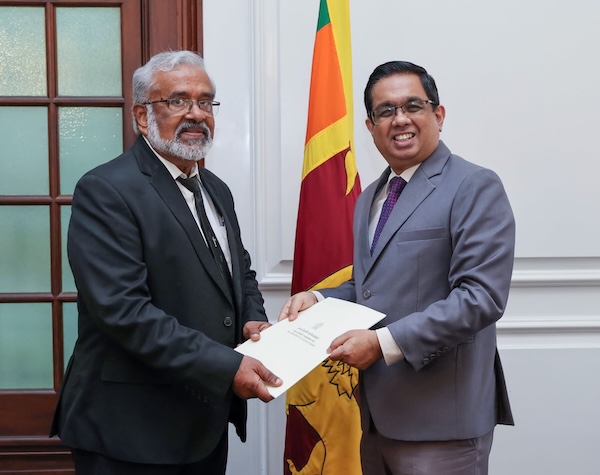
On October 30, 2026, the Presidential Secretariat announced the reconstitution of the Human Rights Commission of Sri Lanka (HRCSL). Appointed by President Anura Kumara Dissanayake on the recommendation of the Constitutional Council, the Commission is now chaired by retired Supreme Court Justice Vijith Malalgoda, alongside commissioners S.Y.M. Gomes, former diplomat A.L.A. Azeez, Dr. S.S.S.B.D.H. Jayawardena, and Professor Thangamuthu Jayasingam (former Vice-Chancellor of Eastern University)(1) (2).
While official announcements frame this as routine renewal to fill vacated seats, the appointment of Prof. T. Jayasingam constitutes a serious retreat from constitutional vetting standards, institutional integrity, and international human rights obligations. Detailed, evidence-backed objections lodged with the Constitutional Council well before the decision was finalized were ignored in total silence. No inquiry was conducted, no written findings were issued, and a documented history of scientific conflict of interest was brushed aside.
This appointment does not stand in isolation. It deepens the disillusionment felt by the Tamil people, who continue to witness a cycle of broken promises: from cosmetic anti-terror law revisions to state-sponsored attempts to explain away mass graves like Chemmani.
The Paris Principles & General Observation 1.8: An Abandoned Standard
Under the Paris Principles, which govern National Human Rights Institutions (NHRIs), a commission’s credibility rests upon the demonstrable integrity, independence, and impartiality of its members.
General Observation 1.8 of the Global Alliance of National Human Rights Institutions (GANHRI) Sub-Committee on Accreditation (SCA) establishes clear benchmarks for appointing governing bodies. The process must be:
1. Transparent, participatory, and open to public scrutiny;
2. Anchored in clear, published, and merit-based criteria; and
3. Subject to meaningful civil society consultation and rigorous vetting of conflicts of interest.
The HRCSL is already vulnerable internationally. It was previously downgraded by GANHRI from “A” to “B” status precisely because political appointments and opaque selection mechanisms compromised its autonomy (3) (4). The Constitutional Council has repeated these exact errors. When formal objections highlighting specific, documented disqualifications are lodged and dismissed without review, the vetting process ceases to function as a constitutional safeguard.
The Chunnakam Groundwater Debacle: A Matter Of Record
The core substantive objection submitted to the Constitutional Council concerns Prof. T. Jayasingam’s record regarding the environmental and public health crisis in the Jaffna Peninsula.
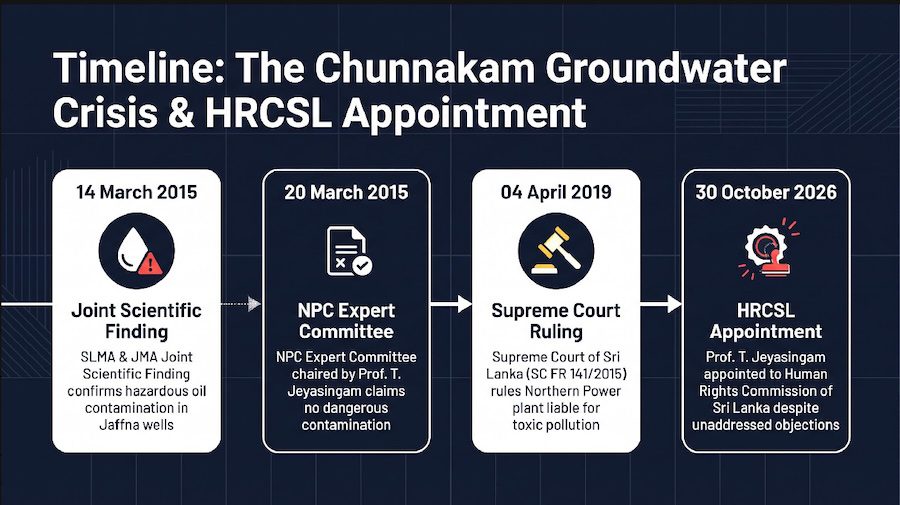
In early 2015, as President of the Jaffna Medical Association (JMA), I led frontline investigations into widespread well contamination across Valikamam. Hundreds of domestic and agricultural wells were visibly contaminated with heavy oil and grease, emitting petroleum fumes and presenting acute health risks to local communities. Recognizing the scale of the threat, I invited the Sri Lanka Medical Association (SLMA)—under the presidency of Prof. Jennifer Perera—to initiate a joint scientific mission. On March 14, 2015, our joint SLMA–JMA scientific sessions in Jaffna presented empirical evidence of toxic hydrocarbon pollution, demanding urgent state intervention to protect the community.
Six days later, on March 20, 2015, a 4-member Expert Committee appointed by the Northern Provincial Council (NPC) / Ministry of Agriculture & Environment—chaired by Prof T Jeyasingam alongside Dr. K. Velauthamoorthy, Dr. Nalina Gnanavelraja and Dr. A. Atputharajah—convened a press conference in Jaffna. Dismissing the empirical public health findings, they declared that there was “no dangerous contamination” or toxic pollution affecting the Chunnakam aquifer from the nearby thermal power station (5) (6).
This premature clearance was used immediately by the corporate polluter (Northern Power Company / MTD Walkers) in legal proceedings to vacate court injunctions and resume operations, undermining public health safeguards and leaving thousands of families exposed to contaminated water.
The committee’s claims were later refuted by empirical science and the judiciary:
1. Empirical Public Health and Technical Evidence: Testing by the National Water Supply and Drainage Board (NWSDB) confirmed widespread oil and grease levels far exceeding Sri Lanka Standards (SLS 614) (7).
2. Definitive Supreme Court Judgment: In Ravindra Gunawardena Kariyawasam v. Central Environmental Authority, Northern Power Company, and Others (SC FR 141/2015), the Supreme Court of Sri Lanka ruled conclusively that the power company and regulatory authorities were liable for environmental destruction and violations of fundamental rights. The Court affirmed the Public Trust Doctrine and Polluter Pays Principle, ordering remediation and compensation (8).
Screenshot
Section 3 of the Human Rights Commission of Sri Lanka Act No. 21 of 1996 requires commissioners to be persons of recognized integrity and impartiality. Entrusting human rights oversight to an individual whose official findings dismissed community health hazards and minimized corporate liability directly contradicts this standard.
Opacity At The Constitutional Council
The Constitutional Council is mandated under the 21st Amendment to act as an independent constitutional check on executive authority.
Yet, throughout this process, the Council provided no transparency:
* The Council never summoned objectors or examined the documentary evidence submitted.
2. It conducted no documented inquiry into the appointee regarding these judicial contradictions.
3. It published no reasoned decision addressing the objections against Paris Principle benchmarks.
This secrecy demonstrates that administrative expediency continues to override transparent public accountability.
The Trifecta Of Disillusionment: Appointments, The PTA, And Chemmani
For the Tamil community, this appointment fits into a broader pattern of unfulfilled promises regarding institutional reform, accountability, and the rule of law.
First, the persistence of the Prevention of Terrorism Act (PTA). Successive governments have promised to repeal the PTA, only to propose cosmetic replacements like the Anti-Terrorism Bill (ATB) that preserve sweeping executive powers, broad definitions of national security, and arbitrary detention. The state apparatus continues to deploy exceptional laws against civil society, journalists, and memorialization activities, while genuine legal reform remains stalled.
Second, the recurring subversion of mass grave investigations. The recent developments surrounding the Chemmani mass grave site in Jaffna have compounded local skepticism. Following the excavation of skeletal remains—including those of children—an interim archaeological report by Prof. Raj Somadeva emerged advancing speculative “epidemic or natural disaster” theories, sparking widespread criticism across the North and East (9) (10) (11) (12).
The HRCSL’s own 2025 fact-finding mission had already acknowledged a “reasonable likelihood that the burials were unlawful and pursuant to extrajudicial killings.” The subsequent introduction of archaeological theories minimizing state responsibility repeats the patterns seen at Mannar and Kokkuthoduvai, reinforcing concerns that domestic inquiries systematically obscure accountability for past violations.
When mass grave investigations are deflected, emergency legislation is retained, and individuals associated with discounting public health crises are appointed to the national human rights body, public confidence in domestic remedies breaks down entirely.
International Scrutiny As Necessary Recourse
An independent Human Rights Commission must serve as an impartial shield for citizens. When appointments bypass transparent vetting and ignore verified records, the institution risks becoming an instrument of state justification.
With domestic vetting exhausted, this appointment will be submitted to the GANHRI Sub-Committee on Accreditation (SCA) under Article 18.1 of the GANHRI Statute for a Special Review, as well as to the UN Special Rapporteur on the Situation of Human Rights Defenders, the UN Special Rapporteur on the Independence of Judges and Lawyers, and the OHCHR Sri Lanka Accountability Project (SLAP).
If the administration intends to deliver genuine systemic change, it must ensure constitutional bodies respect recorded evidence, operate transparently, and adhere to international standards.
*Dr Murali Vallipuranathan, MBBS (Jaffna), PGD (Population Studies), MSc (Colombo) MD (Community Medicine), FCCP (SL), FRSPH (UK)
Declaration of Conflict of Interest:
In the interest of transparency and professional ethics, the author discloses that he was an applicant for the position of Member/Commissioner of the Human Rights Commission of Sri Lanka (HRCSL) during the recent selection cycle. The concerns detailed in this article are based on empirical public health records, official judicial rulings, and formal representations submitted to the Constitutional Council in the public interest.
[1] https://www.dailymirror.lk/breaking-news/Human-Rights-Commission-gets-new-chairman/108-353817
[2] https://www.themorning.lk/articles/KvvVg4bL4KCklv1SW0EN
[3] https://ganhri.org/wp-content/uploads/2021/12/StatusAccreditationChartNHRIs_dec2021.pdf
[4] https://dbsjeyaraj.com/dbsj/?p=75352
[5] https://tamildiplomat.com/no-dangerous-contamination-in-chunnakam-area-expert-group/
[7] https://scholarsarchive.byu.edu/cgi/viewcontent.cgi?article=1083&context=openwater
[8] https://srilankabrief.org/wp-content/uploads/2019/04/sc_fr_141_2015.pdf