


By Asoka S. Seneviratne –

Prof. Asoka.S. Seneviratne
“In the end, a society’s success depends not on what it owns, but on what it can do.” — Lee Kuan Yew
In the early 1960s, Lee Kuan Yew viewed Ceylon (Sri Lanka) as the “model” for a developing Singapore. Decades later, he famously diagnosed New Zealand’s economic decline as a result of being “too comfortable” in its pastoral way of life. Today, Sri Lanka faces a far more precarious version of the “New Zealand slippage.” While New Zealand drifted from 3rd to 28th in global wealth, Sri Lanka has collapsed into a debt-ridden, low-complexity trap. This article argues that to survive, Sri Lanka must look beyond the immediate constraints of the IMF framework and mine its “intellectual minerals.” By pivoting from raw exports to high-value industrial sectors like battery-grade graphite and SaaS products, Sri Lanka can avoid a future more “pathetic” than the one Lee warned against.
The Mirror of History: From Muse to Cautionary Tale
In 1960, the economic distance between nations was vastly different. New Zealand was a titan, Singapore was a swamp, and Sri Lanka was a beacon of literacy and infrastructure. Lee Kuan Yew (LKY) famously lamented that if Ceylon had maintained its course, Singapore might have been following Colombo’s lead.
Instead, the roles were reversed. LKY’s diagnosis of New Zealand’s “sheep and cows” economy—a nation content with low-complexity agricultural exports while the world moved toward silicon and services—is a mirror for modern Sri Lanka. If a nation as wealthy as New Zealand can “slip” by failing to industrialize, a nation as debt-burdened as Sri Lanka can disappear from the developed stage entirely.
The Data of Decline: Hard Figures on the Slippage
The divergence between a “High-Complexity” economy (Singapore) and “Low-Complexity” economies (NZ and Sri Lanka) is revealed in the numbers.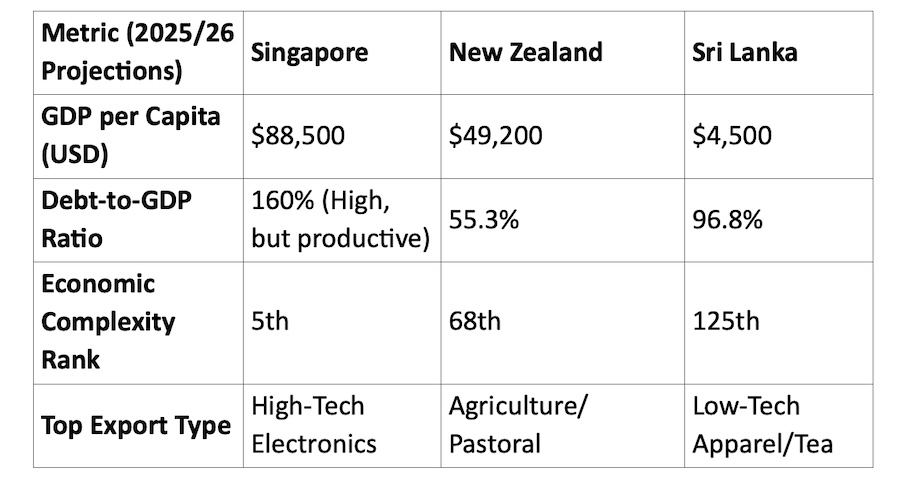
Sri Lanka’s debt-to-GDP ratio, projected to stay near 97% in 2026, means every rupee of growth is currently swallowed by interest. Unlike NZ, which has a safety net of high social capital, Sri Lanka is attempting to climb out of a pit while its “intellectual minerals” are fleeing the country.
The “Intellectual Minerals” vs. The Human Capital Flight
LKY often remarked that Singapore had “no minerals.” He proved that the only mineral that matters in the 21st century is “grey matter.” Sri Lanka is currently suffering from a “Human Flight” index score of 7.5/10.
In 2024 and 2025, record numbers of doctors, engineers, and IT professionals left the island. This is not just a migration; it is a divestment. When 53% of graduates want to leave, the nation is effectively subsidizing the workforces of Australia and the UK. Sri Lanka must realize that a 22-million population is only an asset if it is an educated, high-skilled industrial workforce.
The “Sheep and Cows” Trap: The Sri Lankan Variant
Lee’s warning to NZ about relying on “grass” is even more applicable to Sri Lanka’s reliance on “leaves and shirts.”
* The Reality: Tea, rubber, and garments still make up over 50% of our export basket.
* The Risk: These are price-taker markets. We do not set the price; the world does. When a new competitor arises in Vietnam or Bangladesh, our economy shakes.
To move beyond this, we must transition from Resource Extraction to Resource Transformation.
Post-IMF Industrial Policy: The “Production First” Framework
The IMF provides the “medicine” (tax hikes and fiscal discipline), but it does not provide the “nutrition” for growth. A Post-IMF strategy must focus on Productive Complexity. We must move from a state that manages poverty to a state that manages production.
This requires a radical shift in how we view our assets. We must stop thinking of ourselves as a “tourist island” and start thinking of ourselves as a “technical hub” that happens to have beautiful scenery.
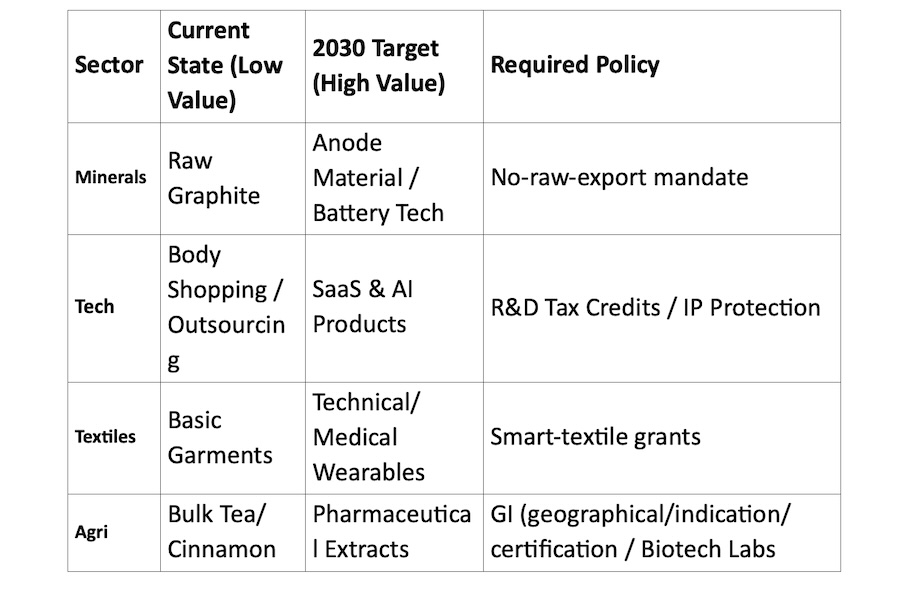
Technical Pivot 1: The Graphite-to-Battery Value Chain
Sri Lanka sits on the world’s highest-quality vein graphite (99%+ purity). Currently, we export it in raw form. This is so pathetic.
* The Strategy: Establish Value-Addition Mandates.
* The Goal: In 2026, Sri Lanka should not export a single ton of raw graphite. Instead, we should be exporting Anode Material for EVs.
* Impact: This transforms a $500/ton export into a $2,500+/ton export. By leveraging our graphite, we can integrate into the Japanese and Indian EV supply chains, moving from “mining” to “advanced manufacturing.”
Technical Pivot 2: From IT Outsourcing to SaaS Ownership
Our IT sector (earning $1.2 billion) is largely based on selling “hours” of labor. This is a digital version of manual labor.
* The Strategy: Use the Port City Colombo as a “SaaS Sandbox.”
* The Goal: Encourage Sri Lankan firms to build Software-as-a-Service (SaaS) products. Ownership of Intellectual Property (IP) allows for “exponential growth“—selling the same software to a million people without hiring a million more workers.
* Impact: This turns the brain drain into “brain circulation,” where our diaspora can invest in and scale Sri Lankan-owned digital products globally.
The Export Transformation Blueprint
The 22 Million Strength: Meritocracy or Clientelism?
LKY’s final warning was about the “quality of the administration.” He watched as Ceylon’s meritocratic civil service was dismantled by political patronage. To avoid a future more “pathetic” than NZ’s, Sri Lanka must enforce Singaporean Meritocracy.
* SOE Reform: State-Owned Enterprises must be run by professionals, not political loyalists.
* Education Reform: Our 22 million people need a vocational revolution. If we do not align our degrees with the needs of the 2030 global market (AI, Green Energy, Maritime Logistics), we are educating our youth for unemployment or emigration.
Conclusion: The Choice for 2026 & beyond
The “Lee Kuan Yew Warning” is not a death sentence; it is a call to action. New Zealand is a cautionary tale of how even a rich nation can stagnate when it loses its competitive edge. For Sri Lanka, the stakes are existential. We cannot remain in a “High-Cost, Low-Wage” trap.
The IMF has given us the fiscal space to breathe, but only a bold, high-complexity industrial policy will allow us to walk. We must mine our “intellectual minerals,” protect our “human capital,” and transform our “natural resources” into industrial exports. Only then can we fulfill the potential that Lee Kuan Yew saw in us over sixty years ago. The leadership of President Anura Kumara Dissanayake will help all the way.
*The writer, among many, served as the Special Adviser to the President of Namibia from 2006 to 2012 and was a Senior Consultant with the UNDP for 20 years, and a Senior Economist with the Central Bank of Sri Lanka (1972-1993). He can be reached at asoka.seneviratne@gmail.com
Jit / January 12, 2026
1/2 – I can see the point the author is trying to make by drawing a comparison between New Zealand and Sri Lanka based on LKY narratives. However, I struggle to see any meaningful connection between the historical trajectories of the two countries since those 1970s. My bigger question is: why are we still debating to validate the remarks made by a leader of a tiny city‑state half a century ago?
There is no doubt that LKY was the architect who transformed a struggling backyard port into a modern, efficient city. But why do we continue to treat him as an economic prophet for all other nations? He may have made a few superficial observations about Sri Lanka, but did he possess any real understanding of the depth and complexity of our culture, religion, and rituals—and how badly these shape our politics? Certainly not. It is far easier to diagnose and direct a society of 600 sqkm than one spanning 60,000! We all know how complicated our society becomes under a multi party, vote based electoral system – far more so than under Singapore’s single party model – whenever “change” is proposed, so I need not elaborate further. Contd….
/
Jit / January 12, 2026
2/2 – LKY comments on New Zealand were equally out of touch. New Zealand was not “pushed” into dairy and meat production; its climate and topography make it ideally suited for exactly that. Why shouldn’t a country excel at what it is naturally equipped to do? Forcing an industrialisation model similar to Singapore’s simply makes no sense for them.
A quick look at the numbers shows how well New Zealand has done by leaning into its strengths. In 2000, dairy and meat exports earned NZD 9 billion; by 2024, that figure had risen to 36 billion—a 400% increase. And this growth occurred even as national herds declined after 2015 due to strict environmental and freshwater regulations. Tourism and horticulture added another 16 billion and 8 billion respectively in 2024. Meanwhile, forestry, wine, and seafood continue to attract strong demand from China and Western markets, contributing roughly 12 billion annually.
These figures simply illustrate that New Zealand performs far better in its own well‑worn leather shoes than by attempting to squeeze into Singapore’s metal ones.
LKY may have been the right leader for Singapore at the right time, but his success does not grant him the authority to prescribe economic doctrine for every other nation.
/
old codger / January 12, 2026
“In 1960, the economic distance between nations was vastly different. New Zealand was a titan, Singapore was a swamp, and Sri Lanka was a beacon of literacy and infrastructure”
What a load of BS from an author renowned for it.
Singapore was no “swamp” in 1960. In the early 20th century, it had the world’s biggest dry dock, as the HQ of the British Eastern Fleet. By 1939, it had a Ford car factory, and was attracting migrants even from purportedly (according to the author) Ceylon. Singapore city itself was more like Hong Kong than sleepy Colombo. Authors should do their research instead of fabricating evidence to suit their particular prejudices.
/
old codger / January 13, 2026
even from purportedly “advanced ” (according to the author) Ceylon.
/