


Dr. Murali Vallipuranathan
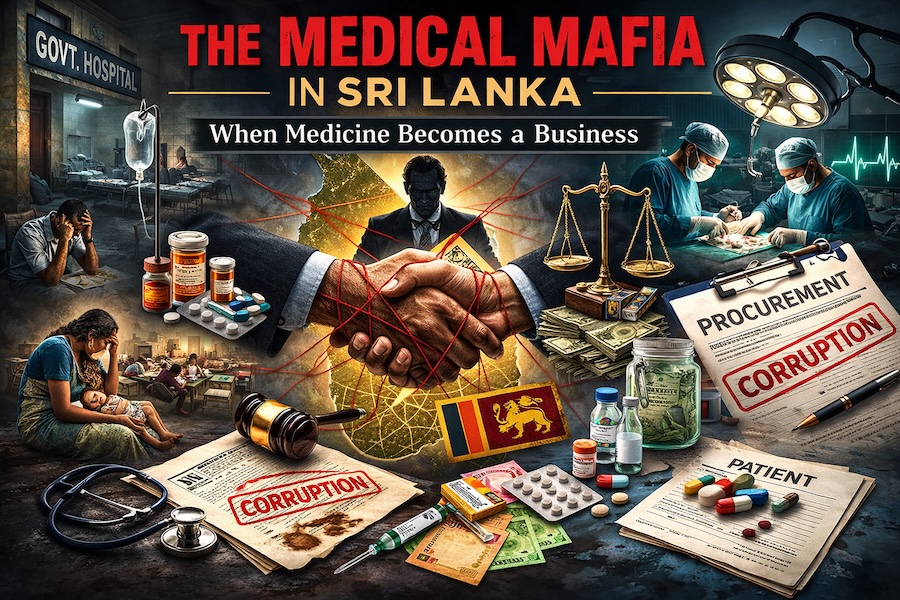
The phrase “Medical Mafia” in Sri Lanka has recently moved from private complaints to public discussion, especially after the latest strike actions by the Government Medical Officers’ Association (GMOA). As the term becomes common in social media and news reporting, an important question arises: Is it being used correctly to describe systemic wrongdoing, or is it being used too broadly for any problem inside the health system?
This article discusses the issue in a careful and responsible manner. It does not pronounce any specific individual as guilty. It highlights allegations, reported practices, and public concerns that require proper inquiry, lawful investigation, and administrative accountability.
Defining “Mafia”: From Sicily to the Hospital System
To understand the idea of a “medical mafia,” it helps to recall what “mafia” originally meant. The Italian Mafia was known as a multi-layered network, from powerful leaders to ground-level operators, making money through illegal methods and using intimidation to protect its interests.
In global healthcare discussions, the term “medical mafia” is sometimes used to describe situations where profit becomes more important than patient welfare. In such a context, it often refers to coordinated exploitation involving three areas.
First, healthcare providers or professional associations may use their influence in unfair ways. Second, pharmaceutical and medical equipment companies may prioritize market control over patient benefit. Third, regulators may fail to enforce safety and standards, sometimes due to weak oversight or “regulatory capture.”
When these parts align to exploit the vulnerability of sick people, the problem can go beyond simple mismanagement and begin to resemble organized exploitation.
Sri Lanka’s Institutional Concerns
Sri Lanka has recently faced serious public concern about what some describe as an institutional-level “medical mafia.” This concern has grown especially around the ongoing investigation into the importation of counterfeit Human Immunoglobulin vials. According to public reporting and allegations in circulation, the case involves a wide cross-section of actors, including high-ranking officials linked to the Ministry of Health, the National Medicines Regulatory Authority (NMRA), and also allegations involving a former Health Minister and family members.
These matters remain within the scope of ongoing inquiries and due process. However, the scale and nature of the allegations have increased public fear about weaknesses in procurement, regulation, and accountability.
During the COVID pandemic period, the widely discussed “Dhammika Paniya” episode was also seen by many as a major fraud. However, it did not appear to involve the same kind of structured procurement and regulatory machinery. By contrast, critics argue that the Immunoglobulin issue suggests deeper institutional weaknesses and poor internal control systems, because the online procurement platform itself is alleged to have been misused.
Local-Level Collusion and Brand Monopolies
Apart from national-level concerns, “mafia-like” patterns are also discussed at the local level, especially relating to branded medicines.
Under the NMRA Act No. 5 of 2015, doctors are required to prescribe medicines by generic name. Even so, some areas in Northern Sri Lanka are reported to show strong brand dominance, where affordable alternatives are difficult to access.
For example, it is claimed that a particular brand of deworming tablet is sold for about 600 LKR (or 800 LKR for a pack of six) across local pharmacies, while an equivalent in Colombo is available for around 80 LKR. If such pricing is linked to coordinated behaviour between prescribers and sellers, it may function like a regional cartel rather than a normal market variation. Such claims require careful review by relevant authorities.
Syndromes of Neglect: TTTS and EOWS
It is also necessary to separate administrative weakness from organized malpractice. Some failures occur due to poor management, weak systems, or lack of supervision. The author recalls an early personal experience as a student at Hartley College, where a dentist refused treatment after 12:00 PM. That was an example of poor administration rather than a coordinated structure.
However, newer patterns of absenteeism described as “syndromes” are viewed as more serious because they can harm service delivery and patient safety.
The so called “Tuesday to Thursday Syndrome (TTTS)” describes allegations that some medical specialists and medical officers posted to the North, East and peripheral stations, while living mainly in the South and Colombo, limit their physical presence to a mid-week period. It is claimed that some still draw a full month’s salary and large overtime allocations, including up to 120 hours, despite limited actual attendance.
The concern becomes critical during emergencies. During the Cyclonic Storm Ditwah, there are allegations that timely mitigation measures were affected in healthcare facilities because key medical administrators were not present due to such attendance patterns.
This issue was also highlighted after the Ministry of Health’s Flying Squad reportedly conducted a surprise inspection recently at the Ampara District General Hospital, where a significant number of medical specialists were allegedly absent during peak duty hours. It is also claimed that, instead of supporting a transparent inquiry, the matter was politicised by affected parties, and that trade unions responded by boycotting the annual clinical sessions of the Regional Clinical Society, thereby setting a harmful precedent.
Every Other (two) Weeks Syndrome (EOWS) refers to a pattern reported in Mannar and parts of the Eastern Province, where specialists are said to do alternate two-week shifts, allowing them to maintain private practices in Colombo while also drawing government salary and extra duty payments.
Critics argue that trade unions play a key role in protecting such arrangements by presenting them as “rights.” When administrators attempt to intervene, it is claimed they can face strong resistance, including counter-complaints and pressure for transfers or removals from the institutions.
The Weaponization of Patient Suffering
Economic crisis in Sri Lanka has increased pressure on public hospitals and has also, according to many accounts, increased predatory behaviour in some settings. The concern is that scarcity, whether real or artificially created, can be used to push patients toward private care.
Reported patterns include specialists allegedly telling patients they will not perform surgery in a government hospital but can do so quickly in a private facility. Another allegation is that procedures are postponed even when supplies are available, until families become desperate and pay through informal channels. A further concern is that in places like Batticaloa, multi-million rupee worth wards and theatres have remained closed for years, forcing patients, especially mothers, into overcrowded conditions until private options appear as the only practical solution.
These are serious allegations. If proven, they represent exploitation of patients at their most vulnerable moments.
Malpractice Concerns Beyond Doctors
Public discussion often focuses on doctors, but other healthcare staff categories are also accused of “mafia-like” practices that can harm the taxpayer and the patient.
One concern relates to Medical Laboratory Technologists (MLTs). Historically, “piece-rate” payments existed when lab work required manual counting and labour-intensive processes. Today, in the Colombo National Hospital and majority of state hospitals, many tests are performed using automated analyzers, and MLTs mainly handle samples and verify reports. It is alleged that unions have pushed to keep “piece-rate” payments for each test component despite automation. It is also claimed that some MLTs leave government duty during official hours to work in private labs, while still receiving high per-test allowances from the state.
A second concern relates to health service assistants, including care givers. In state hospitals, it is alleged that certain staff refuse to clean ward interiors, claiming it is not part of their duty list. It is further alleged that administrators are pressured into hiring private cleaning contractors to do tasks that permanent staff are already paid to perform. This can result in double spending of public funds. There are also claims that some permanent staff do other work during duty hours and that taking disciplinary action is difficult due to union pressure.
A third issue raised in public reporting relates to allegations of a “narcotics mafia” at the National Hospital of Sri Lanka (NHSL), involving some health service assistants and certain other staff members. Such allegations require careful investigation and should be handled through lawful procedures and evidence-based inquiry. It is also claimed that political affiliations can sometimes shield wrongdoing, creating hesitation in enforcement due to the political consequences of union-led disruptions.
Strike Culture and Resistance to Oversight
The trend of multiple health unions striking together, often excluding doctors, is frequently presented as an economic justice issue, including debates around allowances such as the DAT allowance. However, critics argue that some actions also reflect resistance to modern accountability tools.
Many state health sector unions have historically opposed biometric attendance and CCTV monitoring, claiming these violate worker rights. Supporters of reform argue that such systems can reduce absenteeism and expose patterns where staff receive salaries while regularly working elsewhere.
A Path Forward
If Sri Lanka is serious about reducing corruption, malpractice, and organized exploitation in healthcare, reforms must go beyond slogans and firefighting political responses. Many argue that it is no longer realistic to depend on a Ministry that is perceived as too weak to resist pressure.
One proposed reform is a strong conflict-of-interest policy. Government healthcare workers should be prohibited from private practice and pharmacy ownership, while being paid a dignified and competitive state salary. Another proposal is stronger technological oversight through biometric attendance and CCTV with clear rules and safeguards. A third proposal is stronger union accountability, so that unions protect professional standards rather than shielding misconduct. A further concern is leadership by example, because it is harmful for medical education when professors and specialists teach only at midnight after completing private practice, as this normalizes the wrong priorities for young doctors.
“If the health system continues to operate under pressure tactics, young doctors may learn that medicine is not a service but a business built on power over patients.” Public anger should not be dismissed as a social media trend. It reflects a deep demand for medical ethics, fair access, and real accountability.
*Dr. Murali Vallipuranathan is a visiting lecturer at the Universities of Jaffna, Peradeniya, and Colombo, a Senior Specialist of the Ministry of Health, and a Council Member of the Sri Lanka Medical Association. The views expressed are offered with social responsibility to improve healthcare and accountability in Sri Lanka and do not reflect official positions.