

By Raj Sivanathan –

Raj Sivanathan
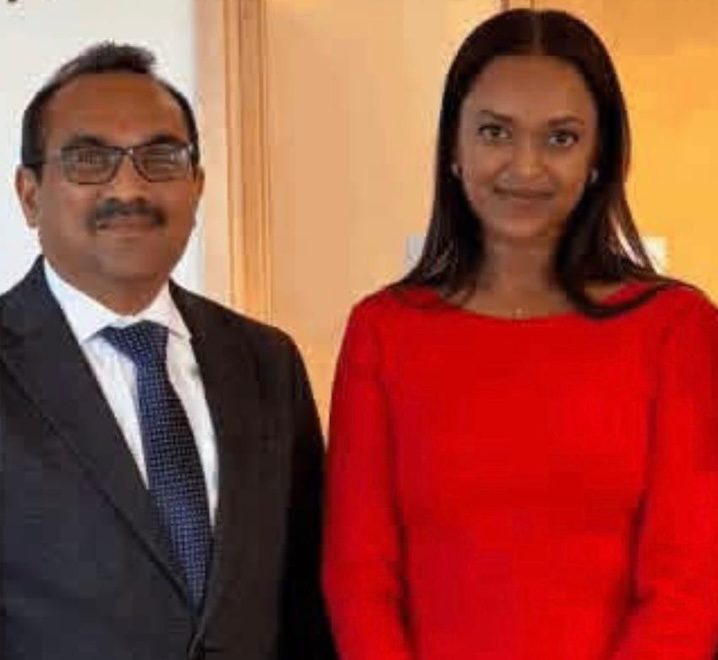
A recent meeting between Norway’s Transport Minister, Kamzy Gunaratnam, and Sri Lanka’s Transport Minister, Bimal Rathnayake, carries a significance beyond their shared responsibilities for roads, railways and public transport.
One arrived in Norway as a Tamil refugee child from Sri Lanka. The other built his political career within the Janatha Vimukthi Peramuna, a movement with a history of armed insurrection that subsequently embraced parliamentary politics. Today, both hold ministerial office through democratic political systems. Their meeting was reported on 18 October 2026.
Their journeys invite reflection on displacement, political transformation and the opportunities countries provide their people.
Sri Lanka’s Transport Minister, Bimal Rathnayake and
Norway’s Transport Minister, Kamzy Gunaratnam
A childhood displaced and a future rebuilt
Born in Jaffna in 1988, Khamshajiny “Kamzy” Gunaratnam reached Norway with her family in 1991, aged three, as they fled Sri Lanka’s armed conflict. Her parents rebuilt their lives in northern Norway, working in the fishing industry before the family moved to Oslo.
She was a child whose future depended on decisions made by adults, governments and the society that received her. Norway offered the setting in which she could grow, participate and eventually help govern.
Her advancement was earned through years of political work. Elected to Oslo City Council in 2007, she became a leader in the Labour Party’s youth movement, served as Oslo’s deputy mayor from 2015 to 2021, and entered Parliament in 2021. On 11 September 2026, she became Transport Minister.
Her achievement belongs to her. It also illustrates what becomes possible when a refugee child can develop a sense of belonging and gain access to democratic institutions.
For Sri Lanka, that success should inspire pride—and an uncomfortable question: how many children displaced by our conflicts might have flourished at home if they had enjoyed security and equal opportunity?
A political movement’s transformation
Bimal Rathnayake’s route was different. His official biography records that he joined the JVP’s Socialist Students Union in 1989 and became a full-time political activist in 1996. He entered provincial politics in 1999, Parliament in 2000 and later served as a deputy minister before rising to his present cabinet responsibilities.
His career must be discussed accurately. The JVP’s involvement in armed uprisings is established history. However, the sources examined for this article do not establish that Rathnayake personally took part in armed violence. Describing him as a former armed militant would therefore go beyond the evidence. In a 2000 interview, he placed his entry into mainstream politics in 1994.
The defensible comparison is between a refugee child’s rise in an adopted country and a JVP activist’s rise through the democratic institutions of his own.
The JVP’s transition into parliamentary government deserves recognition. Democracy benefits when political movements pursue change through elections, debate and public accountability. That recognition must also leave space for honest examination of past violence and the suffering of its victims.
The responsibility that comes with a second chance
In my view, the most important lesson is that democratic opportunity must be available consistently.
A country that allows a movement with an insurrectionary history to rebuild its political standing should also ensure that communities affected by war can rebuild their lives with dignity. Political transformation should deepen a government’s understanding of exclusion, repression and the need for reconciliation.
This creates a particular responsibility for Sri Lanka’s present leadership: to demonstrate that belonging to the country does not depend on ethnicity, religion, language or political allegiance.
For Tamil communities, reconciliation must become visible in everyday life—in fair treatment by public institutions, access to services in their language, meaningful participation in decisions and equitable development.
Transport policy offers a practical opportunity. Reliable connections can help a student reach university, a patient reach hospital, a farmer reach a market and a family remain connected. Investment decisions should respond to those needs across every province.
A meeting that should lead to action
Gunaratnam’s appointment cannot erase the circumstances that forced her family to leave Sri Lanka. Rathnayake’s ministerial position cannot, by itself, resolve the historical questions surrounding his party. Yet their meeting offers a constructive possibility: two people shaped by different experiences of Sri Lanka can now exercise public responsibility.
The appropriate response is to welcome the meeting and ask what follows.
Can cooperation produce safer transport and wider opportunity? Can it encourage a more honest conversation about inclusion? Can Sri Lanka build a future in which children from every community feel secure enough to remain, contribute and lead?
Norway gave a child displaced from Jaffna the opportunity to become a minister. Sri Lanka’s responsibility is to ensure that its own children can imagine an equally meaningful future at home.