

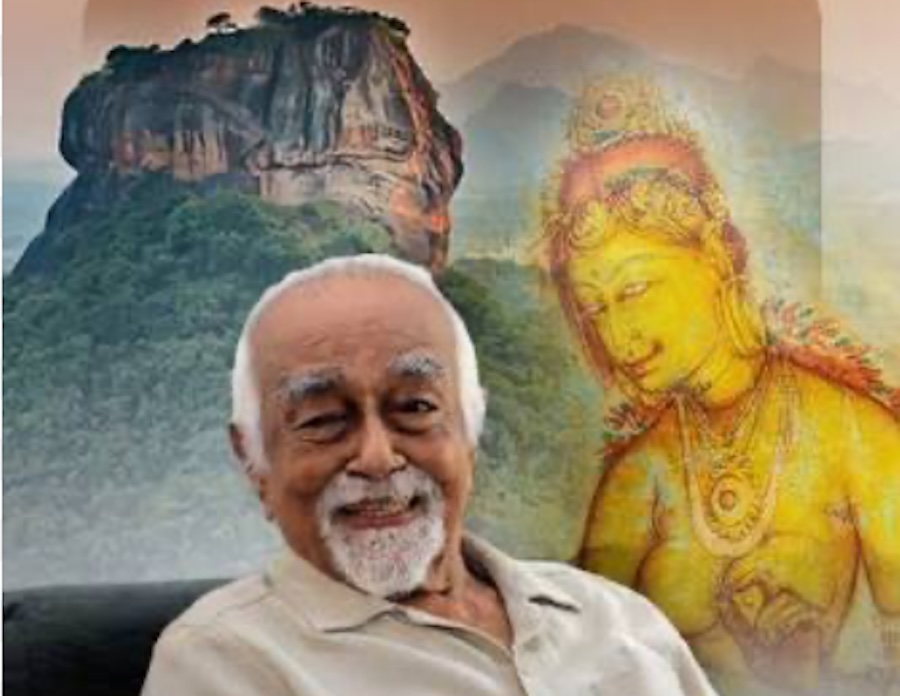
By Ari Ariyaratne –

Prof. Ari Ariyaratne
August 2026 marks the 102nd birth anniversary of Vidya Jyothi Dr. Raja de Silva, the pioneering scientist and former Commissioner of Archaeology (1967–1979) who radically transformed Sri Lanka’s historiographical landscape. Originally trained as a chemist, Dr. de Silva famously saved the vandalized Sigiriya frescoes in 1967 alongside Italian conservator Luciano Maranzi.
Yet, his greatest contribution to South Asian scholarship was his fearless intellectual iconoclasm (Ariyaratne 2024). By approaching ancient monuments with strict empirical skepticism, he exposed a profound systemic issue in heritage management: the uncritical reliance on ancient literary texts over physical, material evidence. To understand his revolutionary re-interpretation of Sigiriya, one must first trace how text-based biases historically erased or distorted archaeological realities across wider South Asia.
Dr. Raja De Silva
The Ethnographic Turn: Monuments as Political “Texts”
Modern anthropologists seek to shift the focus away from treating ancient structures as static monuments. Instead, they use an ethnographic approach to analyze monuments as “texts” that are constantly manipulated at local and national levels to construct state-sanctioned historical narratives while deliberately silencing multilayered or minority histories (Ray 2019). To parse these deep-seated biases, scholars employ tools like the ‘Invention of Tradition’, which explains how medieval and modern texts retrospectively construct ‘ancient’ cultural practices or narratives to project a sense of unchanging continuity (Hobsbawm & Ranger 1983).
Crucially, ancient texts represent the worldview of a minuscule, literate elite—such as scribes, priests, and monks—who possessed the exclusive power to preserve records. Conversely, the archaeological record reflects the lived, physical reality of the broader populace. When an ancient chronicle completely omits a complex layout, anthropologists treat the text not as objective historical fact, but as an artifact of political projects designed to establish cultural hegemony.
Literary Myth vs. Archaeological Reality: The Omission of Harappa
For thousands of years, the dominant literary tradition of India maintained that South Asian civilization began in the rural, pastoral Ganges plains. This worldview relied heavily on the oldest Sanskrit texts, such as the Ṛgveda, which celebrated the deconstruction of walled cities, praising the god Indra as Purandara or ‘Destroyer of Forts.’
The ideological bias of these chronicles toward the Iron Age Vedic Period in northern India—and their total omission of the Bronze Age Indus Valley Civilization—effectively obscured the existence of highly centralized, non-Vedic, urban, and maritime-trading populations. It was not until the 1920s, when micro-stratigraphy and field archaeologists excavated Harappa, that the world realized a sprawling, literate, urban superpower had existed prior to the composition of the Vedic texts. The chronicles did not explicitly lie; rather, their profound cultural and religious bias ensured that an entire urban civilization was culturally delegitimized and forgotten by the literary record (Singh 2008).
Sectarian Politics in Buddhist Historiography: Edicts vs. Chronicles
Even within Buddhism itself, different sects heavily manipulated chronicles to downplay rivals, mimicking the structural tension between the Theravāda (Pali for ‘The Doctrine of the Elders’) and Mahāyāna (Sanskrit for ‘The Great Vehicle’) traditions. The northern Sanskrit text Divyāvadāna (‘The Heavenly Stories’), specifically its chapter the Aśokāvadāna (‘The Narrative of Aśoka’), records the life of the Mauryan Emperor Ashoka, as does the southern Pali chronicle, the Mahāvaṃsa. However, because these texts belonged to competing monastic lineages, they constructed radically different narratives to assert their own sectarian authority.
The Mahāvaṃsa claims Ashoka converted to Buddhism through a Theravāda monk named Nyagrodha and focuses entirely on the emperor’s sending of his son, Mahinda, to Sri Lanka (Laṅkā). Conversely, the northern Sanskrit texts completely ignore the Sri Lankan mission, crediting Ashoka’s conversion to a different monk named Upagupta. When James Prinsep deciphered Ashoka’s Rock and Pillar Edicts in the 1830s, historians gained direct access to the monarch’s actual contemporary voice. The edicts revealed that Ashoka’s Dhamma was a broad, pluralistic ethical code aimed at civic harmony, actively promoting tolerance for non-Buddhist groups like the Ājīvikas and Brahmins. In contrast, ancient monastic chronicles had profoundly romanticized and distorted Ashoka’s reign, portraying him as a fierce sectarian zealot who exclusively funded their specific monasteries (Strong 1983).
Decolonizing Sigiriya: Dr. de Silva’s Monastic Iconoclasm
It is precisely within this broader historiographical battlefield—mirroring the erasure of the Indus Valley and the sectarian distortion of Ashoka—that Dr. Raja de Silva launched his most iconoclastic critique against the orthodox history of Sigiriya. For over a century, colonial and nationalist archaeology accepted the southern Pali chronicle, the Cūḷavaṃsa, as absolute truth, framing the massive granite rock as the secular, fifth-century pleasure palace fortress of the patricide King Kassapa I.
Drawing on his background in chemical analysis and material conservation, Dr. de Silva exposed this dominant narrative as an ideological invention. He demonstrated that the site completely lacked the structural layouts of a functional royal capital or defensive citadel. Instead, it featured the unmistakable architecture of a massive, multi-layered Mahāyāna-Theravāda monastic complex that existed centuries before and after Kassapa’s brief 18-year reign.
Just as the Mahāvaṃsa suppressed Ashoka’s pluralistic Dhamma, its authors intentionally downplayed the presence of non-orthodox Mahāyāna lineages in Sri Lanka. By comparing the iconic frescoes to the sacred art of the Ajanta caves in India, Dr. de Silva brilliantly demonstrated that the painted damsels were not secular concubines or queens, but representations of the Goddess Tārā, the great Mahāyāna saviouress. In doing so, he rescued Sigiriya from the confines of an ancient royal melodrama, restoring it to its rightful place as a sacred landscape of profound, cosmopolitan devotion (De Silva 2002).
An Enduring Legacy of Principled Scepticism
Two years after his passing, Dr. Raja de Silva’s intellectual legacy remains an indispensable beacon for decolonial archaeology in South Asia. His work proved that ancient texts are not transparent windows into the past, but highly curated political artifacts designed to establish cultural hegemony.
By validating material evidence over narrative romance, his life’s work proved that true patriotism does not lie in defending state-sanctioned historical myths, but in interrogating them with scientific rigor. On his 102nd birth anniversary, as scholars increasingly adopt material-first approaches to South Asian heritage, Dr. de Silva’s iconoclastic spirit stands thoroughly vindicated. He did not merely preserve the physical stones of Sri Lanka’s heritage; he bequeathed to subsequent generations the intellectual tools to liberate the past from the biases of its chroniclers.
References Cited:
Ariyaratne, Ari 2024, Dr. Rājā de Silva – Pioneer Conserver, Engaging Interpreter, and Bold Defender. In Kurukulasuriya, Uvindu (ed), Raja de Silva: Centenarian Extraordinaire. 2024.
De Silva, Raja. Sigiriya and Its Significance: A Mahāyāna- Theravāda Buddhist Monastery. Nawala, Colombo, Sri Lanka: Bibliotheque/Aitken Spence. 2002.
Hobsbawm, Eric, and Terence Ranger, eds. The Invention of Tradition. Cambridge, UK: Cambridge University Press, 1983.
Ray, Himanshu Prabha. Decolonizing Heritage in South Asia: The Global, the National and the Transnational. New Delhi, India: Routledge. 2019.
Singh, Upinder. A History of Ancient and Early Medieval India: From the Stone Age to the 12th Century. New Delhi, India: Pearson Education. 2008.
Strong, John S. The Legend of King Aśoka: A Study and Translation of the Aśokāvadāna. Princeton, NJ, USA: Princeton University Press. 1983.
*The writer is an anthropologist and the author of Key Concepts of Cultural Anthropology (Second Edition, Dubuque, IA, USA: Kendall-Hunt Publishing, 2026).
old codger / August 4, 2026
“The Mahāvaṃsa claims Ashoka converted to Buddhism through a Theravāda monk named Nyagrodha and focuses entirely on the emperor’s sending of his son, Mahinda, to Sri Lanka (Laṅkā). Conversely, the northern Sanskrit texts completely ignore the Sri Lankan mission, “
Haven’t many been heard to claim that the Buddha himself visited Sri Lanka three times? This of course is supported by the Mahavamsa. But a check of foundation legends in Thailand, Burma and Cambodia has him visiting those places too. He must have been a frequent flyer.
/
Native Vedda / August 6, 2026
old codger
–
“He must have been a frequent flyer.”
–
Buddha was not only a frequent flyer, but the Mahavamsa also depicts him as a Superman-like figure, similar to the one played by Christopher Reeve. It describes the Buddha cleansing or purifying Lanka (Sri Lanka) by expelling the Yakkhas and creating a whirlwind.
–
If the island was cleansed, what was the guarantee period? It seems he didn’t do a very good job.
/
old codger / August 7, 2026
Native,
“Buddha cleansing or purifying Lanka (Sri Lanka) by expelling the Yakkhas “
We still have the same sort of “Buddhism “
So 1983 had a Mahavamsa precedent?
/
Lasantha Pethiyagoda / August 6, 2026
Romanticizing history, not just in Asia but in Europe as well, has led to history being recorded in contexts that are often misleading. These are the results of religious influence on the writers of history. A common historical account that most contemporary Europeans, other Westerners and their colonial converts read is the Christian bible. There are many accounts of long-dead people being resurrected, together with vast oceans turning into blood and miraculous transformations of water into wine. Most such accounts use human sentiments and experiences as the basis of their concoctions to impress upon those who believe in the said doctrines. Similarly, there are Buddhist chronicles that claim that the baby Siddhartha walked seven steps on lotus flowers soon after birth and spoke stanzas in Pali, whereas that language was a later development. The same can be said of God speaking to Moses in Hebrew (or Aramaic). From human heights of eighteen Riyan to a handful of soil transforming into a fully grown Caucasian man, such accounts are now largely dismissed as folklore. Similarly, king Ashoka’s edicts and indeed the history of Sigiriya or pre-Buddhist archaeology hiding under giant Buddhist structures in Anuradhapura serve political narratives that favour dominant entities in power, preventing exposure of uncomfortable truths.
/
LankaScot / August 7, 2026
Hello Lasantha,
After reading Dr Robin Coningham’s Archaeological Reports on the Anuradhapura Excavations, I started to realise that there was a thriving pre-Buddhist Iron Age Trading Civilisation in Sri Lanka. I also suspect that Sri Lanka was one of the early developers of Brahmi Script and may have migrated Northwards not the other way round.
After a number of visits to Sigiriya I was impressed by their ability to transport Building Materials etc. up such a high Rock Face, however this was well into the Iron Age (early Medieval) and building an Iron Staircase was not beyond them. If it was purely Monastic why is there a Throne Seat at the top overlooking the Rock-cut Pool?
In the UK the Legendary King Arthur was possibly a Contemporary of Kasyapa. He also had a legendary City and Castle. It was called Camelot. The Roman City in Shropshire, Viriconium (Wroxeter) has been postulated as the location of Camelot. The building materials and construction are very reminiscent of Sigiriya. Sorting out fact from fiction without Documentary Evidence is difficult, although Archaeology can help.
Best regards
/
CChampa / August 8, 2026
Isn’t it kind of funny that former Archaeology Commissioner of Ceylon, Dr. Raja de Silva’s only proof for Sigiriya being a Mahayana monastery is the Sigiriya haĺf-clothed damsels?
.
Dr. Raja de Silva’s narrative of Sigiriya has no basis as Sigiriya was not about damsels but a well preserved archaeological, epigraphical, architectural, sculptural, speleological, numismatic and documentary evidence of ancient Ravana civilization during “Kashyapa Buddha’s” time.
Dr. Raja de Silva has clearly failed to explain the following facts in his narrative of Sigiriya.
1..What was the original name of Sigiriya? Sigiriya was only a name given by H.C.P. Bell who was the first Archaeological Commissioner of Ceylon from 1890 to 1912. Also, it was his own theory that King Kashyapa I built Sigiriya without any supporting evidence.
2. The giant paws at the entrance of Sigiriya were not of a lion’s. Therefore, the name “Lion’s Rock” was a made up name by Bell to conceal the ancient civilization where the rock was the capital, a fa
mous Buddhist monastery and later a centre of foreign trade. If not a lion, whose feet were at the Sigiriya entrance and why were they there?
3. How many times has the Sigiriya mirror wall been plastered and colourwashed?
.
1/4
/
CChampa / August 8, 2026
There is absolutely no evidence that King Kashyapa I built a palace on the Sigiriya rock likened to Alakamanda as envisaged by the Archaeologist Dr. Senerat Paranavithana. This Kashyapa theory was developed by the first Archaeological Commissioner of Ceylon H.C.P. Bell.
It is also evident that Sigiriya was not a natural rock but a carved one which was obviously not done by King Kashyapa who was only a tenant.
And, where is the elevator (Sopanaya) found by H.C.P. Bell at the entrance of Sigiriya?
Also, the Sigiri graffiti was not all about damsels. It contained a list of Buddhist Viharas and their locations. (C.W. Nicholas: 1963)
.
These are my answers to the questions I raised in the previous comment:
1. The name Sigiri has obviously derived from the name “Irshigiri”. (The correct pronunciation is Irshi සෘෂි not Rishi.) Evidently, Sigiriya was a Buddhist rock temple with monastic cave cells underneath.
However, is Sigiri the real Irshigiri or was the latter located in Anuradhapura District? For example, before British colonizers, Mihinthalawa was known as Chetiyapabbatha or Seyagiri and Kiri Vehera in Kataragama was known as Mangala Vehera.
.
2/4
/
SJ / August 8, 2026
සෘෂි is certainly not pronounced Irshi.
/
CChampa / August 8, 2026
2. Re: fake lion’s paw narrative
You don’t have to be an archaeologist to see that the feet at the entrance of Sigiriya were of a bird. The bird is called Garunda (Sanskrit) or Gurula (Pali) in Sinhala, and Vulture in English.
The monastery on the Sigiriya rock may have looked like a Vulture which makes the name of the rock called ”Gijjakuta Parvata” or “Vultures’ Peak/Rock” where Lord Buddha frequented and also the place where he met four heavenly Yakkha Kings. However, there is another possibility that a certain type of Irshis have landed there and hence the name.
.
3. According to the Archaeological Survey of Ceylon Annual Report (ASCAR) 1938, A. H. Longhurst, the infamous Archaeology Commissioner of Ceylon from 1934 to 1940, plastered and colourwashed the gallery wall of the Sigiriya Rock. His restoration work was not recorded which is suspicious. His other conservation work in Polonnaruwa has included placing new Buddha statues near shrines which people now believe as genuine antiquities.
The fact that some damsels were wearing jackets and others not, give the impression that the Sigiriya damsels were actually wearing upper clothes but after restoration work carried out by the British Archaeology Commissioner Longhurst, some may have “lost their tops”.
3/4
/
SJ / August 8, 2026
There is no bird called Garunda in Sanskrit. It is Garuda on which Mahavishnu is said to ride.
Garuda is not a vulture. Have you ever seen a vulture?
No bird in heaven or earth can have claws to go with the seemingly fleshy paws on the Sigiriya rock.
Have mercy and stop c******g
/
CChampa / August 8, 2026
Sigiriya half-clothed damsels are the only non-religious paintings in a temple cave in Sri Lanka which does not make sense.
There are rock paintings similar to that of Sigiriya in other temple caves in Sri Lanka which Dr. Raja de Silva has conveniently ignored.
For example, rock paintings at Hindagala temple cave are believed to have belonged to the Sigiriya period as the colours and the style of drawing are similar.
Then, in the Kotiyagala temple cave, there is a female figure holding a lotus flower in her hand, similar to that of Sigiriya damsels.
And, why do Sigiriya frescoes look incomplete? What was underneath the damsels?
Also, there have been other murals in Sigiriya as mentioned by DRINNEBERG (1926: 32). (Translation)
“At Sighiri, located southwest of Anuradhapura, we see the monumental remains of a massive rock fortress. (…..) Within its rugged bosom lie enshrined sacred Buddhist relics from the earliest times.”
“Deep within the cool rock lie buried vast cavities, concealing sanctuaries and chambers richly adorned with imagery. The path leads down through excavated passages and stairways into gloomy rock caverns. These are catacomb-like vaults featuring exquisitely fine and elaborate ornamentation—either painstakingly chiseled from the stone or painted as colorful frescoes upon the rock walls.” DRINNEBERG.
4/4
/
SJ / August 8, 2026
You do not sound even reasonably informed on the subject.
/