

By Jude L. Fernando –

Jude L. Fernando
The Fort Speaks Before the Play Does
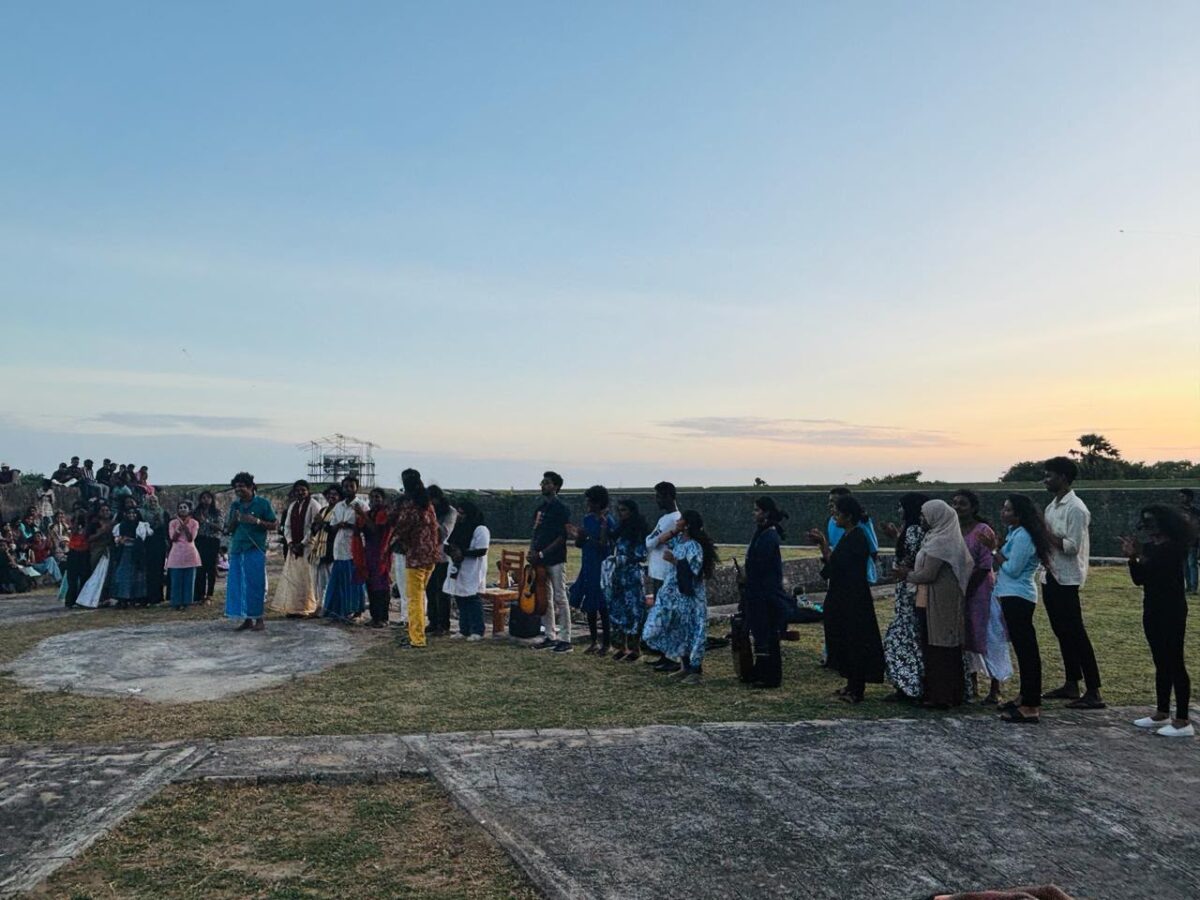
Some theatres do not wait for your permission. It arrives — in the salt air off a rampart wall, in the sudden collision of three languages inside a single breath, in the moment a colonial fort ceases to be a monument to conquest and becomes, without warning, a stage for its undoing. The University of Jaffna’s open-air production of The Tempest was precisely that kind of theatre — the kind that does not entertain so much as implicate, that does not interpret a text so much as put it on trial. Shakespeare’s island of sorcery and servitude, of stolen power and dreamed liberation, required no borrowed ghosts. It already had its own.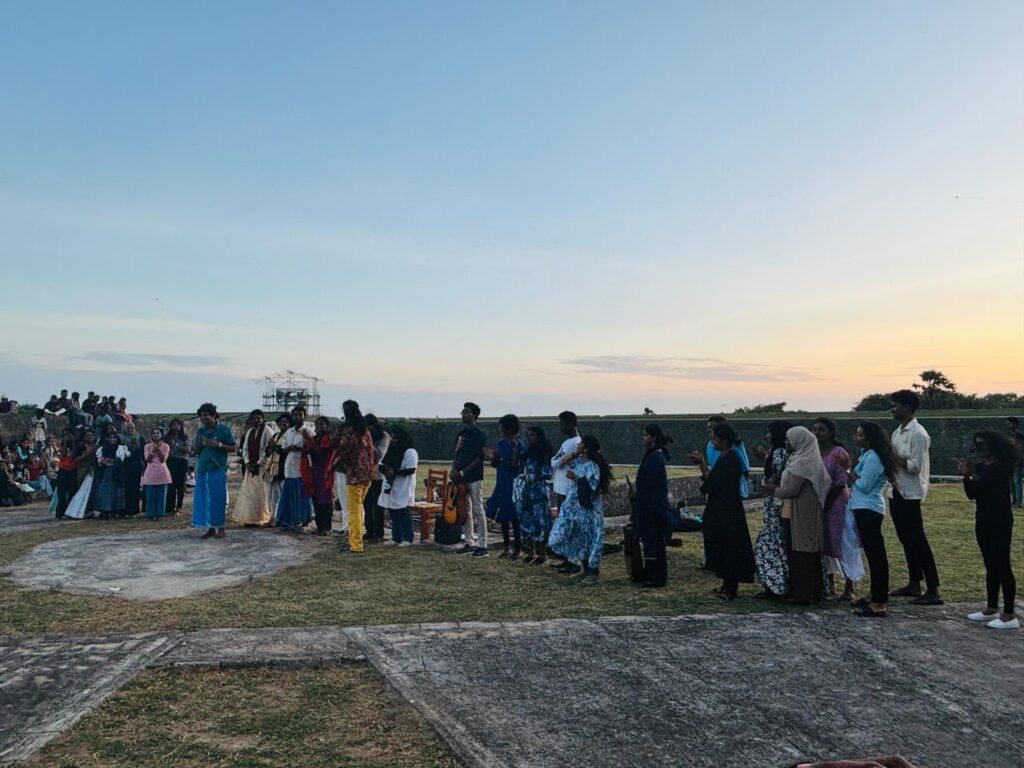
Full disclosure demands one confession before we proceed: this is not my first encounter with The Tempest. I played Trinculo once — at the University of Peradeniya, in a production directed by Richard Birch in 1985 — where the late Ruwanthi Sivapragasam brought to Caliban a power and presence I have never forgotten, and which has served as a private reference point ever since. Stephano was played by J.S. Tissainayagam — and that trio, the island’s comic axis of servitude, seduction, and misrule, carried between them something that only becomes fully visible in retrospect: three young men on a stage in 1985, inhabiting Shakespeare’s most politically charged threesome, in a country already quietly loading the weapons that would define the next thirty years.
That the same triangle — Caliban, Stephano, Trinculo — should be staged again in Jaffna in 2026, inside a Dutch fort, before a Tamil community audience in a post-war city, is not coincidence. It is history completing a thought it began four decades ago. A Sunday Observer reviewer found it necessary to clarify, with what one imagines was considerable editorial satisfaction, that my Trinculo had been rendered not as a Jester but as a Buffoon — with a Tamil villager accent — as though that were the most withering verdict a critic’s vocabulary could produce. One has carried that sentence with philosophical equanimity for four decades.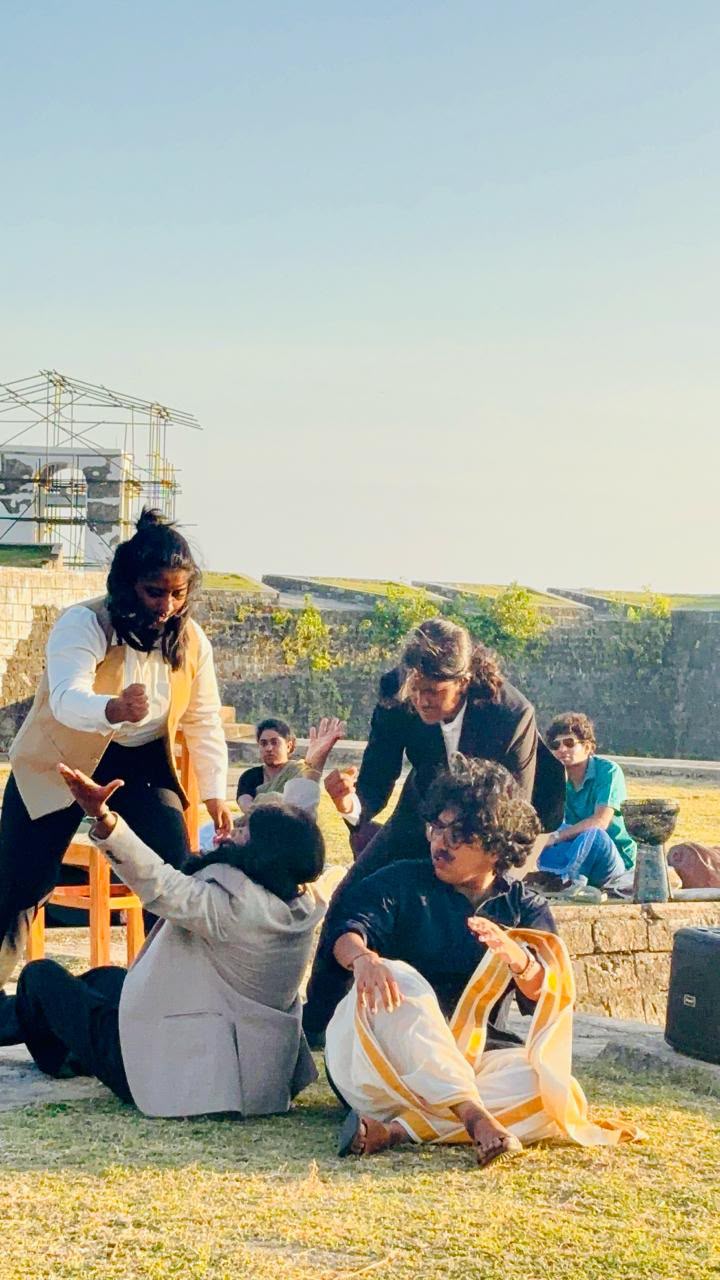
That production opened in 1985. Within a year, Sri Lanka had descended into a war that would consume three decades, redraw nearly every institutional boundary on the island, and end — officially, triumphantly — in 2009, with a military victory proclaimed, in the polished language of the state, as liberation. For some, it was exactly that: the defeat of a brutal separatist movement that had held its own people hostage as much as its enemies. For others — particularly those in whose name this “liberation” and “humanitarian war against terrorism” were so confidently declared — the end of the war and the arrival of justice proved to be very different events, moving on very different timelines. The first came with parades, speeches, and certainty in 2009; the second has yet to be confirmed.
Shakespeare, who understood islands rather well, gave Caliban a line that has never quite released its grip on this particular reader: “This island’s mine, by Sycorax my mother / Which thou tak’st from me.” An island. A birthright. A dispossession recast, by those doing the dispossessing, as civilisation. Sri Lanka is not simply a metaphor for Shakespeare’s island. If anything, Shakespeare’s island now reads — with that uncanny prescience the plays so often display — like a premonition of Sri Lanka. Prospero’s departure at the play’s end, however magnanimous, however ceremonially final, does not resolve what Caliban’s enduring presence makes permanent: the question of what liberation means to those who were already living on the island, and for whose flourishing it was, supposedly, intended.
Into this unresolved question — carried across thirty years of war and into a fractured, still-negotiating present — the University of Jaffna’s production of The Anniyan steps with rare and serious intelligence. The university itself was rebuilt in the post-war years, in a city that has spent longer being fought over than being allowed simply to exist. That its English Department should stage Shakespeare in three languages, inside a Dutch fort, before a community audience drawn from those the war marked, divided, and implicated, is not incidental context. It is the entire argument.
It is with particular and unrepentant satisfaction, then, that one arrives at Jaffna Fort in 2026 — cast as Gonzalo, Shakespeare’s weathered and quietly radical utopian, who dreams of a commonwealth without hierarchy, without enclosure, without the organised violence of ownership — to find a production in which the Tamil villager accent is woven into the very sinew of a political and artistic vision. In that light, forty-year-old critical anxieties about Shakespeare, English, accent, and authority seem not merely irrelevant, but faintly preposterous.
The Stones Remember Everything
Honesty compels an acknowledgment the programme notes chose to omit — one that became, unexpectedly, inseparable from the experience itself. This was an open-air production. In Jaffna. In June. The audience sat not on cushioned seats in a climate-controlled auditorium but on the ancient stones of the fort — rocks that had absorbed the Northern sun since the Dutch laid them, and which, even as evening descended and the sky turned a magnificent amber, continued radiating their stored warmth upward with the patient, democratic thoroughness of a well-fired kiln. The sun had set. The rocks had not forgotten it.
As the characters grew warmer with wine, the audience grew warmer from the heat rising through the stones beneath them. By the third act, the dramatic question of whether Caliban or Stephano would prevail had acquired an urgent physical sympathy from spectators whose relationship with those particular stones had become, shall we say, increasingly intimate. Shakespeare’s groundlings, it bears noting, had the good sense to stand. We sat. History, as always, extracted its toll from those who remained seated longest.
Nobody left. Nobody retreated to cooler ground. The production held us — and the discomfort, one came to understand, was not incidental to the meaning but constitutive of it. Post-war reconciliation cannot begin with cold, archived, officially curated history. It must begin with the kind still warm to the touch: history that lives in language, in land, in the bodies of people who have not finished grieving and have not finished imagining what comes next. Frozen history sits behind museum glass, safely labelled, containable, and serviceable to those who prefer it inert. To stage this play, in these languages, in this fort, before this audience, was not merely a theatrical choice. It was a decolonial act — the deliberate thawing of a history that certain forces would very much prefer to keep glacial. A tempest, after all, was never meant to be experienced from an armchair.
Prospero Surrenders the Staff; the Students Keep It
What makes this production genuinely revolutionary is not only what was performed but how it came to exist at all. This Tempest emerged from a university classroom that, in its director’s hands, became something considerably more subversive than a room with desks and a received syllabus. The cast extended well beyond a single discipline, drawing students from across faculties — and crucially, several performers were themselves teachers, making the production’s argument about the dissolution of pedagogical hierarchy not merely theoretical but embodied, visible, and irrefutable. When a teacher stands alongside a student on a stage, speaking the same lines under the same open sky before the same community audience, Paulo Freire’s “banking concept” of education — the teacher as sole depositor of knowledge, the student as passive vault — does not merely get challenged. It gets abolished. Publicly. Before witnesses. Without appeal.
The entire company participated in editing, researching, and shaping the production. No clean line persisted between those who knew and those who learned, between those who directed meaning and those who received it. What Dhunaka Bandara designed is not merely a production but a decolonial curriculum — one that takes the master’s text, returns it to the colonised land, and insists that the colonised body, voice, and language are not supplementary to meaning but constitutive of it. The rehearsal room became what the classroom too rarely is: a space of genuine co-creation, where the company collectively interrogated the text, reimagined it, and carried it onto a stage before the very community whose history the production was made to bear.
This is not an adaptation. This is repatriation.
For students who carry the weight of canonical texts like an inherited debt — who have been taught, implicitly and explicitly, that Shakespeare belongs to a register of English they may approach with sufficient deference but never truly inhabit — standing before a community audience under open skies and delivering these lines with the full authority of their own languages and bodies is an act of profound reclamation. The syllabus said: study this. The production said: own it, transform it, make it answer for itself in your presence. These students did not merely study The Tempest. They dreamed it into being — and in doing so, quietly and irrevocably, rewrote the stories they had been told about themselves and about what voices are permitted to live inside these words.
The pedagogy this production enacts answers bell hooks’ insistence on education as the practice of freedom — not the acquisition of approved content within approved parameters, but the radical expansion of who is permitted to think, to speak, and to be heard. It enacts Augusto Boal’s Theatre of the Oppressed, made viscerally literal by the fort setting, the community audience, and the deliberate dissolution of the boundary between performer and witness, student and teacher, canonical text and living experience. Beneath both frameworks runs something older and more fundamental: the ancient understanding, periodically suppressed and periodically reclaimed, that learning is not transmission but transformation — that education worthy of the name changes not only what you know but who you understand yourself to be and what world you understand yourself to inhabit.
Among those present was Professor Emeritus Walter Perera of the University of Peradeniya — a scholar for whom English literature has never been merely a subject but a lifelong intellectual vocation and a sustained argument about what these texts can be made to do in the hands of those who refuse to approach them on bended knee. Watching him watch this production, one thought irresistibly of Prospero in his final act — not the Prospero of command and conjuring, but the one who has laid down his staff and watches, with something suspended between pride and wonder, as the island he once tended finds its own weather, its own voice, its own capacity for magnificent storm. Dhunaka Bandara’s pedagogical vision feels less like an innovation imported from elsewhere than a homecoming — a reconnection with the University of Jaffna’s own finest instincts, finding their fullest expression in the most improbable of vessels: a Shakespeare play, performed in three languages, on the scorching ancient stones of a Dutch fort, under a sky dense with stars and the long memory of catastrophe.
“You Taught Me Language”: Caliban Addresses Sri Lanka
The actor playing Anniyan — the Island, the Caliban of this telling — was not the grotesque monster of lazy theatrical tradition, the creature conjured expressly to justify its own subjugation. He was the land itself: named by others, claimed by others, educated into a tongue designed not for his flourishing but for his efficient management. “You taught me language, and my profit on’t / Is I know how to curse” — delivered with quiet, devastating restraint, this line felt as though it had waited four centuries to be spoken in precisely this place, before precisely this audience. Shakespeare was no longer addressing Elizabethan England. The Island was addressing Sri Lanka.
The central comic scene unfolded on Katchachtheevai — that small, salt-sprayed, perpetually contested strip of land between nations, carrying a name everyone recognises and a sovereignty no one has finished arguing over. To stage seduction, intoxication, and the gilded promises of false liberation on this particular ground was a stroke of dramaturgical precision so exact it bordered on the surgical. When Caliban offers to “show thee every fertile inch o’ th’ island,” the line sheds its comedy entirely and becomes a cartography of longing — and of peril. An island offered freely to those who have already decided it is theirs to receive.
The scene was genuinely and uproariously funny. The audience roared. But laughter in the finest theatre always contains its own embedded critique — and here the audience laughed at the precise mechanics of how colonialism perpetuates itself: seduction first, intoxication second, promises of liberation that deliver only a new chain with a different name engraved on the lock. “Ban, Ban, Cacaliban / Has a new master — get a new man!” Caliban’s song of freedom is also, heartbreakingly, a song of subjugation transferred rather than ended. In this fort, before this audience, in this post-war city still feeling its way toward a future it has not yet been permitted to fully imagine, that heartbreak carried no comfortable historical distance. It was immediate. It was local. It was, for many seated on those warm stones, a question not yet settled and not yet safe to ask aloud.
That this reclamation was enacted in a post-war Tamil minority space — where the rubble of the “humanitarian” war has been cleared with remarkable official efficiency, and where the population it was fought to liberate remains quietly, persistently uncertain about what precisely was liberated and for whose enduring benefit — lends the production an institutional courage no critical framework can adequately measure. The Dutch Fort, older than the conflict and magnificently indifferent to its official narratives, offered a candour that contemporary political language conspicuously withholds. Colonial architecture, it transpires, is remarkably honest about power. It does not reach for the word humanitarian. It simply builds walls.
English as Weapon, English as Stage: The Kaduwa Class and the Sword That Has Two Edges
A production this boldly rooted will always attract a particular species of objection — from those postcolonial inheritors who have so thoroughly internalised the aesthetic standards of the coloniser that they now defend those standards with a ferocity the coloniser himself has largely, and with some visible relief, abandoned. These are the self-appointed custodians of a “proper” Shakespeare the Royal Shakespeare Company stopped performing decades ago, who remain convinced that theatrical authenticity resides in received pronunciation and a certain quality of lighting rig.
In Sri Lanka, this social formation has its own precise and illuminating name — the Kaduwa class: kaduwa meaning sword. English, in this formulation, is not a medium of communication or a tool of thought but a weapon of exclusion — the blade that cuts, separates, and reminds those without it of precisely where the boundary of belonging falls. It is wielded at dinner parties and in boardrooms, in casting decisions and hiring committees, and in the particular tightening of expression that greets a Tamil villager accent in a space that considers itself cultivated. For the Kaduwa class, Caliban speaking Tamil from a colonial rampart is not a political act. It is a category error — the sort of theatrical transgression that makes one set down one’s glass and murmur, with pained and exquisitely calibrated restraint, that one had rather expected something more considered. Shakespeare, after all, must be protected. From whom is never entirely specified — though the answer, in Sri Lanka, has generally proven to be: from the people who actually live here.
The exquisite irony, savoured here without apology, is this: the sharpest description of their English-language elitism was coined not in English but in Sinhala. The language they subordinated named them. It named them perfectly. It named them first. The sword has two edges — and the sharper one, as is so often the case in history, belongs to those who were never supposed to be holding it.
Jan Kott argued in Shakespeare Our Contemporary that the plays are not museum pieces but dramaturgical machines for generating meaning, and the finest productions dare to feed contemporary reality directly into those machines without flinching from what emerges. Shakespeare wrote for groundlings. He wrote in a wooden amphitheatre open to the London rain, with clowns who interrupted tragic speeches and heroines who cross-dressed and conspired and took matters into their own capable hands. A Caliban who speaks Tamil with the full weight of lived experience, before an audience seated on ancient warm stones beneath open stars — this is not a betrayal of Shakespeare. This is his theatre, recovered and returned to the radical conditions of its own origins. The dream Shakespeare dreamed is capacious enough to contain us all. It always was. The Kaduwa class was simply never the intended audience — and Shakespeare, one suspects, would have found the groundlings considerably more instructive company.
The 1956 Act Undone in a Single Evening, Without a Government Circular
Perhaps the most arrestingly radical feature of this production was its trilingualism — and the extraordinary, almost insolent ease with which it worked. The dialogue moved fluently between Tamil, Sinhala, and English, and not all members of the audience were conversant in all three. There were passages when Tamil washed over this reviewer in beautiful, luminous incomprehension. And yet — nothing essential was lost.
This is not a flaw in the production. It is a more honest account of Sri Lankan society than anything the state has managed to produce in seventy years of concerted, often anguished, and occasionally cynical trying. The 1956 Sinhala Only Act stripped Tamil of its official status — not merely a linguistic policy but an act of symbolic annihilation, a legislative declaration of who belonged and who did not, of whose voice the island would officially carry and whose it would not. The wounds it opened deepened across decades, hardened into grievance, and ultimately — for those who trace the arc carefully and honestly — into a war whose ending was swift, decisive, and total, and whose meaning, for those it was officially prosecuted to liberate, remains a conversation unfinished and deeply consequential. Sri Lanka’s constitution now nominally recognises both Sinhala and Tamil as official languages — a recognition purchased in blood, enshrined in ink, and honoured with the particular enthusiasm a government reserves for provisions it finds structurally inconvenient.
Then a company of university students and faculty in Jaffna staged a Shakespeare play in three languages — and accomplished in a single evening what seventy years of legislation, commission reports, truth processes, and reconciliation frameworks have conspicuously, repeatedly, almost magnificently failed to do. They made it work. Effortlessly. Beautifully. Without a single government circular. Without a ministerial statement expressing solemn commitment to the process. Without a budget line, a task force, or a three-year implementation plan with quarterly reporting requirements. Just three languages breathing together in the dark, over warm ancient stones, under open stars, making an audience laugh and grieve in the same unguarded moment.
The irony achieves a density almost too rich for comfortable contemplation. The very space in which this multilingualism so effortlessly flourished — this brief, luminous interval of linguistic coexistence, three tongues moving together without legislation or compulsion — was a fort constructed by Dutch colonial power. External colonialism built the walls inside which, for one evening, the accumulated damage of internal colonialism was momentarily, defiantly, and beautifully undone. The Dutch, one imagines, would have been profoundly baffled. The audience was not.
Here one thinks of Ngũgĩ wa Thiong’o, who argued in Decolonising the Mind that the deepest colonial wound was never the occupation of land but the occupation of language — the seizure of the very instrument through which a people imagines, names, grieves, and inhabits itself. This production answered that erasure not with a single counter-language asserting dominance over the others, but with three languages insisting simultaneously, and with equal authority, on their coequal right to exist, to carry meaning, to make an audience laugh and grieve and think. Three languages did not fracture this audience. They wove it together — imperfectly, humanly, beautifully — into something that felt, for the duration of an evening, like the society Sri Lanka is still, haltingly and against considerable resistance, in the process of becoming.
Theatre moved faster than law. One is tempted to suggest this reflects poorly on the law — but that would imply the law was genuinely trying, which may be too charitable an assumption.
The Island Belongs to Those Who Dream It Together
What was achieved on those ramparts is not merely a successful production. It is a demonstration — practical, collective, and irrefutable — of what theatre at its most ambitious can be: a classroom without walls, a space where ancient words become urgent speech, where students become artists, where teachers relinquish their monopoly on knowledge and stand alongside those they teach in the shared and equalising act of dreaming, and where a fort built by one empire becomes a stage for reckoning with every empire that followed.
This was a radically collective achievement, brought to life under the mentorship of Dhunaka Bandara by a company of remarkable collaborators — Pavirthra Subangan, Rameesa Abdul Asees, Vasuki Rajasingham, Trimaandra Wijesuriya, Izrath Yasmin, and Mahendran Thiruvarangan, teachers and students together, the distinction between those roles dissolved by the demands and dignity of the work itself — along with an ensemble drawn from across the University of Jaffna whose commitment bordered on the sacrificial. Direction, vision, editing, research: none of it resided in a single authoritative hand. It belonged, as the best things do, to everyone who brought imagination, courage, and the willingness to be transformed by what they were making.
Peter Brook observed that theatre requires only a person walking across an empty space while someone else watches. Space, Brook understood, is never neutral — it is always already saturated with history, with power, with the residue of everything that has unfolded within it and everything that has been silenced there. The Dutch Fort carries centuries of accumulated meaning: conquest, colonial administration, resistance, war, and the long unfinished aftermath of all of it. This production made the space itself a co-author — a stage that was already a history, a cast that was already a community, an audience already implicated before a syllable was spoken or a gesture made.
Truth and reconciliation processes founder when they remain confined to commissions, reports, and the sanitised grammar of official language. What theatre can do — and what this production did with rare intelligence and genuine courage — is make truth sensory, communal, and impossible to experience from a safe distance. Settle onto those stones, and the polite fiction that the history beneath you is neatly resolved becomes untenable. The weight of the past presses upward through the rock. It does not ask permission. It does not submit to official periodisation. It simply insists.
Forty-one years separate the Peradeniya Tempest of 1985 from this one. A war occupies the space between them — and the question that war was ostensibly prosecuted to resolve: who belongs here, in whose language this island speaks, under whose authority and for whose flourishing it is governed — remains, in 2026, as open and as aching as it was when a young man played a Buffoon with a Tamil villager accent and a reviewer reached, with admirable efficiency, for entirely the wrong conclusion. Prospero departs the island. The island does not depart with him. Caliban remains — and the question of what the island’s liberation means to those who were always already living on it is not answered by the exit of the one who claimed to be civilising it. Some islands, Shakespeare understood, are like that. So, it seems, are some wars.
Theatre steps into that long, unresolved, still-yearning space — and what it does there is neither naïve nor merely symbolic. Theatre is not a tribunal. But it does something a tribunal cannot: it makes the plural society — the one still ached for, still argued over, still perpetually deferred — briefly, undeniably, physically real. Not as policy. Not as aspiration. As lived, breathing, laughing, grieving, sweating experience, shared by everyone on those warm ancient stones on a June evening in 2026. Outside the fort walls, the world remains stubbornly unreconciled. Inside them, for one evening, something more honest than reconciliation had already quietly occurred.
That gap is not a comfort. It is a provocation. The finest theatre — like the most consequential dreams — does not permit you to rest within it. It sends you back into the world with the full knowledge of what is still missing, and considerably less patience for being told it is not yet the right time to ask for it.
The Storm Has Not Passed
Prospero’s epilogue petitions the audience for indulgence: “Let your indulgence set me free.” This production asked for something altogether more demanding — genuine engagement, imaginative courage, the willingness to be unsettled and permanently marked by what an evening of theatre, at its most serious and most alive, can do to a person who arrives with their defences insufficiently raised.
Some productions end when the lights descend. Others persist longer — in the conversation that follows, in the silence a genuinely powerful theatrical experience installs behind the eyes and beneath the ribs. And then there are productions that embed themselves in the imagination as permanent reference points — that refuse the comfortable terms of their own domestication, that cannot be tidily filed under the heading of a pleasant evening’s entertainment — and that send you back into the world changed in ways you could not have anticipated when you found your seat on an ancient stone. This Tempest belongs, without hesitation or qualification, to that third and rarest category.
We are such stuff as dreams are made on — and this production understands, with uncommon seriousness and uncommon joy, that some dreams are not consolations but demands. The island Prospero departs is not healed by his departure. Caliban remains. The fort remains. The question of who this land belongs to, in whose language it speaks, under whose authority and for whose genuine flourishing it is governed — that question remains as urgent and as unanswered as it was in 1985, unadorned by the false comfort of a reconciliation that history has not yet honestly earned, and undimmed by the passage of forty-one years and everything those years contained and consumed.
The storm has not passed. It is still gathering. The only honest thing theatre can do — the only thing, finally, worth doing — is to stand inside it, without shelter, without euphemism, and make the audience feel, in their bones and on their skin and on the warm ancient stones beneath them, the full and undiminished force of the wind.