

By Mass L. Usuf –

Mass Usuf
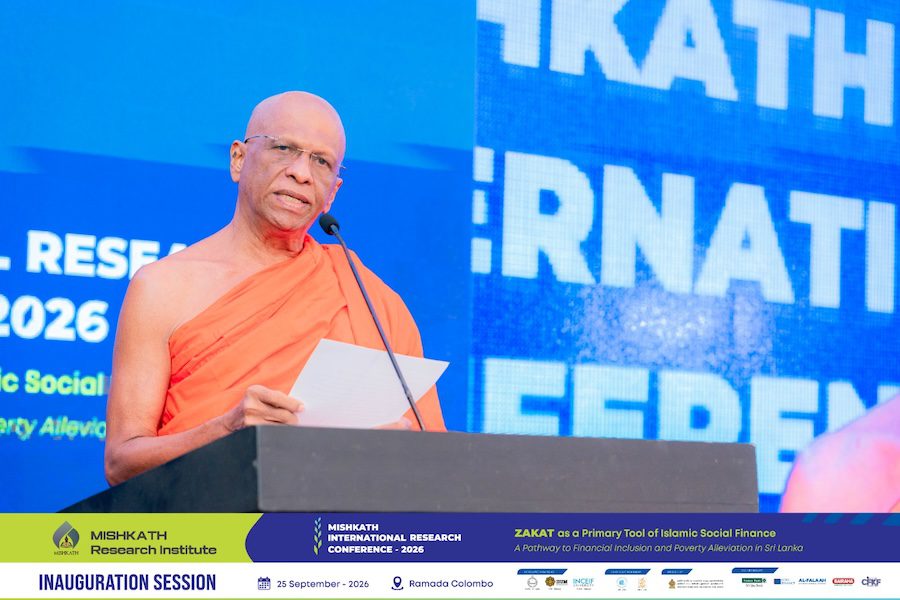
It was enlightening to hear Venerable Wimalaratana Thero, Emeritus Professor Department of Economics, University of Colombo expounding on the Islamic concept of Zakat, an obligatory charity that forms the core of Islamic socio-economics. The Gala event which kicked off a three-day Conference on “Zakat as a tool of Islamic finance and poverty alleviation in Sri Lanka” was held from 25 to 27 September 2026 at Hotel Ramada, Colombo with international participation under the auspices of Mishkath Research Institute.
Zakat is named in the Quran as a charity that is obligated upon Muslims to pay yearly on their surplus money and some forms of property to the poor and needful. The most important point to note is that this payment should never be considered as a favour from the rich to the poor. Islamically, what is given as Zakat is reckoned as the right of the recipient to receive such charity. This is the humaneness that Islam encourages.
Venerable Wimalaratana Thero
Venerable Wimalaratana highlighted how Zakat is far more than a simple act of charity. It is a structured, mandatory, systemic transfer of wealth designed to purify one’s accumulated assets and, more importantly, to alleviate societal suffering. Hearing a Buddhist monastic speak with such deep insight into an Islamic pillar of faith was a profound statement of Buddhistic compassion and shared humanity.
Zakat and Income Tax
A major difference between Zakat and conventional income tax is that Zakat targets stagnant wealth that sits idle. The economic priority being against hoarding money and encouraging circulation of money into the economy. The conventional taxing is on the annual income of the tax payer. Zakat is an extensive subject which is beyond the scope of this column. The content herein is intended as a stepping stone for an academic and intellectual discussion. The final objective being the formulation of governmental level policy and a structured mechanism to benefit from this wealth goldmine.
Brutal Realities
The Sri Lankan government, financial institutions, the treasury and the macro-economic policy makers should not shy away from this valuable economic concept that is taught in Islam. The modern capitalist financial landscape evidently serves to widen the gap between the haves and the have nots. In doing so, exacerbating extreme inequality. Zakat, as an institution focussed on community welfare and organically sustained development, offers an alternative mechanism to narrow this gap of inequity.
One of the core objectives of the government under the Presidency of His Excellency Anura Dissanayake is to ensure that the living standards of the people must be alleviated from the rigours of poverty. Towards this end, programmes such as ‘Samurdhi’ and ‘Aswesuma’ are continuing to function benefitting the poor and needy. Yet, here lies the million-dollar question. Do they, in the long term, positively contribute to alleviating poverty and addressing hunger? Is this State intervention adequate? The answer is a resounding ‘NO’. Much remains to be done. Unfortunately, the Treasury is stretched to its limit. The main reason for this is because conventional state social security models rely entirely on the national budget.
It is encouraging to see GDP growth reaching 4.2% in Q2 2026, following the 2022 financial crisis, signalling macroeconomic recovery. However, what goes unnoticed while basking in this achievement are the underlying microeconomic pressures. According to the Colombo Consumer Price Index (CCPI), the current inflation rate stands at 8.0%, driven largely by volatile food inflation at 8.5%. The Department of Census and Statistics tracking the national poverty line records a steep climb to Rs. 17,679 per person/month, peaking at Rs. 18,461 in Colombo [Daily FT]. The condition of the lower middle class and poor worsens because the government’s reliance on regressive indirect consumption taxes. This, in turn, increases microeconomic inflation.
Gross Economic Injustice
The egalitarian and socialist ambitions of President Dissanayake target the concentration of wealth. His vision is the equal distribution of wealth, ensuring the flow of money downwards to reach Citizen Perera in the remotest part of Sri Lanka. As an ideal, it is commendable, but having ambitions alone is insufficient. Apparently, no action plan or innovative strategies have been clearly identified to bridge the gap or to ensure that its effect reaches the grassroots.
The staggering wealth gap in Sri Lanka has reached alarming proportions. As per estimates, the top 20% of households command over 50% of the total national income, while the poorest 20% survive on a mere 5%. According to the Department of Census and Statistics Household Income and Expenditure Survey (HIES), the average monthly income for a household in the bottom 20% is just LKR 17,572, whereas a household in the top 20% averages more than LKR 196,289 per month.
The financial relief given to the poor does not equate or even come closer to the rise in food inflation and basic survival costs including medicine. To dwell only on the macro level positives will be misleading if such achievements are not seen to benefit the most vulnerable citizens. A large segment of the people are hungry!
Zakat Can Help
In this background, examining the possible integration of the institution of Zakat in a dynamic sense is a workable option which could generate the much-needed funds. It would thus service not only these projects but also create diverse economic opportunities within a sustainable structure. It is incumbent upon the government to explore the avenues of how true systemic economic justice can be delivered to the masses. Institutional hesitation is no longer justifiable when confronted with the brutal realities of our present economy.
The fact that half the national wealth is concentrated in the hands of a few is gross economic injustice. It calls for a mandatory, fractional wealth-transfer mechanism like Zakat which could systematically bridge the regional and urban-rural divide. The Zakat model discourages hoarding of money – it encourages circulation, investment, production, manufacturing and consumption (basic needs, food, medicine etc.).
Zakat Foundation
It is highly recommended that the government, forward thinking institutions and economic scholars/policy makers study the principles of Zakat from the perspective of statecraft and not religion. To study the smooth integration into the national revenue grid, the establishment of a State approved Zakat Foundation is recommended. This can also examine the relevant post-study legislative amendments to the Inland Revenue Act No. 24 of 2017 (as amended).
In a demography where over 70% of the population belongs to the majority community, any systemic economic reform naturally serves them the most. It is a forward-thinking, pragmatic step towards building an inclusive, resilient, and unified national system where no citizen is left behind. True patriotism lies in embracing every ethical tool available to uplift our people, integrate our systems, and secure a dignified future for all Sri Lankans.
*Mass L. Usuf, LL. B (Hons) U.K., Attorney at Law (Ex-Corporate and Legal Advisor)