



Uvindu Kurukulasuriya
Raja de Silva passed away peacefully in his sleep early yesterday morning at the remarkable age of 101 years, 6 months and 19 days. Vidya Jyothi Raja De Silva B.Sc (Cey), B.Sc (Lon), D.Phil (Oxf) has been a member of the statutory Archaeological Advisory Committee since his retirement as Archaeological Commissioner in 1979. A specialist graduate in Chemistry from the Universities of Ceylon and London, he was appointed to the Department of Archaeology in 1949 and became the first scientist in its cadre.
After training for two years at the Archaeological Survey of India, he was placed in charge of the newly established service for the conservation of cultural property and research materials in culture. In 1962, he obtained his postgraduate qualification in the technical aspects of art history. After eighteen years as Assistant Commissioner of Archaeology, he was appointed Archaeological Commissioner in 1967.
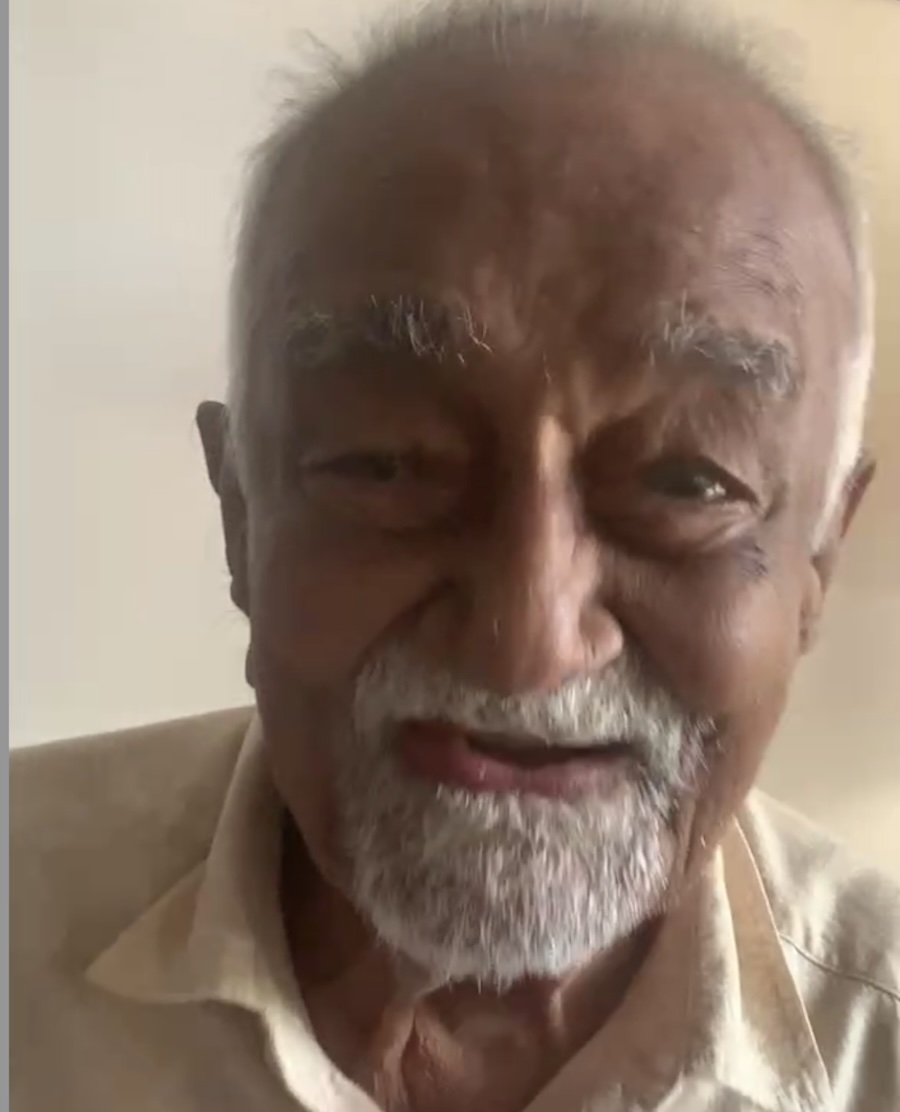
Raja
From 1979 to 1986, he served as Advisor to the Department of Archaeology in the Conservation of Cultural Property. He is the author of numerous academic publications, as well as the official guidebooks to Sigiriya and Polonnaruwa. His latest book, titled John Still’s Index to the Mahavamsa: Revisited, Annotated and Edited, is currently in press.
To commemorate his centenary, a book was published celebrating his life and his invaluable contributions, particularly in the field of archaeology. His work, carried out with the support and encouragement of his family members and friends, leaves behind a lasting legacy.
For Raja
By Uvindu Kurukulasuriya
It is a little known fact that bookshelves are an opportune place to meet your own relatives. I say this because that’s how I got to know Dr Raja de Silva. As far as I remember, when I was around age five or six, I was in the habit of meddling with my father’s books. One day I managed to climb upto the fifth rack of one of his bookshelves, when a docket fell to the floor. The documents inside it scattered all over the floor, and I was very scared. When my father came home, he didn’t say anything. Instead he started to gather all the paper cuttings while telling me who and what they were about. Most of them related to one of his uncle’s son, Dr Raja de Silva and the vandalism of the Sigiriya Rock paintings. There were also paper cuttings about some of his first cousins, Professor SN Arseculeratne (Chubby mahappa), CP de Silva (Desamanya Charitha Prasanna de Silva), and his uncles, relatives like (Savitri’s father (Prof. Silva), Arthur V. Dias (Kos Mamama), Wilmot A Perera (who was a witness to his parent’s marriage. But above all he spoke extensively about Uncle Raja and his work.
I have a vague memory of the first meeting with Raja de Silva. If I’m correct, it was my Aunt’s 25th wedding anniversary at their Bambalapitiya residence. We kids were playing. I saw one person, surrounded by his cousins. They were having lots of fun and laughter. Apparently he was one of the witnesses for my Loku Nannda’s marriage.
Another memory, this time very vivid, was of my father’s elder brother Kingsley’s wedding. During his schooling days at Ananda College, he had lived at Uncle Raja’s residence at Ward Place. Kingsley later told me that his cousin Raja was his mentor. Raja came to our Kandy home as one of his marriage witnesses. What I remember clearly was that Uncle Kingsley was drunk and Uncle Raja had to push him into the honeymoon car, to lots of laughter.
While I was reading for my degree, I did some group tuition classes to earn my pocket money. Each week when I got paid I visited Professor Osmund Jayaratne’s (Osi Sahodaraya – comrade Osi) house with an Extra Special Arrack (Gal Arakku) bottle and a pack of Bristol 20 to chat with him. On one visit, his wife Joyce was reading out loud, from an article in the Island. [Osi had had eye surgery at that time.] Osmund commented that the arguments were fascinating and that no one could oppose his theories. When I enquired as to who he was talking about, he said it was one of his classmates Dr Raja de Silva, with whom he had been classmates from the lower kindergarten onwards, and that once Raja Mahappa had been made the monitor of the class. I told Uncle Kingsley about this conversation one day. The next week he called me to say that Uncle Raja wanted to meet me. That is how we finally met when I was an adult.
We lost contact after that as I left for London where I lived for nearly two years. When I returned there was controversy over a project called “An after sunset walk in Sigiriya”. Two Norwegians together with the Ministry of Tourism, were planing to to boost tourism at Sigiriya. Their proposal included a display at night for batches of 400 tourists in the so-called water gardens of Sigiriya, where the tourists would be conducted from the South Gate to the moat along the gravel path running through the paddy fields, with a person representing Kassapa rowing a boat with a group of damsels. Actors would enact the construction of Sigiriya, with so-called Sigiriya Apsara’s (heavenly damsels) and others completing the scene. Sounds and light effects would be added, making it more picturesque.
Many questions had been raised by this proposal. I got a letter written on a few yellow Post-it Super Sticky Notes by an obviously angry Raja opposing that project. Instead of replying to him, I wrote an article the following week, not exactly in line with his thinking, but criticising the project and the views of protesters, instead arguing that they didn’t know the history of Sigiriya. In that article, amongst other things, I used Raja’s views of Sigiriya. Within a couple of days, again I got a note on a yellow Post-it Super Sticky Note, congratulating me for my article.
After that, we met regularly together with Uncle Kingsley, close to Uncle Raja’s home in Nawala, after his usual morning walk. Sometimes we had lunch at his home with Aunty Kamala. Each time I met him, he gave me a book, and on every book he signed as “Raja Bappa’ instead of Mahappa.
After a couple of months the International Federation of Journalists called for submissions for the “South Asian Tolerance Prize”. Many friends who had read my article – Sigiriya, Norway and the Sinhala Buddhists – encouraged me to submit it to the competition, so I did. I became the finalist! The judge who went to New Delhi representing Sri Lanka – Dr. Sunil Wijesiriwardena – wrote the citation – “Uvindu Kurukulasuriya’s writing addresses the core post-colonial cultural problems in the psyche of Sinhala society. This report is unique in the sense that it challenges the prevalent dominant perception about Sinhala religious history, quoting from authoritative historical research findings.”
The following day it was all over the newspapers. Uncle Kingsley called me and told me that Uncle Raja wanted to meet me. The meeting point was as usual, the Nawala Solis roof top. Raja came after his usual morning walk. He was amazed by the good news and we had a good time. While having a little drink, he took out his cheque book and wrote me a cheque, and when I said NO, he said it was a token. I refused again, and said that I didn’t take payment for my writing. Then Uncle Kingsley told me off saying ‘don’t play the fool, take it”. So I took the cheque. Later after dropping Uncle Raja at his home, we went to Nugegoda and cashed the rupees 2000 cheque. We bought books at Sarasavi bookshop and lunch packets for some poor people living in the Nugegoda streets that Uncle Kingsley knew by name.
So I declare a conflict of interest before I write below, about this living legend.
Everyone talks about Raja’s involvement with the restoration of the vandalized Sigiriya paintings and his theory about Sigiriya being a Mahayana- Theravada Buddhist Monastery, they themselves had no knowledge or little knowledge of what his theory is. So let’s go to Sigiriya first.
Though I’m not an academic specialized in History or Archaeology let me simplify his arguments in my words.
According to his findings, Sigiriya was neither Kassapa’s palace nor his pleasure garden. Nor was it a capital of ancient Sri Lanka or a fortress. The ladies depicted in the Sigiriya frescos are neither Kassapa’s queen nor damsels. Sigiriya, in fact, is a Mahayana-Theravada monastic complex that existed for over a thousand years.
After HCP Bell began archaeological excavations at Sigiriya more than a century ago, the views expressed by archaeologists, art historians and intellectuals were based on a few references made to Kassapa I (479-492 BC) by the author of the Mahavamsa, the chronicle of the Maha Vihara. As a result, with the exception of a few, like the German national Swami Gauribala and A H Mirando, it has been the accepted view that memorials and paintings remaining in the extensive Sigiriya complex are Kassapa’s creations in his kingdom. They have also accepted them as secular and non-religious in character.
The second section of the Mahavamsa, covering the reigns of Datusena, Kassapa I and Moggalana I presently mentioned in the Chulawamsa,, was complied by Dammakitti Thero in the 13th century. It was written several centuries after the actual events occurred. Moreover, the writer belonged to the Maha Vihara sect which suppressed dissenting sects. Based on these facts we can safely conclude that the patricidal Kassapa I was not considered a popular patron of the Theravada Buddhist tradition espoused by the Maha Vihara. It is possible therefore that the true facts about Kassapa may have been wrongly interpreted or distorted by the Maha Vihara monk.
Dr Raja de Silva has offered an extensive critique of the deliberate suppression of the Mahayana character of Sigiriya and Kassapa who was a patron of that tradition, quoting the Mahavamsa itself. Historians have repeatedly proved that the Mahayana school, which offered alternative interpretations of Sri Lanka’s Buddhist history, had been suppressed.
In my article published in the Ravaya on the 17th of December, 1995, “Was it the monks’ opposition that was symbolised by the act of arson?” I wrote the following:
“It was the kings Voharikatissa and Gotabaya who settled the sharp dispute between the two competing schools, Mahavihara and Abhayagiriya, both based in the capital of Anuradhapura, in favour of the former. According to the Mahavamsa these reforms in the Sasana were implemented by a minister named Kapila. Thereafter donations were showered upon the Mahavihara by way of cash, property and lands. The Mahawamsa mentioned that a leading Abhayagiriya monk, Sangamitta, had been successful in winning over King Gotabaya who had formerly been well disposed towards the Mahavihara and that having returned to the Mahaviharaya fold, he had arrested, insulted and deported 60 Abhayagiri monks and had ordered their manuscripts to be set on fire, thereby cleansing the Buddhist Order. I don’t know whether the writer of the Mahavamsa was writing the truth, but if one goes by the ways in which today’s monks offer opposition to something, it is legitimate to surmise that it is a heritage that has been passed down over the centuries. If the writer of the Mahavamsa was not speaking the truth, then the Mahavamsa heritage of Sinhala Buddhist guardians is heading for a crisis.”
Let us now return to Raja de Silva’s simple but insightful arguments.
Describing the artefacts of the Sigiriya complex one by one, Raja de Silva has adduced facts to expose the fallacy of other and indeed dominant interpretations. He has elaborated his thesis by comparing popular theories with his readings of the non-Theravada characteristics such as vihara, boundaries, palace at the highest elevation, line of rooms, throne, ponds, dagoba, garden with circular stones, seats, the circular relic house, the royal pleasure garden, moat, paintings in the shrine room, the lion rock, lion staircase, inscriptions on the wall, and the capital Anuradhapura.
We must keep in mind that the author of the Mahavamsa portrays Kassapa as a cruel ruler and that only a surrounding wall, the building with the lion stairway and palace at the top are ascribed to him. The Mahavamsa is silent about other structures in this greatest building complex of Sri Lanka. Indeed there is no other place in the Mahawamsa where so little has been said of any collection of facts as vast.
Now let us consider the idea of a palace at the top of the rock. Is it a fact? If so, let us consider other facts that ensue from it. Sigiriya, where Kassapa sought refuge, was a prosperous monastic complex and not some sylvan rock arising out of a jungle devoid of a population. There is archaeological evidence to prove that from the 2nd century BC onwards caves in the lower western and northern precipices of this gigantic rock housed many statues and had numerous cells for Buddhist monks to reside. That these were shrine rooms from time immemorial is proved by the fact that statues have been unearthed during the excavation of two of these caves.
It is difficult to imagine that a Buddhist king, especially one in the disadvantageous position that Kassapa found himself in, would have indulged in unwarranted interference into the functions of the monastic complex or would act in a manner that could harm the well-being of the Buddhist monks. It is more likely that the king, his ministers, army and the people would have supported the Buddhist Order. This, in fact, is what Kassapa did. Although the account of the Mahavamsa author and certain modern pundits indicate that Kassapa was one who bit the hand that fed him, he did nothing of the kind. Having reinforced the Western boundary, by constructing ramparts of bricks and clay, the king may have further protected the temple complex from possible attacks by his enemies. The king’s army may very well have been stationed between the two (moats). The spacious area where the king was temporarily resident close to Sigiriya, an area yet to be excavated, may have been large enough for himself and his retinue.
It is unwise to look for a colourful account in the Mahawansa of religious buildings constructed by Kassapa, a king alleged to have opposed the Maha Vihara and worked for the betterment of the Mahayana School, which was not considered the true faith. The true account of the the summit was not supplied because it was not the predilection of the compiler of the Mahavamsa to give publicity to non Theravada Buddhist activities. It was easier to convert Kassapa’s religious benevolence into the construction of secular palaces and thereby efface the services he rendered to the opposing Mahayana tradition.
There was a dagoba of moderate size on the top of the rock. John Bailey, of the Ceylon Civil Service, who climbed to the top with his colleague A.Y. Adams and his secretary G. Wijekoon (22.09.1833) has mentioned this dagoba in a subsequent report. The dagoba was existent even during the tenure of Dr. Raja de Silva. He has written an article about it in the Siyavasa Education Centenary volume in 1969 and was photographed beside it.
Raja De Silva has expressed the following theory on the few paintings preserved on the main ceiling of the caves and in the caves used as shrine rooms:
In general, paintings are meant to decorate the walls or convey a message. The Apsaras theory does not explain why so much energy has been spent on these paintings. What is special about paintings in Mahayana temples is that they contained a message that could be understood by inmates but couldn’t be grasped by the average person.
Tara is the most respected goddess of the Mahayana pantheon. She is the guardian of all Buddhas and is the female aspect of the Bodhisattva Avalokitheshwara. If the paintings depict Tara, then why are so many of them painted on the rock face? I can do no better than Roger Gamplar’s explanation. Representing each righteous form a thousand fold was a popular feature of Buddhist art. It is done not through gigantic forms but via an endless feeling of nothingness. Representing a thousand forms of the Buddha or Bodhisattva has been recorded from India to Japan and China across Central Asia.
Sculptors and artists used this method of multiple representation to help strengthen the faith of the devout about the divine entities they worship.
Making definitive determinations simply because something has not been mentioned by those who scribbled graffiti on the Mirror Wall or has not been substantiated by way of written word or oral tradition can be erroneous.
The visitors of later periods haven’t mentioned Tara but they have identified the female figures as those of Kassapa’s queens. It is sufficient to note here that even if the general public had a knowledge of Tara, their memory of the goddess may have declined over the centuries. This decline in memory may have been further reinforced by the propaganda of the Maha Vihara which privileged the Theravada tradition over the unfavourable Mahayana Buddhism.
Raja De Silva says that due to climatic conditions, especially monsoonal winds and rains, no field work could be conducted in Sigiriya during eight months of the year. Any and all construction could only be done from February to May. Therefore, during Kassapa’s reign of 19 years, only 60 months of work at Sigiriya could have been possible. If we imagine for a moment that Kassapa employed 1000 workmen for this purpose, the work ascribed to him by others simply couldn’t have been accomplished in 60 months.
That Buddhist kings protected the faith is a significant fact. As the Tooth Relic was considered the symbol of royal power, it was kept safe in the capital itself. As such the Temple of the Tooth Relic was in Anuradhapura. During the relevant period, Kassapa offered the Kasub-Bo-Upulvan temple to the monks in the area that is today within the precincts of Vessagiriya. Anuradhapura remained the capital of Kassapa. We are compelled to conclude from literary and archaeological sources that the theory of Kassapa having made Sigiriya his urban capital and transformed it into a pleasure palace is patently untenable. The unstable foundation indeed is the unwarranted faith in the veracity of the biased Mahawamsa account.
What is the logic of concealing Raja de Silva’s theory on Sigiriya, which, we repeat, has not been repudiated as of now? It is the communal ideology of Sinhala-Theravada Buddhist culture established in this country from ancient times under the auspices of the Royalty. The outcome of the state being amalgamated with religion is the disappearance of democratic character of Sangha and an authoritarian, rejectionist Buddhist tradition taking root in Sri Lanka.
That was just a simple summary of Raja’s arguments regarding Sigiriya. As of now, no academic possessing requisite attributes has critiqued this view. If in fact, those who oppose this view have not come forward to point out its flaws, I’m compelled to conclude that it is indeed correct. Those who wish to acquaint themselves with Raja de Silva’s views on Sigiriya are welcome to read his final work on the subject.
Before finishing this short article, I want to relate three more incidents regarding his straightforward personality. I was thinking of him last year when the controversy over Kurundi was raised. I was thinking if Raja was the Commissioner of Archaeology, what would he have been done. I’ve read one of his articles – MJ Perera: An Appreciation – in that he wrote how he did settle a dispute with a Buddhist monk. He writes; “…. About 4 months after I took charge of the Archaeological Department in an acting capacity, I was faced with a seemingly (incredible or intractable) problem. The young monk at Tantrimalai was busy trespassing on an archaeological reserve and putting up modern structures around the dagoba on which was growing a Kaputu-bo-tree) which he had renamed the bodhi-tree, and a bell-tower. I informed the monk of his misdemeanours and requested him to kindly refrain from “developing” the ancient site with modern buildings, and to let me expend government funds from the following year to take in hand the excavation and conservation of ancient monuments there. I was told that Maitripala Senanayake and KB Ratnayake (former ministers) and Hemasiri Premawardana (former Government Agent) were lay-supporters of Tantrimalai; who was I to stop his meritorious work? During the next 3 months, all my persuasive powers exercised while on circuit there were found to be of no avail. I then addressed MJ, now Permanent Secretary, on my problem (Paranavitana had prosecuted a Buddhist monk in 1951) and stated that it was not possible to persuade the errant monk to desist from spoiling with modern structures, a perfectly good archaeological site where I proposed opening a workstation the next year. My short letter ended up with the following request; “Please inform me whether or not I am to take legal action against the monk under the provisions of the Antiquities Ordinance”
MJ replied that there was no objection to invoking the provisions of the law in this case. I visited Tantrimalai soon after, spoke to the monk who by now appeared “sick” of my persistence, and told him that I would, regretfully – for I too am a Buddhist – have to take legal action against him if he did not agree to desist from his building construction work. When I was asked what my authority was (I showed him the letter) in my pocket. This episode ended well – the incumbent monk undertook to cease from new works, and abided by it; I undertook to have a permanent workstation opened at Tantrimalai and did so. …..”
That is how he used his authority to save archaeological sites regardless of who was opposing him.
I remember another incident which Raja, Kingsley and I discussed with lots of laughter. Much later Uncle Kingsley wrote; “…..When Hans Christian Anderson wrote ‘The Emperor’s New Clothes’ he must have been thinking of Sri Lankans who exhibited their gullibility when a parcel of charcoal was taken in procession round the country twice, the government proclaiming its contents to be those of King Dutugemunu’s ashes. This is what a government did several years ago to fool the people.
“But one MAN stood tall against this proclamation from the beginning. He is Dr. Raja de Silva who, incidentally, saved not only all paintings at Hindagala but all but two of the famous paintings at Sigiriya after their dreadful vandalism. He said what was sent round the country to be worshipped was nothing but a parcel of charcoal. The others who were called to decide on the matter, excepting Dr. Abhaya Aryasinhe, stated that the parcel contained the ashes of King Dutugemunu.
“Although the parcel was sent to a laboratory in France, the results were not made public, maybe by a ‘mild Despot’. Clearly, this amounts to a government hiding information from the public. It is high time the results of that laboratory test were made public in Sri Lanka.
“Will the government, at least now, disclose the results of the tests done on the parcel of charcoal or the parcel which others assumed to comprise the ashes of King Dutugemunu?”
Much before in May 22, 2011 Uncle Kingsley wrote to me; “……Anyway, the very day the article on Dhakkina Thupa appeared in the Sunday Observer (1957), written by a young and handsome archaeologist (Raja de Silva, Asst. Commissioner of Archaeology, then) — against his own Chief’s (Paranavithana’s) view — I, as a teenager, read it while schooling from his father’s (Dr. Walter T. de Silva’s–one of your great uncles) home at Ward Place, next door to JR Jayewardene’s. To date no one (including Paranavitana) has refuted its contents in public.”
I have many things to say about Uncle Raja’s jokes, works ethics etc. But to conclude this short essay I would like to quote Henrik Ibsen, “The strongest man upon the earth is he who stands most alone.” In other words, individuals who stand alone are the ones who realize the strength within themselves and become powerful characters. Uncle Raja is one of them.
Happy 100th Birthday Raja mahappa!
*An article published in honour of his 100th birth anniversary is reproduced above as a tribute to his life and service.
Goodbye Raja Mahappa. You lived a happy 101 years, 6 months and 19 days. Goodbye my friend !!!
Jaffna Man / February 24, 2026
Thank you Uvindu! Particularly for the lines:
“He said what was sent round the country to be worshipped was nothing but a parcel of charcoal. The others who were called to decide on the matter, excepting Dr. Abhaya Aryasinhe, stated that the parcel contained the ashes of King Dutugemunu.
“Although the parcel was sent to a laboratory in France, the results were not made public, maybe by a ‘mild Despot’. Clearly, this amounts to a government hiding information from the public. It is high time the results of that laboratory test were made public in Sri Lanka.”
My wife who was teaching Analytical Chemistry at the Open University asked in a text she authored on behalf of the university the question how a lab in France can tell if these ashes were from “Duttagemunu.” The age of the ashes, yes, but whose they were, no.
In communalist Sri Lanka that did not go well.
Thank God for the few non-communal Sri Lankans like you and your uncle Raja de Silva or Raja, Truly a Maha-Appah among archaeologists
Jeevan Hoole
/
Manel Fonseka / February 24, 2026
Deepest sympathies, Uvindu.
/
Pundit / February 25, 2026
I was introduced to the great man at a party at his favourite watering hole, the Orient Club twenty-five years ago. We were in conversation when the devilled cashew was passed around. He turned to me and said, “eat plenty of this stuff, it’s very good for your health”. A great tip for the aspiring centenarians out there.
/
old codger / February 25, 2026
“the views expressed by archaeologists, art historians and intellectuals were based on a few references made to Kassapa I (479-492 BC) by the author of the Mahavamsa,”
I, like Uvindu, am no expert on archaeology, but shouldn’t that date be AD ?
/
Mallaiyuran / February 26, 2026
In Tamil, at very early ages like primary schooling, I read a Muni called Kashipa. He was married to Aditi. Aditi was very powerful woman, while Kashipa lived married celibacy, She made him to give children. These were similar to Novah’s fables. But Nova salved a pair of Animal from the marooned towns and jungles in the deluge. But Adidi got as children by getting to different forms of Animals. One she all the animal pires are born, she abandoned Kasipa.
/
Leonard Jayawardena / February 26, 2026
OC
Yes, it should be AD or CE.
K M de Silva’s A History of Ceylon gives the period of reign of Kassapa I as being from AD 473-491. The book, however, has a note that warns the reader that dates up to Sena I (AD 833-853) are “only approximate.”
The Wikipedia has yet another period (473-495)!
/
Mallaiyuran / February 26, 2026
In Tamil, at very early ages like primary schooling, I read a Muni called Kashipa. He was married to Aditi. Aditi was very powerful woman, while Kashipa lived married celibacy, She made him to give children. These were similar to Novah’s fables. But Nova saved pair of Animals from each spieces from the marooned towns and jungles in the deluge. But Adidi got the animals as children by changing to different forms of Animals. Once she saw all the animal pairs are born, she abandoned Kasipa Muni. The Sigiriya painting portray only angels, with whom the Monks in connection. No warriors or horses, the symbol of a kingdom.
That Kashipa looks like a Sanskrit name. Not Pali. But the Sigiriya Kasiappan has Tamil name. There is a dispute that the Tamil Kasiappan building the Sigiriya Monastery. That tells neither of the Ceylon Kasies built the Monastery. This particular artwork in Sigiriya was appearing to exist in India only for a short while. It is completely unlikely it lasted in Ceylon, much more than 700 years, to connect both Kasiappas. The mountain cave dwelling monks came from India, spreading the Buddhism, and at some point, abandoned the project and left. Abandoned the Monastery by the cost of over run and/or South Indian Saiva Kings’ repeated invasion.
/
SJ / February 26, 2026
oc
You are dead right
/
SJ / February 25, 2026
Thank you for the very interesting and informative tribute.
/
Lester / February 27, 2026
Hello Uvindu,
Can you ban the fake ID’s of Old Codger?
https://www.colombotelegraph.com/index.php/onset-of-ai-revolution-sri-lanka-must-join-indian-bandwagon/
nutgpt and other rubbish ID’s
Your choice to allow beggars to trash your website, but I don’t see the point.
https://wordpress.com/plugins/wp-ban
/
old codger / February 27, 2026
Lester darling,
You could ban yourself from the site instead of whining. Nobody would miss you.🤣🤣🤣🤣
/