

By S. Ratnajeevan H. Hoole – (Low-caste, Vellala Chettiar)

Prof S. Ratnajeevan H. Hoole
I) THREAT OF DEFAMATION SUITS AND COLOMBO TELEGRAPH
As Colombo Telegraph just passed its 15th Birthday with Uvindu Kurukulasuriya as its bold leader for that period, this article is written to celebrate their stellar history in Sri Lankan leadership. Their strength is in daring their enemies to challenge them. In Sri Lanka it is near impossible to expose false narratives. Those exposed challenge such exposure by threatening a defamation suit that has no foot to stand on. Our newspapers, with cowardly leadership and no budget to defend themselves in court, simply refuse to publish any exposé with names. When they do publish and receive a threat to sue, they often print without charge a denial.
I have seen such letters of demand two years after publication. It does not matter as a means of harassment even though the demand is too late. That is the value of these demands for damages. The one being sued has to pay his lawyer and keep coming to court
The Virakesari’s foray into English language publishing, was successfully threatened by a group of Christian Evangelicals (including the monopoly-holder of Indian Ink so essential to a newspaper). Their law-and-order management style was exposed in an article for sacking theology students. The powerful Evangelicals preachers walked into the Managing Director’s room with a prepared statement that the article was untrue. With no further ado, the MD ordered the editor to print that Preachers’ untruthful denial. The Editor had no choice but to comply and soon left the newspaper which thereupon shut its doors permanently. The Editor, Sukumar Rockwood, appropriately moved on to be the Chief Executive Officer at the Press Complaints Commission of Sri Lanka with some power to set things right.
The purveyors of untruths are usually backed by a battery of lawyers to whom cost is no issue except for copying and distributing the plaint and its counter affidavits.
Operating from London protects CT.
II) THE COLOMBO CHETTIES
The Colombo Chetties are Tamils and ran afoul of Ponnambalam Ramanathan when Christopher Britto contested for the Legislative Council. Says M. Vythilingam, the famous Ramanathan biographer, by Hindu law a person of good caste does not cross the seas. That is why the Chetties of Vaisya standing, migrated to Ceylon leaving their women-folk behind. The Sudra Vellalas faced no constraint like that. Tradition does not assign a more distant date than the middle of the sixteenth century to their migration to Ceylon.
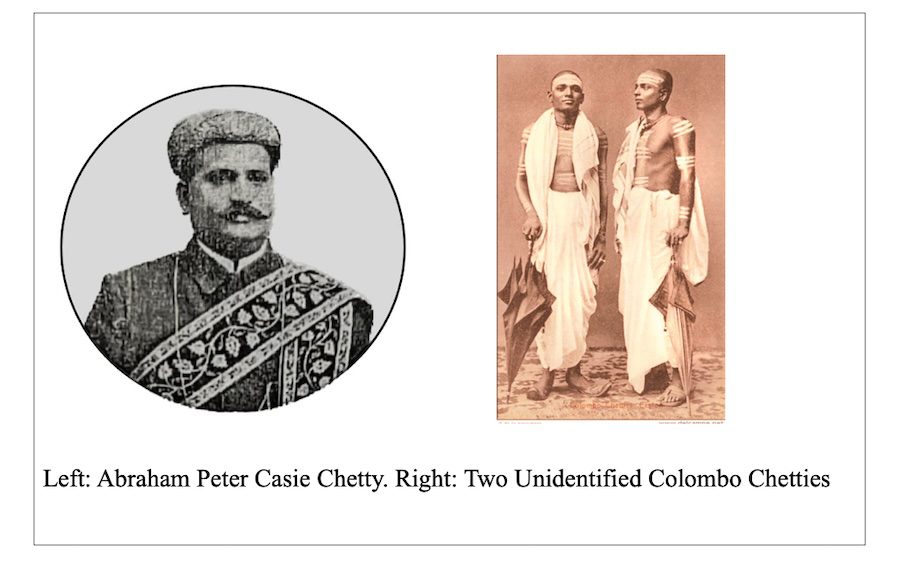
The Chetty traders contracted matrimonial alliances with the high caste natives of the neighbourhoods of Colombo, Toppu and Munniswaram where they settled. They, nevertheless, kept up their national religion, dress, customs and language, until the conquest of the Portuguese, when they embraced like all Ceylonese (save the Muslims) the religion of the conquerors, the readiest means to preferment and protection. The Colombo Chetties are Christians.
At the end of the 16th century, owing to a great famine in South India, numerous new Chetties came to Ceylon, bringing, now their wives and daughters. Many of the new arrivals embraced the religion of the older and more prosperous settlers of their caste. The Colombo Chetties were sharply demarcated from other Tamils by peculiarities of dress, habits and language.
A person of mixed caste is not half this caste and a half that. There is no provision for such castes in Manu’s Dharmasastras so they form a new caste like the Colombo Chetties or become low-caste. This writer’s great-grandfather Modliar Richard Ariathurai Hoole of the judicial service was posted to Chilaw and met Sophia Ondachi (presently misspelt Ondaatje) in the Anglican Church. He practised their faith at St. Andrews Batticaloa and his mother-parish St. James’ Nallur. His new culture included making and seving barrels of Christmas cake and dancing into the early hours of the morning for their 25th wedding anniverary as reported in The Morning Leader.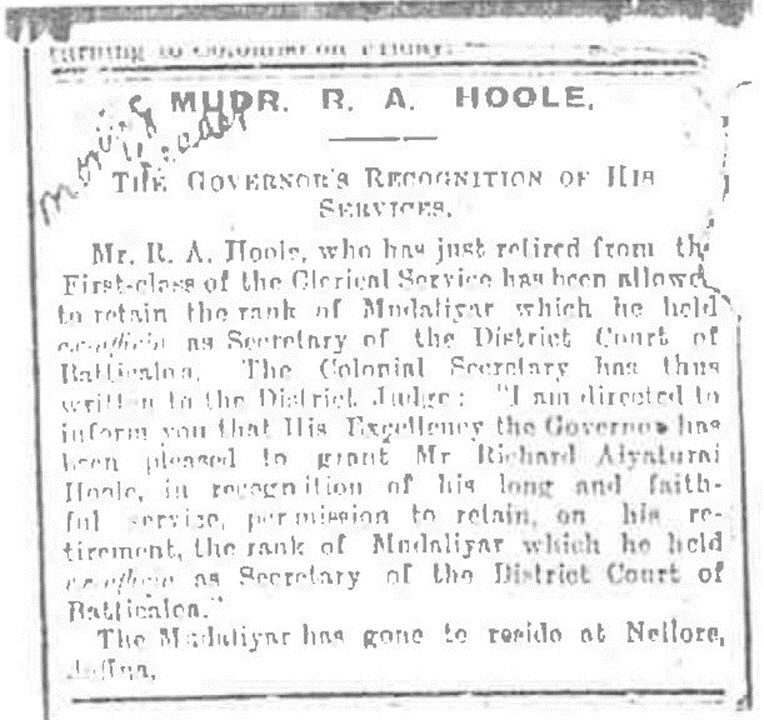
My grandmother’s sister (a Kingsbury) would snipe at my mother saying, “The Hooles are a good family but Modliar Hoole spoilt it by marrying a Chetty. My father who never talked caste, was moved to contest that saying that the Chetties are higher than the Vellalas in Hindu law.
III) COLOMBO CHETTIES OUTDID VELLALAS
The Dutch had run a Seminary, a school of theology by the side of Wolfendhal Church opposite today’s Supreme Court. One of Governor North’s reforms (the First British Governor, appointed in 1798) was the re-establishment, on 28 Oct. 1799, of the Seminary which had been reserved for the sons of the aristocracy but had been abandoned. This was a few years before the Anglo-Dutch war was settled definitively by the Treaty of Amiens in March 1802.
The Sinhalese branch of the school, consisting at first of about 18 students, was presided over by Rev. Phillips and the Tamil branch of fewer students by Rev. Schroter. Rev. Cordiner was chiefly instrumental in reviving it.
Having risen high under their Dutch, the family retained its instincts after the Dutch departed in 1796. Within a short time Coomaraswamy became a seminarian under training for the Christian clergy. Shortly thereafter, the Government Gazette (16th June 1802) announced:
His Excellency was pleased to invest with swords of honour, as a mark of distinction, i) Cornelis de Saram Wijesekera Gunatilekaratne; ii) Wijesekera Gunawardhana; and iii) Don Jacobus Dias Wjeyawardana Bandaranayake; these three being the three senior Sinhalese boys in the school at Wolfendhal; and iv) Gabriel Casie Chetty, one of the Tamil Translators to Government, being the first Tamil boy at the seminary.
All four had been reported to the Governor as having made sufficient progress in English to be Interpreters.
IV) THE RISE OF THE PC FAMILY
Naturally in 1805 Coomaraswamy of the Ponnambalam-Coomaraswamy or PC Family, was chosen to act as Interpreter to the Sitting Magistrate of the Port of Colombo and earned the good opinion of his superior officer. So began the rapid rise of the PC family.
Tamils would insist that Coomaraswamy was a Tamil and not a Colombo Chetty, thinking in their ignorance that Chetties are not Tamils. My house in Bambalpitiya had been owned for some genrations by Bridget Machado (Née Gomez), a Colombo Chetty whose home language was Tamil.
V) THE PC FAMILY: BEGGING AND BRIBING
Through his paternal lineage, Mana Mudaliyar of Thondai Nadu is identified as the prominent Ramanathan ancestor who migrated from India to Jaffna during the late 15th century. His descendants eventually established the highly influential PC family line.
The family got the highest appointments in Ceylon under the British and therefore are considered National Heroes. This paper questions his caste like the Colombo Chetties did. Those appointments did not go by merit, but by who stooged best.
According to the Daily News (2 Dec. 2016), Sir Ponnambalam Ramanathan was nominated to the Legislative Council of Ceylon in 1879 by the British Governor, Sir James Longden as an unofficial member. Though appointed, the phrase is used that he was “returned.”
Why was he chosen? Although Ramanathan had been sacked from Presidency College, Arumuga Navalar lied in The Colombo Observer (May 29, 1879). Like the seasoned politician he was, Navalar praised Ramanathan’s pedigree and elite qualifications. He specifically commended Ramanathan for being “educated at Presidency College” in Madras, using it to validate his intellectual supremacy over rival Christopher Brito. Ramanathan family supporters now call them The Royal Family of Jaffna by running a website which carries through that lie hiding that Ramanathan had been sacked: “After his higher studies, he chose the legal profession and became an Advocate of the Colombo Bar in 1874.”
The PC family held massive wealth, high social prestige, and a deeply entrenched, friendly relationship with the British elite in colonial Ceylon. Because the early Legislative Council seats were heavily based on elite family ties and recommendations, the colonial administration frequently favored established, anglicized, and wealthy Ceylonese lineages. It was common practice for cash-strapped British officials, civil servants, and planters arriving in Ceylon to look to wealthy local merchant and elite families to finance their personal endeavors, land investments, or lifestyle expenses.
Kumari Jayawardena has indicated (Nobodies to Somebodies – The Rise of the Colonial Bourgeoisie in Sri Lanka. pp. 416. London, Zed Books, 2003) that Ponnamablam Ramanathan’s appointments were by lending money to British officials who in punishment were recalled to London. Yet, Ramanathan, has been described thus by D.S. Senanayake: “The greatest Ceylonese of all time was [he]” A postage stamp has been issued in his name as a national hero.
According to the late Prof. A. Jeyaratnam Wilson (Sri Lankan Tamil Nationalism: Its Origins and Development in the Nineteenth and Twentieth Centuries. UBC Press, 2000) Gate Mudaliyar Arumugathapillai [sic.] Coomaraswamy (1783-1836 who was Ramanathan’s Grandfather) provided vital logistical and intelligence assistance to the British military during their attempt to gain control of the kingdom of Kandy. As a reward for being one of Britain’s eager collaborators from the upper classes, he obtained gold medals, a chain and a gold-headed Malacca Cane. The the literature mentions assisting Governors Frederick North, Thomas Maitland (1805-1811) and Robert Brownrigg (1812-1820) in particular in the Kandyan Wars. That was the family tradition. Ramanathan’s maternal great-grandfather, Edirmannasinha Mudaliyar, served as a governor or high official of the Vanni district under the Dutch. His high-ranking service implies conformity to the state church since the Dutch made “assent to the Helvetic Confession of Faith necessary for holding of any ‘office of profit or trust’ under the government.” Edirmannasinha Mudaliyar was surely of the Dutch Reformed Church.
We see further signs in the Coomaraswamy family of siding with the ruling clique in the tendency to change religion to the side of the rulers. Coomaraswamy was one of the first to join the Seminary for which he had to be a Christian which he was, although it is claimed he went there to learn English!
As an influential leader from Jaffna, Coomaraswamy utilized local intelligence pipelines to supply information regarding the treacherous geography and secret mountain passes leading to the Kandyan capital. He helped the British navigate and exploit the intense political rifts between the Nayakkar Dynasty from South and the indigenous Sinhalese nobles who were actively seeking to overthrow their own king.
His loyalty and critical aid during these campaigns earned him the prestigious title of Gate Mudaliyar (one of the highest official ranks granted to locals by the British administration), laying the foundation for the family’s immense political prominence.
To claim Ramanathan as theirs, Tamils would deny that the Ramanathans are Colombo Chetties. At the time the British had a problem over Colombo Chetties being jurors. It was in 1843 that British reforms allowed any caste members to be impanelled as jurors and Sudras judging high Chetties was a problem.
As the breach between the Jaffna Vellalas and the Colombo Chetties widened in 1830 when the election to fill the office of Chief of the non-Christian Tamils in the metropolis came up, the Colombo Chetties, demanded an enquiry into the caste of Coomaraswamy Mudaliyar. An enquiry was held by the government, and it was “established” by the Government that Ramanathan “was a pure Vellala.” That is how the Head of the Colombo Chetiies suddenly became a “Pure Vellala.”
VI) GENOCIDE OF COLOMBO CHETTY TAMILS
Prior to the 2001 census, the Colombo Chetties were administratively and historically categorized as a caste or sub-group within the broader Tamil community. In the wake of the extreme ethnic violence of July 1983 – which targeted Tamils and their economic assets – members of the Colombo Chetty Association sought to distance themselves from their Tamil identity to avoid persecution by Sinhalese mobs and secure recognition as an independent ethnic minority. President J. R. Jayewardene facilitated this distinction. By the 2001 census, Sri Lankan Chetties were officially enumerated as a separate ethnic group rather than a Tamil sub-caste. Ironically, many Jaffna Chetties who carry the bastardized genes of Arumuga Navalar, do not want to be Chetties and have lowered themselves to the status of Vellala Sudras.
VII) VINNAYAGAR VARITHAMBY ASIRWATHAM
Vinayagar Varithamby Asirwatham (Coomaraswamy’s elder brother) was also a Christian and with his wife Mareya Thangamma built the America-Ceylon Mission church in Usan). One of Ramanathan’s three daughters married a Hallock. Another, Rukmini, also appears to have married a Christian.
Ramanathan was indeed a Chetty. Coomaraswamy Mudaliyar, Ramanathan’s maternal grandfather, was the younger of the two sons of Arumugam Pillai and was born in 1783 at Garudavil near Point Pedro. James Rutnam, confirms (Colombo Tribune July 19, 1957 “The House of Nilaperumal”) that Arumugampillai Coomaraswamy – the paternal grandfather of Sir Ponnambalam Ramanathan’s mother and father of Sir Muthu Coomaraswamy – migrated from South India to Jaffna.
Upon the death of the father, the elder son Varithamby Asirwatham was charged with the responsibility of supporting his family. Within the family he is unquestionably a Chetty. My children are descended from Varithamby Chettiyar.
Varithamby Asirwatham was a prominent local figure and educator in Usan who initially started the American Mission School, now renamed J/Usan Ramanathan Maha Vidyalaya. When Sir Ponnambalam Ramanathan expanded his educational reforms into northern Ceylon, Asirwatham inaugurated the college, heavily supported by his Usan network (Eliezers, Kadirgamars, Rasiahs, [ABC] Durais, Crossette-Thambiahs). The relationship also extended into legal circles – Varithamby’s sons Warren Thambapillai Asirwatham was a contemporary of major northern leaders, while lawyer Richard Nalliah Asirwatham edited the Law Reports when Ramanathan was the former Solicitor-General.
VIII) SNOOTINESS: REFUSING COMMENSALITY BUT WILLING TO BEG
Sucking up to the British for patronage, the Ramanathan family was snooty. Ponnambala Mudlaiyar entertained Sir Emerson Tennent one of his benefactors and his family with a few select friends at dinner on 8 Dec. 1849 to wish a safe voyage and back from England. Ponnambalam of course considered himself too orthodox to dine with Europeans.
The family’s pretentiousness comes out again on the arrival in Colombo of Lord Stanley, the eldest son of the Earl of Derby (Secretary of State for the Colonies 1841-1845), and Tennent’s patron). Coomaraswamy Ponnambalam hosted a grand entertainment in the name of Tamils of the city to the Governor Anderson and Lord Stanley.
As the Earl of Derby had been the patron of Sir Emerson Tennent, Ponnabalm was naturally anxious to ingratiate himself honouring his son, who was only 25 years old, already with a seat in the Parliament. The entertainment took the form of a garden party and dinner, at Muthucoomaraswamy’s gardens at Korteboam, next to the Cathedral (then being constructed in Mutwal).
Neither Edirmanasingha Mudliyar nor Ponnambala Mudaliyar participated in the dinner, being too orthodox to do so, but their place was well filled by Muthucooaraswamy, then in his eighteenth year.
Yet, Ramanathan describes his grandfather Gate Mudaliyar Arumugampillai Coomaraswamy thus: Tolerant as he was, he never swerved from the customs of his ancestors; he never drank wine or smoked; never ate any food that was against caste-law; never sat at table with Europeans or Sinhalese, or Burghers or any other race of people whose ideals and practices were different from his own; never put on the dress of foreigners; in fact never attempted anything that was inconsistent with his own nationality.
IX) PRODIGIOUSLY PRETENTIOUS
IX.1) PRENTENTIOUS IN TOLERANCE
The Ramanathan family’s Profligacy and Pretentiousness preclude the “good pedigree” label in Jaffna. Mudaliyar Ramanathan who was happy to beg Europeans for their benefactions but would not be commensal with them, was a dissembler.
If Coomaraswamy was as tolerant as claimed, why as a boy, did Ramanathan have a slave Mailan to ride on his shoulders “in the cool hours of the morning and evening”? I suggest in excuse it was to practise our ancestral slavery customs.
IX.2) PRETENTIOUS IN CLOTHING
Surely, Arumugampillai Coomaraswamy did not go bare-bodied to the Legislative Council when mission schools forbade bare-body!
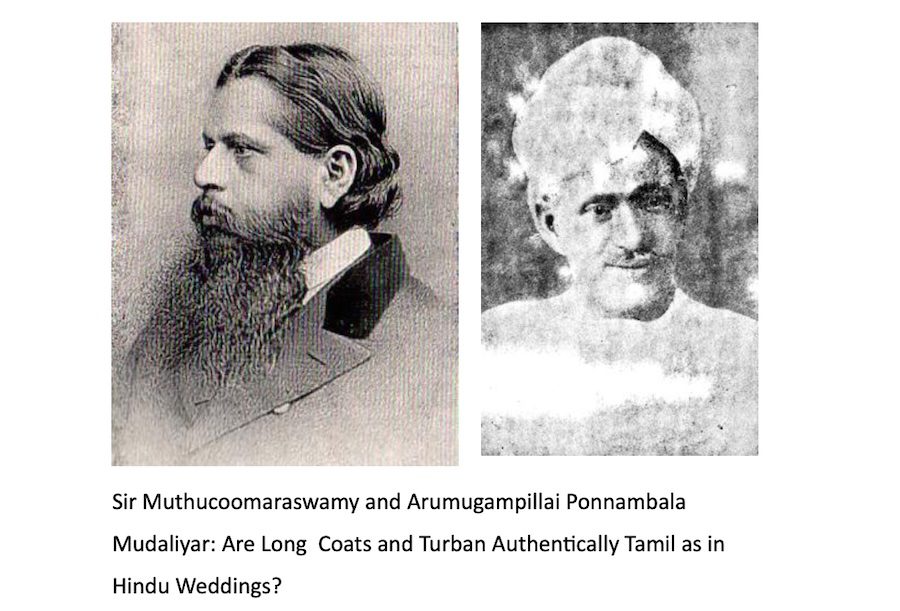
Tamil men traditionally had no upper garment. P. T. Srinivasa Iyengar (Pre-Aryan Tamil Culture , 1930) explicitly details that stitched clothing like coats or shirts are late introductions to Tamil life. Individuals like Ramanathan adopted unique elite markers (such as his signature long-coat and turban) to institutionalize a “Ceylonese” high-status modern identity.
Our claim that the kurta is ours is a part of our pretentiousness. Tamil men traditionally had no upper garment. P. T. Srinivasa Iyengar (Pre-Aryan Tamil Culture , 1930) explicitly details that stitched clothing was introduced late to Tamil life.
Individuals like Ponnambalam Ramanathan, says AJ Wilson, adopted unique elite markers (such as his signature long-coat and turban) to institutionalize a “Ceylonese” high-status modern identity. Gate Mudaliyar Arumugampillai Coomaraswamy is often shown in this same western long-coat and turban. Our wedding costume is exactly this pretentiousness.
IX.3) PRETENTIOUSNESS IN PROFLIGACY
Refusing to dine with European or western women, the PC family welcomed conjugal relations with them. Sir Ponnambalam Ramanathan who boasts like this about his grandfather, for his second marriage, took an Anglo-Australian named Rosa Lilian Harrison. His first wife Sellachi Ammal fell in a well and immediately in the same year 1906 Ramanathan remarried making many speculate if the fall into the well was precipated, especially because even when she was alive Ramanathan went about in a Railway Sleeping Car with only her as companion calling herself Personal Secretary.
Marrying western women was a family habit: i) Ramanathan’s uncle, Sir Muthu Coomaraswamy (1834–1879) married Elizabeth Clay Beeby, an Englishwoman; ii) Dr. Ananda Kentish Coomaraswamy (1877–1947), Muthucoomarasmamy’s son, married 4 white women in succession.
IX.4 PRETENTIOUSNESS IN PROFANATION
There are other reasons also why “good caste ” labels – what Navalar called Ramanathan’s pedigree – would not be accepted by Hindus. For one, in Hindu law, a widow is inauspicious, not invited to weddings even today and does not remarry. Ponnambala Mudaliyar (Ramanathan’s father) was born in 1814. His father Arunachalam having died soon afterwards, his widowed mother Thangam, then about 16 years of age, was given in marriage by her parents to Ariyaputhira. Who this Ariyapthira is, is difficult to list since supportive biographers seemingly deliberately hide it. He was perhaps a servant.
IX.5) PRETENTIOUSNESS IN ADULTERY
A bigger reason for Tamils not accepting Ramanathan as a Tamil hero is adultery in the Family. I follow closely the words of Vythilingam (pp. 64-) from Sir P. Arunachalam her grandson. Arunachalam makes reference to his grandmother in his book ‘The Worship of Muruka or Skanda ‘: “In the thirties of the last century when good roads were scarce even in Colombo my grandmother walked barefoot the whole way to Kataragama and back in fulfilment of a vow for the recovery from illness of her child the future Sir Muthucoomaraswamy.” Thus Sir Muthu is her son, not brother as often claimed.
Arunachalam’s words on Tamil women’s “Customary Hospitality and Reverence,” are telling of those times and an insult to decent women. For the Cambridge product so nonchalantly to write so about his grandmother is terrible.
Arumugam Coomaraswamy was married to Visalachchi Ammaiyar. Their supposed son, Sir Muthu Coomaraswamy, or Visalachy’s brother was born on 23 January 1834 in Amaittodam, Mutwal. Arumugam Pillai Coomaraswamy died two years later on November 7, 1836.
How old was Visalachi then? The records are deliberately waffled for a period when records were good. It is said she was born in the 1920s or 1930s. If Visalachi was born in 1920, she would have given birth to Sir Muthu at the age of 14. Ramanathan’s pretending Maternal Uncle, step brother really, Sir Muthu, was Ponnambala Mudaliyar’s illegitimate step-son through his young wife Visalachi Ammaiar. He was a bastard.
This “mistake or accident” occurred when Visalachi Ammaiar went on pilgrimage to Kataragama, perhaps because of her husband’s stroke. Ponnambala Mudaliyar was shaken to his depths by the tragedy that overtook him in the loss of his beloved wife. She was young and only nineteen at the time she took leave of him. The intelligent and devoted upbringing of his three children (Coomaraswamy, Ramanathan and Arunachalam) was cheerfully undertaken and accomplished by his mother-in-law, Mrs. Coomaraswamy.
Visalachy was widowed early in life on 7 Nov. 1836 says Vythilingam when her year of birth is waffled. She was burdened with the responsibility of bringing up her two children and managing the extensive properties by her great husband. Her two children are said to have been Sir Mutu Coomaraswamy (1834–1879), and Sellachchi Coomaraswamy, who married into the Ponnambalam family.
Ponnambalam’s father died when he was an infant and his mother married one Ariyaputhira. In 1830, aged 16, Ponnambalam was sent to Colombo to live with Gate Mudaliyar Coomaraswamy and his wife Visalachi. He studied English at the Regimental School which could not have had high standards as it was for Malays who were not highups.
Visalachi would go accompanied by a large retinue of servants and retainers carrying a large store of provisions which she would distribute along the way for pilgrims. The story goes that on one such pilgrmage she met a saint whom she treated with customary hospitality and reverance. The saint blessed her and foretold that from her womb would issue forth a man child who woud shed lustre not merely on her house but on the whole country. That was Sir Muthucoomaraswamy. Visalachi at age 16 or less was probabaly raped by this horrid Chaami although the Ramanathan family worshipping him is reluctant to admit that.
X) CONCLUSIONS
National heroes are good to have. They must be people whom we can emulate, not those following whom would be a disaster for society. We must accept that we borrow from better cultures rejecting what is bad in ours.
CT and Uvindu by exposing the ills of society form a good model for all of us.