

By W.A. Wijewardena –

Dr. W.A Wijewardena
Challenge of establishing a university
Establishing a university is a monumental undertaking that tests the limits of traditional leadership. The creation of a higher education institution requires a delicate synthesis of academic vision, bureaucratic navigation, administrative foresight, and financial sustainability. It is a decade-long endeavour so complex that it routinely eludes even seasoned corporate executives and veteran administrators.
For an individual whose entire life has been forged outside the halls of academia, the challenge is multiplied exponentially. The vocabulary of syllabus design, faculty recruitment, accreditation frameworks, and research infrastructure is entirely foreign to those accustomed to different institutional ecosystems.
This challenge becomes uniquely pronounced when the individual tasked with building such an institution hails from a military background. The military operates on a rigid architecture of command, control, obedience, and immediate execution. Decisions are made hierarchically, and objectives are secured through absolute compliance and tactical precision. Higher education, by contrast, thrives on a completely antithetical philosophy.
A university is built upon the principles of academic freedom, critical dissent, consensus-driven governance, and the slow, deliberate intellectual debate required to expand the boundaries of human knowledge. To transition from a culture where orders are followed without question to an environment where questioning every order is a fundamental virtue requires an extraordinary degree of intellectual agility.
Battle-hardened soldier
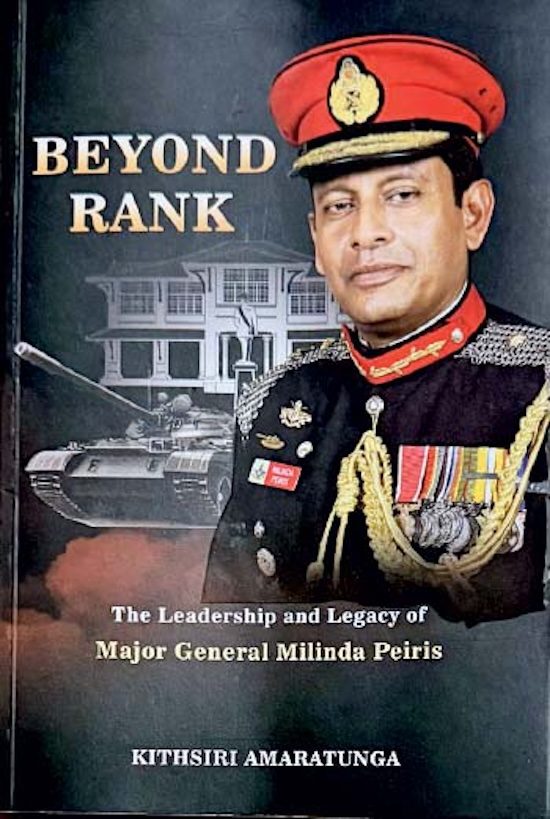
This profound institutional chasm is precisely what Major General Milinda Peiris navigated when he took the helm of Sri Lanka’s premier defence academy. His remarkable journey from the battlefields to the apex of higher education administration is masterfully chronicled by his biographer, Kithsiri Amaratunga, a seasoned lecturer in English, who aptly titled it “Beyond Rank”.
In his biographical account, Amaratunga provides an intimate look at a man who successfully bridged two vastly different worlds. To his biographer, and to those who came to understand his multifaceted character, he is simply Milinda—a name that reflects the human being behind the formidable military titles and decorations. For most of his life, Milinda was the quintessential career military officer.
He belonged to a generation of soldiers whose youth and adulthood were entirely consumed by the grim realities of the Sri Lankan civil war. He spent decades in the field, enduring the relentless hardships of active combat, strategically planning operations, and leading troops under fire. His primary adversary was the Liberation Tigers of Tamil Eelam (LTTE), a highly sophisticated militant organisation that waged a bloody, decades-long secessionist campaign to carve out a separate, independent State called Tamil Eelam in the northern and eastern provinces of Sri Lanka.
In such an intense, high-stakes environment, where survival and national sovereignty depended entirely on martial prowess, the contemplative world of academic work is surely a luxury to a soldier moving from bunker to bunker in the battlefield.
Unquenchable academic ambitions
Beneath the camouflage uniform and the battlefield exterior, Milinda’s deep-seated academic ambitions could not be permanently obscured. His intellectual curiosity and desire to understand the deeper systemic drivers of conflict eventually led him away from the frontlines and into the sphere of rigorous postgraduate research.
He enrolled at the prestigious Madras University in India, where he undertook a Master of Philosophy degree, while still following a course at the Indian National Defence College, focusing his research on the complex matrix of Sri Lanka’s national security challenges. This academic pursuit proved to be a profound turning point.
As he immersed himself in the literature of political science, international relations, and strategic studies, he discovered that he possessed an equally powerful talent for academic work. He was not merely a soldier applying force; he was a scholar capable of analysing the socio-political structures that necessitated that force.
Consequently, when he was appointed as the Vice Chancellor of the newly established General Sir John Kotelawala Defence University (KDU) in 2008, he did not view the role as a comfortable pre-retirement posting or a standard bureaucratic reassignment. Instead, he willingly and enthusiastically accepted the challenge, recognising it as the perfect crucible to merge his military experience with his newfound academic passion. He understood that transforming a military academy into a fully-fledged, nationally recognised university required someone who could speak the language of both the barracks and the faculty lounge.
Foresight on sustainable peace
Though General Peiris was a seasoned soldier hardened by years in the field, he remained, above all else, an officer and a gentleman in the truest sense of the phrase. His approach to the highly volatile, real-world issues facing his fractured nation was characterised by an unyielding pragmatism and a strict commitment to rational analysis. He refused to allow emotional nationalism or rigid military dogma to cloud his judgment. This intellectual independence is starkly evident in the pioneering thesis he submitted to Madras University for his MPhil degree, appropriately titled ‘Political Reforms for Sustainable Peace in Sri Lanka’.
In this seminal work, Milinda posited an argument that was both profoundly insightful and dangerous for a serving military officer of his rank. He suggested that if Sri Lanka genuinely desired to achieve a permanent, sustainable peace rather than a temporary cessation of hostilities, the State had to adopt a sophisticated dual approach to the Tamil issue.
This dual strategy required a simultaneous deployment of military pressure and political concessions, with an absolute, overriding emphasis placed on systemic political reforms. For this strategy to succeed, he argued, the Government of Sri Lanka had to demonstrate a genuine, transparent commitment to restructuring the State, whilst actively securing international support—most critically and controversially from India.
To fully appreciate the sheer audacity of this proposition, one must understand the political psychology of Sri Lanka at the time. In the highly polarised atmosphere of the island’s ethnic conflict, suggesting a political solution that involved active Indian intervention was nothing short of anathema to the Sinhalese majority. It was a heretic suggestion that, had it been publicised widely at the time, could easily have led to him being branded a traitor to the aspirations of the nation because to speak about a political solution supported by India was anathema to many.
Anti-Indian sentiment had been deeply embedded within the Sri Lankan psyche following the deeply frustrating and traumatic experiences of the late 1980s. During that period, the Indian Government had intervened directly in the ethnic crisis, deploying the Indian Peace Keeping Force (IPKF) to the north and east of the island. The intervention was widely perceived by the majority Sinhalese population as a heavy-handed violation of national sovereignty. The subsequent escalation of violence left deep scars, and the majority community came to view India with intense suspicion, perceiving it as a regional hegemon that did not have the existential interests of the Sinhalese people at heart.
However, Milinda chose to bypass these deep-seated emotional biases. He boldly and rationally presented his argument, maintaining that sustainable peace was impossible without engaging India as a guarantor and partner.
Devolving police powers to provinces
Furthermore, Milinda’s thesis did not stop at abstract geopolitical theories; it ventured into highly specific, sensitive constitutional mechanics. He suggested that the Sri Lankan State should devolve significant autonomy to the provinces, explicitly including the devolution of police powers. This was a radical departure from the highly centralised status quo. He envisioned a sophisticated hybrid solution wherein police powers would be exercised concurrently by both the Provincial Governments and the Central Government, operating in close institutional cooperation with one another.
Within this proposed framework, he recommended that the Central Government’s police forces should exclusively handle cross-border, inter-provincial crimes and national security issues, while the provincial police forces would be entirely responsible for maintaining day-to-day law and order within their respective geographical boundaries.
By any contemporary standard of military discipline and national political discourse, this was a rebellious, boundary-pushing suggestion. It was a thesis that defied the conventional hawkish positions expected from a serving high-ranking military officer who was actively fighting the very insurgency the reforms sought to address. Yet, the rational, objective man within Milinda overrode the institutional biases of his military uniform. He allowed empirical reality and political science to dictate his conclusions.
The historical events that unfolded after the dramatic end of the war in May 2009 have vindicated Milinda’s foresight. Years after the military defeat of the LTTE, the underlying questions of ethnic reconciliation, devolution, governance, and regional geopolitical balancing continue to dominate the Sri Lankan political landscape. The enduring complexity of the post-war era has proved Milinda entirely correct: a military victory can clear the ground, but only rational political reforms and strategic international partnerships can construct a lasting peace. In writing that courageous thesis, it was the rational, visionary academician within Milinda speaking.
At the helm of KDU
This rational academician was soon called upon to manifest his vision in concrete reality. The General Sir John Kotelawala Defence Academy, which had originally functioned purely as a training ground to officer cadets for the tri-forces, was formally upgraded by law to a specific defence university.
Milinda was handed the monumental task of building it up virtually from scratch, transforming an austere training academy into a modern, comprehensive university. By conventional global standards, a defence university is expected to maintain a highly restrictive, specialised scope. It typically limits its academic footprint to faculties directly relating to the defence services—such as strategic studies, military history, and tactical engineering.
Going beyond conventional thinking, Milinda possessed a far grander, more disruptive vision. He decided that KDU should not be a cloistered military enclave, but rather a modern, expansive university housing diverse faculties that were not overtly or directly related to traditional defence work.
In his very first address after being given the prestigious position of Vice Chancellor, he looked out at his staff and boldly declared: “I will transform this institution into an internationally recognised university.” This was not empty administrative rhetoric; it was a firm, actionable manifesto. He did exactly what he promised, systematically developing an unprecedented array of diverse undergraduate and postgraduate study programs within the university structure, fundamentally altering the trajectory of the institution.
Broadening the definition of defence
To justify this unprecedented expansion, Milinda re-engineered the very philosophy of military education. He gave a much broader, modernised definition to the concept of ‘defence’ itself, extending it far beyond the narrow parameters of weaponry and tactics. In his vision, true national defence comprehensively covered ‘civil-military relations’, the ‘expansion of higher education opportunities’ for the populace, ‘creating a professional military volunteer outfit’, ‘linking education with socio-economic development’, and ‘producing a disciplined workforce’ capable of driving national progress.
These represented entirely new, progressive ideologies of developing an academic institution. By placing defence at the core but expanding the periphery, he positioned the university as a vital national instrument designed to serve the country in resolving its most burning socio-economic and structural issues. Every brick laid and every curriculum drafted under his tenure was executed precisely along these strategic lines.
Host of new faculties at KDU
The first major battleground for this expansion was the audacious project to set up a medical faculty. In the landscape of Sri Lankan higher education, establishing a medical faculty is fraught with immense political, regulatory, and financial hurdles.
The initial challenge lay in identifying a suitable, logistically viable location and managing the massive task of establishing a state-of-the-art teaching hospital dedicated entirely to medical education. Furthermore, Milinda had to navigate the stringent demands of the Ceylon Medical Council (CMC).
The council insisted on the provision of clinical services free of charge to the public, a necessity ensuring that medical students would have the vital opportunity to interact with and treat patients from a wide, diverse cross-section of society. From securing capital infrastructure to the meticulous selection and appointment of highly qualified professors and clinicians, the obstacles were immense. Yet, through sheer administrative willpower and meticulous planning, Milinda accomplished this task successfully, birthing a premier medical institution.
With the medical faculty established, he immediately turned his sights toward the engineering field. When this faculty was set up, he faced an identical matrix of steep challenges. He had to oversee complex staffing requirements, spearhead comprehensive curricula development, and design rigorous examinations closely tied to heavy practical, laboratory-based work.
The overarching goal was not merely to graduate individuals with degrees, but to produce highly skilled, visionary engineers tailored specifically to meet the rapidly evolving future needs of a developing country. Through structured management and an unyielding commitment to global standards, this milestone too was successfully accomplished by Milinda.
Crucially, Milinda firmly believed that a university cannot be truly called a university if it is divorced from the culture of research. To attain this vital academic goal, he institutionalised research into defence and strategic studies, ensuring it served as the intellectual backbone of the newly emergent university. He then broke new ground by setting up a dedicated Faculty of Law.
Rather than merely duplicating the curricula of civilian universities, Milinda introduced a unique dimension—teaching, in addition to normal civil and criminal laws, the complex legal frameworks relating to military affairs and international humanitarian law, subjects that are usually entirely neglected in the law faculties of other public universities.
His final, crowning administrative task was to set up the Faculty of Management, Humanities, and Social Sciences, thereby opening the university to the broader study of human culture, commerce, and societal dynamics. Thus, within a remarkable eight-year span of his tenure as Vice Chancellor, KDU was thoroughly transformed from a rigid training academy into a fully-fledged, multi-disciplinary university specialising in defence services.
Legacy not to be forgotten
Today, though the institution is structurally run by military personnel and maintains a distinct martial discipline, KDU possesses a remarkable, almost paradoxical spirit of generating independent, rational thought. Over the years, I have had several personal opportunities to deliver guest lectures at KDU, often speaking on sensitive subjects that were openly considered rebellious or taboo by pro-Government academia in civilian institutions. I also had the distinct opportunity to advise groups of student officers on current, highly controversial economic issues facing the island.
Without exception, though all these students had come from the strict, hierarchical backgrounds of the tri-forces, they displayed a genuine, refreshing keenness to critically look at the issues at hand, questioning status quos and debating economic data with absolute intellectual honesty.
This vibrant, open intellectual environment is the true, enduring legacy which Milinda has left behind at KDU. It is a legacy that is currently being followed both to the letter and the spirit by his administrative successors.
The profound transformation—from a battlefield commander to the architect of an enlightened, free-thinking seat of learning—is precisely why Major General Milinda Peiris’s name remains deeply and permanently ingrained in KDU’s history.
This is the reason why his biography, “Beyond Rank”, should be read by all.
*The writer, a former Deputy Governor of the Central Bank of Sri Lanka, can be reached at waw1949@gmail.com